
Thread Lift in Delhi
- Home
- Thread Lift in Delhi
Thread Lift in Delhi
A thread lift does two things at once, and understanding both is the key to knowing whether it is right for you. It lifts — a barbed suture is passed under the skin, its tiny barbs grip the tissue, and the practitioner draws sagging skin upward and anchors it. And it stimulates — the thread material, as your body slowly absorbs it, provokes a healing response that lays down new collagen along its path. One effect is immediate and mechanical. The other is gradual and biological. A good result depends on getting both right.
It is marketed everywhere as the ‘lunchtime facelift’, which is half true and half a problem. Half true because it takes thirty to forty-five minutes, uses only local anaesthetic, and lets you go home the same day. A problem because the word ‘facelift’ sets an expectation the treatment cannot meet. A thread lift is not a small facelift. It is a different thing that does a fraction of the job, for a fraction of the time, at a fraction of the cost — and for the right patient, that fraction is exactly enough.
At Sarayu Clinics in Greater Kailash, thread lifts are performed by facial plastic and maxillofacial surgeon Dr. Adarsh Tripathi. That matters here more than it might sound, for one specific reason: because he also performs the surgical facelift, his advice on whether you need threads or surgery is not steered by which one he is able to sell you. Most clinics offering threads in Delhi can only offer threads.
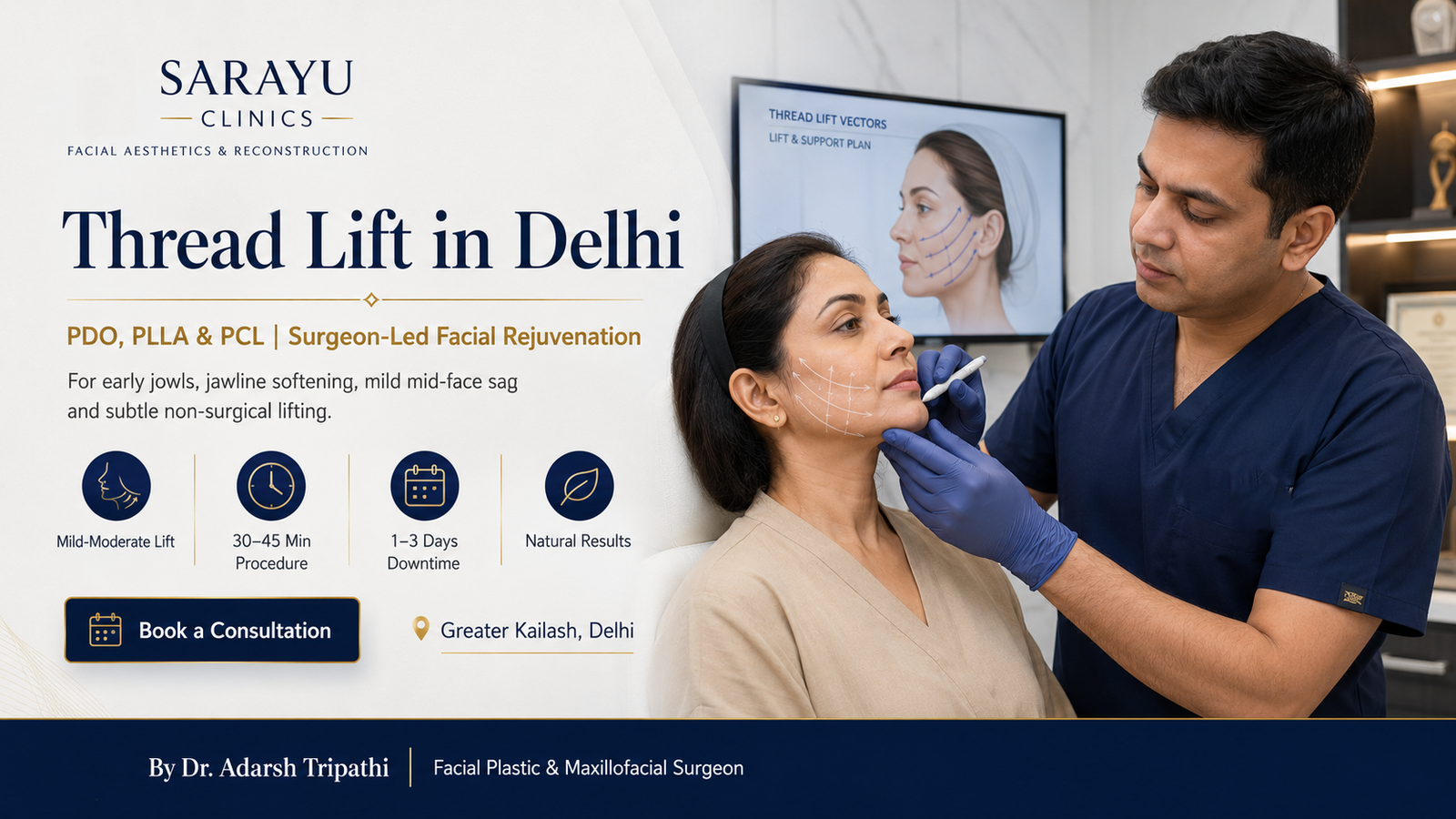
The short answer : A thread lift inserts absorbable sutures under the skin to lift mild-to-moderate sagging and stimulate collagen. Threads come in three materials: PDO (lasts 6-12 months, the affordable entry point), PLLA (18-24 months, stronger collagen stimulation), and PCL (18-24+ months, the longest-lasting). Separately, threads come in designs: barbed or cog threads do the actual lifting; smooth mono threads and mesh threads mainly stimulate collagen and tighten. The procedure takes 30-45 minutes under local anaesthetic, with 1-3 days of social downtime and results visible immediately, improving over 2-3 months as collagen builds. It suits early jowls, a softening jawline, mild mid-face sag and brow drop. It does NOT fix significant sagging — that needs a facelift. Complication rates are real but mostly minor (bruising, dimpling, asymmetry, rarely thread extrusion) and are overwhelmingly down to injector skill. Delhi cost: roughly Rs 10,000-60,000+ depending on material and number of threads. The most important decision is not the thread. It is who places it.
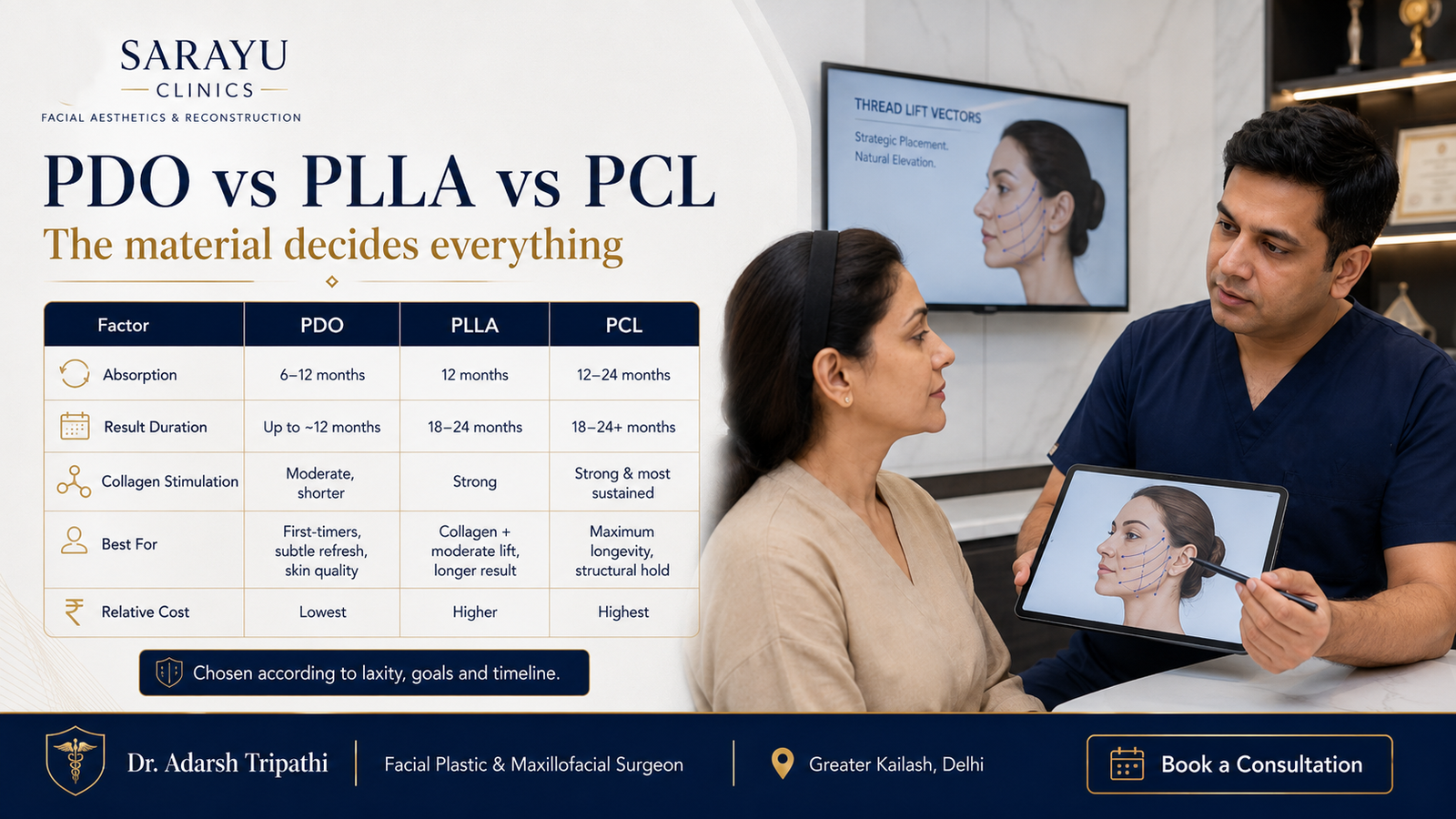
PDO vs PLLA vs PCL: The Material Decides Everything
Ask a Delhi clinic about thread lifts and most will say ‘we use PDO threads’ as though that settled the matter. It does not. There are three materials, they behave differently, they last for different lengths of time, and they cost accordingly. This is the first real decision.
| PDO | PLLA | PCL |
Full name | Polydioxanone | Poly-L-lactic acid | Polycaprolactone |
Absorbed in | 6-12 months | 12 months | 12-24 months |
Result lasts | Up to ~12 months | 18-24 months | 18-24+ months |
Collagen stimulation | Moderate, shorter | Strong (same polymer as Sculptra) | Strong and most sustained |
Best for | First-timers, subtle refresh, skin quality | Collagen + moderate lift, longer result | Maximum longevity, structural hold |
Relative cost | Lowest | Higher | Highest |
Track record | Longest, most published | Well established | Newest of the three |
A useful way to think about cost: the cheapest thread per session is not the cheapest thread per month of result. A PLLA or PCL thread costs more upfront but lasts roughly twice as long as PDO, so the monthly cost of looking the way you want often evens out. The right material is the one matched to your laxity and your goals, not the one with the smallest sticker price — a well-chosen PDO can outperform a badly-chosen PLLA.
Barbed vs Smooth vs Mesh Threads
The material is one decision. The design of the thread is a second, entirely separate one, and conflating the two is where most confusion lives. A thread can be PDO or PLLA or PCL AND barbed or smooth or mesh — the two choices are independent.
- Barbed / cog threads — the lifting threads. Tiny barbs or cogs cut into the thread grip the tissue like fishhooks, letting the surgeon physically reposition sagging skin. This is the thread that actually lifts, and it is what most people picture when they say ‘thread lift’. Used for the jawline, jowls, mid-face and brow.
- Smooth / mono threads — the tightening threads. Fine, barbless filaments placed in a pattern to stimulate collagen. They do not lift; they firm and improve skin quality. Used for fine lines, crepey skin, the neck, and around the eyes and mouth.
- Screw / tornado threads — the volumising threads. One or two threads twisted together, used to restore a little fullness to sunken areas through concentrated collagen stimulation.
- Mesh threads — the scaffolding. A pre-formed mesh laid under the skin to firm broad areas such as the neck and lower face.
Most real treatment plans combine them: barbed threads to lift the jowl, smooth threads to tighten the skin above it. A clinic that only talks about one type is describing a narrower treatment than the one you probably need.
How a Thread Lift Works ?
The mechanism is worth understanding because it explains both what the treatment can do and what it cannot.
- The immediate lift. Barbed threads are introduced through a cannula or needle, engaged into the soft tissue, and used to draw that tissue upward and fix it in a higher position. You see this change on the table. It is real, and it is mechanical.
- The gradual collagen response. Over the following weeks, your body treats the thread as something to heal around, and lays down new collagen along its length. As the thread itself dissolves, that collagen remains, which is why the benefit outlasts the material. This is the same neocollagenesis that drives every collagen-stimulating treatment.
The limit is built into the mechanism. A thread anchored in soft tissue can lift soft tissue by a modest amount. It cannot remove excess skin, it cannot reposition the deep muscular layer of the face, and it cannot hold a heavy, significantly-sagged face against gravity for long. Those are surgical jobs. Threads work with the tissue you have; they do not remove or fundamentally restructure it.
Benefits of a Thread Lift
- Immediate, visible lift — you leave with a result, which then improves as collagen builds.
- Minimal downtime — local anaesthetic, 30-45 minutes, and one to three days of social recovery rather than weeks.
- No incisions, no general anaesthesia, no scars — entry points are needle punctures, not cuts.
- Collagen stimulation that continues after the thread dissolves — the skin quality improvement is genuine and lasting to a degree.
- Natural, subtle result — done well, a thread lift refreshes without the ‘done’ look of an over-tightened face.
- Far lower cost than surgery — and payable in stages, treatment by treatment.
- Buys time — for a patient in their thirties or forties not yet ready for surgery, threads can defer it by years.
- Combines well — with fillers for volume, Botox for expression lines, and skin treatments for quality. Threads are one instrument in an orchestra, not a soloist.
Areas We Treat
- Jawline — sharpening a softening jaw, one of the best thread indications
- Jowls — early jowl formation, lifted back toward the jawline
- Mid-face and cheeks — restoring a little lift to a flattening cheek
- Eyebrows — a subtle brow lift, opening the upper eye
- Nasolabial folds — softening, usually alongside filler
- Marionette lines — the downturned lines from mouth to chin
- Neck — mild laxity and early banding, with smooth and mesh threads
- Under-chin — a modest improvement in a soft jaw-neck angle
Conditions & Concerns It Treats
- Early jowls and a blurring jawline — the flagship indication. For a more definitively contoured jaw, see jawline enhancement.
- Mild mid-face descent — a cheek that has begun to fall rather than one that needs volume. Where the problem is volume, dermal fillers are the answer.
- Brow heaviness — a subtle non-surgical lift. For more, see brow lift surgery.
- Crepey skin and loss of firmness — smooth threads, often with skin boosters.
- Early neck laxity — mild cases only; significant neck sag is surgical.
- The ‘not ready for surgery’ patient — someone with early ageing who wants to postpone or avoid a facelift.
The Procedure: Step by Step
- Assessment, and an honest candidacy discussion. Tripathi assesses the degree and type of your laxity. If threads will genuinely help, he says so. If your sagging is beyond what threads can hold, he says that too — and explains what will actually work, even when that is surgery he would perform separately.
- Planning and marking. Entry points, vectors and thread paths are marked on the face while you are upright, because gravity is the thing being corrected and it only shows when you are sitting.
- Choosing material and design. PDO, PLLA or PCL; barbed, smooth, mesh or a combination; and how many. Matched to your laxity, your goals and your timeline, and explained to you.
- Local anaesthesia. The entry points and thread paths are numbed. The procedure is comfortable; you are awake and can talk throughout.
- Insertion and lifting. Threads are introduced through a cannula or needle along the planned vectors, engaged into the tissue, and drawn up to lift. The surgeon assesses symmetry continuously, adjusting as he goes.
- Trimming and finishing. Excess thread is trimmed below the skin surface at the entry point. There is nothing to see afterwards — no suture ends, no dressing beyond small tapes.
- Review and aftercare. Written instructions, and a review to check the settling of the lift and the developing collagen response.
Downtime & Aftercare
- First 24-48 hours: swelling, mild bruising, tenderness and a feeling of tightness. All expected, all settling within days.
- Mild dimpling or puckering at entry points can appear early and usually resolves within one to two weeks as the tissue settles. Persistent dimpling should be reviewed.
- Do not rub, massage or press the face for at least two weeks — this is how threads are dislodged before they have anchored.
- Sleep on your back, head slightly elevated, for the first week, to protect the lift and reduce swelling.
- Avoid wide mouth movements — no big yawns, no dental work, no drinking through a straw, minimal chewing of hard food — for the first one to two weeks.
- No strenuous exercise, sauna, steam or hot yoga for two weeks.
- Avoid alcohol and blood-thinning supplements for a few days before and after, to limit bruising, if medically appropriate for you.
- Sleep, expressions and patience: the lift may look slightly overdone for the first week and settles into a natural position as swelling resolves. Do not judge the result on day two.
Thread Lift Cost in Delhi
Threads are usually priced by material and by the number used, which is why quotes vary so widely. Verified Delhi ranges:
Treatment | Typical cost (INR)* |
Consultation & facial assessment | Rs 2,500 – Rs 5,000 |
PDO thread lift — per session (area-dependent) | Rs 10,000 – Rs 35,000 |
PLLA thread lift — per session | Rs 25,000 – Rs 55,000 |
PCL thread lift — per session | Rs 30,000 – Rs 60,000+ |
Full lower-face and jawline lift | Rs 30,000 – Rs 80,000, by material and thread count |
Brow thread lift | Rs 15,000 – Rs 40,000 |
Neck threads | Rs 20,000 – Rs 50,000 |
Smooth thread skin tightening (per area) | Rs 8,000 – Rs 25,000 |
Threads combined with filler or Botox | Package pricing after assessment |
*Indicative ranges only. Compare quotes on material, thread count and — above all — who is placing them. A very low quote usually means PDO where PLLA was indicated, too few threads to hold the lift, or an inexperienced injector. Threads are one treatment where the cheapest option reliably disappoints, because the result is almost entirely technique-dependent.
Prices shown are for guidance only. Your final treatment cost will be confirmed during the initial consultation, based on your individual needs, concerns, and personalised treatment plan.
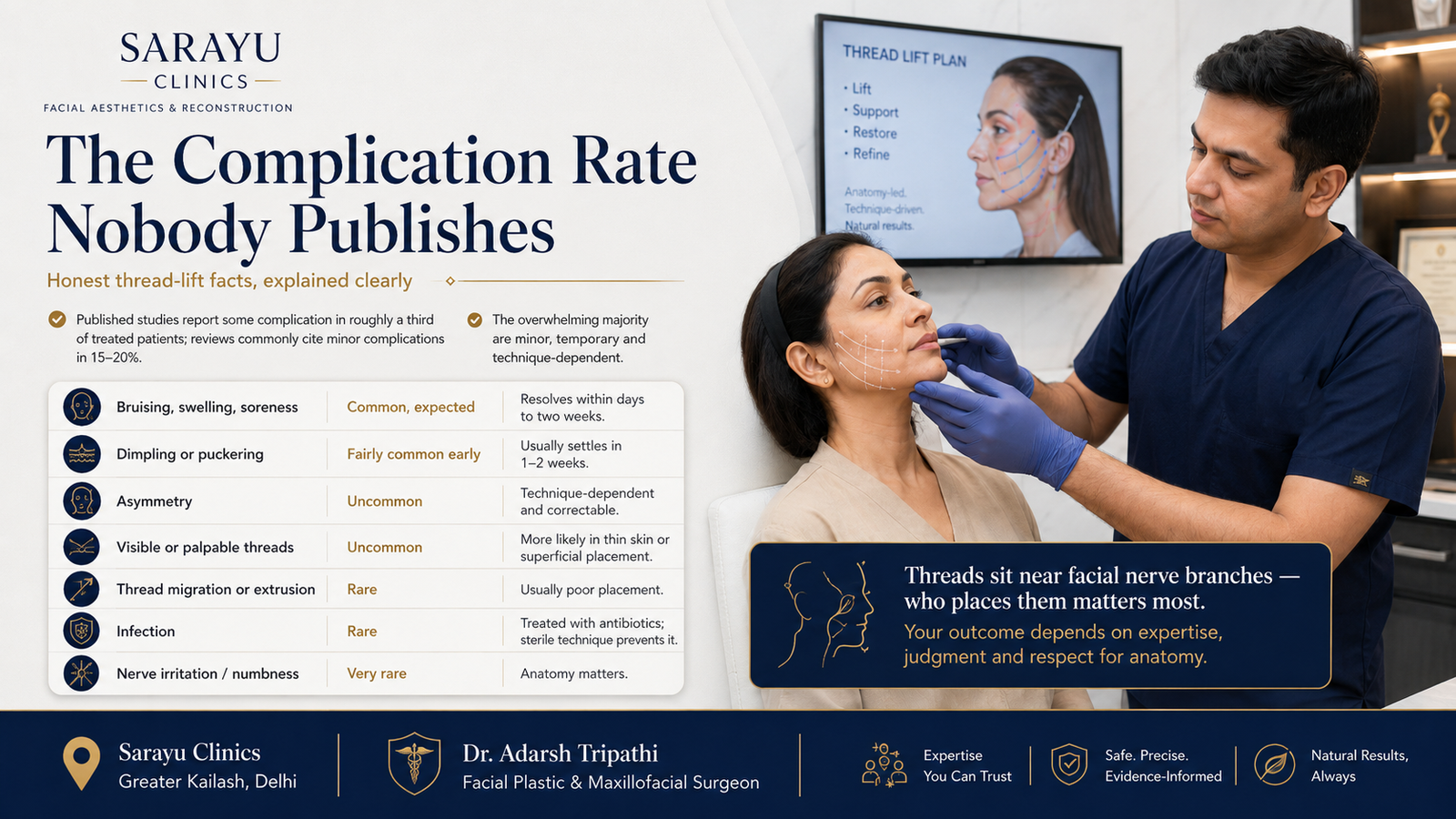
The Complication Rate Nobody Publishes
Delhi thread-lift pages describe the treatment as safe with minimal downtime and leave it there. That is broadly true, but it is not the whole truth, and you are better served by the whole truth.
Published studies put the complication rate meaningfully higher than the marketing suggests — one 2019 study reported some complication in roughly a third of treated patients, and reviews commonly cite minor complications in 15 to 20 per cent. Read that correctly before it alarms you: the overwhelming majority of these are minor, temporary and self-resolving, and almost all are a function of injector skill rather than the treatment itself.
Complication | How common | Notes |
Bruising, swelling, soreness | Common, expected | Resolves within days to two weeks |
Dimpling or puckering | Fairly common early | Usually settles in 1-2 weeks; persistent needs review |
Asymmetry | Uncommon | Technique-dependent; correctable |
Visible or palpable threads | Uncommon | More likely in thin skin or when placed too superficially |
Thread migration or extrusion | Rare | Almost always poor placement; the thread works out through the skin |
Infection | Rare | Treated with antibiotics; sterile technique prevents it |
Nerve irritation / numbness | Very rare | Threads sit near facial nerve branches — this is why anatomy matters |
The two facts that follow from this : First: almost every serious thread complication traces back to placement — wrong plane, wrong vector, wrong patient, too superficial, too near a nerve. The threads sit millimetres from branches of the facial nerve. This is not a treatment where the identity of the person holding the needle is a detail. It is the whole thing. Second, and rarely mentioned: threads are difficult, and sometimes impossible, to remove once placed and anchored. A filler can be dissolved; a bad thread result largely has to be waited out. That permanence-of-error is precisely why facial-anatomy training is not a luxury here. Ask who is placing your threads, what their training is, and how many they place a year. A high-volume, anatomically-trained operator has both fewer complications and longer-lasting results.
Results Timeline
Timeframe | What usually happens |
Day 0 | Immediate visible lift. Some swelling and tightness. The lift may look slightly overdone. |
Day 2-7 | Swelling and bruising settle. Any early dimpling begins to resolve. The lift starts to look natural. |
Week 2-4 | Settled result. Skin feels firmer. Collagen stimulation is underway but not yet visible. |
Month 2-3 | The collagen response becomes visible — skin quality and firmness improve beyond the initial lift. This is the true result. |
Month 6 | Peak benefit. PDO threads have largely dissolved but their collagen remains. |
Month 12 | PDO results fading; PLLA and PCL still holding. Time to plan maintenance for PDO patients. |
Month 18-24 | PLLA and PCL results gradually fading. The skin does not drop below its starting point — it returns gradually to baseline as collagen turns over. |
An honest note on a common fear: threads do not leave your skin worse than before. When they dissolve, the improvement fades gradually as collagen naturally turns over — the same as after any collagen treatment. You return to baseline, not below it.
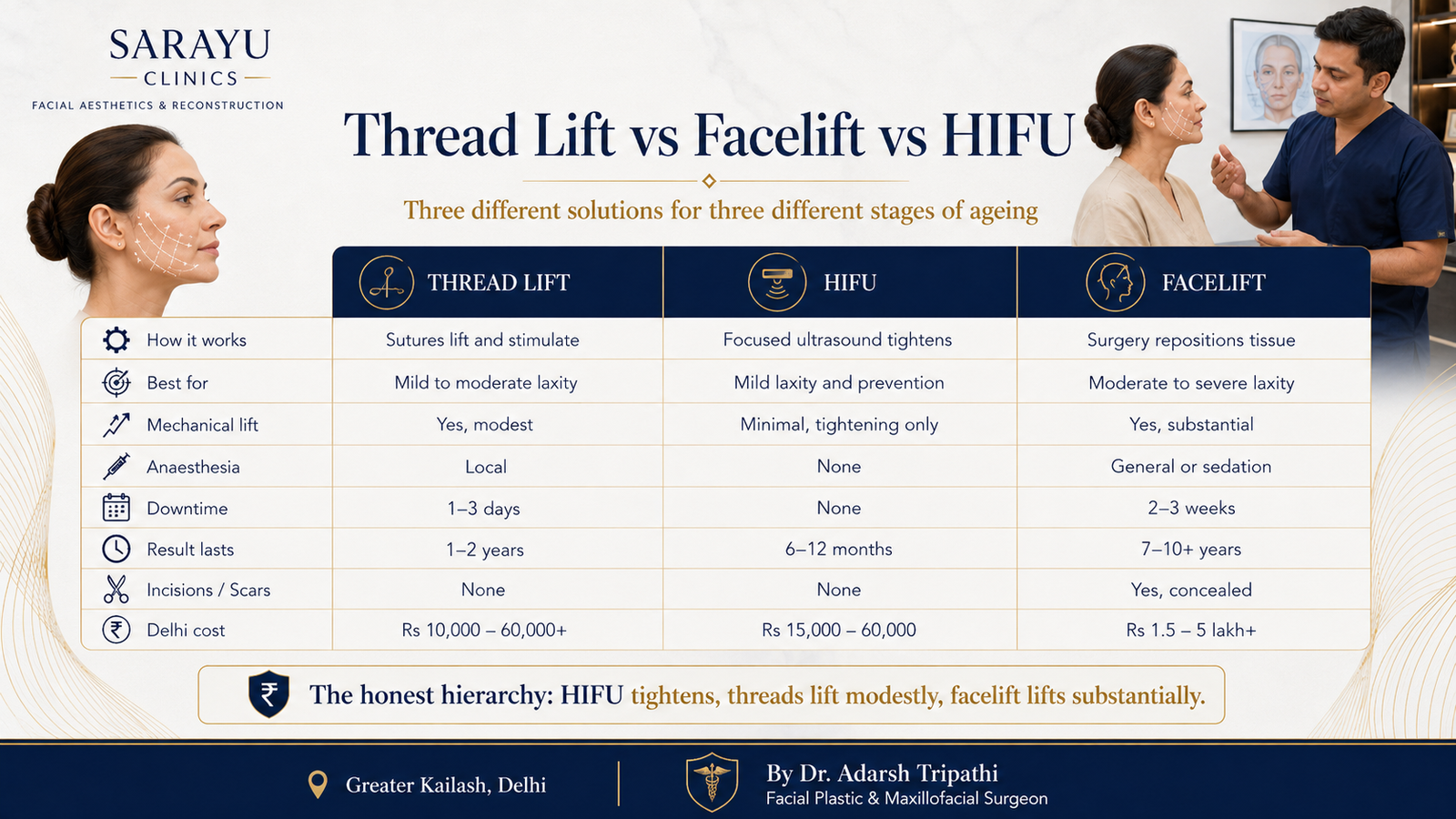
Thread Lift vs Facelift vs HIFU
The three are constantly compared and frequently confused. They occupy different points on the same scale of intervention.
| Thread Lift | HIFU | Facelift |
What it is | Sutures lift and stimulate | Focused ultrasound tightens | Surgery repositions tissue |
Best for | Mild-moderate laxity | Mild laxity, prevention | Moderate-severe laxity |
Mechanical lift | Yes, modest | Minimal — tightening only | Yes, substantial |
Anaesthesia | Local | None | General or sedation |
Downtime | 1-3 days | None | 2-3 weeks |
Result lasts | 1-2 years | 6-12 months | 7-10+ years |
Incisions/scars | None | None | Yes, concealed |
Delhi cost | Rs 10,000-60,000+ | Rs 15,000-60,000 | Rs 1.5-5 lakh+ |
The honest hierarchy: HIFU tightens but barely lifts, and suits the youngest, mildest cases and prevention. A thread lift lifts modestly and suits mild-to-moderate laxity. A facelift lifts substantially and lasts years, and is the honest answer for moderate-to-severe sagging. The trap to avoid is spending repeatedly on the non-surgical options, year after year, for a face that needed the surgery — because over time that costs more and delivers less. A surgeon who offers all three will tell you which stage you are actually at.
Are You Actually a Candidate?
Threads are a good treatment for a specific window of ageing. Being honest about that window is the most useful thing this page can do.
You are likely a good candidate if you:
- Have mild-to-moderate laxity — early jowls, a softening jawline, a slightly descended mid-face
- Are typically in your thirties, forties or early fifties
- Have reasonable skin quality and some remaining elasticity
- Want a subtle, natural refresh rather than a dramatic change
- Are not ready for surgery, by preference or by stage of ageing
- Understand the result lasts one to two years and will need maintaining
Threads are the wrong choice, and honesty is owed, if you:
- Have significant sagging, heavy jowls or substantial excess skin — this needs a facelift, and threads will disappoint
- Have very thin skin, where threads may show or be felt
- Expect surgical, permanent results — the expectation itself guarantees disappointment
- Have an active skin infection or inflammation in the area
- Have an autoimmune condition, a bleeding disorder, or a keloid tendency, or are pregnant — assessed individually
- Are chasing the cheapest possible quote — this is the wrong treatment on which to economise
If your sagging is genuinely beyond threads, we will tell you, and we will talk you through the facelift honestly rather than sell you a thread lift that cannot hold your face. That conversation is the whole reason to have this treatment done by a surgeon.
Why Choose Sarayu Clinics for a Thread Lift in Delhi ?
The single most important variable in a thread lift is the person placing the threads. At Sarayu Clinics that person is facial plastic and maxillofacial surgeon Dr. Adarsh Tripathi, alongside co-founder and celebrity aesthetician Dr. Nidhi Bhatia.
- Placed by a surgeon who knows the facial nerve. Threads sit millimetres from nerve branches, and cannot easily be removed if misplaced. Anatomical training is not optional here.
- Advice with no conflict of interest. Because Dr. Tripathi also performs the facelift, his opinion on whether you need threads or surgery is not steered by what he is able to sell. A threads-only clinic cannot say that.
- The right material and design, explained. PDO, PLLA or PCL; barbed, smooth or mesh — chosen for your face and told to you, not defaulted to whatever is in stock.
- Honest about the complication rate. Real numbers, mostly minor, mostly avoidable with good technique. You will hear them before, not after.
- Honest about candidacy. If threads will not hold your face, you will be told before you pay, not after they fail.
- Part of a plan. Threads combined intelligently with filler, Botox and skin treatments, rather than sold as a standalone miracle.
Medical Review & Sources
This page is for general information and is medically reviewed by the team at Sarayu Clinics under Dr. Adarsh Tripathi. It is not a substitute for an in-person clinical assessment. Thread lifts should be performed in a sterile clinical setting by a practitioner trained in facial anatomy. Individual results, longevity and complication risk vary with thread type, technique and patient factors. Sources:
How to Reach Us:
Phone: +91 9289111081 , +91 9289111082
Email: sarayuinquiries@gmail.com
Sarayu Clinics website: www.sarayuclinics.com
Facebook: https://www.facebook.com/sarayuclinic
Instagram: https://www.instagram.com/sarayuclinics/
Dr. Adarsh Tripathi’s profile: https://dradarshtripathi.com/
Online Booking: Visit our website https://sarayuclinics.com/contact-us/ to schedule appointments conveniently.
How much does a thread lift cost in Delhi?
It depends on the material and the number of threads. PDO thread lifts run roughly Rs 10,000-35,000 per session; PLLA Rs 25,000-55,000; PCL Rs 30,000-60,000 or more. A full lower-face and jawline lift is typically Rs 30,000-80,000 depending on material and thread count. Compare quotes on material, number of threads and — most importantly — the experience of the person placing them, because the result is almost entirely technique-dependent. A very low quote usually means fewer threads than needed, a cheaper material than indicated, or an inexperienced injector.
How long does a thread lift last?
It depends on the thread material. PDO threads give a result lasting up to about a year; PLLA threads 18-24 months; PCL threads 18-24 months or more. The threads themselves dissolve sooner than that, but the collagen they stimulate persists after they are gone, which is why the visible benefit outlasts the material. When it fades, it fades gradually back to your baseline — the skin does not end up worse than before.
Is a thread lift better than a facelift?
They are not competing for the same patient. A thread lift suits mild-to-moderate laxity, is done under local anaesthetic with a few days’ downtime, and lasts one to two years. A facelift suits moderate-to-severe sagging, involves surgery and two to three weeks’ recovery, and lasts seven to ten years or more. For early ageing, threads are the sensible choice; for significant sagging, a facelift does what threads cannot. The costly mistake is buying threads repeatedly for a face that needed surgery — over several years that spends more and delivers less.
What is the difference between PDO, PLLA and PCL threads?
They are three different absorbable materials. PDO (polydioxanone) is the most established and affordable, dissolves in 6-12 months, and gives moderate collagen stimulation. PLLA (poly-L-lactic acid, the same polymer as Sculptra) lasts 18-24 months and stimulates collagen more strongly. PCL (polycaprolactone) is the newest and longest-lasting, at 18-24 months or more, with the most sustained collagen response. Separately from material, threads also come in designs — barbed threads lift, smooth threads tighten — and the two choices are independent.
Does a thread lift hurt?
Not much. It is performed under local anaesthetic, so the insertion itself is comfortable and you stay awake and able to talk throughout. You may feel pulling or pressure as the threads are placed. Afterwards there is tenderness, tightness and sometimes bruising for a few days, and a feeling of tightness when you move your face that settles over one to two weeks.
What are the risks and complications of a thread lift?
Real, but mostly minor. Published studies put some complication in a meaningful proportion of patients — one 2019 study around a third, reviews commonly 15-20% — but the overwhelming majority are minor and temporary: bruising, swelling, dimpling, occasionally asymmetry. Rarer problems include visible or palpable threads, thread migration or extrusion, and infection. Serious complications such as nerve irritation are very rare. Almost all complications trace back to injector skill and thread placement, which is why who performs the procedure matters more than any other factor — especially since threads are difficult to remove once placed.
How long is the downtime after a thread lift?
One to three days of social downtime. Swelling, bruising and tightness are usual for the first 24-48 hours and settle over one to two weeks. You will be asked to sleep on your back with your head elevated for a week, avoid rubbing or massaging your face for two weeks, avoid wide mouth movements and hard chewing early on, and skip strenuous exercise, saunas and steam for two weeks. Most people return to work within a day or two.

Can a thread lift be combined with other treatments?
Yes, and it usually should be. Threads lift, but they do not add volume or relax expression lines, so they are frequently combined with dermal fillers for volume, Botox for dynamic wrinkles, and skin treatments such as skin boosters or lasers for quality. A thread lift is best thought of as one component of a facial rejuvenation plan rather than a standalone solution — and combining sensibly gives a far more natural result than overloading any single treatment.
Am I a good candidate for a thread lift?
You are a good candidate if you have mild-to-moderate laxity — early jowls, a softening jawline, a slightly descended mid-face — reasonable skin quality, realistic expectations, and you want a subtle refresh rather than a dramatic change. You are typically in your thirties, forties or early fifties. You are not a good candidate if you have significant sagging or heavy excess skin, which needs a facelift; if your skin is very thin, where threads may show; or if you expect permanent, surgical-level results. An honest assessment is the only way to know which applies to you.
Do threads leave your skin worse when they dissolve?
No. This is a common fear and it is unfounded when threads are correctly placed. As the threads dissolve, the improvement fades gradually as your collagen naturally turns over — exactly as happens after any collagen-stimulating treatment. Your skin returns to its baseline, not to a worse state. What you should avoid is repeated over-tightening by an inexperienced injector, which is a technique problem rather than an inherent property of the treatment.
Our Patients


What areas can be treated with a thread lift?
Thread lifts can be performed on various areas of the face, including the jowls, jawline, cheeks, brow line, and under-eye area. They can also be used to lift and tighten the skin on the neck and even the breasts after weight loss or pregnancy.
How is the thread lift procedure performed?
The procedure typically involves administering local anesthesia to minimize discomfort. A thin needle or cannula is used to insert the threads under the skin, which are then pulled to create a lifting effect. The entire process usually takes about 30 to 60 minutes.
Is the thread lift procedure painful?
Most patients report minimal discomfort during the procedure due to the use of local anesthesia. After the treatment, some swelling, bruising, or slight pain may occur, but these effects are usually mild and temporary.
What is the recovery time after a thread lift?
Recovery time is generally minimal, with most patients able to return to their normal activities within a few days. Some swelling and bruising may last for up to a week, but many people can resume work and social activities almost immediately.
What is a thread lift, and how does it work?
A thread lift is a non-surgical cosmetic procedure designed to lift and tighten sagging skin on the face and neck. During the treatment, absorbable threads are inserted into the skin using a fine needle. These threads stimulate collagen production, leading to natural skin tightening and rejuvenation over time. The procedure is minimally invasive and typically performed under local anesthesia, making it suitable for individuals seeking subtle yet effective facial rejuvenation without the need for surgery.
What is the cost of a thread lift at Sarayu Clinics?
The cost of a thread lift at Sarayu Clinics in Delhi, depending on the specific treatment area and the number of threads required. This pricing includes the consultation, procedure, and post-treatment care. It’s advisable to schedule a consultation with Dr. Adarsh Tripathi to receive a personalized treatment plan and accurate cost estimate tailored to your needs.
What are the benefits and risks associated with thread lifts?
Benefits:
- Non-surgical procedure with minimal downtime.
- Stimulates collagen production for natural-looking results.
- Improves skin texture and tightness.
- Suitable for individuals with mild to moderate skin sagging.
Risks:
- Possible mild swelling, bruising, or discomfort post-procedure.
- Rare risk of thread displacement or infection.
- Not suitable for individuals with severe skin laxity or certain medical conditions.
To ensure optimal results and safety, it’s essential to consult with a qualified practitioner at Sarayu Clinics who can assess your suitability for the procedure and discuss any potential risks.