
Blepharoplasty in Delhi: Eyelid Surgery for a Rested, Youthful, and Naturally Refreshed Appearance
- Home
- Blepharoplasty in Delhi: Eyelid Surgery for a Youthful, Refreshed Look
Blepharoplasty is a surgical procedure that corrects drooping upper eyelids, puffy lower eyelids, and under-eye bags by removing or repositioning excess skin, muscle, and fat around the eye area. At Sarayu Clinics in Delhi, it is performed under Facial Surgeon supervision using techniques that minimise visible scarring and downtime. It is available as upper eyelid surgery, lower eyelid surgery, or a combined procedure — and in some cases improves both appearance and peripheral vision.
People rarely say ‘my eyelids are drooping’. What they say is: ‘I look tired no matter how much sleep I get.’ Or: ‘Everyone keeps asking if I’m okay.’ Or simply: ‘I look older than I feel.’
The eyes are the first feature people look at when they look at your face — and the eye area is also where the earliest and most visible signs of ageing appear. Drooping upper eyelids, puffiness below the eyes, and excess skin that creates a heavy, fatigued expression are not weaknesses or vanities to dismiss. For many people they are a daily frustration that affects how they feel about themselves and how they present to the world.
Blepharoplasty — eyelid surgery — is one of the most precise and consistently effective procedures in facial aesthetics. At Sarayu Clinics in Delhi, we perform upper and lower eyelid surgery using techniques that prioritise natural-looking results. The goal is never to make you look ‘done’. It is to make you look like yourself again — the version that is rested, alert, and proportionate — with results that last a decade or more.
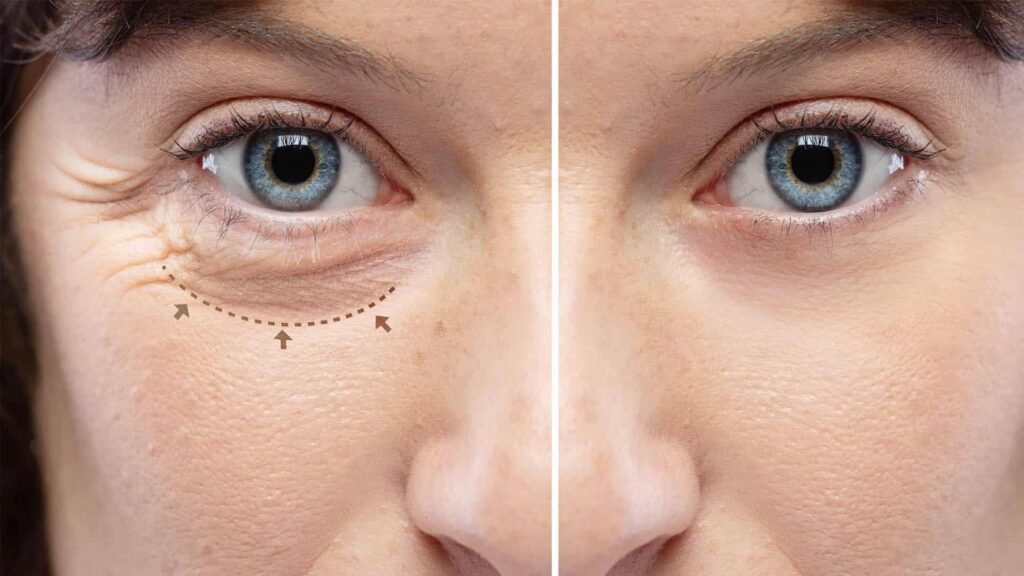
What Is Blepharoplasty?
Blepharoplasty — from the Greek blepharon (eyelid) and plastia (moulding or forming) — is a surgical procedure that corrects structural changes around the eye caused by ageing, genetics, or both. Depending on which eyelids are treated, it involves one or more of the following:
- Removing excess, overhanging skin from the upper eyelid that creates a heavy or hooded appearance
- Tightening weakened orbicularis oculi muscle that contributes to eyelid drooping
- Removing or redistributing fat deposits that cause upper eyelid fullness or lower eyelid bags
- Smoothing the under-eye area to reduce the shadow and depression that creates a ‘dark circle’ effect
The procedure is performed through incisions placed carefully within or directly below the natural crease of the eyelid — meaning that once healed, the scars are essentially invisible, tucked into the natural anatomy of the eye area.
Blepharoplasty can be performed purely for cosmetic reasons — to improve appearance — or for functional reasons, when sagging upper eyelid skin physically obstructs the upper field of vision. In the latter case, the procedure is also medically indicated and may be partially covered by health insurance in some systems.
Why Do Eyelids Start to Droop? Understanding What Is Actually Happening
Most people understand that eyelids change with age — but fewer understand the specific mechanisms behind it, which helps explain why blepharoplasty produces such lasting and effective results.
What Is Actually Happening to the Eye Area as You Age ?
Skin loses elasticity: Collagen and elastin production declines from the mid-twenties onward. The thin, delicate skin around the eyes — the thinnest on the entire face — loses its ability to spring back, becoming loose and crepe-like.
Muscles weaken: The levator muscle responsible for lifting the upper eyelid, and the orbicularis oculi that encircles the eye, gradually lose tone. This contributes to the ‘heaviness’ patients describe when they notice their upper eyelids beginning to droop.
Fat compartments shift: The orbital fat that cushions the eye within its socket is held in place by a thin membrane. As this membrane weakens with age, fat pushes forward — creating the puffiness in the upper lid and the distinct ‘bags’ beneath the lower lid that no amount of sleep resolves.
Volume is lost around the socket: As the bony structures around the eye become slightly more prominent and surrounding soft tissue reduces, the orbital rim becomes visible — creating shadows, hollows, and the ‘tired’ appearance that patients most commonly describe.
Understanding that these are structural, physical changes — not simply surface dullness — explains why skincare products and topical treatments have limited effect on these concerns. Blepharoplasty addresses the underlying anatomy directly.
These changes are accelerated by external factors — UV exposure, smoking, significant weight fluctuation, and chronic sleep deprivation. They are also strongly hereditary: many patients in their thirties seek blepharoplasty not because of ageing, but because hooded or heavy eyelids run in their family and have been a feature of their face since early adulthood.
Types of Blepharoplasty: Upper, Lower, and Combined
Blepharoplasty is not a single procedure — it is a category of procedures, each addressing a different set of concerns. Your clinician will recommend which type is appropriate based on your specific anatomy and what you want to achieve.
Upper eyelid surgery addresses excess skin, and where present, excess fat or muscle, in the upper eyelid area. The incision is made precisely within the natural upper eyelid crease — a fold of skin that exists in virtually all patients — making the scar invisible when the eye is open and minimally visible even when closed.
For patients with a genetic predisposition to hooded lids (a feature common across South and East Asian populations), upper blepharoplasty can create a defined eyelid crease and open the eye area dramatically — an outcome that many patients describe as transformative.
Upper blepharoplasty can also serve a functional purpose: when excess skin overhangs far enough to obstruct the superior visual field, the procedure restores full peripheral vision.
Patients often report that they did not realise how much their vision had been affected until after surgery.
Upper Blepharoplasty | Details |
Anaesthetic | Local anaesthetic — no general anaesthesia typically required |
Procedure duration | 45 – 60 minutes |
Incision location | Within the natural upper eyelid crease — effectively invisible |
Downtime | 7 – 10 days; most patients return to work within 10 days |
Suture removal | 5 – 7 days post-procedure |
Swelling resolution | Most swelling resolves in 2 – 3 weeks |
Final result | Visible at 4 – 6 weeks once all swelling has settled |
Result longevity | 10 – 15 years before any repeat procedure may be considered |
Lower Eyelid Blepharoplasty
Lower eyelid blepharoplasty is technically more nuanced than upper lid surgery because the lower lid anatomy is more complex and the margin for error is smaller. It is performed using one of two approaches:
- Transcutaneous approach: An incision just below the lower lash line allows the surgeon to access and remove or redistribute lower lid fat, and tighten excess skin. This is the preferred approach when skin removal is needed alongside fat correction.
- Transconjunctival approach: The incision is made inside the lower eyelid (within the conjunctiva), leaving absolutely no visible external scar. This approach is used when the concern is primarily fat removal with no significant skin excess — common in younger patients.
For patients whose ‘eye bags’ are partly caused by volume loss in the cheek creating a shadow rather than true fat prolapse, lower blepharoplasty may be combined with fat repositioning or dermal filler in the tear trough to produce a smoother, more natural transition between the lower eyelid and cheek.
Lower Blepharoplasty | Details |
Anaesthetic | Local anaesthetic with or without sedation |
Procedure duration | 45 – 75 minutes depending on technique |
Incision location | Below the lower lash line (transcutaneous) or inside the lid (transconjunctival — no visible scar) |
Downtime | 7 – 14 days; bruising typically more pronounced than upper lid |
Suture removal | 5 – 7 days (if external sutures used) |
Swelling resolution | 2 – 4 weeks for most swelling; residual subtle changes up to 3 months |
Final result | Fully visible at 6 – 8 weeks |
Result longevity | Long-lasting — fat does not return; structural correction is permanent |
Combined Upper and Lower Blepharoplasty
Many patients benefit from addressing both upper and lower eyelids in a single procedure — particularly those in their forties and fifties where both drooping upper skin and lower lid bags contribute to the overall tired appearance. Treating both in one session avoids the need for two separate anaesthetic events and recovery periods, and allows the surgeon to assess the whole eye area together for the most balanced result.
Combined Procedure | Details |
Procedure duration | 90 – 120 minutes |
Anaesthetic | Local anaesthetic with sedation (or general — discussed at consultation) |
Combined downtime | 10 – 14 days |
Final result | Visible at 6 – 8 weeks |
Result longevity | Upper lid: 10 – 15 years; lower lid: long-lasting |
Functional Blepharoplasty vs Cosmetic Blepharoplasty: What Is the Difference?
This is a distinction that genuinely matters — both medically and, in some cases, financially.
Factor | Functional Blepharoplasty | Cosmetic Blepharoplasty |
Primary purpose | Restore visual field obstructed by drooping skin | Improve appearance of the eye area |
Who needs it | Patients with dermatochalasis causing visual obstruction | Patients unhappy with ageing/aesthetic eye changes |
Procedure performed | Typically upper eyelid only | Upper, lower, or both |
Diagnosis required | Visual field test and ophthalmology / dermatology assessment | No medical diagnosis needed |
Can overlap | Yes — many functional cases also have a cosmetic component treated simultaneously |
|
At Sarayu Clinics, functional visual field concerns are assessed during the consultation. If obstructed vision is a factor alongside aesthetic concerns, both can be addressed in a single procedure — and your clinician will document the functional component appropriately for medical records.
Who Is the Right Candidate for Blepharoplasty in Delhi?
You Are Likely a Good Candidate If:
- You have excess, overhanging upper eyelid skin that creates a heavy or hooded appearance
- You have persistent upper eyelid puffiness that does not improve with sleep or lifestyle changes
- You have under-eye bags that make you look tired regardless of how rested you actually are
- You experience drooping upper eyelid skin that partially obstructs your vision
- You have a genetic predisposition to hooded lids and have been bothered by it for years
- You are in good general health with no active eye conditions or uncontrolled systemic disease
- You have realistic expectations — you want to look refreshed, not dramatically different
You Should Delay or Avoid the Procedure If:
- You have active eye conditions including dry eye syndrome, glaucoma, or retinal disease — these must be reviewed and stabilised before surgery
- You have thyroid eye disease (Graves’ ophthalmopathy) — this requires specialist assessment before any eyelid surgery
- You are a smoker who is unable to stop before and after surgery — smoking significantly impairs wound healing and increases complication risk
- You have a bleeding disorder or are on anticoagulant medications that cannot be safely paused
- You have had previous eyelid surgery or trauma that has significantly altered the local anatomy — this requires a more detailed assessment
- You have unrealistic expectations about what eyelid surgery can achieve
Every one of these factors is assessed during your initial consultation at Sarayu Clinics. If any contraindications apply, your clinician will discuss what can be done and when treatment would be appropriate.
How to Prepare for Blepharoplasty at Sarayu Clinics
Proper preparation is not just about following rules before surgery — it is about optimising your healing and the quality of your outcome. Here is what your clinician will advise:
- Stop smoking at least 2 weeks before surgery — ideally 4 weeks: Nicotine constricts blood vessels and impairs the delivery of oxygen and nutrients to healing tissue. The delicate eye area is particularly vulnerable. Patients who smoke have measurably higher rates of poor wound healing, prolonged bruising, and infection risk.
- Pause blood-thinning medications and supplements (if medically permitted): Aspirin, ibuprofen, vitamin E, fish oil, and certain herbal supplements all increase bleeding risk. Your clinician will provide a specific list and timeline for pausing each based on your medical history.
- Arrange someone to accompany you home: You will not be able to drive after surgery, even if only local anaesthetic was used. Arrange a trusted person to collect you and stay with you for the first 24 hours.
- Prepare your recovery space before the day: Stock your home with cold compresses (or gel eye masks for the freezer), prescribed medications, gentle eye drops, and easy-to-prepare food. Having everything ready means you can rest properly rather than running errands in the first few days.
- Arrive with clean skin — no makeup, skincare, or contact lenses: On the day of surgery, the eye area must be completely clean. Remove contact lenses the night before. Do not apply any products to the face on the morning of the procedure.
- Share your complete medical history at the consultation: This includes all medications, eye conditions, previous surgeries, allergies, and any relevant family history. Do not omit anything — even supplements or ‘natural’ remedies.
What Happens During Blepharoplasty at Sarayu Clinics? Step by Step
Many patients feel anxious about eyelid surgery — primarily because it involves working so close to the eyes. Understanding exactly what happens at each stage almost always reduces that anxiety significantly.
Step 1 – Pre-Operative Assessment and Marking
Before any anaesthetic is administered, your clinician examines the eye area in detail, assesses the natural skin creases and fat distribution, and makes precise markings on the eyelid skin that guide the incision. This marking process is one of the most important technical steps in blepharoplasty — the placement of the incision directly determines the symmetry and quality of the scar.
Step 2 – Anaesthetic Administration
A local anaesthetic is injected into the eyelid skin and surrounding area, numbing the tissue completely. Most patients describe the injection itself as a brief, mild stinging sensation — after which the area is completely numb and the remainder of the procedure is painless. For patients undergoing combined upper and lower blepharoplasty or those who prefer it, light sedation can be arranged to make the experience more relaxed.
Step 3 – Incision and Tissue Correction
For upper blepharoplasty, the incision follows the natural crease of the upper eyelid precisely. The marked strip of excess skin is removed, and where necessary, small amounts of underlying muscle or protruding fat are addressed. For lower blepharoplasty, the approach depends on the technique selected — either just below the lash line or from inside the conjunctiva. Fat is removed or redistributed as appropriate for the anatomy.
Step 4 – Closure
The incisions are closed with very fine sutures — typically 6-0 or 7-0 monofilament, which is some of the finest suture material used in any surgical specialty. The fine calibre and precise placement are what allow blepharoplasty scars to heal so discreetly. Closure takes as much time and care as the surgical steps that precede it.
Step 5 – Immediate Post-Operative Care
Antibiotic ointment is applied to the incision lines. Cool compresses may be placed over the eye area. You will be monitored for 30–60 minutes before being discharged into the care of your accompanying person. You will leave with a clear set of aftercare instructions, prescribed medications, and a date for suture removal.
Blepharoplasty Recovery: A Week-by-Week Guide
Recovery from blepharoplasty is manageable for most patients — but it helps to know exactly what to expect at each stage so you are not alarmed by normal post-operative changes.
Recovery Timeline — What to Expect
Day 1 – 2: Maximum swelling and bruising. The eyelids will feel tight and look puffy — this is completely normal and does not reflect the final result. Cold compresses applied regularly help reduce swelling. Rest with your head elevated. Avoid all screens if possible to minimise eye strain.
Day 3 – 5: Swelling begins to reduce. Bruising may appear to worsen initially (as it spreads and shifts colour from dark purple to yellow-green) before improving. Most patients begin to feel more comfortable and mobile from Day 3.
Day 5 – 7: Sutures are removed at Sarayu Clinics, typically on Day 5 for upper lid procedures and Day 5–7 for lower lid. Suture removal is a very quick, painless appointment. Once sutures are out, the incision lines look pink and slightly raised — this is the normal early scar appearance.
Week 2: Most bruising has resolved. Residual swelling continues to reduce. Most patients are comfortable returning to desk work and light daily activities. Makeup over the incision lines can typically be resumed from Day 10–14 with your clinician’s clearance.
Weeks 3 – 6: Continued gradual improvement. Incision lines fade from pink to a pale skin tone. Any residual tightness or minor asymmetry in swelling resolves during this period. The eye area looks progressively more natural and refreshed.
2 – 3 months: The final result is visible. Incision lines have fully matured and are typically invisible within the natural eyelid crease. This is the stage at which before-and-after photographs most accurately reflect the outcome.
Post-Operative Care Instructions
- Apply prescribed antibiotic ointment to the incision lines as directed — typically twice daily for 5–7 days
- Use cold compresses for 15–20 minutes every 2 hours during the first 48 hours to reduce swelling and discomfort
- Keep your head elevated when resting and sleeping — use an extra pillow for the first week to reduce fluid pooling around the eyes
- Avoid rubbing or touching the eye area for at least 2 weeks — even gentle pressure on a fresh incision can disrupt healing
- Protect the eyes from sun and wind with sunglasses when going outdoors for the first 4 – 6 weeks
- No contact lenses for 2 – 4 weeks post-surgery — your clinician will confirm when it is safe to reintroduce them based on how your eyes feel
- Avoid strenuous exercise for at least 2 – 3 weeks — any activity that raises blood pressure significantly increases the risk of post-operative bleeding and prolonged swelling
- No alcohol for at least 1 week — alcohol promotes fluid retention and increases bruising
- Attend all follow-up appointments — your clinician monitors your healing at each stage and can address any concerns early
Blepharoplasty Results: What to Expect and How Long They Last
Blepharoplasty consistently ranks among the aesthetic procedures with the highest patient satisfaction rates — and a large part of that is because the results are both visible and genuinely long-lasting.
What the Results Look Like ?
The goal of blepharoplasty at Sarayu Clinics is a refreshed, natural appearance — not one that reads as ‘operated’. Patients do not look like they have had surgery. They look like they have slept properly, or like a younger version of themselves. The key indicators of success are:
- Upper eyelids that are open, defined, and free of overhanging skin
- A visible upper lid crease that was previously hidden by excess skin
- A lower eye area that is smooth and rested — without the shadow or puffiness of under-eye bags
- A more alert and approachable facial expression at rest
- Incision lines that are effectively invisible within the natural eyelid anatomy
How Long Do Results Last?
Upper eyelid blepharoplasty results typically last 10 to 15 years before any repeat procedure might be considered. The removal of excess skin is a structural correction — that skin does not grow back. Natural ageing continues, but from a significantly improved baseline.
Lower eyelid results — particularly fat removal or repositioning — are also very long-lasting. The fat that has been removed does not return. However, skin continues to age and may eventually require attention again.
Factors that affect result longevity: Sun exposure (the single most significant accelerator of eyelid skin ageing), smoking, significant weight fluctuation, and genetics. Consistent daily SPF use around the eye area and sun protection are the most effective ways to preserve your results long-term.
Non-Surgical Alternatives to Blepharoplasty: Are They Right for You?
For patients who are not ready for surgery, or whose concerns are mild enough that surgery would be an overtreatment, there are non-surgical options that can provide meaningful — if more modest — improvement to the eye area.
Non-Surgical Option | What It Addresses and Its Limitations |
Tear trough filler (dermal filler) | Reduces the hollow shadow under the eye that contributes to tired appearance. Effective for volume-related dark circles and mild under-eye hollowing — but does not remove fat bags or excess skin |
Brow lift (Botox or surgical) | Repositions a descended brow that is contributing to upper eyelid heaviness. Important to distinguish brow ptosis from true upper lid skin excess — sometimes both are present |
Plasma pen / radio-frequency skin tightening | Non-invasive skin tightening for mild upper lid skin laxity. Results are significantly more modest than surgery and require maintenance sessions |
Anti-wrinkle injections (Botox) | Addresses crow’s feet and fine lines around the eyes — useful as an adjunct but does not treat skin excess or fat prolapse |
The honest assessment: non-surgical options can complement blepharoplasty results and are useful for early or mild concerns. But for established skin excess, fat prolapse, or meaningful drooping, they do not produce equivalent outcomes to surgery. Your clinician will give you an honest recommendation based on your specific anatomy — including when surgery is genuinely the better option and when a non-surgical approach is worth trying first.
Blepharoplasty Cost in Delhi: What to Expect
The cost of blepharoplasty in Delhi varies depending on which procedure is performed (upper only, lower only, or combined), the anaesthetic approach, and the clinical setting.
Procedure | Approximate Cost Range (Delhi Market) |
Upper eyelid blepharoplasty (both eyes) | INR 35,000 – INR 80,000 |
Lower eyelid blepharoplasty (both eyes) | INR 45,000 – INR 95,000 |
Combined upper and lower blepharoplasty | INR 70,000 – INR 1,50,000 |
Sarayu Clinics pricing | Discussed transparently at your free initial consultation |
Consultation fee | No charge — assessment included before any commitment |
Important note on cost: blepharoplasty is an inherently precise surgical procedure that requires a skilled, experienced clinician operating close to one of the body’s most sensitive and structurally complex areas. Cost should not be the primary deciding factor — the quality of the outcome, the safety of the environment, and the experience of the surgeon are significantly more important. We recommend prioritising clinical expertise and a transparent consultation over the lowest quoted price.
6 Common Myths About Blepharoplasty — Set Straight
Eyelid surgery carries several persistent misconceptions that prevent patients from making an informed decision. Here are the most common ones:
MYTH | FACT |
Blepharoplasty results look obvious and unnatural. | When performed by a skilled clinician with an understanding of facial proportion, blepharoplasty results are essentially undetectable to others. The incision hides in the natural eyelid crease. The change is that you look rested and alert — not that something has visibly been altered. |
The results only last a few years. | Upper eyelid blepharoplasty results typically last 10 – 15 years. The skin that was removed does not grow back. Natural ageing continues from a significantly improved baseline, but a repeat procedure is not something most patients need for well over a decade. |
Blepharoplasty is only for older patients. | Many patients in their thirties — and occasionally younger — undergo blepharoplasty for genetic reasons: hooded lids, heavy upper eyelids, or under-eye bags that are a family trait rather than an ageing change. There is no age restriction, only a clinical assessment of whether the anatomy warrants the procedure. |
Eye drops and creams can achieve the same results. | Topical products can improve skin hydration, reduce puffiness temporarily, and slow surface-level skin ageing. They cannot remove excess skin, redistribute fat, or tighten weakened muscle. These are structural changes that require a structural solution. |
Blepharoplasty interferes with how the eyes function. | Properly performed blepharoplasty does not affect eye function. In fact, for patients with visual field obstruction from overhanging upper lid skin, it improves vision. The procedure addresses only the eyelid skin, fat, and muscle — not the eye itself. |
Recovery is very long and painful. | Most patients describe post-operative discomfort as mild to moderate — managed effectively with prescribed pain relief. Bruising and swelling peak in the first 48 hours and resolve progressively. The majority of patients return to desk work and light activities within 10 – 14 days. |
Why Choose Sarayu Clinics for Blepharoplasty in Delhi?
Facial Surgeon-Led Surgical and Aesthetic Expertise
Blepharoplasty at Sarayu Clinics is performed and supervised by Dr. Adarsh Tripathi, a qualified Facial Surgeon with specialist expertise in both clinical dermatology and facial aesthetic surgery. Eyelid surgery requires precise anatomical knowledge — not just of the skin, but of the underlying musculature, fat compartments, and the critical structures of the eye itself. Dr. Tripathi’s background in dermatology and aesthetics means your treatment is planned and executed with both medical depth and aesthetic sensitivity.
Incision Placement That Prioritises Invisible Scarring
We spend as much time on closure as on the surgical correction itself. Incision placement, suture calibre, and wound care protocols are all managed to the highest standard to ensure that blepharoplasty scars heal within the natural anatomy of the eyelid — invisible in the crease of the upper lid or completely hidden within the conjunctiva for transconjunctival lower procedures.
Both Functional and Cosmetic Concerns Addressed
Sarayu Clinics is equipped to assess and treat both cosmetic blepharoplasty and functional cases involving visual field obstruction. If drooping eyelid skin is both an aesthetic concern and a genuine visual impairment, both aspects are addressed in a single procedure — with appropriate documentation for medical records.
Honest, Pressure-Free Consultations
We do not recommend surgery unless it is clearly the right option for your anatomy and your goals. If a non-surgical approach — tear trough filler, Botox, or brow lift — would produce a satisfying outcome without surgery, we will say so. If surgery is genuinely the better option for what you want to achieve, we will explain clearly why, without pressure.
Complete Post-Operative Support
Recovery from blepharoplasty involves multiple follow-up appointments, and our clinical team is accessible between visits for any questions or concerns. We document your progress at each stage and adjust post-operative care as needed. You are never left managing a surgical recovery without direct access to clinical support.
Combining Blepharoplasty with Other Facial Treatments
Blepharoplasty is frequently performed alongside complementary procedures for patients who want to address the broader signs of facial ageing rather than the eye area in isolation. Common combinations include:
Combined Treatment | Why It Works Well with Blepharoplasty |
Brow lift (surgical or non-surgical) | A descended brow contributes to upper eyelid heaviness — lifting the brow and correcting the upper lid together produces a more complete and natural upper-face rejuvenation |
Tear trough filler | Addresses the hollow shadow under the eye (a different concern from fat prolapse) — often combined with lower blepharoplasty for a smoother lid-cheek junction |
Anti-wrinkle injections (Botox) | Crow’s feet and forehead lines are complementary concerns — addressing them alongside blepharoplasty produces a more harmonious overall refresh of the eye area |
Facelift or neck lift | For patients addressing multiple areas of facial ageing, combining procedures reduces total recovery time compared to staging them separately |
Skin resurfacing / medical facial | Addresses skin texture, sun damage, and surface quality around the eyes — useful as a maintenance treatment following blepharoplasty |
Frequently Asked Questions About Blepharoplasty in Delhi
Q1.What is blepharoplasty and what does it correct?
Blepharoplasty is eyelid surgery that corrects drooping upper eyelids, under-eye bags, and excess skin around the eyes caused by ageing or genetics. It works by removing or repositioning excess skin, weakened muscle, and displaced fat through incisions placed in the natural eyelid crease. It can be performed on the upper eyelids, lower eyelids, or both. In some cases, it also corrects visual obstruction caused by overhanging upper eyelid skin.
Q2.Is blepharoplasty painful?
The procedure itself is not painful — a local anaesthetic numbs the eyelid area completely before any incision is made. Most patients report that the anaesthetic injection feels like a brief sting, after which the procedure is painless. Post-operatively, most patients experience mild discomfort, tightness, and sensitivity — managed comfortably with the prescribed pain medication. The eyes may feel dry or gritty in the first few days, which is normal and addressed with prescribed eye drops.
Q3.How long does blepharoplasty take?
Upper eyelid surgery typically takes 45 to 60 minutes. Lower eyelid surgery takes 45 to 75 minutes. A combined upper and lower procedure takes approximately 90 to 120 minutes. All procedures at Sarayu Clinics are performed under local anaesthetic on an outpatient basis — meaning you go home the same day. Total time at the clinic including preparation, the procedure, and the post-operative rest period is typically 2 to 3 hours.
Q4.What are the risks of eyelid surgery?
Common, temporary risks include bruising, swelling, dry eyes, light sensitivity, and asymmetry in swelling during recovery (which resolves as healing progresses). Less common risks include infection, a visible scar (rare with correct incision placement and closure technique), and temporary changes in eyelid position as swelling resolves. Very rare risks include persistent dry eye and, in lower lid procedures, lid retraction — both significantly mitigated by choosing an experienced clinician. All risks are discussed in detail at your consultation.
Q5.Will blepharoplasty remove my dark circles?
It depends on what is causing them. If the dark circles are caused by fat prolapse (bags) creating a shadow — yes, lower blepharoplasty will significantly reduce this. If the darkness is caused by a hollow tear trough (volume loss creating a shadow rather than a bag), dermal filler in the tear trough is the more appropriate solution. If it is pigmentation in the skin itself, a different treatment approach is needed. Your clinician will assess which factor is causing your dark circles during the consultation and recommend the most appropriate treatment.
Q6.Can blepharoplasty improve my vision?
Yes, in cases where drooping upper eyelid skin overhangs far enough to obstruct the superior visual field. This condition is called dermatochalasis, and blepharoplasty is a medically indicated treatment for it. Many patients do not realise how much their vision has been affected until after surgery when their full peripheral vision is restored. If you notice that your upper eyelids create a feeling of ‘heaviness’ when looking upward, or that your brow feels raised in an effort to keep your lids open, a functional assessment should be part of your consultation.
Q7.How much does blepharoplasty cost in Delhi?
The cost ranges from approximately INR 35,000 to INR 80,000 for upper eyelid surgery, INR 45,000 to INR 95,000 for lower eyelid surgery, and INR 70,000 to INR 1,50,000 for a combined procedure — depending on the clinic and technique. At Sarayu Clinics, pricing is discussed fully during your free initial consultation. We do not quote a fixed price without first assessing your specific anatomy and agreeing on the appropriate procedure, because cost depends on what is genuinely needed.
Q8.Can I wear contact lenses after blepharoplasty?
Contact lenses should not be worn for 2 to 4 weeks after blepharoplasty. In the initial recovery period, the eyes are more sensitive and the lids are swollen — inserting and removing contact lenses increases the risk of introducing bacteria near healing incisions and places unnecessary pressure on the eyelid tissue. Your clinician will confirm when it is safe to reintroduce contact lenses based on your individual healing progress at your follow-up appointments.
Q9.Is there a non-surgical alternative to blepharoplasty?
For mild concerns — early upper lid laxity, hollow tear trough creating dark circles, or crow’s feet — non-surgical options including plasma pen tightening, tear trough filler, and Botox can produce meaningful improvement. However, for established skin excess, fat prolapse, or meaningful drooping, these alternatives produce significantly more modest results than surgery. Your clinician at Sarayu Clinics will give you an honest assessment of whether a non-surgical approach would achieve what you are looking for, or whether surgery is the more appropriate recommendation.
Q10.How do I book a blepharoplasty consultation at Sarayu Clinics?
Call +91 9289111081 or +91 9289111082, email sarayuinquiries@gmail.com, or book online at sarayuclinics.com/contact-us. Your initial consultation includes a detailed eye area assessment and a personalised treatment recommendation — at no charge, with no obligation to proceed on the day.
How to Reach Us:
Phone: +91 9289111081 , +91 9289111082
Email: sarayuinquiries@gmail.com
Sarayu Clinics website: www.sarayuclinics.com
Facebook: https://www.facebook.com/sarayuclinic
Instagram: https://www.instagram.com/sarayuclinics/
Dr. Adarsh Tripathi’s profile: https://dradarshtripathi.com/
Online Booking: Visit our website https://sarayuclinics.com/contact-us/ to schedule appointments conveniently.
Our Patients


What are the benefits of blepharoplasty?
Blepharoplasty can improve the appearance of sagging or drooping eyelids, reduce under-eye bags and puffiness, and create a more youthful, refreshed look. It can also improve vision in some cases where excess skin is obstructing the field of vision.
Who is a good candidate for blepharoplasty?
Ideal candidates for blepharoplasty are generally healthy individuals over the age of 35 who have realistic expectations about the procedure and its results. Patients should be non-smokers and have no serious eye conditions or medical issues that could affect healing.
How is the blepharoplasty procedure performed?
During an upper blepharoplasty, incisions are made in the natural crease of the upper eyelid to remove excess skin and fat. In a lower blepharoplasty, incisions are made just below the lower lash line or inside the lower lid to address under-eye bags and puffiness.
Is blepharoplasty painful?
Most patients report minimal discomfort during the procedure, as it is typically performed under local anesthesia with sedation. Some mild pain and swelling may occur after the surgery, but this can be managed with medication and cold compresses.
What is blepharoplasty, and how can it enhance my appearance?
Blepharoplasty, commonly known as eyelid surgery, involves the removal or repositioning of excess skin, fat, and muscle from the upper and/or lower eyelids. This procedure can rejuvenate the eyes, reducing puffiness, sagging, and wrinkles, resulting in a more youthful and alert appearance.
What can I expect during the recovery process?
Recovery times vary among individuals, but most patients experience swelling and bruising around the eyes for a few days to a week. Cold compresses and prescribed medications can help manage discomfort. It’s advisable to avoid strenuous activities and follow your surgeon’s post-operative care instructions to ensure optimal healing.
Will blepharoplasty leave visible scars?
Scarring is minimal and strategically placed in natural eyelid folds, making them less noticeable. With proper care and healing, scars typically fade over time and become inconspicuous.