
Best Laser Tattoo Removal in Delhi
- Home
- Best Laser Tattoo Removal in Delhi
Tattoo Removal in Delhi
Tastes change. Careers change. Relationships change. The tattoo, unfortunately, doesn’t — at least not on its own. If you’re living with ink you’ve outgrown, the good news is that modern laser technology can fade or fully clear most tattoos safely, without the scarring people used to fear.
At Sarayu Clinics in Greater Kailash, tattoo removal is led by facial plastic and maxillofacial surgeon Dr. Adarsh Tripathi. That matters more than it sounds: because the clinic is surgeon-led, you get the full toolkit — advanced lasers for most tattoos, and surgical options for the small or stubborn ones — plus the scar-management expertise to keep your skin looking clean afterwards. Many laser-only clinics can only offer one path.
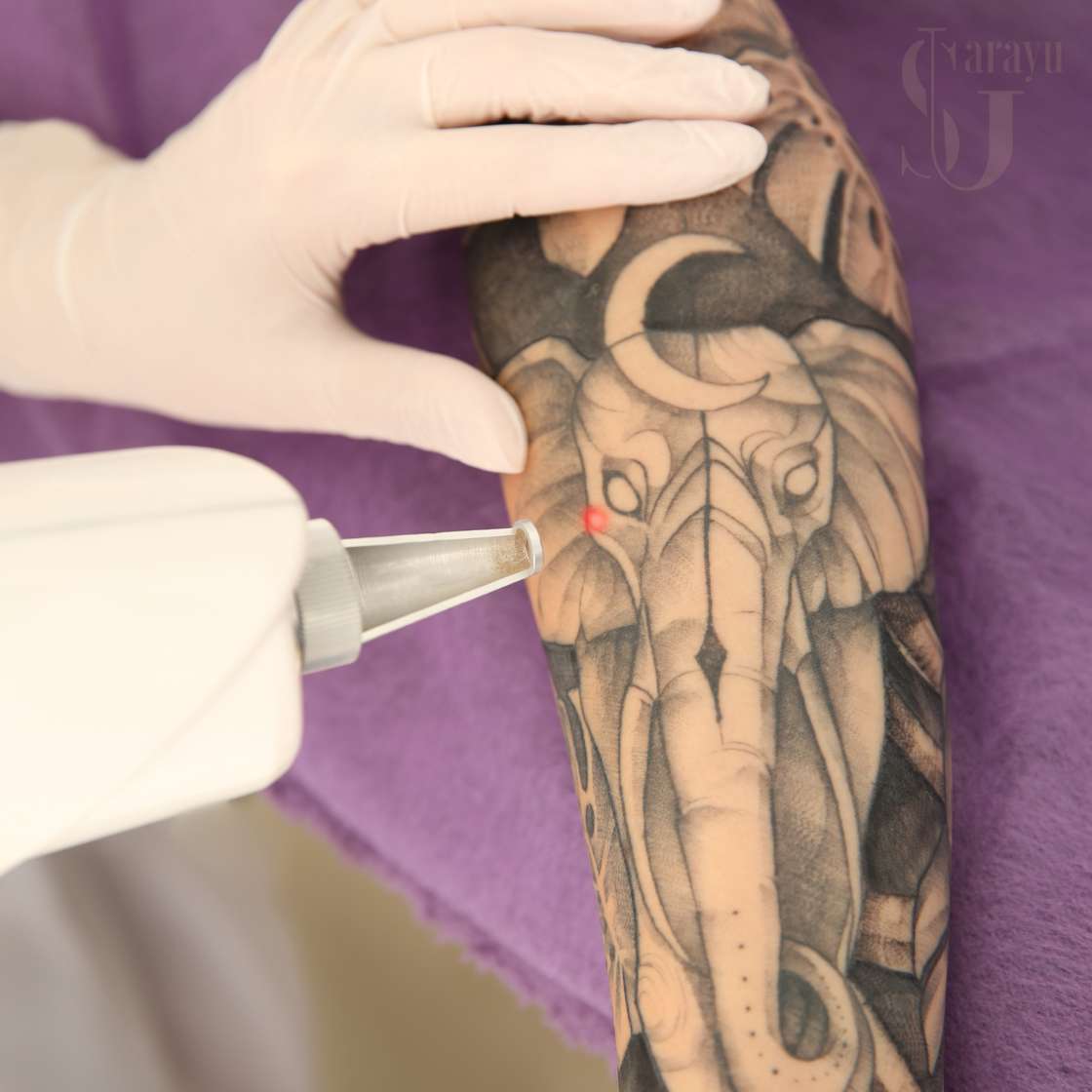
How Laser Tattoo Removal Works ?
Tattoo ink sits in the deep (dermal) layer of your skin in particles too large for your immune system to clear. A tattoo-removal laser fires extremely short, high-energy pulses of light that are absorbed by the ink and shatter it into much smaller fragments. Your body’s own immune system then gradually carries those fragments away over the following weeks — which is why a tattoo keeps fading between sessions, not just during them.
Different ink colours absorb different wavelengths of light, so the right laser is matched to your tattoo:
- 1064 nm — penetrates deep for black, dark blue and green ink (and is the safest wavelength for darker skin).
- 532 nm — targets red, orange and warm tones.
- Specialised wavelengths — used for stubborn greens and light blues, the hardest colours to remove.
Our Q-switched platform, including the Hollywood Spectra laser, delivers these wavelengths precisely, targeting pigment while leaving the surrounding skin intact.
Benefits of Professional Tattoo Removal
- Works on most tattoos — all sizes, most colours, amateur or professional.
- Low scarring risk — modern lasers target ink, not skin, so scarring is uncommon when done correctly.
- Safe for Indian skin tones — the right wavelength and settings protect darker skin from burns and pigment change.
- Minimal downtime — most people return to normal activities the same day.
- Precise & adjustable — we can fully remove a tattoo, or just fade it enough for a cover-up.
- A surgeon’s safety net — if a tattoo is small, raised or scarred, surgical removal and scar revision are available in the same clinic.
Areas We Treat
Tattoos can be removed almost anywhere on the body. Common areas include:
- Arms, wrists and hands
- Shoulders, back and chest
- Neck
- Legs, ankles and feet
- Face and eyebrows (including cosmetic / permanent makeup)
Tattoos further from the heart (hands, ankles) tend to fade more slowly because circulation — which clears the ink — is lower there. We factor this into your plan from the start.
Types of Tattoos We Remove
Not all tattoos behave the same way under a laser. During your consultation we identify exactly what we’re working with:
- Amateur / home tattoos — usually shallower single-colour ink; often the quickest to clear.
- Professional tattoos — denser, deeper, multi-coloured ink that needs more sessions and a multi-wavelength approach.
- Multicoloured tattoos — treated with different wavelengths for different colours in the same design.
- Cosmetic tattoos / permanent makeup — old microbladed brows, lip or eyeliner tattoos. These need special care because flesh-and-white inks can darken if treated carelessly (more on that below).
- Traumatic tattoos — embedded debris from injuries or accidents.
- Faded or partially removed tattoos — including work started elsewhere.
Removing an old cosmetic brow tattoo and want to start fresh? We also offer nanoblading once the area is clear.
Tattoo Removal Methods at Sarayu Clinics
Q-switched laser (the gold standard)
Q-switched Nd:YAG lasers deliver nanosecond pulses across multiple wavelengths and remain the gold-standard, most reliable choice for tattoo removal in pigmented Indian skin. They clear dark inks especially well with a low risk of scarring.
Picosecond laser (fewer sessions for tough ink)
Picosecond lasers fire even shorter pulses, shattering ink by a photomechanical “pressure” effect rather than heat. Studies show they can cut the number of sessions needed by around a quarter, and they’re particularly useful for stubborn colours and resistant tattoos.
R20 and R0 accelerated techniques
To speed up clearance, we can use multi-pass techniques in a single visit. The R20 method makes several laser passes spaced about 20 minutes apart; the R0 method uses a topical agent (perfluorodecalin) to clear the laser “frosting” almost instantly, allowing repeated passes with little waiting. Both can reduce the total number of sessions for suitable patients.
Surgical removal & scar revision (the surgeon’s advantage)
For small tattoos — or where a previous removal left a scar — surgical excision can remove the ink in one step, and Dr. Tripathi’s training as a facial plastic surgeon means the closure and any scar management are handled with an aesthetic eye. This is something most laser-only clinics simply can’t offer.
What Happens During a Session: Step by Step
- Consultation & assessment. We examine the tattoo’s size, colours, depth, age and location, check your skin type, and estimate your sessions (see the Kirby–Desai section below).
- Patch test. A small test confirms how your skin and ink respond — essential for darker skin and cosmetic inks.
- Numbing & eye protection. Numbing cream (or local anaesthetic) keeps you comfortable; protective eyewear is provided.
- Laser treatment. The laser is passed over the tattoo in controlled pulses. Most sessions take only a few minutes to half an hour depending on size.
- Soothing & aftercare. A calming ointment and dressing are applied, with clear home-care instructions.
- Healing interval. Sessions are spaced 6–8 weeks apart so your skin recovers and your body clears the shattered ink before the next pass.
Pain level? Most people compare it to a rubber band snapping against the skin — brief and very manageable with numbing.
How Many Sessions Will You Need?
There’s no single answer, because it depends on your specific tattoo. Clinicians use the Kirby–Desai scale to estimate sessions based on skin type, ink colours and amount, layering, location, scarring and existing fading. As a rough guide:
- Amateur tattoos: often 4–6 sessions.
- Professional tattoos: typically 8–12, occasionally up to 15–20 for dense, multicoloured work.
- Picosecond / R0 techniques: can reduce the total number for suitable cases.
We give you a realistic estimate after seeing your tattoo, not a one-size-fits-all promise.
Downtime & Aftercare
Downtime is minimal. Expect some redness, mild swelling, a whitish “frosting” that fades quickly, and sometimes light blistering or scabbing over the next few days. Caring for the area properly is what keeps results clean and scar-free:
- Keep the area clean and gently washed with mild soap and water
- Apply the recommended healing ointment to prevent dryness and itching
- Use broad-spectrum SPF 30+ and avoid direct sun — sun slows healing and risks pigment change
- Let scabs and blisters heal on their own — never pick or scratch them (this is the main cause of scarring)
- Avoid swimming pools, saunas and heavy sweating until healed
Once the skin has settled, treatments such as Dermapen 4 microneedling or skin microneedling can improve texture and help the area blend in.
Tattoo Removal Cost in Delhi
Tattoo removal is priced per session, and the total depends mostly on the size, colours and number of sessions your tattoo needs. As a general guide for Delhi:
Factor / option | Typical cost (INR)* |
Consultation & patch test | ₹2,500 – ₹5,000 |
Small tattoo (per session) | ₹5,000 – ₹25,000 |
Medium tattoo (per session) | ₹5,000 – ₹25,000 |
Large / professional tattoo (per session) | ₹5,000 – ₹25,000 |
Picosecond laser (per session) | ₹8,000 – ₹25,000 |
Multi-session packages | Discounted — quoted after assessmen |
Prices shown are for guidance only. Your final treatment cost will be confirmed during the initial consultation, based on your individual needs, concerns, and personalised treatment plan.
Why Choose Sarayu Clinics for Tattoo Removal in Delhi ?
Tattoo removal is unforgiving of inexperience — the wrong laser or setting on Indian skin can leave a mark worse than the tattoo. Treatment at Sarayu Clinics is led by facial plastic and maxillofacial surgeon Dr. Adarsh Tripathi, supported by a team experienced in laser work on deeper skin tones.
- Both laser and surgical options — a genuine advantage of a surgeon-led clinic.
- Gold-standard, FDA-cleared lasers — multiple wavelengths for all ink colours and skin tones.
- Safe for Indian skin — patch tests and conservative settings to avoid burns and pigment change.
- Honest estimates — realistic sessions and costs upfront, using the Kirby–Desai scale.
- Scar-aware aftercare — so the finished skin looks clean, not patchy.
Frequently Asked Questions
How many sessions does tattoo removal take?
Most tattoos need around 6–10 sessions, though amateur tattoos can clear in 4–6 and large professional pieces may take 12–20. The number depends on ink colour and density, your skin type and the tattoo’s age and location. We give you an estimate using the Kirby–Desai scale after seeing it.
Is laser tattoo removal painful?
It’s manageable for most people — often described as a rubber band snapping against the skin. Numbing cream or local anaesthetic is used to keep you comfortable, and each session is short.
Can all tattoos be completely removed?
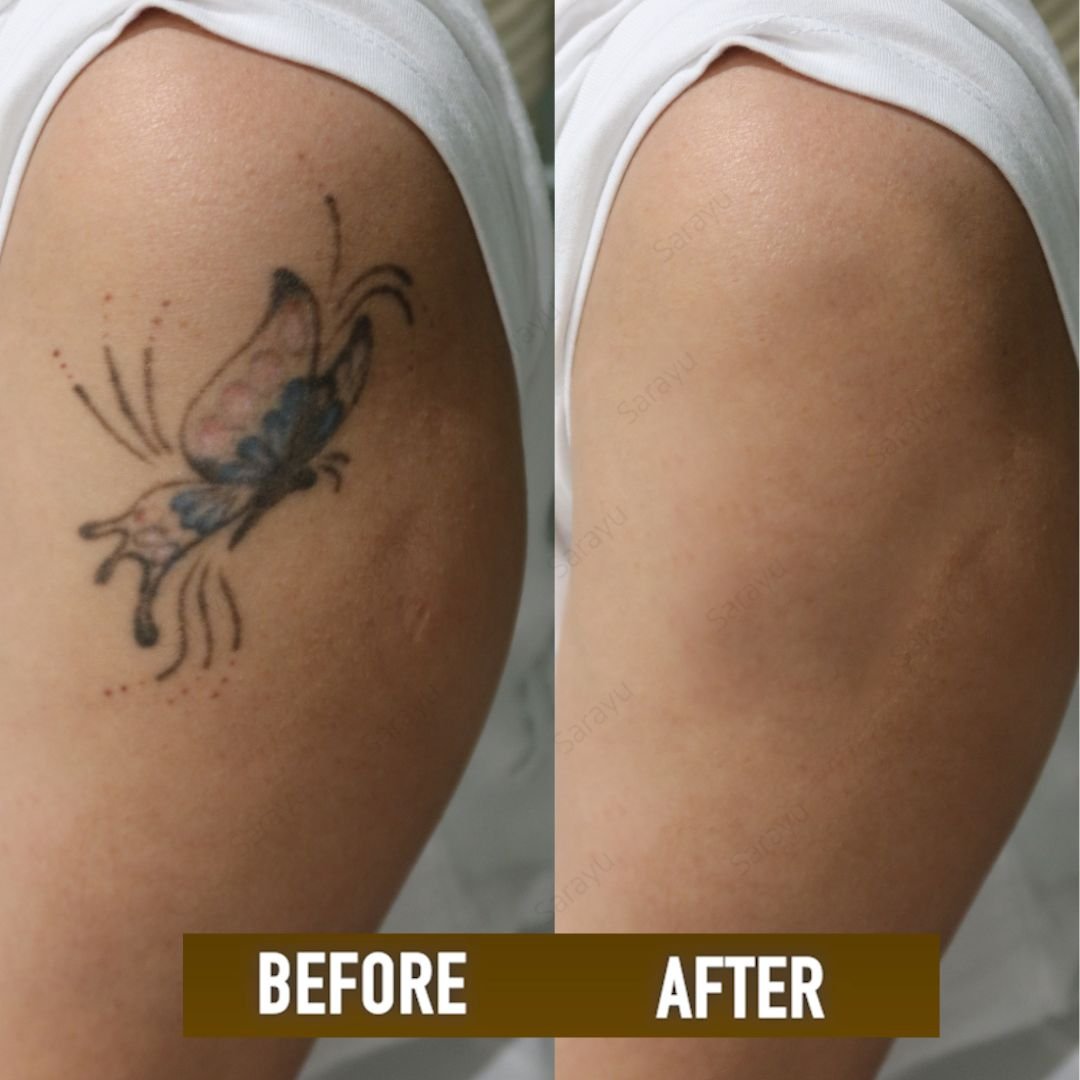
Most can be significantly faded or fully cleared. Black ink responds best; greens, light blues and some cosmetic inks are more stubborn and may not clear 100%. Modern picosecond technology has improved results considerably.
Is it safe for dark / Indian skin?
Yes, with the right laser and settings. The 1064 nm Q-switched wavelength is well suited to darker skin, and a patch test plus conservative settings reduce the risk of burns or pigment change. Experience with deeper skin tones matters here.
Will it leave a scar?
When done correctly with modern lasers, scarring is uncommon — the laser targets ink, not skin. Most scarring comes from picking scabs or poor aftercare. Following post-care instructions is key, and a surgeon-led clinic can manage any pre-existing scarring.
What are the side effects?
Temporary redness, swelling, frosting, and sometimes light blistering or scabbing, which settle within days. Serious complications are rare when treatment is done by an experienced clinician.
How much does tattoo removal cost in Delhi?
Per session, costs typically range from about ₹2,000 for a small tattoo to ₹25,000 for large or picosecond treatments. Your total depends on size, colours and number of sessions, and is shared upfront after assessment, with package options available.
Can I remove an old eyebrow or cosmetic tattoo?
Yes — but cosmetic inks need extra caution because flesh and white pigments can darken under a laser. We always patch-test first. Once the area is clear, we can also reshape brows with nanoblading if you wish.
How long should I wait between sessions?
Usually 6–8 weeks. This lets your skin heal and your body clear the shattered ink. Rushing doesn’t speed up removal and can raise the risk of skin reactions.
Can tattoo removal be combined with other treatments?
Yes — once healed, microneedling or skin treatments can refine the area’s texture and tone. Your clinician will advise what suits your skin.
How to Reach Us:
Phone: +91 9289111081 , +91 9289111082
Email: sarayuinquiries@gmail.com
Sarayu Clinics website: www.sarayuclinics.com
Facebook: https://www.facebook.com/sarayuclinic
Instagram: https://www.instagram.com/sarayuclinics/
Dr. Adarsh Tripathi’s profile: https://dradarshtripathi.com/
Online Booking: Visit our website https://sarayuclinics.com/contact-us/ to schedule appointments conveniently.
Our Patients
FAQ's : People Generally Ask
What is the safest way to remove a tattoo?
For most people, laser tattoo removal is considered the safest and most effective method because it breaks tattoo ink into smaller particles that the body gradually clears over time. Compared with older removal methods, modern lasers are more precise and are widely used by Facial Cosmetic Surgeon for better results.
Can every tattoo be removed completely?
Not always. Some tattoos fade very well, while others may only partially clear. Results depend on the ink type, tattoo depth, skin type, and how the tattoo was made. In some cases, a faint mark or scar can remain even after treatment.
Which tattoo colors are hardest to remove?
Darker inks, especially black, usually respond better than many other colors, while some bright or mixed pigments can be harder to treat. Newer laser technology has improved the removal of colors that used to be more difficult.
Why does tattoo removal take multiple sessions?
A tattoo is usually removed in stages because the laser can only break down part of the pigment in each session. After that, your body needs time to flush out the ink and allow the skin to recover before the next treatment.
Does the age of a tattoo affect removal results?
Yes. Older tattoos may already be slightly faded, which can sometimes make them easier to treat than very fresh, dense ink. Even so, results still depend on the ink quality, depth, and how your skin responds to laser treatment.
What happens if I want to remove only part of a tattoo?
Partial removal is possible in some cases, especially when someone wants to lighten a tattoo for a cover-up or reduce the visibility of specific areas. A dermatologist can map the treatment so the ink is reduced in a controlled way rather than removed all at once.
What side effects are normal after tattoo removal?
Temporary redness, swelling, blistering, bruising, or mild crusting can happen after laser tattoo removal. In some people, the treated area may also look lighter or darker for a while before settling.
Will tattoo removal leave a scar?
Scarring is not the goal, but it can happen in some cases, especially if the tattoo itself was already scarred, the skin is sensitive, or aftercare is not followed properly. Even with treatment, some tattoos may not disappear completely.
How should I prepare my skin before a tattoo removal session?
The skin should be clean and healthy before treatment. It is best to avoid sun exposure on the area and to share your full skin history with the doctor so the laser settings can be chosen safely. A qualified dermatologist should evaluate the skin before treatment.
What should I avoid after tattoo removal?
After treatment, the area should be protected from the sun and not picked, rubbed, or scratched. Following aftercare instructions helps reduce the risk of pigmentation changes, delayed healing, and irritation.
Is tattoo removal suitable for all skin types?
Tattoo removal can be done on many skin types, but the laser choice and settings must be selected carefully, especially for darker skin tones, to reduce the risk of pigment changes. That is why treatment with a trained dermatologist matters.
Who is the best candidate for tattoo removal in Delhi?
The best candidate is usually someone who wants a medically supervised, realistic approach to fading or removing unwanted tattoo ink. People who have healthy skin at the treatment site and clear expectations about multiple sessions tend to do best.