
Pigmentation Treatment in Delhi
Pigmentation Treatment in Delhi
Pigmentation is the most common skin complaint we see, and the one people have usually already spent the most money on before they arrive. A cream from a chemist. A brightening serum from Instagram. A course of laser sessions somewhere that promised clear skin in six weeks. Sometimes it improved slightly. Sometimes it came back worse. And almost always, nobody explained why.
The reason is simple and rarely said out loud: pigmentation is not one condition. It is a category. Melasma behaves nothing like a sun spot. Post-acne marks behave nothing like melasma. And crucially, pigment sitting in the top layer of your skin responds completely differently from pigment sitting deep in the dermis — even when the two look identical in the mirror. Until someone works out which kind you have, and how deep it sits, any treatment is a guess.
At Sarayu Clinics in Greater Kailash, pigmentation treatment is planned by facial plastic and maxillofacial surgeon Dr. Adarsh Tripathi. Every consultation begins with a diagnosis — what type of pigmentation, how deep, and what is driving it — before a single treatment is recommended. That step is the difference between skin that clears and skin that keeps coming back.
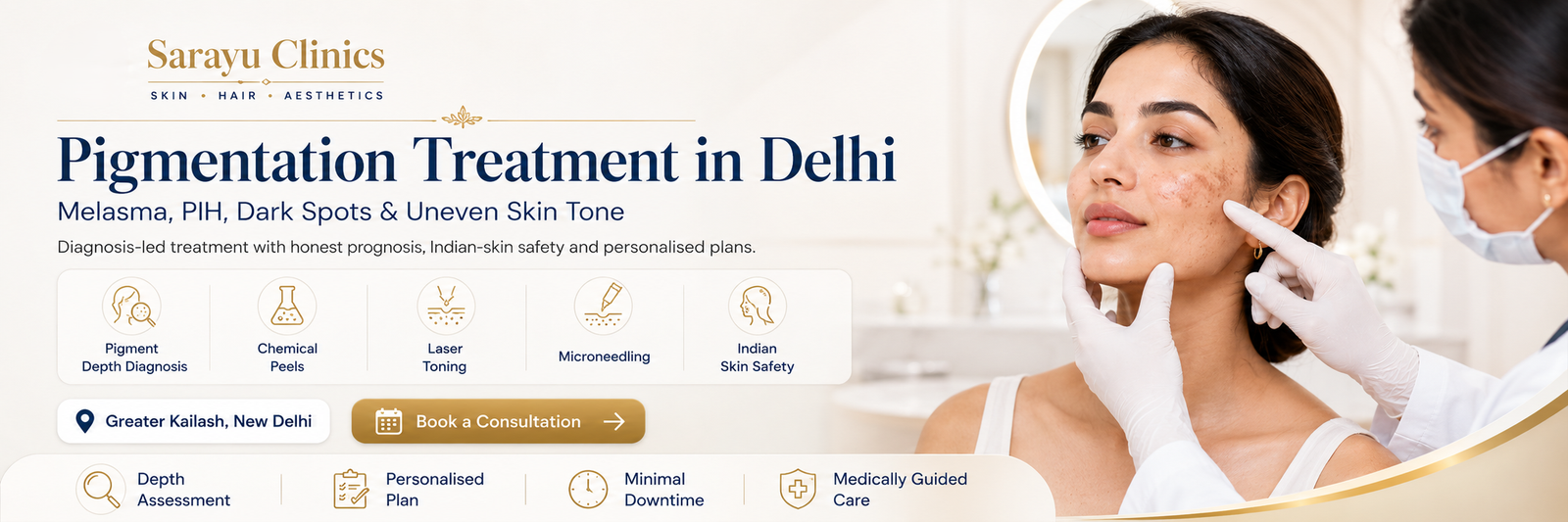
The short answer : Pigmentation happens when melanocytes (pigment-producing cells) overproduce melanin. The main types are melasma (hormonal, stubborn, recurrent), post-inflammatory hyperpigmentation or PIH (after acne, injury or inflammation), sun spots and solar lentigines (UV damage), freckles, and periorbital pigmentation (dark circles). What determines your outcome is not the brand of laser — it is pigment DEPTH. Epidermal (surface) pigment responds well and can clear substantially. Dermal (deep) pigment responds slowly, partially, and needs realistic expectations. Most Indian patients have MIXED pigment. Treatments include topical actives, chemical peels, Q-switched laser toning, fractional lasers, microneedling with brightening actives, and oral tranexamic acid where indicated. Sun protection is not optional — it is the treatment. Delhi cost: Rs 2,500–20,000 per session depending on the modality; most plans need 4–8 sessions plus maintenance.
The Question Nobody Asks: How Deep Is Your Pigment?
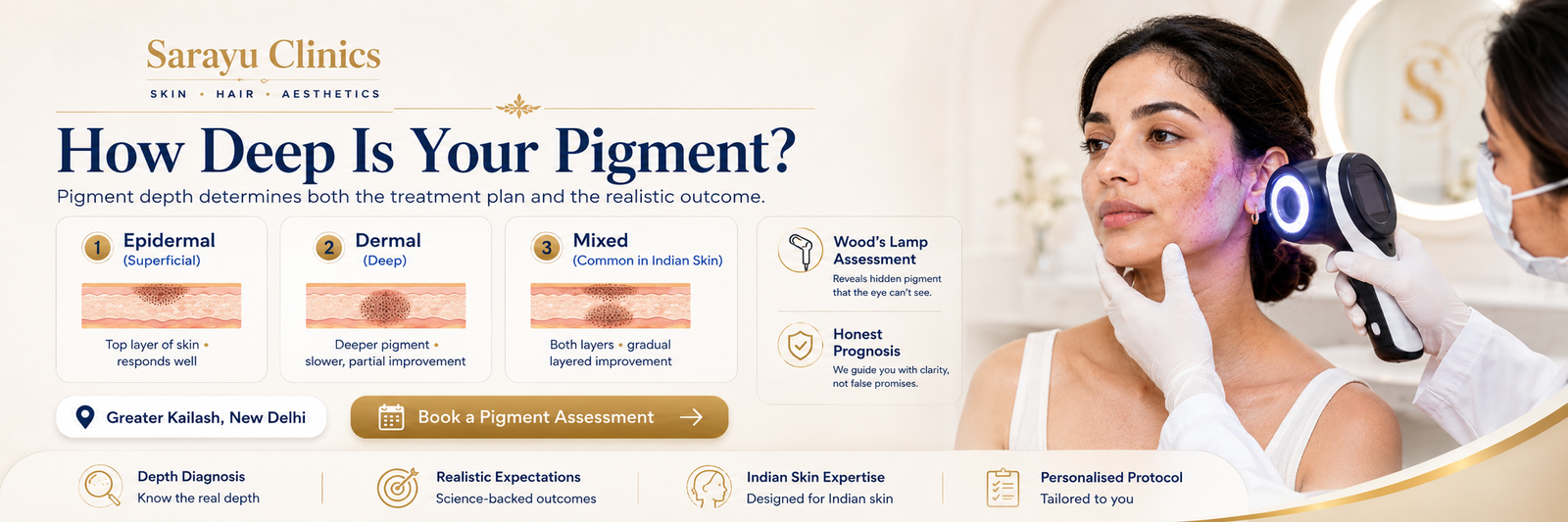
This is the most important section on this page, and the one you will not find on any competitor’s site. Two people can walk in with what looks like identical brown patches on the cheeks. One will clear beautifully in four sessions. The other will improve by forty percent and relapse every summer for the rest of her life. The difference is not the clinic, the laser, or the effort. It is where the pigment physically sits.
Pigment depth | Where the melanin sits | How it looks | Realistic outcome |
Epidermal (superficial) | In the top layer of skin | Well-defined edges; looks distinctly brown; darkens clearly under a Wood’s lamp | Responds well. Substantial clearance is realistic with peels, laser toning and topicals. |
Dermal (deep) | In the deeper dermis, inside pigment-eating cells | Blurred edges; bluish or grey-brown tinge; does not intensify under a Wood’s lamp | Responds slowly and partially. Improvement is real but full clearance is usually not achievable. |
Mixed (most common in Indian skin) | Both layers | Patchy; some areas sharp, some hazy | Layered plan. The epidermal component clears first; the dermal component improves gradually over months. |
We assess depth clinically and, where useful, with a Wood’s lamp examination — a simple, painless UV light that makes epidermal pigment glow more intensely while leaving dermal pigment unchanged. It takes thirty seconds and it tells us more about your likely outcome than any before-and-after gallery ever could.
Why an honest prognosis is better than a promised one ?
If your pigment is largely dermal, no clinic in Delhi — or anywhere — can clear it completely. Any clinic that promises full clearance without examining depth is either guessing or selling. We would rather tell you at the first consultation that we expect a sixty percent improvement and a need for maintenance, than take payment for eight sessions and leave you disappointed at the end of them. Realistic expectations set correctly at the start are the single strongest predictor of patient satisfaction in pigmentation treatment.
The Types of Pigmentation We Treat
Each type has a different driver, a different treatment path, and a different prognosis. Identifying yours is step one.
Type | What drives it | Typical appearance | Treatment direction |
Melasma | Hormones + UV + heat; genetic predisposition | Symmetrical brown-grey patches on cheeks, upper lip, forehead | Gentle, sustained, low-energy. Aggressive treatment makes it worse. |
PIH (post-inflammatory) | Inflammation — acne, injury, harsh products | Flat dark marks exactly where the inflammation was | Treat the cause first; then brighten. Fades with time. |
Sun spots / solar lentigines | Cumulative UV damage | Sharply defined brown spots on cheeks, hands, forearms | Responds very well to Q-switched laser and peels. |
Freckles (ephelides) | Genetic + sun; darken in summer | Small, light brown, scattered across nose and cheeks | Laser and peels work well; recur with sun exposure. |
Periorbital pigmentation | Genetics, thin skin, vascularity, rubbing, sleep | Dark circles under the eyes | Depends entirely on whether the cause is pigment, shadow or vessel. |
Tan | Recent, acute UV exposure | Uniform darkening of exposed skin | Reverses on its own; peels and toning accelerate it. |
Two of these have their own dedicated pages because they need far more detail than a hub page allows: melasma treatment in Delhi (the most stubborn and most misunderstood form), and depigmentation treatment. If your marks came after acne, the distinction between marks and true scars matters enormously — we wrote a full guide on acne marks versus acne scars, because treating one as the other is the single most common and costly mistake in this category.
Areas We Treat
- Face — cheeks, upper lip, forehead, chin, bridge of nose
- Under-eye and periorbital area (dark circles)
- Neck — including pigmentary demarcation lines
- Underarms and inner thighs (friction-related pigmentation)
- Hands, forearms and back of the neck (sun-exposed zones)
- Chest and décolletage
- Elbows, knees and knuckles
Conditions & Concerns This Page Covers
- Melasma — hormonal, symmetrical, recurrent; needs lifelong management rather than a one-off cure.
- Post-inflammatory hyperpigmentation — the dark marks left behind by acne, eczema, injury or over-aggressive treatment.
- Sun spots and age spots — the sharply defined marks of cumulative UV exposure.
- Uneven skin tone and dullness — diffuse patchiness without a single discrete lesion.
- Dark circles under the eyes — where the cause is genuinely pigment rather than shadow or vascularity.
- Tanning and pigmentary demarcation lines — particularly on the neck and forearms.
- Pigmentation worsened by previous treatment — including rebound pigmentation after laser, and damage from steroid-containing creams. This is more common than most clinics admit.
Every Treatment Option, Honestly Ranked
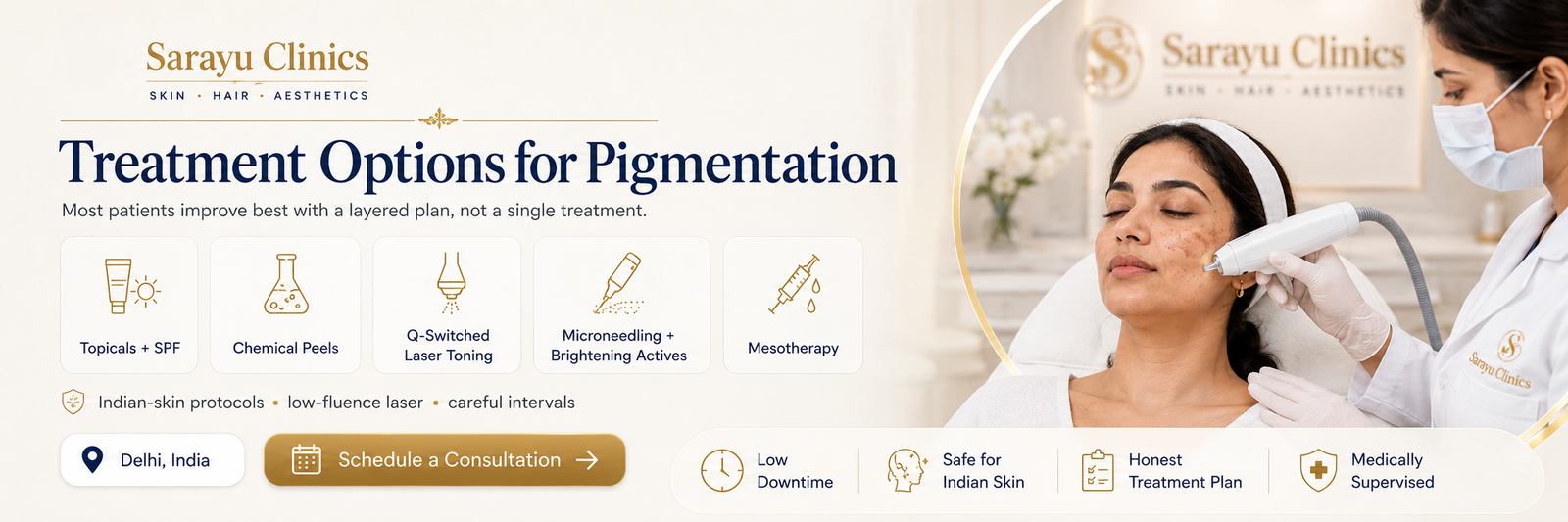
Ordered from foundational to advanced. The correct plan for you almost always combines two or three of these — pigmentation rarely responds to a single modality alone.
1. Sun protection — the treatment nobody wants to hear about
This is not a preamble to the real treatments. It is the single most effective intervention on this page, and every clinical study on pigmentation confirms it. UV radiation — and, for melasma, visible light and heat as well — directly stimulates melanocytes. Without daily broad-spectrum SPF 50+, every other treatment on this list is working against a tap you have left running. Patients who commit to daily sunscreen see roughly double the improvement from identical laser or peel protocols. If you take one thing from this page, take this one.
2. Topical actives (prescription and cosmeceutical)
The foundation of any serious pigmentation plan, and what maintains the result between clinic sessions. Tyrosinase inhibitors (the enzyme melanocytes use to make melanin) include hydroquinone, kojic acid, arbutin and azelaic acid. Melanin-transfer blockers include niacinamide. Tranexamic acid works on the vascular and inflammatory drivers, particularly useful in melasma. Retinoids increase cell turnover, moving pigmented cells to the surface faster. Vitamin C is an antioxidant that reduces oxidative pigment formation.
3. Chemical peels
Controlled exfoliation that lifts pigmented cells from the epidermis and accelerates turnover. For Indian skin, gentler agents are the correct starting point: mandelic acid (large molecule, slow penetration, minimal irritation) and lactic acid are safest. Glycolic and salicylic acid are workhorses. Cocktail peels combining several acids at lower individual concentrations often outperform a single aggressive agent with fewer side effects. Typically a course of 4–6 sessions at 3–4 week intervals. See also our carbon peel page for oily, congested, pigment-prone skin.
Laser Treatment for Pigmentation in Delhi
The Q-switched Nd:YAG laser (we use the Hollywood Spectra platform) delivers energy in nanosecond pulses that shatter melanin particles into fragments small enough for the body to clear. In low-fluence, multi-pass form this is called laser toning — the mainstay of pigmentation laser treatment in Indian skin, precisely because it works at energies low enough to avoid provoking the melanocytes into a rebound response. Typically 6–8 sessions at monthly intervals.
Fractional resurfacing lasers — fractional CO2 — treat pigment alongside texture, but ablate the epidermis and therefore carry a materially higher PIH risk in Fitzpatrick IV–V skin. They are the right tool for the right patient, at conservative settings, and the wrong tool for uncomplicated melasma.
The rebound pigmentation warning — read this before booking laser anywhere
Melanocytes in darker skin are not passive targets. Hit them with too much energy, too often, and they respond by producing MORE pigment — a phenomenon called rebound hyperpigmentation, and it is one of the most common ways pigmentation treatment goes wrong in Indian patients. It is why melasma in particular must be treated gently: low fluence, adequate intervals, no chasing rapid results. If a clinic offers you weekly high-energy laser sessions and promises dramatic clearance in a month, walk away. The slow protocol is not the clinic being cautious. It is the clinic being correct.
5. Microneedling with brightening actives
Skin microneedling and Dermapen 4 create controlled micro-channels that both stimulate turnover and allow tranexamic acid, vitamin C or glutathione to be delivered directly into the skin rather than sitting on its surface. For mixed and dermal pigment, this delivery route substantially outperforms topical application alone. Often the best option where laser is contraindicated.
6. Mesotherapy and skin boosters
Mesotherapy delivers a cocktail of brightening agents — tranexamic acid, vitamin C, glutathione — into the dermis via fine microinjections. A useful adjunct, particularly for diffuse dullness and mixed-depth pigment. Not a standalone cure, and we will not sell it as one.
7. Oral tranexamic acid
For resistant melasma, low-dose oral tranexamic acid has good evidence for reducing pigment and recurrence. It is a prescription medication with real contraindications — a history of clotting disorders, stroke, or current hormonal contraception all require careful assessment. It requires medical supervision, monitoring, and is not appropriate for everyone. This is one of several reasons pigmentation is a medical consultation and not a salon booking.
Pigmentation Treatment for Indian Skin
Fitzpatrick type IV and V skin — the majority of our patients — has more active melanocytes that respond faster and more aggressively to any inflammatory stimulus. That single fact changes everything about how pigmentation should be treated.
- Every treatment is a double-edged tool. The same laser, peel or microneedling session that clears pigment can also provoke it. Energy settings that are routine in European skin are unsafe here.
- Start low, go slow, extend intervals. Conservative protocols are not timidity. They produce better results in this skin type than aggressive ones, consistently.
- Pre-treatment priming matters. Two to four weeks of topical preparation before laser or peels measurably reduces post-procedure PIH.
- Test patches are worth the wait. For any first laser session on a face, a small test area assessed after two weeks is standard good practice.
The fairness cream problem — an honest word
A significant number of pigmentation patients in Delhi arrive with skin that has been made worse by over-the-counter creams. Two mechanisms recur. Long-term unsupervised hydroquinone can cause exogenous ochronosis — a paradoxical blue-black pigmentation that is extremely difficult to reverse. And many unregulated ‘fairness’ creams contain potent topical steroids, which thin the skin, cause visible vessels, trigger steroid-induced acne and rosacea, and produce severe rebound pigmentation on withdrawal. If you are using a cream from a chemist without a prescription, please bring it to your consultation. Stopping it correctly, under supervision, is often the first step of treatment.
A note on framing, because it matters. This is a page about treating pigmentation — a medical concern where melanin is unevenly distributed. It is not about changing your natural skin tone, and we do not offer treatment on that basis. Even, healthy, clear skin at your own complexion is the goal. Anything marketed as ‘fairness’ or ‘skin whitening’ is selling you something different, and usually something worse.
The Treatment Process: Step by Step
- Diagnosis and depth assessment. Tripathi examines the pigmentation clinically and, where useful, under a Wood’s lamp to determine whether the pigment is epidermal, dermal or mixed. Your history — hormonal factors, sun exposure, previous treatments, current creams — is taken in detail.
- An honest prognosis. Before any treatment is booked, you are told what result is realistically achievable, how many sessions it will likely take, and whether maintenance will be needed. If the honest answer is ‘sixty percent improvement with ongoing maintenance’, that is what you will hear.
- Priming phase. Two to four weeks of prescribed topical preparation and strict sun protection before any in-clinic procedure. This step measurably reduces the risk of post-procedure pigmentation and is not optional.
- Test patch (for laser). For first-time laser treatment, a small test area is treated and reviewed at two weeks before proceeding to a full session.
- The treatment course. Sessions at appropriate intervals — typically monthly for laser toning, three to four weekly for peels. Photographs at every visit under standardised lighting, because pigmentation improves too gradually for memory to be reliable.
- For melasma and recurrent pigmentation, a maintenance plan of topicals plus periodic sessions. This is not a failure of treatment. It is the nature of the condition.
Downtime & Aftercare
- Laser toning: essentially none. Mild redness and warmth for a few hours. Back to normal immediately.
- Chemical peels: mild redness and light flaking for 2–5 days depending on depth. Do not pick at peeling skin — picking causes PIH.
- Microneedling: redness for 1–2 days; pin marks settle within 48 hours.
- Fractional CO2: 5–10 days of visible healing. Reserved for specific indications, not routine pigmentation.
- Universal, non-negotiable: broad-spectrum SPF 50+ every single morning, reapplied through the day. No active ingredients (retinoids, acids) for 5–7 days after any procedure. No hot showers, saunas or steam for 48 hours — heat is a melasma trigger in its own right.
Pigmentation Treatment Cost in Delhi
Cost depends on the modality, the area, and how many sessions your pigment type and depth genuinely require. Verified Delhi ranges:
Treatment | Typical cost per session (INR)* |
Consultation, depth assessment & Wood’s lamp | Rs 2,500 – Rs 5,000 |
Chemical peel (mandelic / lactic / glycolic) | Rs 2,500 – Rs 8,000 |
Cocktail / combination peel | Rs 4,000 – Rs 10,000 |
Q-switched laser toning (per session) | Rs 5,000 – Rs 15,000 |
Carbon laser peel | Rs 4,000 – Rs 8,000 |
Microneedling with brightening actives | Rs 6,000 – Rs 15,000 |
Mesotherapy / skin boosters | Rs 8,000 – Rs 18,000 |
Fractional CO2 laser | Rs 8,000 – Rs 20,000 |
Prescription topical protocol (per month) | Rs 1,500 – Rs 5,000 |
Full course (6–8 sessions + topicals) | Package pricing after assessment — usually more economical |
Prices shown are for guidance only. Your final treatment cost will be confirmed during the initial consultation, based on your individual needs, concerns, and personalised treatment plan.
Results Timeline: What to Expect, Honestly
Timeframe | What usually happens |
Weeks 1–4 (priming) | No visible change yet. Skin is being prepared; topicals are working at a cellular level. This phase is easy to abandon and shouldn’t be. |
After session 1–2 | Subtle brightening. Epidermal pigment starts to lift. Sun spots respond fastest. |
After session 3–4 | Clear, photographable improvement in epidermal pigment. Melasma may look better but is not yet stable. |
After session 6–8 | The realistic endpoint for most epidermal and mixed pigmentation. Dermal component continues improving slowly. |
Months 4–6 | Full benefit of collagen and turnover changes. Tone is more even; texture improved. |
Ongoing | Melasma and hormonally-driven pigmentation require maintenance. Sun spots, once cleared, stay cleared — provided sunscreen is worn. |
Anyone promising clear skin in two weeks is describing a tan fading, not pigmentation being treated. Real pigment clearance is measured in months, because melanin is cleared by your own immune cells at their own pace.
Comparing Your Treatment Options
Treatment | Best for | Works on dermal pigment? | Indian skin safety | Downtime |
Topicals + SPF | All types; foundation of every plan | Slowly | Excellent | None |
Chemical peels | Epidermal pigment, PIH, dullness | Minimally | Excellent (gentle agents) | 2–5 days |
Q-switched laser toning | Melasma, sun spots, mixed pigment | Partially | Excellent at low fluence | None |
Carbon laser peel | Oily, congested, pigment-prone skin | No | Excellent | None |
Microneedling + actives | Mixed and dermal pigment; PIH | Yes — best delivery route | Excellent | 1–2 days |
Mesotherapy | Diffuse dullness; adjunct only | Partially | Excellent | Minimal |
Fractional CO2 | Pigment with texture/scarring | Yes | Caution — real PIH risk | 5–10 days |
Pigmentation rarely travels alone. Where it accompanies active breakouts, acne treatment comes first — every new lesion creates new PIH. Where it accompanies textural change, Morpheus8 or MNRF can address both. Where enlarged pores and congestion coexist, see open pores treatment.
Are You a Good Candidate?
Almost everyone with pigmentation can be helped — the question is by how much, and with what commitment. You are well-suited to treatment if you have:
- Melasma, PIH, sun spots, freckles or uneven tone that bothers you
- Realistic expectations — significant improvement, and for melasma, ongoing management
- A genuine willingness to wear sunscreen daily (this is the deciding factor)
- Any Fitzpatrick skin type, including IV–V, with appropriately calibrated protocols
Extra caution or a modified plan applies if you:
- Are pregnant or breastfeeding (many actives and oral agents are deferred; melasma often improves postpartum anyway)
- Have been using an unprescribed steroid or hydroquinone cream (this needs supervised withdrawal first)
- Have a history of keloid scarring or active skin infection in the area
- Have a clotting disorder or take hormonal contraception (relevant to oral tranexamic acid specifically)
- Have hypopigmentation such as vitiligo rather than hyperpigmentation — a different condition entirely, requiring dermatological and sometimes immunological management. We will assess and refer appropriately rather than treat it as a pigmentation-reduction problem.
Why Choose Sarayu Clinics for Pigmentation Treatment in Delhi ?
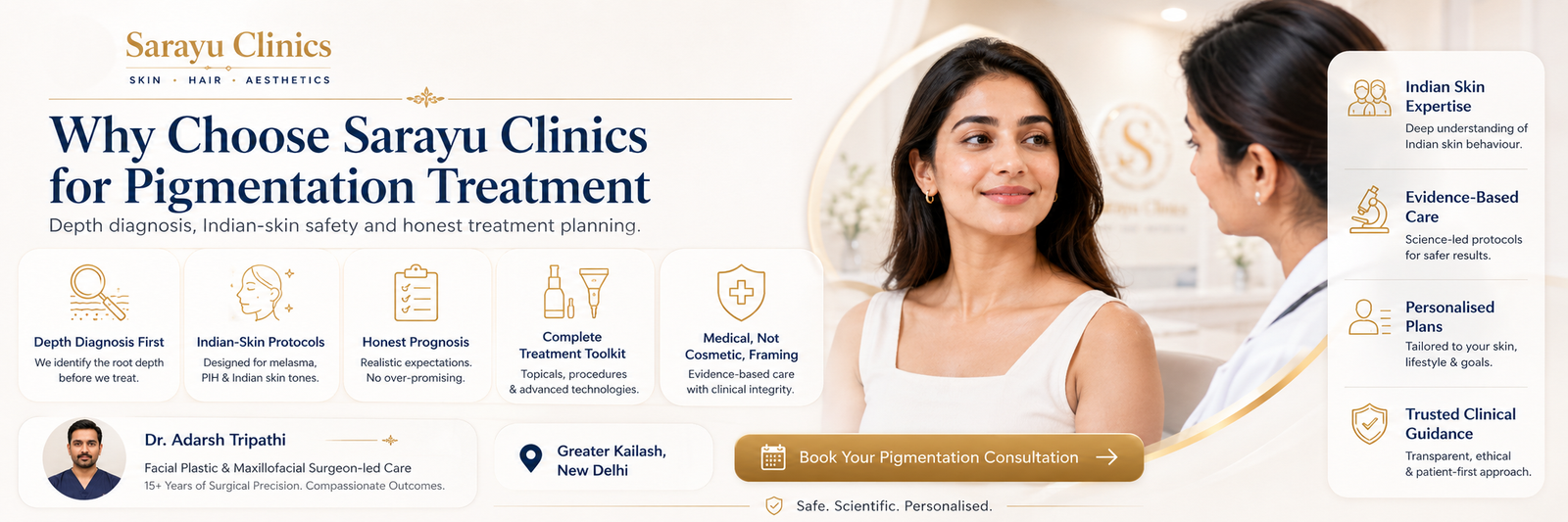
Pigmentation is the most over-promised category in Indian aesthetics, and the one where the wrong treatment does the most damage. At Sarayu Clinics, pigmentation is diagnosed and treated by facial plastic and maxillofacial surgeon Dr. Adarsh Tripathi, alongside co-founder Dr. Nidhi Bhatia.
- Depth diagnosis before treatment. Wood’s lamp assessment and clinical examination determine whether your pigment is epidermal, dermal or mixed — and therefore what is genuinely achievable.
- Indian-skin protocols, not imported ones. Low-fluence laser toning, gentle peel agents, adequate intervals, priming and test patches. Calibrated for Fitzpatrick IV–V, where rebound pigmentation is a real risk.
- An honest prognosis at the first visit. If full clearance is not achievable, you will be told so before you pay for anything.
- The complete toolkit. Topicals, peels, Q-switched laser toning, carbon peel, microneedling with actives, mesotherapy, fractional laser and prescription oral therapy where indicated.
- Medical, not cosmetic, framing. We treat pigmentation. We do not sell fairness, and we will tell you plainly if a cream you are using is harming your skin.
Medical Review & Sources
This page is for general information and is medically reviewed by the team at Sarayu Clinics under Dr. Adarsh Tripathi. It is not a substitute for an in-person clinical assessment. Pigmentation has multiple causes, some of which require medical rather than cosmetic management. Sources:
How to Reach Us:
Phone: +91 9289111081 , +91 9289111082
Email: sarayuinquiries@gmail.com
Sarayu Clinics website: www.sarayuclinics.com
Facebook: https://www.facebook.com/sarayuclinic
Instagram: https://www.instagram.com/sarayuclinics/
Dr. Adarsh Tripathi’s profile: https://dradarshtripathi.com/
Online Booking: Visit our website https://sarayuclinics.com/contact-us/ to schedule appointments conveniently.
How much does pigmentation treatment cost in Delhi?
Pigmentation treatment in Delhi typically costs Rs 2,500–20,000 per session depending on the modality. Chemical peels run Rs 2,500–8,000; Q-switched laser toning Rs 5,000–15,000; microneedling with brightening actives Rs 6,000–15,000; fractional CO2 laser Rs 8,000–20,000. Most plans need 4–8 sessions plus a topical protocol, so ask for total course pricing rather than per-session cost when comparing clinics.
Can pigmentation be removed permanently?
It depends entirely on the type and depth. Sun spots and freckles, once cleared, stay cleared provided you wear sunscreen daily. Melasma is a chronic, hormonally-driven condition — it can be substantially improved and controlled, but it recurs without maintenance, and no clinic can honestly promise permanent cure. Deep dermal pigment can be improved but rarely eliminated. Any clinic promising permanent removal without examining your pigment depth is overpromising.
Why does my pigmentation keep coming back after laser?
Three common reasons. First, inadequate sun protection — UV re-stimulates melanocytes faster than any laser can clear them. Second, the underlying driver was never addressed: melasma is hormonal, PIH keeps forming if acne is still active. Third, and most importantly in Indian skin, the laser energy may have been too high — provoking rebound hyperpigmentation, where the melanocytes respond to aggressive treatment by producing more pigment, not less.
What is the best laser for pigmentation in Indian skin?
Q-switched Nd:YAG laser toning, used at low fluence over multiple passes and monthly sessions, is the safest and most reliable option for Fitzpatrick IV–V skin. It targets melanin without ablating the epidermis, which keeps the risk of post-inflammatory hyperpigmentation low. Ablative fractional lasers are more powerful but carry meaningfully higher PIH risk in darker skin and are reserved for specific indications rather than routine pigmentation.
How many sessions will I need?
Most epidermal pigmentation responds over 4–8 sessions. Laser toning is usually monthly; peels every three to four weeks. Dermal and mixed pigment take longer and improve partially rather than completely. Melasma requires ongoing maintenance indefinitely. The honest number for you depends on your pigment depth, which is assessed at consultation — not quoted over the phone.
Is my dark patch melasma or post-acne pigmentation?
Melasma is usually symmetrical, appears on both cheeks or across the upper lip and forehead, has hazy rather than sharp borders, and often worsens with sun, heat or pregnancy. Post-inflammatory hyperpigmentation appears exactly where a pimple, injury or rash was — asymmetrical, discrete, corresponding to a remembered lesion. They need different treatment approaches, which is why a clinical assessment matters before you start anything.
Are fairness or skin-whitening creams safe?
Unprescribed ones frequently are not. Many contain potent topical steroids, which thin the skin, cause visible blood vessels, trigger steroid-induced acne, and cause severe rebound pigmentation when stopped. Long-term unsupervised hydroquinone can cause exogenous ochronosis — a paradoxical blue-black discolouration that is very difficult to reverse. If you are using a chemist-bought cream without a prescription, bring it to your consultation. Supervised withdrawal is often the first step of proper treatment.

Does sunscreen really make that much difference?
Yes, more than any single treatment. UV radiation directly stimulates the melanocytes that produce pigment, and for melasma, visible light and heat do too. Patients who wear broad-spectrum SPF 50+ daily see roughly double the improvement from identical laser or peel protocols compared with those who do not. Without it, you are treating pigmentation while continuing to cause it.
Can pigmentation be treated during pregnancy?
Most active treatments are deferred. Many topical agents (including hydroquinone and retinoids) and oral tranexamic acid are avoided in pregnancy. Melasma that appears during pregnancy — sometimes called the mask of pregnancy — frequently improves on its own in the months after delivery. The safe and effective interventions during pregnancy are rigorous sun protection and gentle, pregnancy-appropriate skincare. Discuss any treatment with both your obstetrician and your doctor.
What is the difference between hyperpigmentation and hypopigmentation?
Hyperpigmentation means too much melanin — dark patches, spots, melasma, PIH. This page addresses hyperpigmentation. Hypopigmentation means too little melanin — pale or white patches, of which vitiligo is the best-known form. Vitiligo is an autoimmune condition requiring dermatological and sometimes immunological management, and it is treated very differently. If your patches are lighter than your surrounding skin rather than darker, that requires a different assessment and we will refer you appropriately.