
Fractional CO2 Laser Treatment in Delhi
- Home
- Fractional CO2 Laser Treatment in Delhi
Fractional CO2 Laser Treatment in Delhi
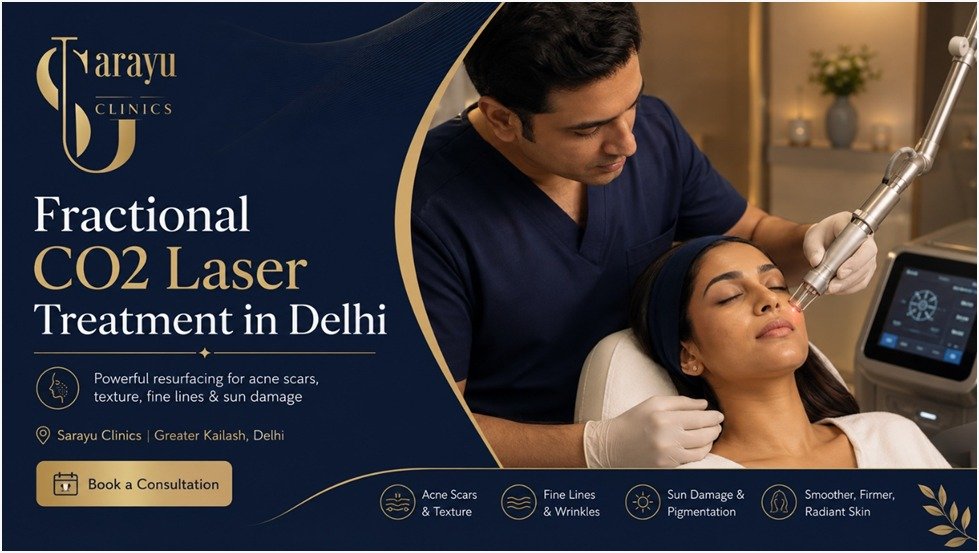
Fractional CO2 is the most powerful resurfacing laser in routine aesthetic practice, and that cuts both ways. For deep acne scars, sun-damaged skin, fine lines and stubborn texture, nothing non-surgical resurfaces as decisively. It is also the laser with the most real downtime and, in Indian skin specifically, the highest risk of the one complication nobody wants: pigmentation that arrives after the treatment and takes months to fade.
Both halves of that sentence are true, and you deserve to read them on the same page. Most clinic pages give you the first half — the dramatic before-and-afters, the phrase ‘suitable for all skin types’ — and leave you to discover the second half in week two, peeling, wondering whether something has gone wrong. Almost nothing has gone wrong; you simply weren’t told what normal looks like.
At Sarayu Clinics in Greater Kailash, fractional CO2 laser treatment is planned and performed under facial plastic and maxillofacial surgeon Dr. Adarsh Tripathi. This page is the honest version: what the laser actually does, what it treats well, what recovery genuinely looks like day by day, what it costs in Delhi and why prices vary so widely, how we keep it safe in brown skin — and when we will tell you to have something else instead.
The short answer : Fractional CO2 is an ablative laser (10,600 nm) that vaporises microscopic columns of skin, leaving healthy tissue between them so healing is faster than old full-surface resurfacing. Those columns trigger months of collagen remodelling. It is the strongest option for deep acne scars, surgical and burn scars, sun damage, fine lines and rough texture. Expect 5-10 days of visible peeling and redness, with residual pinkness for weeks — this is not a lunchtime laser. Most people need 1-3 sessions for resurfacing and 3-5 for deep scarring, spaced 6-8 weeks apart. In Delhi, expect roughly Rs 8,000-15,000 for a small area or single session and Rs 15,000-30,000 for a full face, with packages for multi-session scar work. The critical Indian-skin point: fractional CO2 carries the highest post-inflammatory hyperpigmentation risk of any resurfacing laser in Fitzpatrick IV-V skin, so conservative settings, pre-treatment priming and absolute sun protection are not optional extras — they are the treatment. Some patients are safer and happier with MNRF or Morpheus8 instead, and we will say so.
What Fractional CO2 Laser Actually Does ?
The CO2 laser emits light at 10,600 nanometres, a wavelength absorbed almost entirely by water. Since your skin is mostly water, that energy converts to heat instantly and vaporises tissue — which is why CO2 is called an ablative laser. It removes skin rather than merely heating it.
The word ‘fractional’ is what makes it usable. Instead of stripping the entire surface, the beam is split into a grid of microscopic columns — microthermal treatment zones — that go deep, while the untouched skin between them acts as a reservoir of healthy cells that heals the wounds from the sides. Old-style full-field resurfacing gave superb results and weeks of raw recovery. Fractional delivers most of the benefit with a fraction of the downtime, and it is the reason the treatment is practical at all.
Two things then happen. The columns of damaged tissue are removed and replaced with new skin, which is the resurfacing. And the controlled injury triggers a wound-healing cascade that lays down fresh collagen for three to six months afterwards, which is the tightening and the scar remodelling. That second part is slow, and it is why the result at three months is better than the result at three weeks.
Benefits of Fractional CO2 Laser
- The most decisive scar improvement available without surgery — particularly for boxcar and rolling acne scars, and for surgical, burn and traumatic scars.
- Genuine textural resurfacing — rough, weathered, sun-damaged skin is replaced rather than polished.
- Fine lines softened, especially around the mouth and eyes — perioral lines respond better to CO2 than to almost anything else non-surgical.
- Pore size visibly reduced — as the surrounding collagen tightens.
- Collagen that keeps building — remodelling continues for months, so results deepen well after the peeling stops.
- Fewer sessions than gentler devices — one CO2 session can achieve what several non-ablative sessions would.
- Precision for lesions — the same laser removes certain benign growths, syringomas and skin tags cleanly.
- Long-lasting — resurfacing results persist for years with sensible sun protection, though ageing continues.
Areas We Treat
- Full face — the commonest treatment
- Cheeks — acne scarring and texture
- Around the mouth (perioral) — fine vertical lines
- Around the eyes (periorbital) — crepey texture, with great care
- Forehead and temples
- Neck and décolletage — at conservative settings; skin here heals more slowly
- Hands — sun damage and texture
- Isolated scars anywhere on the body — surgical, burn, traumatic
- Stretch marks — on the abdomen, thighs and arms
Conditions & Concerns It Treats
Acne scars — the flagship indication, especially atrophic boxcar and rolling scars. CO2 is usually one component of a combination plan rather than a solo act; see acne treatment for the active-acne side and our acne-scar page for the full scar protocol.
Surgical, burn and traumatic scars — resurfacing and remodelling raised or textured scars. See also burn mark removal.
- Photoageing and sun damage — the rough, mottled, leathery texture of accumulated Delhi sun.
- Fine lines and wrinkles — particularly perioral and periorbital lines.
- Enlarged pores and uneven texture.
- Stretch marks — mature, white striae respond better than fresh red ones.
- Benign lesions — syringomas, seborrhoeic keratoses, skin tags, dermatosis papulosa nigra, treated precisely with the same device.
- Rhinophyma — reshaping the thickened nasal skin of advanced rosacea, a genuinely surgical use of the laser.
A note on what it does not treat well: flat pigmentation and melasma. CO2 is a texture and scar tool, not a pigment tool — and used on melasma it frequently makes things worse. Pigment belongs on the pigmentation treatment pathway, often with Q-switched laser toning instead.
Is Fractional CO2 Laser Safe for Indian Skin?
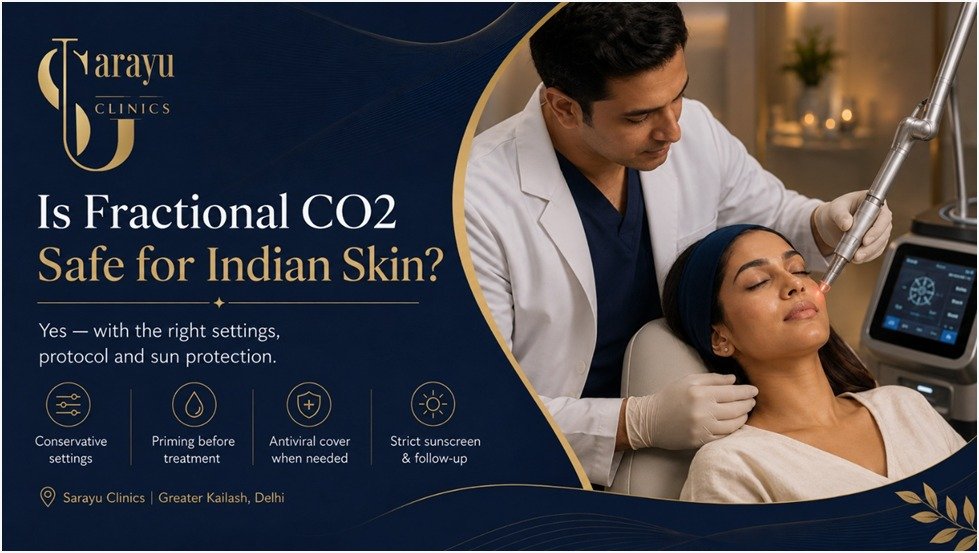
This is the section every Delhi page should have and almost none does. The honest answer is: yes, in the right hands, with the right settings, on the right patient — and the qualifiers are the whole point.
Fractional CO2 carries the highest risk of post-inflammatory hyperpigmentation (PIH) of any resurfacing laser in Fitzpatrick skin types IV and V — which describes the majority of Indian patients. The mechanism is simple: melanocytes in brown skin respond to injury by producing more pigment, and a fractional CO2 laser is, by design, a controlled injury. That is not a reason to avoid the treatment. It is the reason to be selective about who performs it and how.
How we manage it:
- Conservative density and energy. Lower density with adequate depth beats aggressive settings in brown skin. The temptation to ‘get it all in one session’ is precisely what produces PIH.
- Priming before treatment. A course of topical preparation in the weeks beforehand calms melanocytes and lowers the odds of a pigment response.
- Antiviral prophylaxis. Anyone with a cold-sore history is covered before treatment — an ablative laser can trigger a widespread herpes flare across resurfaced skin.
- Longer intervals. Six to eight weeks minimum between sessions, so the skin fully settles before it is challenged again.
- Absolute sun protection. Non-negotiable before and for months after. In Delhi’s UV, sun exposure on healing resurfaced skin is the fastest route to pigmentation.
- A test patch when we are unsure. Especially in deeper skin tones or with a history of pigmenting easily.
Types of Acne We Treat
Beyond severity, the type pattern matters:
- Comedonal acne — blackheads and whiteheads dominate; usually needs retinoid-based topical therapy and extractions.
- Papulopustular acne — the classic mix of red bumps and pustules; combination topical/oral therapy works.
- Nodulocystic acne — deeper, painful, inflammatory; isotretinoin and intralesional cyst injections are the answers.
- Hormonal acne — typically lower-face, jawline and chin; PCOS workup is important; combined OCPs, spironolactone or anti-androgens can help.
- Adult-onset acne — appearing or worsening in your 20s, 30s and 40s; often hormonal or stress-driven, sometimes from skincare.
- Mask acne / mechanical acne — from masks, helmets, sports gear and friction.
- Acne cosmetica — triggered by comedogenic skincare or makeup; switching products is part of the fix.
- Steroid-induced acne — an explosion of small uniform papules from oral or topical steroid use.
- Acne with active scarring / PIH — needs simultaneous treatment of the acne and the marks.
- Fungal acne (Malassezia folliculitis) — looks like acne but doesn’t respond to it; needs antifungals.
When we will tell you not to have it ?
We decline or defer fractional CO2 when: you have active melasma (CO2 commonly worsens it); you have a strong history of PIH or keloid scarring; you have taken isotretinoin recently and healing may be impaired; you have an active skin infection or an uncontrolled cold-sore history; you are pregnant or breastfeeding; you cannot commit to strict sun avoidance during healing; or you simply cannot take 7-10 days of visible recovery and would be happier with a non-ablative option. Saying this before you pay is the difference between an honest clinic and a busy one. In many of these cases MNRF or Morpheus8 achieves much of the collagen benefit with a fraction of the pigment risk — and because we perform those too, our recommendation isn’t steered by which machine we own.
The Procedure: Step by Step
- Consultation and skin typing. Tripathi assesses your scar type or texture concern, your Fitzpatrick skin type, your pigment history and your realistic downtime tolerance — then tells you honestly whether CO2 is the right tool.
- Priming, usually 2-4 weeks before. Topical preparation to reduce pigment risk, plus antiviral cover if indicated, and a strict sunscreen routine begun in advance.
- Numbing on the day. Topical anaesthetic for 45-60 minutes; nerve blocks or light sedation for deeper or full-face treatments. Comfort is planned, not improvised.
- The laser pass. Cleansing, eye shielding, then the fractional pass — typically 20-45 minutes depending on area. You’ll feel heat and prickling; smoke evacuation and cooling run throughout. Settings are chosen for your skin, and recorded so the next session can be adjusted.
- Immediate aftercare. Cooling, a bland occlusive ointment, and clear written instructions. You go home the same day; arrange not to drive if sedated.
- Structured follow-up. Reviewed during the peeling phase and again at 6-8 weeks to assess the collagen response before planning any further session.
Downtime & Recovery: The Honest Day-by-Day
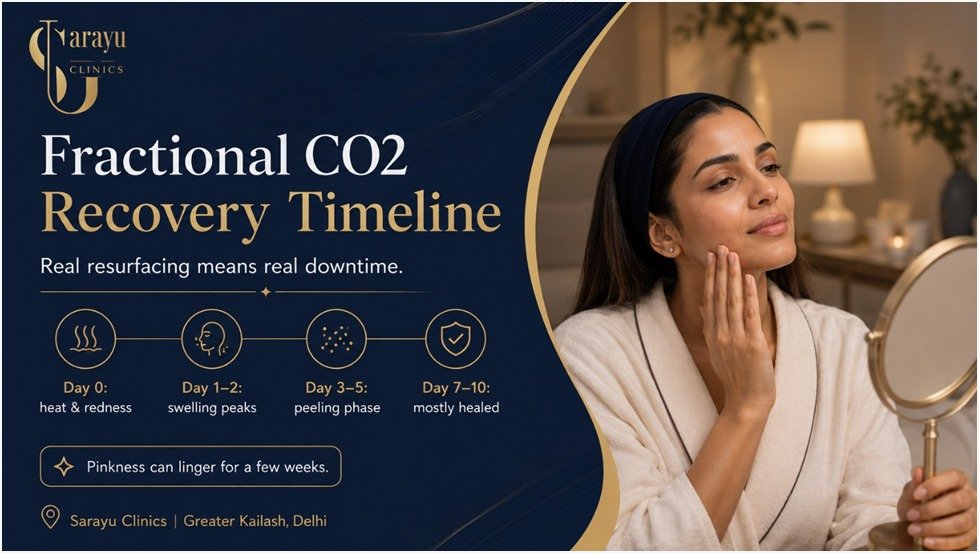
This is where most pages are vague. Here is what genuinely happens, so nothing surprises you.
When | What to expect |
Day 0 | Skin feels like strong sunburn — hot, tight, red. Swelling begins. Ointment on, sun off. |
Day 1–2 | Peak swelling, especially around the eyes. Redness deepens; skin may look bronzed or grid-patterned. This is normal. |
Day 3–5 | Peeling and flaking begin in earnest. Itching is common. Do not pick — this is when scarring and pigment problems are created. |
Day 5–7 | Most peeling completes. New skin underneath is pink and delicate. Many people are presentable with mineral makeup around now. |
Day 7–10 | Back to work and social life for most. Residual pinkness remains, easily covered. |
Weeks 2–6 | Pinkness fades gradually. Skin feels smoother; the texture change is becoming visible. |
Months 2–6 | The real result. Collagen remodelling continues, scars keep softening, firmness improves. |
Plan around it: don’t book fractional CO2 within three weeks of a wedding, shoot or major presentation. And if a clinic tells you this is a lunchtime treatment with a day of redness, they are describing a different, gentler laser — or they are not being straight with you.
Aftercare that actually decides your result
- Do not pick, scrub or exfoliate the peeling skin. Let it shed on its own; interfering is the main cause of scarring and pigment marks.
- Bland occlusive ointment and gentle cleansing only until the new skin is intact. No actives, no retinoids, no acids until cleared.
- SPF 50+, reapplied, from the moment the skin is closed — and for months. Hats and shade too. This single habit decides whether you get pigmentation.
- No gym, sauna, steam or swimming for 7-10 days. Sweat and heat on healing skin invite infection and inflammation.
- Sleep elevated for the first couple of nights to limit swelling, and take the antivirals if prescribed.
- Call us if something changes. Increasing pain, spreading redness, pus, fever or blistering beyond expectation are not normal — tell us early and it is easily managed.
How Much Does Fractional CO2 Laser Cost in Delhi?
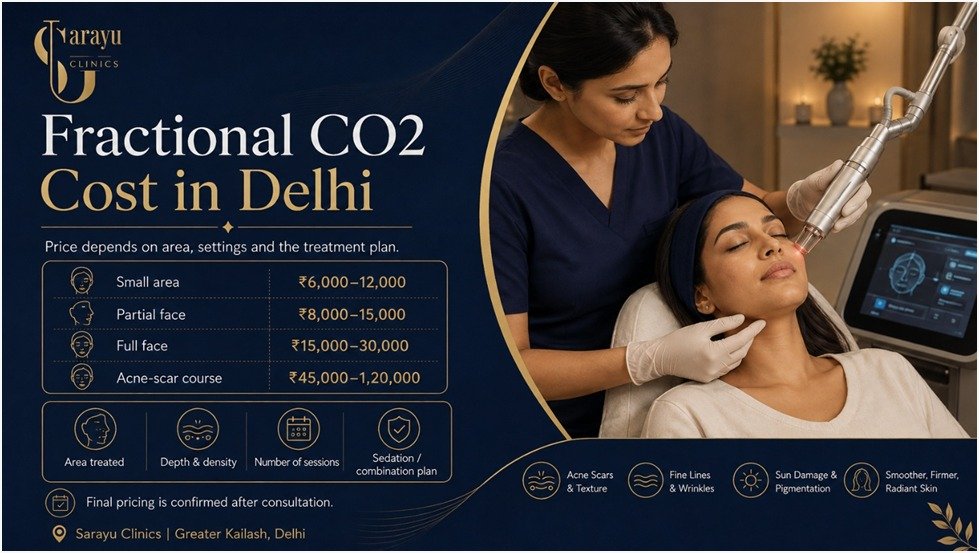
Cost and price for fractional CO2 laser treatment in Delhi vary more than almost any other aesthetic procedure, and the spread is not arbitrary — it reflects real differences in what you’re buying. Here are honest, indicative ranges.
Treatment | Typical cost in Delhi (INR)* |
Consultation & skin assessment | Often nominal — confirmed when you book |
Single small area (e.g. perioral, isolated scar) | Rs 6,000 – Rs 12,000 |
Cheeks / partial face | Rs 8,000 – Rs 15,000 |
Full face — per session | Rs 15,000 – Rs 30,000 |
Full face + neck — per session | Rs 20,000 – Rs 40,000 |
Acne-scar course (3–5 sessions) | Rs 45,000 – Rs 1,20,000 (package pricing usual) |
Stretch marks (per area, per session) | Rs 10,000 – Rs 25,000 |
Benign lesion removal (per lesion) | Rs 2,000 – Rs 8,000 |
Combination scar plan (subcision + CO2 ± TCA CROSS) | Individualised after assessment |
*Indicative ranges only, confirmed at consultation. This may in no way considered as final treatment cost.
What actually moves the price ?
- Area and number of passes. A full face at treatment-grade density costs more than a light single pass — and a light single pass is often what a suspiciously cheap quote actually buys.
- Depth and density settings. Deep scar work takes longer, needs more anaesthesia and carries more clinical responsibility than a superficial refresh.
- Topical numbing is included; nerve blocks or sedation for extensive work add cost.
- Who operates the laser. A physician planning and performing the treatment prices differently from a technician running a preset programme — and in an ablative laser on brown skin, that difference is the safety margin.
- Single session vs package. Scar work is a course; per-session pricing looks cheaper but the honest comparison is total plan cost.
- Device and maintenance. Properly serviced, calibrated systems cost more to run. Deep discounts frequently mean older or poorly maintained equipment.
A word on very cheap CO2 offers
Fractional CO2 is one treatment where the lowest price is a genuine warning. A heavily discounted ‘CO2 laser facial’ usually means one of three things: settings so light that nothing meaningful happens, an untrained operator running a preset on skin that needs individual judgement, or an ageing device. In brown skin, an under-trained operator with an ablative laser is how burns and long-lasting pigmentation happen. Compare on who is treating you, what settings and why, and the total plan cost — not the headline number.
Results Timeline
Timeframe | What you’ll see |
Week 1 | Peeling and redness. No result visible yet — do not judge anything now. |
Weeks 2–4 | New skin settled. Brighter, smoother surface; pinkness fading. |
Weeks 4–8 | Texture visibly improved. Scars beginning to soften. Fine lines reduced. |
Months 2–3 | Collagen remodelling in full effect — the point where most people say it was worth it. |
Months 3–6 | Continued firming and scar remodelling. Peak result. Next session planned if needed. |
Beyond 6 months | Results hold for years with sun protection; ageing continues, so occasional maintenance helps. |
Sessions needed: 1-3 for general resurfacing and photoageing; 3-5 for deep acne scarring, spaced 6-8 weeks apart. Scar work is a project, not an appointment.
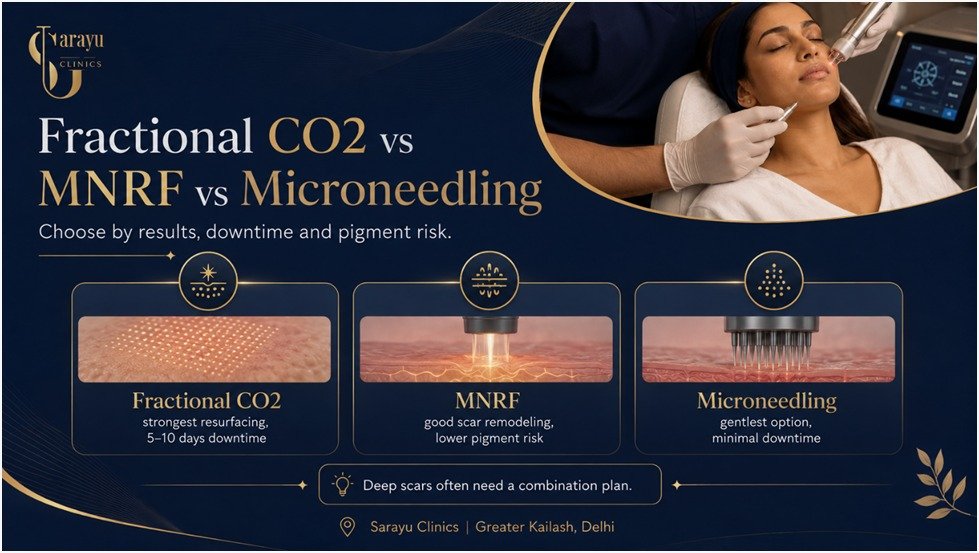
Fractional CO2 vs MNRF vs Er:YAG vs Microneedling
Choosing between resurfacing options is really a trade between how much change you want and how much downtime you can accept.
| Fractional CO2 | MNRF / Morpheus8 | Er:YAG | Microneedling |
Type | Ablative laser | RF microneedling | Ablative laser (gentler) | Mechanical |
Strength | Strongest | Strong | Moderate | Mild |
Downtime | 5–10 days | 1–3 days | 3–5 days | 1–2 days |
PIH risk (brown skin) | Highest | Low | Moderate | Low |
Best for | Deep scars, photoageing | Scars + laxity, safer in IV–V | Superficial texture | Mild texture, maintenance |
Sessions | 1–3 (3–5 scars) | 3–4 | 2–4 | 4–6 |
The honest read: if you have deep scarring and can take the downtime, fractional CO2 gives the most change per session. If you pigment easily, cannot disappear for a week, or want a gentler ladder, MNRF achieves much of the collagen benefit with 24-72 hours of redness and far less pigment risk — and microneedling is the gentlest rung. Deep scars are frequently best treated by combining approaches (subcision for tethered scars, then CO2) rather than by any single device.
How to Choose the Best Clinic for Fractional CO2 Laser in Delhi ?
Rather than tell you we’re the best, here is what genuinely separates a safe fractional CO2 provider from a risky one. Use it on us and on anyone else you consult.
- Ask who operates the laser — and whether they are a doctor. This is an ablative device that wounds skin. Settings should be a clinical decision, not a preset selected by a technician.
- Ask what settings they’ll use on your skin, and why. A good answer references your Fitzpatrick type, your pigment history and your scar type. A vague answer is the answer.
- Ask about PIH risk directly. If a clinic tells you there’s no pigmentation risk in Indian skin, they are either uninformed or not being straight. The right response is a candid risk discussion plus a prevention protocol.
- Ask what the downtime really is. If you hear ‘a day or two’, they’re describing a different laser or underselling this one.
- Ask whether they offer alternatives. A clinic that only owns a CO2 laser will recommend CO2. One that also offers MNRF, Morpheus8 and microneedling can route you honestly.
- Ask about priming, antiviral cover and follow-up. A clinic with a real protocol will describe it without hesitating.
- Check the total plan cost, not the session price. And be wary of steep discounts on an ablative laser.
Why Choose Sarayu Clinics ?
Fractional CO2 is a surgeon’s instrument as much as a beauty device — it wounds skin deliberately to rebuild it. At Sarayu Clinics it is planned and performed by facial plastic and maxillofacial surgeon Dr. Adarsh Tripathi, alongside co-founder Dr. Nidhi Bhatia.
- A surgeon setting the parameters. Depth, density and passes chosen for your skin and scar type, recorded and adjusted between sessions.
- Indian-skin protocols as standard. Conservative settings, pre-treatment priming, antiviral cover, longer intervals and strict photoprotection — because PIH prevention is the treatment, not an afterthought.
- Honest downtime, stated upfront. You’ll know what days three to seven look like before you book, not during.
- We’ll decline when we should. Active melasma, keloid tendency, recent isotretinoin or an impossible schedule all get a straight answer and a better alternative.
- Every rung of the ladder in one place. CO2, MNRF, Morpheus8, microneedling, peels and surgical scar revision — so the recommendation follows your skin, not our inventory.
- Scars treated as combination problems. Subcision, TCA CROSS and surgical revision alongside the laser, because deep scars rarely answer to one tool.
Medical Review & Trusted Sources
This page is for general information and is medically reviewed by the team at Sarayu Clinics under Dr. Adarsh Tripathi. It is not a substitute for an in-person clinical assessment. Fractional CO2 laser resurfacing is an ablative procedure with real downtime and, in darker skin types, a meaningful risk of post-inflammatory hyperpigmentation; it should be performed only after individual assessment by a qualified physician. Sources:
How to Reach Us:
Phone: +91 9289111081 , +91 9289111082
Email: sarayuinquiries@gmail.com
Sarayu Clinics website: www.sarayuclinics.com
Facebook: https://www.facebook.com/sarayuclinic
Instagram: https://www.instagram.com/sarayuclinics/
Dr. Adarsh Tripathi’s profile: https://dradarshtripathi.com/
Online Booking: Visit our website https://sarayuclinics.com/contact-us/ to schedule appointments conveniently.
How much does fractional CO2 laser treatment cost in Delhi?
Indicative Delhi ranges: Rs 6,000-12,000 for a small area or isolated scar, Rs 8,000-15,000 for cheeks or partial face, Rs 15,000-30,000 for a full face per session, and Rs 20,000-40,000 for face and neck. A full acne-scar course of three to five sessions typically runs Rs 45,000-1,20,000 with package pricing. Price varies with the area treated, the density and depth of settings, anaesthesia, and crucially who performs it. Judge on total plan cost and on the operator’s qualification rather than the headline session price.
What is the price difference between clinics, and why is it so wide?
Because you aren’t always buying the same thing. A low price often means a single light pass at settings too gentle to do much, a technician running a preset rather than a physician choosing parameters, or an older device. Higher pricing usually reflects physician-planned settings, proper anaesthesia, a maintained and calibrated system, priming and follow-up protocols. On an ablative laser used on brown skin, that gap is the safety margin — which is why the cheapest quote is a genuine warning sign here.
Is fractional CO2 laser safe for Indian skin?
Yes, with the right precautions — but it carries the highest post-inflammatory hyperpigmentation risk of any resurfacing laser in Fitzpatrick IV-V skin, which describes most Indian patients. Melanocytes in brown skin respond to injury by producing more pigment, and this laser is a controlled injury by design. Safety comes from conservative density and energy, pre-treatment priming, antiviral prophylaxis where indicated, longer intervals between sessions, and absolute sun protection during healing. Any clinic that tells you there’s no pigmentation risk is not being straight with you.
How much downtime does fractional CO2 laser really need?
Five to ten days of visible recovery, not one or two. Expect sunburn-like heat and redness on day zero, peak swelling on days one to two, active peeling from days three to five, and mostly healed but pink skin by days five to seven. Most people return to work and social life between days seven and ten, with residual pinkness that makeup covers, fading over two to six weeks. Don’t schedule it within three weeks of a wedding, shoot or major event.

FAQ's : People Generally Ask
How many sessions will I need?
One to three sessions for general resurfacing, photoageing and texture; three to five for deep acne scarring. Sessions are spaced six to eight weeks apart so the skin fully settles and the collagen response can be assessed before the next. Deep scar work is best thought of as a project over several months rather than a single appointment, and is often combined with subcision or TCA CROSS for tethered or ice-pick scars.
Does fractional CO2 laser hurt?
It’s managed rather than painless. Topical anaesthetic is applied for 45 to 60 minutes beforehand, and nerve blocks or light sedation are used for deeper or full-face treatments. During the pass you’ll feel heat and prickling. Afterwards the skin feels like a strong sunburn for a day or two, which is expected and settles with cooling and ointment.
Can fractional CO2 laser treat melasma or pigmentation?
No — and this matters. CO2 is a texture and scar tool, not a pigment tool, and used on melasma it frequently makes it worse by provoking the very melanocytes that cause the problem. Pigmentation and melasma belong on a different pathway, usually topicals, gentle peels and Q-switched laser toning. If a clinic offers you CO2 for melasma, ask why.
What's the difference between fractional CO2 and MNRF or Morpheus8?
CO2 is an ablative laser that vaporises microscopic columns of skin — the strongest option, with five to ten days of downtime and the highest pigment risk in brown skin. MNRF and Morpheus8 use radiofrequency delivered through microneedles, achieving much of the collagen and scar benefit with only one to three days of redness and considerably lower PIH risk. If you have deep scarring and can take the downtime, CO2 gives more change per session. If you pigment easily or can’t disappear for a week, MNRF is often the smarter choice.
Who should not have fractional CO2 laser?
People with active melasma, a strong history of post-inflammatory hyperpigmentation or keloid scarring, recent isotretinoin use, active skin infection or uncontrolled cold sores, and those who are pregnant or breastfeeding. It’s also wrong for anyone who cannot commit to strict sun avoidance while healing or cannot take seven to ten days of visible recovery. In most of these situations a non-ablative alternative delivers a meaningful result with far less risk.
How long do the results last?
The resurfacing itself is long-lasting — years, with sensible sun protection — because you’ve replaced damaged skin and rebuilt collagen. Scar improvement is essentially permanent. What continues is normal ageing, so the skin keeps changing over time and some people choose an occasional maintenance session. Results also keep improving for three to six months after treatment as collagen remodelling continues, so the three-month result is better than the three-week one.