
Depigmentation & Skin Whitening Treatment in Delhi
- Home
- Page Title
Depigmentation & Skin Whitening Treatment in Delhi
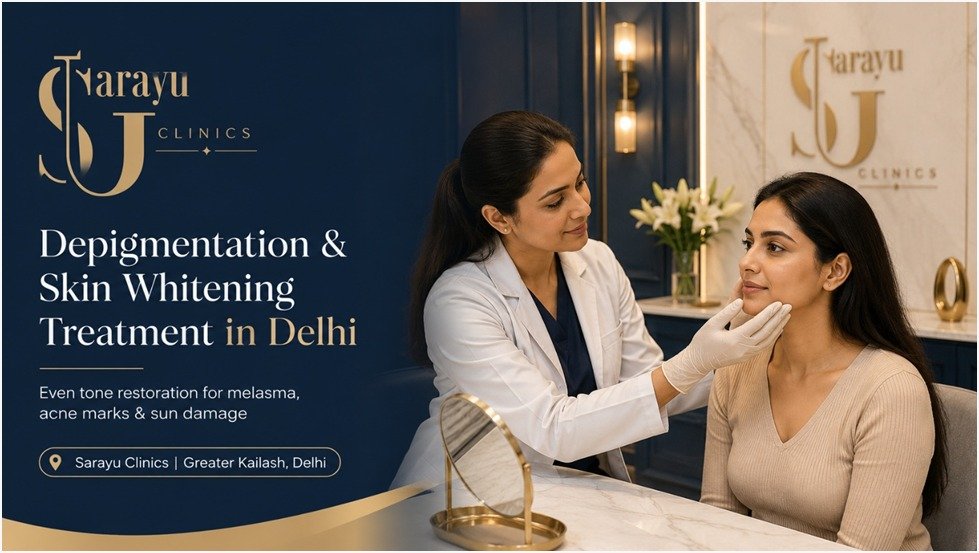
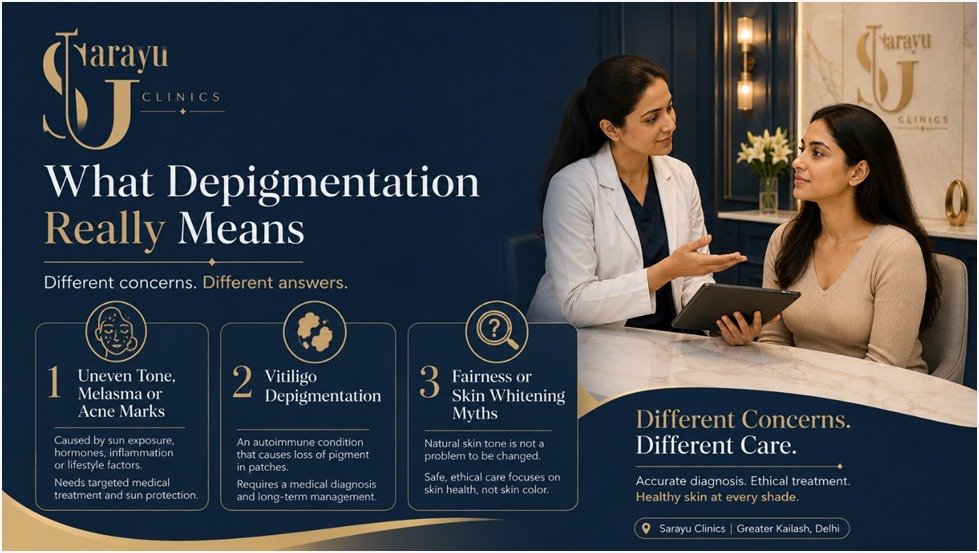
Three different people type these words into Google, and they want three different things. One has melasma or dark patches and wants an even complexion. One has extensive vitiligo and is researching a permanent medical procedure that removes the pigment they have left. And one has perfectly healthy brown skin and has been told, by an advertisement or a relative or the whole weight of the culture, that lighter would be better.
Those three people need three completely different answers, and most clinic pages give all of them the same one. So let us be clear from the start about what this page is: an honest account of what these words mean, which treatments genuinely work, which are dangerous, which are no longer legal to advertise in India — and what we will and will not do at this clinic.
At Sarayu Clinics in Greater Kailash, pigment concerns are assessed by facial plastic and maxillofacial surgeon Dr. Adarsh Tripathi. We treat pigmentary conditions and we restore even tone. We do not sell fairness, and the reasons are medical and legal as much as they are ethical.
The short answer : ‘Depigmentation’ has three meanings. ONE — reducing dark patches (what most people want): melasma, post-acne marks, sun damage and uneven tone, treated with prescription topicals, gentle chemical peels, pigment-targeting laser toning and rigorous sun protection. This restores your own even colour. TWO — clinical depigmentation therapy: permanent removal of remaining pigment using monobenzone (MBEH), reserved for extensive vitiligo affecting more than half the body where repigmentation has failed. It destroys melanocytes, is irreversible, and demands lifelong sun protection. THREE — skin whitening for fairness: making healthy skin lighter than its natural colour. We do not offer this. Nor do we offer glutathione drips or skin-lightening injections — in May 2026 CDSCO clarified that cosmetic products may not be administered by injection, and no regulator anywhere has approved IV glutathione for skin whitening. In Delhi, honest pigment treatment costs roughly Rs 1,500–12,000 per session depending on method, with topical protocols from about Rs 1,500 a month.
What Do Depigmentation and Skin Whitening Actually Mean?
The words get used interchangeably in advertising, but clinically they describe very different things. Here is the distinction laid out plainly.
Pigment reduction | Clinical depigmentation | Skin whitening (fairness) | |
Goal | Even out dark patches | Remove remaining pigment permanently | Lighten healthy skin beyond natural colour |
Who it’s for | Melasma, PIH, sun damage, tanning | Extensive vitiligo (>50%), repigmentation failed | Nobody, medically |
Direction | Dark spots back to YOUR baseline | Everything to white, permanently | Below your natural baseline |
Reversible | Yes | No — melanocytes destroyed | Often causes lasting damage |
Offered here | Yes | Assessed and counselled honestly | No — see below |
What We Do — and What We Will Not Do ?
We treat pigmentary conditions. If you have melasma, we treat the melasma. If acne left dark marks, we treat the marks. If years of Delhi sun have mottled your tone, we even it out. The goal in every case is to return your skin to its own healthy, uniform colour — not to move it along a scale toward pale.
What we do not do is make healthy, evenly-toned brown skin permanently lighter for the sole reason that lighter is considered more desirable. That is not a squeamish position; it is a clinical one. The products and procedures sold for that purpose cause real, documented harm, and the honest work of this section is to explain what that harm looks like so you can recognise it.
The three harms of the fairness market
- Exogenous ochronosis — a paradoxical blue-black darkening and thickening of the skin caused by prolonged, unsupervised hydroquinone use. It is stubborn, distressing and difficult to treat. Documented cases of exactly this are why CDSCO moved hydroquinone to Schedule H of the Drugs and Cosmetics Rules in 2019, making it prescription-only in India. If a shop sells it to you over the counter, that is not a bargain — it is a red flag.
- Topical steroid damage — many combination fairness creams contain potent corticosteroids that are never declared. Prolonged use thins the skin, causes steroid-induced rosacea and acne, and produces rebound pigmentation far worse than what you started with when stopped.
- Mercury toxicity — mercury remains present in illegal and imported lightening creams. The World Health Organization has flagged mercury-containing skin-lightening products as a source of serious kidney and neurological damage, and case reports link them to severe skin reactions too. This is not a cosmetic risk; it is a systemic poisoning risk.
If you are already using something and worried
Bring it in. A great deal of the pigmentation we treat in Delhi was caused, or made significantly worse, by an unlabelled fairness cream. If you have been using something and your skin has darkened, thinned, flushed easily or broken out, stopping abruptly can cause a rebound flare — it needs to be tapered and managed. We will look at what you have, tell you honestly what is in that category of product, and help you come off it safely. There is no lecture in this, and no judgement. It is one of the most common things we see.
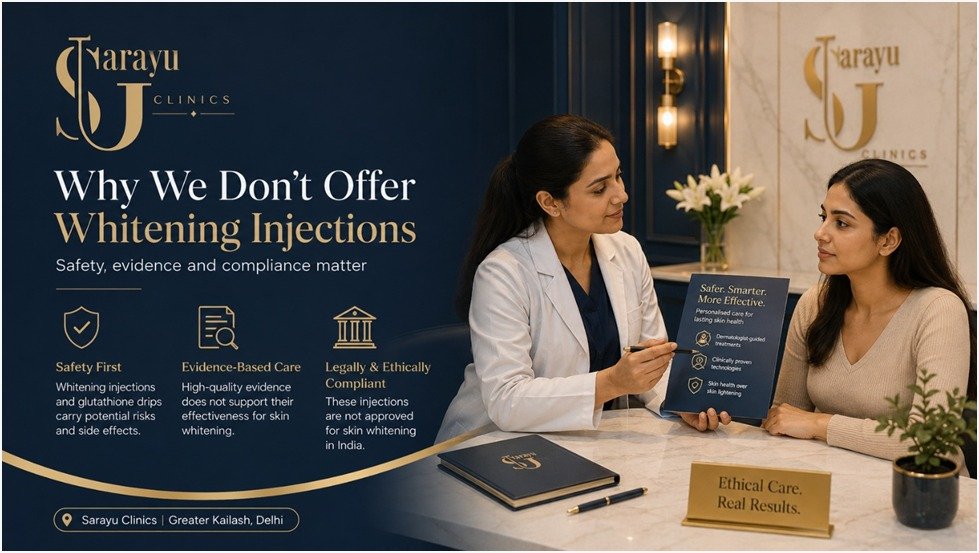
Why We Don't Offer Glutathione Drips or Whitening Injections ?
This deserves its own section because it is currently the most heavily marketed ‘skin whitening treatment in Delhi’ — and because the legal position in India changed recently.
In May 2026, the Central Drugs Standard Control Organisation (CDSCO) issued a public notice clarifying that cosmetic products are not permitted to be administered through injection, and cannot be promoted or used for treatment purposes, under the Drugs and Cosmetics Act, 1940. Reporting on the notice specifically identified glutathione drips, skin-lightening injections and IV ‘glow’ therapies as the practices in question. Clinics offering them face licensing and compliance consequences.
Beyond the legal position, the evidence has never supported it:
- No regulator anywhere has approved IV glutathione for skin whitening. The US FDA has issued warning letters to clinics and compounding pharmacies marketing it for lightening; the Philippines FDA issued a public advisory against it; and the Indian dermatology consensus published in IJDVL reached the same conclusion.
- The risks are real and systemic. Anything injected into a vein circulates through your whole body — your liver metabolises it, your kidneys clear it. Reported adverse effects associated with IV glutathione for lightening include severe skin reactions, kidney and liver dysfunction and thyroid effects, and a death in the Philippines was linked to complications following IV glutathione and stem-cell therapy.
- The premise is wrong anyway. Even setting aside law and safety, systemic lightening treats your natural colour as a defect. We would rather treat the melasma that is actually bothering you.
If a clinic in Delhi is offering you a whitening drip today, it is fair to ask them how they are reconciling that with the CDSCO notice. If you want the evidence for yourself, we have linked the primary sources at the foot of this page.
What Actually Works: Treatments We Offer ?
The good news is that the treatable version of this problem — uneven tone, dark patches, melasma, sun damage — responds well to unglamorous, evidence-based care. The full framework, including how deep your pigment sits and why that decides everything, is on our pigmentation treatment in Delhi page. In summary:
- Prescription topical protocols — tyrosinase inhibitors and pigment-modulating agents, supervised, in courses with breaks rather than indefinitely.
- Gentle chemical peels — the right acid at the right strength for Indian skin, in a graded course. Aggressive peeling causes the pigment it claims to treat.
- Q-switched laser toning — pigment-targeting laser such as Hollywood Spectra, used conservatively and only where indicated.
- Oral therapy where appropriate — for stubborn melasma, prescribed and monitored, after screening.
- Microneedling for pigment-with-texture — see microneedling.
- Rigorous daily photoprotection — the least exciting and most important item on this list. Nothing else holds without it.
For melasma specifically — the commonest and most stubborn presentation — see melasma treatment in Delhi.
Monobenzone and Vitiligo Depigmentation (The Clinical Meaning)
For completeness, the true clinical meaning of the word — handled with the seriousness it needs, because it is one of the few genuinely irreversible decisions in this field.
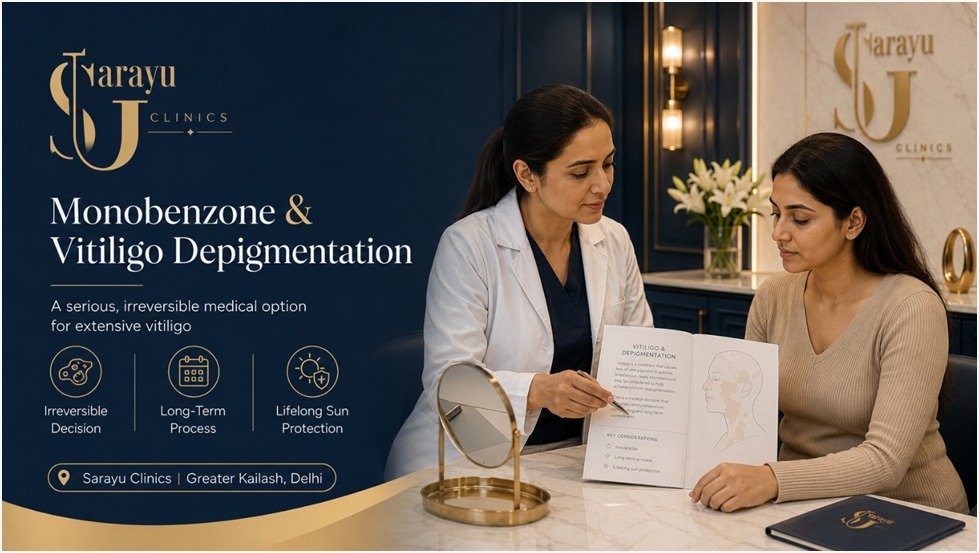
Depigmentation therapy is chosen in a specific and difficult situation: vitiligo affecting more than about half the body, where attempts to restore colour have failed, and where living with two colours has become more distressing than becoming uniformly one. Rather than fighting to repigment small remaining islands of normal skin, the remaining pigment is deliberately and permanently removed so the whole skin matches.
The agent is monobenzyl ether of hydroquinone — monobenzone, or MBEH. Unlike a brightening cream, it does not suppress melanin: it destroys the melanocytes themselves, permanently. It takes many months to a couple of years, can be patchy, may partially repigment with sun exposure, and commits the person to lifelong strict sun protection — skin without melanin has lost its natural UV defence. It is a serious medical treatment for a narrow indication, and it should never be used to lighten normal skin.
How this decision should be made ?
Slowly, and with support. Before starting, a person should fully understand that it is permanent; that it is slow and needs maintenance; that the result may be uneven; that lifelong sun protection is required both to hold it and to guard against skin cancer; and that becoming uniformly white carries psychological, social and cultural weight that deserves to be talked through with family and often with a mental health professional. This is never a treatment anyone should be talked into or sold. Where medical management of vitiligo itself is what you need, we will point you toward appropriate specialist care rather than over-claim a chronic-disease service.
Benefits of Getting This Right
- A correct diagnosis first — which of the three meanings applies to you, and which specific condition you actually have.
- Even tone, safely restored — a gradual return to your own uniform colour without the rebound darkening aggressive treatment causes.
- No hidden steroids, no unsupervised hydroquinone, no mercury — prescription-grade, supervised care instead of a shelf product.
- Nothing that falls foul of the current regulatory position — no injectable cosmetic ‘whitening’ treatments.
- Damage from previous products assessed and reversed where possible — including safe tapering off steroid-containing creams.
- Honest counsel on monobenzone — if clinical depigmentation is genuinely your situation.
- A surgeon’s read of the whole face — pigment rarely travels alone; it comes with texture, laxity and structure.
Areas We Treat
- Face — cheeks, forehead, upper lip, chin (melasma, PIH, sun damage)
- Under-eyes — pigmentary dark circles
- Neck — uneven tone, tanning, poikiloderma
- Underarms, inner thighs and intimate areas — friction and hormonal darkening, treated gently
- Elbows, knees and knuckles — thickened, darkened skin
- Hands and forearms — sun pigmentation and lentigines
- Back, shoulders and arms — post-acne pigmentation
Conditions & Concerns We Treat
- Melasma — the most common and most delicate; hormonally driven and chronic.
- Post-inflammatory hyperpigmentation — marks left by acne, injury or over-aggressive prior treatment.
- Sun damage, tanning and lentigines — cumulative UV, a heavy factor in Delhi.
- Uneven tone and dullness — the general case.
- Periorbital pigmentation — the pigmentary kind of dark circles.
- Exogenous ochronosis and steroid-damaged skin — caused by fairness products; needs the product stopped and managed, not more of it.
- Extensive vitiligo where depigmentation is being considered — assessed with appropriate seriousness.
The Process: Step by Step
- Diagnosis, and which meaning applies. Tripathi establishes whether you want pigment reduced or removed, which condition you have, and how deep the pigment sits. A Wood’s lamp or dermoscopy helps read depth.
- A frank conversation about goals. We establish that the target is even, healthy, natural-coloured skin. If what is being sought is fairness for its own sake, we say honestly that it is not something we treat, and why.
- Review of anything you’re already using. Bring your products. Unlabelled creams are stopped or tapered safely, because abrupt withdrawal from a steroid-containing cream causes a rebound flare.
- Priming and sun protection first. A topical protocol and rigorous SPF begin before any procedure — they reduce the risk of the treatment itself causing pigmentation.
- The graded plan. Topicals, then gentle peels, then pigment laser only where indicated — escalating slowly and watching how your skin responds.
- Review and long-term maintenance. Regular review, realistic expectations about a chronic condition, and lifelong sun protection.
Downtime & Aftercare
- Topical protocols: no downtime; possible mild irritation as the routine beds in. Results are gradual, over weeks to months.
- Chemical peels: mild flaking for a few days in the superficial case.
- Laser toning: little to no downtime; a course is needed and over-treatment risks worsening pigment.
- Microneedling: redness for 1–2 days.
- SPF 50+ every single morning, indefinitely. In pigment treatment, sunscreen is not aftercare — it is part of the treatment. Nothing holds without it.
- Stop any fairness cream, steroid cream or unregulated lightening product under supervision, not abruptly.
How Much Does Depigmentation Treatment Cost in Delhi?
The cost and price of depigmentation treatment in Delhi depend entirely on which condition you have and which methods it needs — this is a course of care, not a single procedure. Honest, indicative ranges:
Treatment | Typical cost in Delhi (INR)* |
Consultation, diagnosis & Wood’s lamp assessment | Often nominal — confirmed when you book |
Prescription topical protocol (per month) | Rs 1,500 – Rs 5,000 |
Chemical peel for pigment (per session) | Rs 1,500 – Rs 6,000 |
Q-switched laser toning (per session) | Rs 3,000 – Rs 12,000 |
Laser toning — course of 6+ | Package pricing after assessment |
Microneedling for pigment with texture (per session) | Rs 5,000 – Rs 15,000 |
Combination pigment plan (topicals + peels + laser) | Individualised after assessment |
Vitiligo depigmentation — monobenzone (per month) | Rs 3,000 – Rs 8,000, over many months |
Skin whitening for fairness | Not offered — see the sections above |
Glutathione drips / whitening injections | Not offered — see the CDSCO section above |
*Indicative ranges only, confirmed at consultation. Pigment care is a course rather than a session — compare on total plan cost and realistic timelines, not a headline price. And be wary of any quote for a ‘permanent whitening’ package: it is promising something that neither medicine nor, now, the regulator supports.
Results Timeline
Timeframe | What to expect |
Weeks 1–4 | Skin settles into the topical routine. Possible mild irritation. No dramatic change yet. |
Month 2–3 | First honest lightening of superficial pigment. Melasma responds more slowly. |
Month 3–6 | Clear, photographable evening of tone with a consistent regimen. |
Month 6–12 | Near the realistic endpoint for most everyday pigment. Maintenance begins. |
Beyond 12 months | Held with maintenance and daily sun protection. Melasma is managed, not cured. |
Pigment reduction in Indian skin is a marathon. Aggressive treatment aimed at a fast result is precisely how post-inflammatory hyperpigmentation and rebound darkening are produced — the melanocyte answers injury by making more pigment. Anyone promising to clear your melasma in two sessions is describing a risk, not a result.

Comparison: What's Safe, What Isn't
Approach | Status | Verdict |
Prescription topicals, supervised | Standard of care | Safe and effective in courses |
Gentle chemical peels | Standard of care | Safe in graded courses for Indian skin |
Q-switched laser toning | Standard of care | Effective; over-treatment worsens pigment |
Over-the-counter fairness creams | Often unlabelled | Risk of steroids, mercury, ochronosis |
Unsupervised hydroquinone | Schedule H since 2019 | Prescription-only in India for good reason |
IV glutathione / whitening drips | No regulator approves for whitening | Not offered — see CDSCO May 2026 |
Monobenzone (MBEH) | Approved for extensive vitiligo only | Permanent; never for cosmetic lightening |
How to Choose the Best Clinic for Depigmentation Treatment in Delhi ?
Rather than claim to be the best, here is what actually separates a safe clinic from a risky one in this specific category. Use it on us and everywhere else.
- Do they diagnose before they prescribe? Melasma, PIH and sun damage need different approaches. A product recommended before an examination is a sale, not a treatment.
- Do they offer injectable ‘whitening’? Given the CDSCO position on injectable cosmetics, a clinic still advertising glutathione drips is telling you something about how it handles compliance.
- Will they name what’s in what they give you? Unlabelled compounded creams are how steroid damage happens. You are entitled to know every active ingredient.
- Do they set realistic timelines? Anything promising dramatic lightening in two sessions is either ineffective or unsafe.
- Do they talk about sun protection seriously? A clinic that treats SPF as an afterthought will not hold your result.
- Do they frame the goal as EVEN tone or as FAIR skin? The language tells you what you are actually buying.
- Will they say no? A clinic willing to decline treatment is one you can trust with the treatments it does recommend.
Why Choose Sarayu Clinics ?
This is a page on which we have spent as many words on what we decline as on what we offer. That is the practice. Pigment is assessed and treated by facial plastic and maxillofacial surgeon Dr. Adarsh Tripathi, alongside co-founder Dr. Nidhi Bhatia.
- We tell you which ‘depigmentation’ you actually want. Reduction or removal — opposite treatments, resolved before anything is prescribed.
- We treat conditions, not skin colour. Even, healthy, natural tone is the goal.
- No injectable ‘whitening’, on principle and on the law. Consistent with the current CDSCO position on cosmetic injectables.
- Prescription-grade, supervised, disclosed. You will know what is in everything we give you.
- We repair fairness-product damage. Ochronosis, steroid-thinned skin, rebound pigmentation — stopped safely and treated.
- Gentle, graded protocols for Indian skin. Because aggression is answered with more pigment.
Frequently Asked Questions
How much does depigmentation treatment cost in Delhi?
It depends on your condition and the methods needed, because this is a course of care rather than one procedure. Indicative Delhi ranges: prescription topical protocols Rs 1,500-5,000 a month; chemical peels Rs 1,500-6,000 per session; Q-switched laser toning Rs 3,000-12,000 per session; microneedling Rs 5,000-15,000. Monobenzone therapy for extensive vitiligo runs roughly Rs 3,000-8,000 a month over many months. Judge on total plan cost and realistic timelines rather than a headline price.
What is the price of skin whitening treatment in Delhi?
We should answer this honestly rather than quote a number. There is no safe, legitimate treatment that permanently lightens healthy skin below its natural colour, so there is no price we can quote for it. What we do price is treatment of pigmentary conditions — melasma, post-acne marks, sun damage, uneven tone — which typically runs Rs 1,500-12,000 per session depending on method. If a clinic quotes you a package price for permanent whitening, ask exactly what product or procedure they are proposing and whether it is approved for that use.
Is glutathione injection safe for skin whitening?
No regulator anywhere has approved intravenous glutathione for skin whitening — not the US FDA, which has issued warning letters to clinics marketing it that way, not the Philippines FDA, which issued a public advisory, and not the Indian dermatology consensus published in IJDVL. Reported adverse effects include severe skin reactions and kidney, liver and thyroid dysfunction. Importantly for Delhi patients, CDSCO issued a public notice in May 2026 clarifying that cosmetic products may not be administered by injection under the Drugs and Cosmetics Act. We do not offer glutathione drips or whitening injections.
What does depigmentation actually mean?
It has three meanings. In everyday use it means reducing dark patches — melasma, acne marks, sun spots — to restore even tone, which is really pigmentation reduction. In clinical dermatology it means the deliberate, permanent removal of remaining pigment in someone with extensive vitiligo, using monobenzone, so that a mostly-white body becomes uniformly so. And in advertising it is often used to mean skin whitening for fairness. The first is what most people want and what we treat; the second is a serious medical decision; the third we do not offer.
Can you make my skin permanently fairer?
No, and no one safely can. We treat pigmentary conditions and restore your skin’s own even tone — that is a genuine and achievable result. Making healthy skin permanently lighter than its natural colour is a different proposition, and the products sold for it cause documented harm: exogenous ochronosis from unsupervised hydroquinone, damage from undeclared steroids, and mercury toxicity that the WHO has flagged as a cause of kidney and neurological injury. We would rather treat the melasma or the marks that are actually bothering you.
Why did my skin get darker after using a fairness cream?
Two common reasons. Exogenous ochronosis — a paradoxical blue-black darkening from prolonged unsupervised hydroquinone use, which is precisely why CDSCO made hydroquinone prescription-only in India in 2019. Or rebound pigmentation after stopping a cream containing undeclared corticosteroids, which suppress pigment temporarily and then let it return worse. If your pigment worsened while using a product, the product is very likely the cause — bring it in, and stop it under supervision rather than abruptly.
Is hydroquinone banned in India?
Not banned, but restricted. In 2019 CDSCO moved hydroquinone to Schedule H of the Drugs and Cosmetics Rules, meaning it cannot legally be sold without a doctor’s prescription. The change followed documented cases of exogenous ochronosis from prolonged unsupervised use. It remains a legitimate and effective prescription treatment for pigmentation when used in supervised courses with breaks — the problem was never the molecule, it was indefinite unsupervised use.
What’s the difference between this page and your pigmentation treatment page?
This page explains what the words ‘depigmentation’ and ‘skin whitening’ actually mean, which treatments are safe and legal, and what we will and won’t do. Our pigmentation treatment page covers the clinical detail — how deep your pigment sits, the full treatment menu, and how each condition is approached. If you already know you have melasma or post-acne marks and want the treatment detail, go there. If you are trying to work out what you are even looking for, stay here.
Can depigmentation treatment help my melasma?
If you mean reducing the dark patches, yes — melasma is treated by suppressing excess melanin with prescription topicals, gentle chemical peels, careful laser toning and rigorous sun protection. But melasma is chronic and hormonally driven, responds slowly, and is easily worsened by aggressive treatment, so it is managed rather than cured. What you do not want for melasma is the clinical, monobenzone sense of depigmentation, which is for extensive vitiligo and entirely inappropriate here.
Should I consider depigmentation for my vitiligo?
Only in specific circumstances and after careful thought. It is considered when vitiligo is extensive — generally more than half the body — treatments to restore colour have not worked, and living with two colours has become more distressing than becoming uniformly white. It is permanent and irreversible, takes a year or more, demands lifelong sun protection because skin without melanin has no UV defence, and carries real psychological and social weight. It should be discussed thoroughly, often with family and a mental health professional, and never rushed or sold. For most people with vitiligo the goal is repigmentation, not depigmentation.
Medical Review & Sources
This page is for general information and is medically reviewed by the team at Sarayu Clinics under Dr. Adarsh Tripathi. It is not a substitute for an in-person clinical assessment. This clinic does not provide skin-whitening treatment for fairness, nor injectable cosmetic lightening treatments. Monobenzone depigmentation is an irreversible medical treatment reserved for extensive vitiligo. Sources:
- CDSCO public notice on cosmetic injectables — reporting, May 2026
- World Health Organization — Mercury in skin lightening products
- American Academy of Dermatology — How to fade dark spots in darker skin tones
- DermNet — Depigmentation therapy for vitiligo
- Case report: mercury-containing skin-whitening cream — PMC
How to Reach Us:
Phone: +91 9289111081 , +91 9289111082
Email: sarayuinquiries@gmail.com
Sarayu Clinics website: www.sarayuclinics.com
Facebook: https://www.facebook.com/sarayuclinic
Instagram: https://www.instagram.com/sarayuclinics/
Dr. Adarsh Tripathi’s profile: https://dradarshtripathi.com/
Online Booking: Visit our website https://sarayuclinics.com/contact-us/ to schedule appointments conveniently.