
HIFU Treatment in Delhi
Advanced HIFU Treatment in Delhi | Skin Tightening & Face Lift
If you’ve started catching the early softening of your jawline in photos, or noticing that your neck doesn’t hold the way it used to, you’re probably not yet in facelift territory — but creams and facials are no longer enough either. HIFU is built for exactly that in-between stage: a non-surgical, no-downtime way to tighten skin and lift the face by triggering your own collagen, with results that build over a few months and last over a year.
At Sarayu Clinics in Greater Kailash, HIFU is performed under the supervision of facial plastic and maxillofacial surgeon Dr. Adarsh Tripathi. That matters more than it sounds: the same anatomy that a surgeon thinks about during a facelift is the anatomy HIFU energy targets. Having that level of expertise plan your treatment means safer placement, better lift, and an honest conversation about when HIFU is genuinely enough — and when it isn’t.
The short answer : HIFU (High-Intensity Focused Ultrasound) delivers focused ultrasound energy to specific depths under the skin (typically 1.5, 3.0 and 4.5mm), heating the SMAS layer — the same fibrous layer surgeons tighten in a facelift — without breaking the skin’s surface. The heat triggers collagen contraction immediately and new collagen growth over 2–6 months. One session is enough for most people; results last 12–18 months on average. It works best for mild-to-moderate skin laxity in your late 30s to 50s. Severe sagging needs surgery, not HIFU.
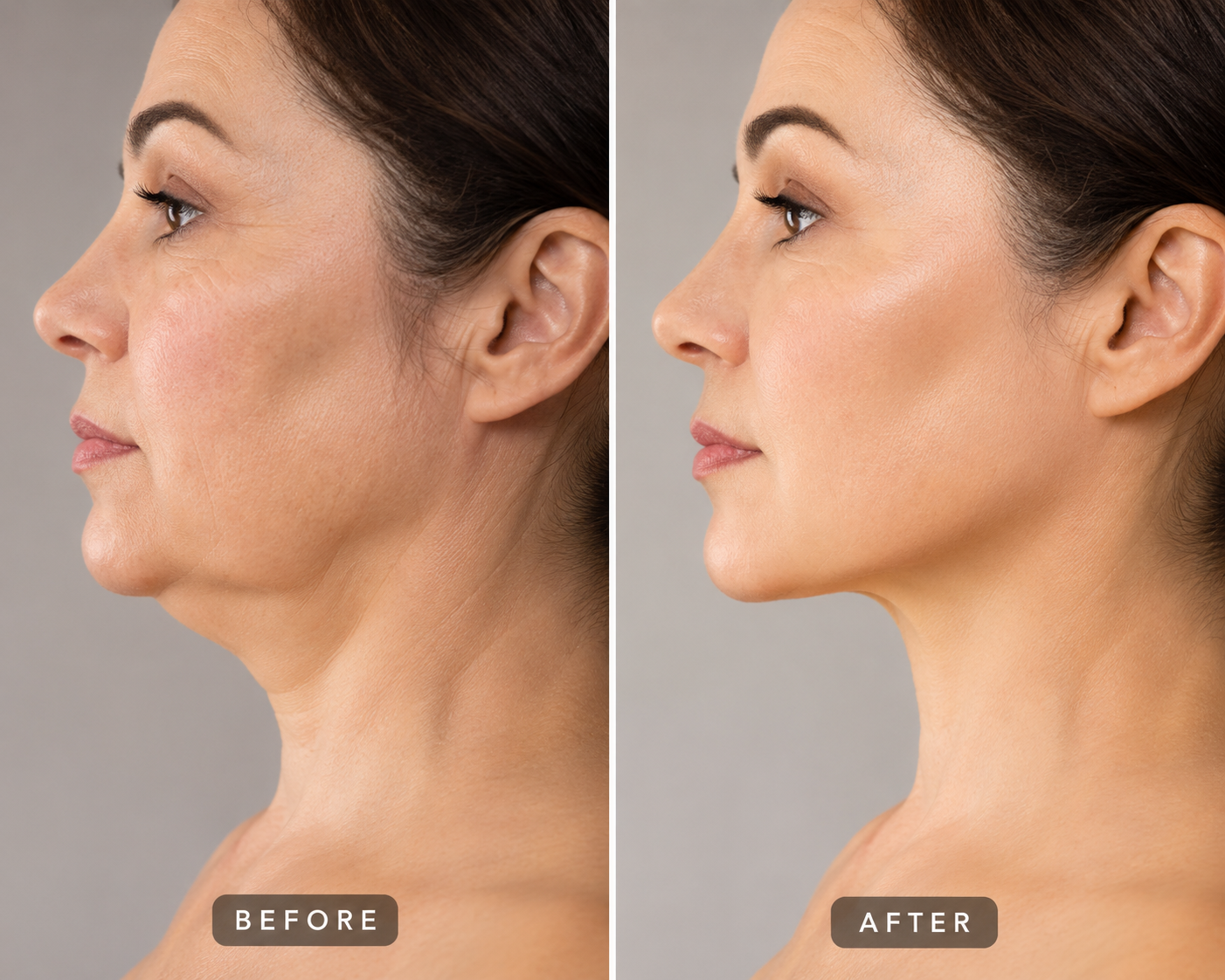
What Is HIFU, Really?
HIFU stands for High-Intensity Focused Ultrasound. The same kind of ultrasound your doctor uses to see inside your body, but turned up and focused like a magnifying glass to deliver heat to a precise depth without touching the skin in between.
Two things make HIFU different from almost every other tightening device:
- It reaches the SMAS layer. The Superficial Musculo-Aponeurotic System is the fibrous network surgeons cut and pull on during a facelift. HIFU is one of the only non-surgical technologies that can deliver clinical heat to that same depth.
- It skips the surface. Energy is focused below the skin like sunlight through a lens, so the top of the skin stays intact. That means no peeling, no scabbing and — importantly — it’s safe across all skin tones, including darker Indian skin where light-based devices need more caution.
Modern HIFU systems treat at three precise depths in a single session: 4.5mm (the SMAS), 3.0mm (the deep dermis where structural collagen lives) and 1.5mm (the superficial layer for tone and fine lines). Working all three layers in one visit is what produces the multi-dimensional “lift + tighten + glow” effect.
Benefits of HIFU :
- A subtle, real lift — a softer jawline, a more defined cheek, a lighter brow. Not a frozen, pulled look — the kind of refresh where people notice you look well, not “done.”
- No cuts, no downtime — walk out and back to your day. The biggest advantage over surgery.
- Stimulates your own collagen — the result builds gradually over 2–6 months and feels natural because it’s your tissue, not a filler.
- Safe across skin tones — ultrasound doesn’t see pigment, so no risk of post-inflammatory hyperpigmentation — a real concern with light-based tightening in deeper Indian skin.
- Long-lasting — typically 12–18 months from a single full session, sometimes longer with a sensible skincare routine.
- Stacks well with other treatments — HIFU lifts and tightens; Botox softens lines; fillers replace volume; skin treatments work on quality. Together they produce a genuinely natural-looking result.
- Works on the body too — the same principle tightens the abdomen, upper arms and thighs.
Areas We Treat with HIFU :
HIFU is most popular for the face and neck, but it works well anywhere skin needs gentle tightening and a collagen boost:
- Forehead and brow area (a subtle brow lift)
- Cheeks and midface (lifts and adds definition)
- Jawline and jowls (the most popular request)
- Under the chin (the “double-chin” area)
- Full neck (softens neck banding and lines)
- Around the mouth (smoker’s lines and lower face)
- Décolletage and upper chest
- Upper arms (for early arm laxity)
- Abdomen (especially post-pregnancy)
- Inner thighs and above the knees
- Buttocks (a subtle lift)
Conditions HIFU Treats :
HIFU isn’t a single fix for every face — it has a sweet spot. It works particularly well for:
- Early to moderate jowling — the soft loss of definition along the jaw.
- Sagging cheeks and midface — loss of lift and the start of nasolabial fold deepening.
- Mild double chin / submental laxity — the heaviness under the chin.
- Brow drop — a heavy upper lid where a subtle brow lift opens the eyes.
- Loose, thinning neck skin — the early stages of a turkey-neck look.
- Crepey décolletage — the chest area that ages quickly with sun.
- Post-pregnancy or post-weight-loss abdominal laxity — when the skin is loose but not surgically excessive.
- Early arm and thigh laxity — better than nothing, not a replacement for a brachioplasty in advanced cases.
- Pre-juvenation / prevention — late-30s to early-40s patients who want to slow the slide rather than wait until they need surgery.
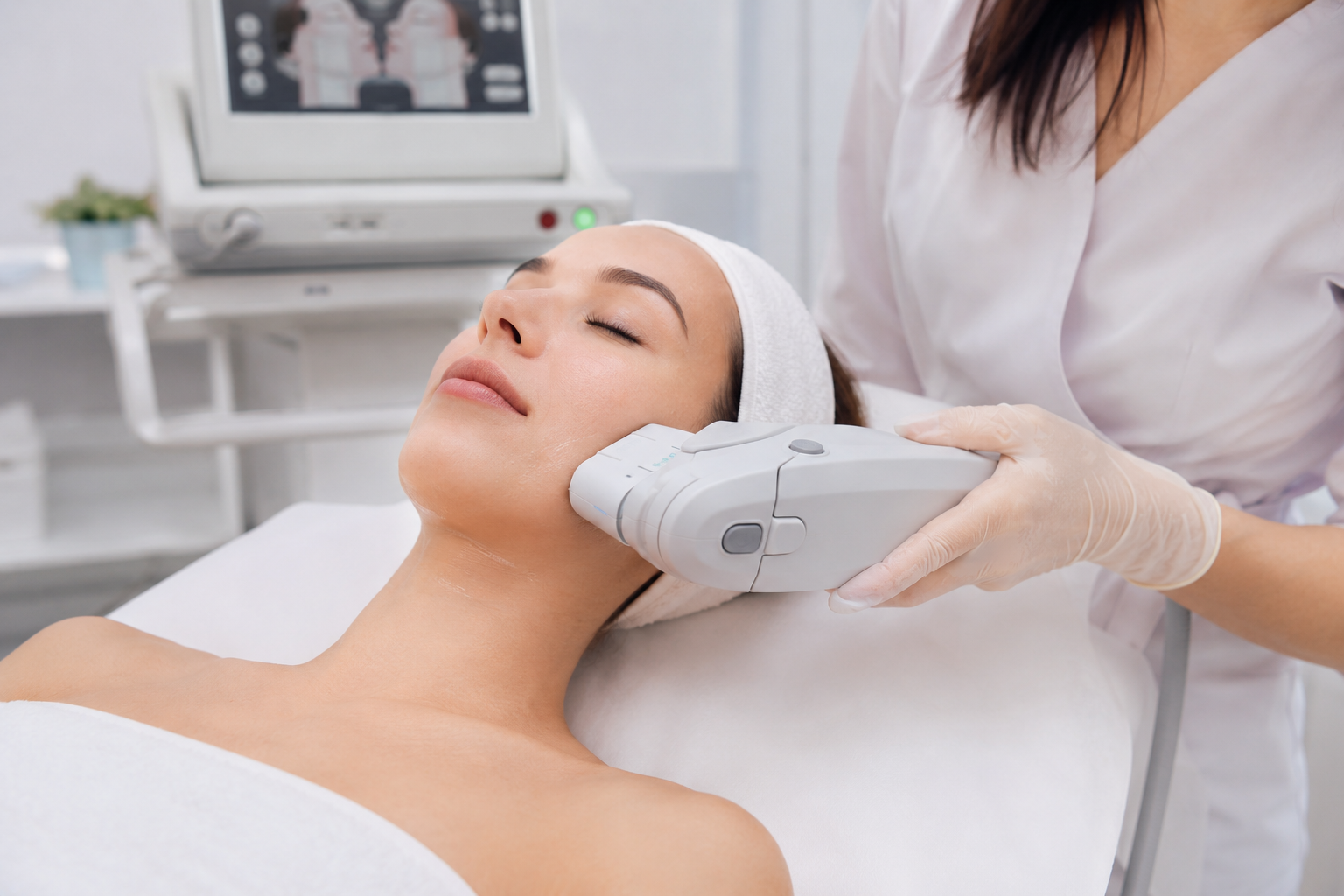
How HIFU Works at Sarayu Clinics ?
There isn’t one “HIFU.” There’s a generation of platforms, and the device used matters as much as the protocol:
Multi-depth, multi-platform approach
We work with clinically validated, FDA-cleared HIFU platforms that deliver controlled energy at the three key depths (1.5, 3.0 and 4.5mm). The protocol is tailored to your skin thickness, the area being treated and how lean or full your face is — important because over-treatment on a lean face can lead to unwanted fat loss.
Generations of HIFU technology
HIFU has evolved significantly. Earlier-generation devices delivered relatively long pulses that felt like “hot staples” under the skin. Modern systems — including 7D and 9D HIFU platforms and devices with Micro-Pulsed Technology (MPT) — deliver shorter, more comfortable pulses with finer energy control, more consistent results and significantly less pain.
Why HIFU is one of the safest skin-tightening options for Indian skin ?
Because ultrasound doesn’t interact with melanin (the pigment in your skin), HIFU carries virtually no risk of post-inflammatory hyperpigmentation — a real concern with many light-based and laser-based tightening treatments in Fitzpatrick IV–V skin. That makes it a particularly good choice for Indian patients.
Surgeon-led planning
The SMAS layer that HIFU heats is the same layer Dr. Tripathi works on during surgical facelifts. That anatomical depth of understanding informs both the placement of shots and the honest assessment of whether HIFU alone is going to give you the result you actually want. If a thread lift or a small touch of cheek filler will multiply the result, we’ll say so. If your laxity is genuinely beyond what HIFU can fix, we’ll say that too.
A note on cheap HIFU — if the price looks too good, it usually is :
The HIFU market in India ranges enormously — from under ₹5,000 for an unbranded generic machine to ₹50,000+ for a full session on a clinically validated platform. The technology, the energy precision, the safety profile, the operator training and the published evidence base are not the same. A very cheap full-face HIFU is almost always either an under-shot session, a generic device with limited published evidence, or both. We use clinically validated platforms and adequate shot counts so the result is real — not an illusion that fades in weeks
What Happens During a Session: Step by Step ?
- Consultation & assessment. We examine your face at rest and in motion, check the degree of laxity, look at bone structure and skin quality, and decide whether HIFU alone is the right move or whether it should be part of a combined plan.
- Honest plan & expectations. We agree what areas to treat, how many shots are needed at each depth, and what your realistic result will look like.
- Numbing cream is applied for 30 minutes; an oral painkiller is offered for sensitive patients. Modern HIFU is much more comfortable than the earliest generation.
- Cleansing & marking. The skin is cleaned; key zones (cheek lift line, jawline, neck) are marked.
- The treatment. Ultrasound gel is applied, then the HIFU transducer is moved across the area, delivering shots at each depth in turn. A face-and-neck session usually takes 45–75 minutes; body areas can take longer.
- Soothing & aftercare. Calming products and SPF are applied. You leave with clear instructions and a date for your review.
- Review & maintenance. We check progress at 6–8 weeks and at 3 months, then plan maintenance at the right interval for your skin.
Downtime & Aftercare
HIFU is genuinely walk-in, walk-out. Most people return to work the same day. What to expect:
- Mild redness for a few hours — sometimes the next day.
- A feeling of warmth or tingling for the rest of the day.
- Slight tenderness along treated lines for 2–7 days; usually mild.
- Occasional small bruise particularly along bony edges — settles within a week.
- Rare swelling for 24–48 hours, mainly on slimmer faces.
Aftercare:
- Broad-spectrum SPF 30+ every morning — collagen takes weeks to build; UV destroys it fast
- Gentle cleanser and a hydrating moisturiser; skip strong actives for 48 hours
- Avoid saunas, hot yoga and heavy exercise for 24 hours
- Stay hydrated; sleep on an extra pillow the first night if you feel any swelling
- No facials or aggressive massages for 2 weeks while collagen is building
Are You a Good Candidate for HIFU?
You’re likely a good candidate if you have:
- Mild to moderate skin laxity on the face, neck or body
- Late-30s to mid-50s skin with the early softening of jowls, jawline or neck
- Realistic expectations — a subtle, natural lift; not a facelift result
- Good general health and no contraindications below
HIFU may not be suitable, or needs extra caution, if you have:
- Severe skin laxity or jowling — surgery will give a better result
- Very thin, lean facial fat — HIFU can reduce fat further; this needs careful planning
- Active skin infection, severe acne or unhealed wounds at the site
- Open cuts or recent surgery in the treatment area
- Metal implants or pacemakers in the treatment area
- Pregnancy or breastfeeding
- Bleeding/clotting disorders or strong blood thinners
- Certain autoimmune conditions or impaired wound healing — medical clearance needed
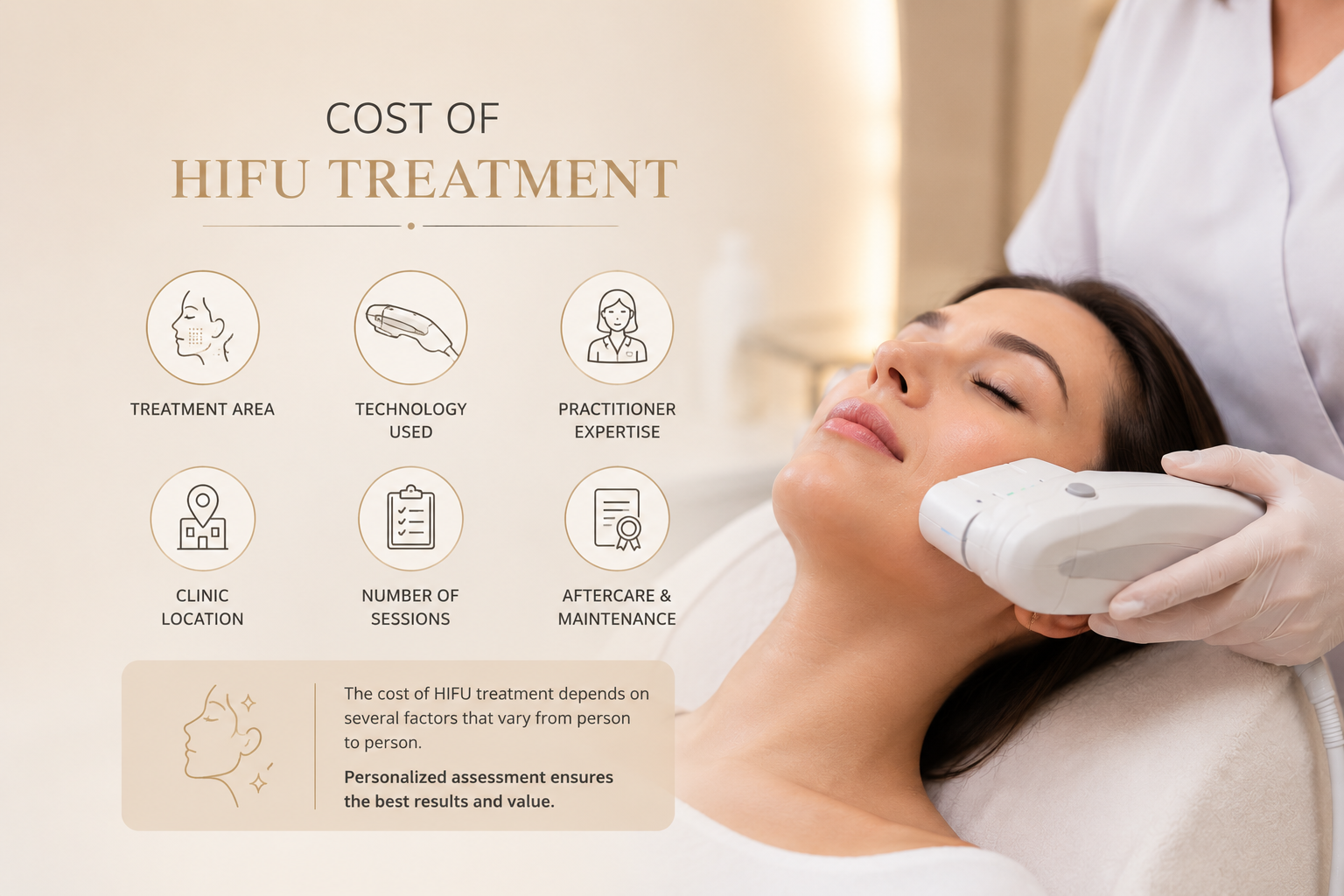
HIFU Treatment Cost in Delhi
HIFU pricing varies more than almost any aesthetic treatment in Delhi — mostly because of the wide range of devices on the market. As a guide:
Treatment area | Typical cost (INR)* |
Consultation & assessment | ₹2,500 – ₹5,000 |
Upper face / brow | ₹10,000 – ₹20,000 |
Lower face (jowls + jawline) | ₹15,000 – ₹30,000 |
Full face | ₹25,000 – ₹45,000 |
Neck only | ₹15,000 – ₹25,000 |
Full face + neck | ₹35,000 – ₹60,000 |
Face + neck + décolletage | ₹50,000 – ₹85,000 |
Hifu Treatment | ₹35,000 Per Session |
Hifu Package (3 Sessions) | ₹50,000 |
Prices shown are for guidance only. Your final treatment cost will be confirmed during the initial consultation, based on your individual needs, concerns, and personalised treatment plan.
Results Timeline: What to Expect ?
HIFU is the opposite of an instant-gratification treatment. It looks subtle on day one and gets better for months.
Timeframe | What usually happens |
Day 1 | Mild redness; some people see a subtle immediate tightening from initial collagen contraction. |
Week 1–2 | Tenderness settles; skin feels firmer to the touch. |
Week 4–6 | Early lift becomes visible; jawline starts looking cleaner. |
Month 2–3 | Clear improvement in lift, contour and skin quality. |
Month 3–6 | Peak result — maximum collagen has built up; results are at their best. |
Month 12–18 | Gradual softening of effect; time to plan a maintenance session. |
Most people need one full session, sometimes a touch-up at 3 months for stubborn areas, with maintenance every 12–18 months. The result isn’t “back to zero” at maintenance — you’re holding the position rather than starting over.
HIFU vs Other Tightening & Lifting Options
Here’s the honest, side-by-side comparison most marketing pages avoid:
Treatment | Best for | Result vs HIFU | Notes |
HIFU | Mild-moderate laxity | Baseline | Reaches SMAS; safe in all skin tones; long-lasting |
RF microneedling / Morpheus8 | Texture + mild tightening | Stronger on texture | Combines well with HIFU |
Thread lift | Visible drop in jowls/cheek | Faster lift, shorter lasting | Threads dissolve over 12–18 months |
Botox | Dynamic wrinkles only | Different problem | Doesn’t tighten skin |
Dermal fillers | Volume loss | Adds volume, not tightening | Pairs with HIFU for full effect |
Surgical facelift | Significant laxity | Far stronger, permanent-style | Surgery, downtime, the real answer beyond a point |
Combining HIFU with Other Treatments
HIFU is excellent on its own, but most people get a better, more natural result when it sits inside a broader plan:
HIFU + Botox — HIFU tightens; Botox smooths the dynamic lines that don’t respond to tightening alone.
HIFU + dermal fillers — HIFU tightens what you have; fillers (and cheek fillers specifically) replace lost volume so your face is lifted and properly supported.
HIFU + RF microneedling / Morpheus8 — HIFU works on the SMAS; MNRF and Morpheus8 work on texture, pores and the more superficial layers. Together they cover the whole depth.
HIFU + microneedling / PRP / exosomes — layering with Dermapen 4 and PRP (vampire facial) improves skin quality alongside the structural lift.
HIFU + thread lift — for slightly more visible laxity — threads pull the tissue mechanically while HIFU stimulates collagen to hold the position.
HIFU as a bridge to (or after) surgery — for younger patients buying time before a facelift, or for post-surgical patients maintaining results.
Why Choose Sarayu Clinics for HIFU in Delhi ?
There’s no shortage of clinics offering HIFU in Delhi. The variables that actually change your result are who plans it and on what device. At Sarayu Clinics, treatment is led by facial plastic and maxillofacial surgeon Dr. Adarsh Tripathi, alongside co-founder and celebrity aesthetician Dr. Nidhi Bhatia.
- Surgeon-led, anatomy-informed treatment. HIFU works on the same SMAS layer surgeons operate on. Planning by a facial plastic surgeon means safer placement and a real understanding of when HIFU is enough — and when it isn’t.
- The whole ladder under one roof. Injectables, RF microneedling, threads, HIFU and surgical facelift are all available here. You won’t be sold HIFU because it’s the only thing on the menu.
- Clinically validated platforms, adequate shot counts. We don’t cut corners on device or protocol. The number of shots is what your skin needs — not what makes the session faster.
- Honest expectations. A subtle, natural lift you’re happy with at month three — not an oversold ‘instant facelift’.
- Indian-skin expertise. HIFU is one of the safest tightening choices for darker skin; we tune the protocol to your face and skin type.
Frequently Asked Questions :
Is HIFU as good as a facelift?
No — and any clinic that claims otherwise is overselling. A surgical facelift physically lifts and removes excess skin and produces a dramatic, long-lasting result. HIFU is a non-surgical tightening treatment for mild-to-moderate laxity that delivers a subtle, natural lift over 2–6 months. The honest answer: HIFU is a great option in your 30s, 40s and early 50s; if you have significant sagging, surgery is the better tool.
How many HIFU sessions do I need?
Most people need one full session, with the result peaking at 3 months and lasting 12–18 months. Some patients with more laxity or in their 50s benefit from a second session 3–6 months later to compound the result. After that, maintenance every 12–18 months keeps the position.
Is HIFU painful?
Modern 7D/9D HIFU systems with Micro-Pulsed Technology are far more comfortable than earlier generations. You’ll feel warmth and a brief prickling sensation at the deeper depths — particularly along the jawline and brow — but numbing cream and, if needed, a mild oral painkiller make it very manageable. Most patients describe it as tolerable rather than painful.
When will I see results?
Some skin tightening is visible immediately as the SMAS contracts. The real result builds gradually over 2–6 months as new collagen forms, with peak result at month three or four.
How long does HIFU last?
Typically 12–18 months, sometimes up to 2 years — depending on your skin quality, age, sun protection, lifestyle and the platform used. Ageing continues, of course, so maintenance sessions are recommended.
Is HIFU safe for Indian skin?
Yes — in fact it’s one of the safest tightening treatments for darker skin tones. Because ultrasound doesn’t interact with melanin, there’s essentially no risk of post-inflammatory hyperpigmentation that you can get with light-based and laser-based tightening.
Medical Review & Sources
This page is for general information and is medically reviewed by the team at Sarayu Clinics under Dr. Adarsh Tripathi. It is not a substitute for an in-person consultation. The clinical approach reflects current aesthetic and dermatological guidance, including:
How to Reach Us:
Phone: +91 9289111081 , +91 9289111082
Email: sarayuinquiries@gmail.com
Sarayu Clinics website: www.sarayuclinics.com
Facebook: https://www.facebook.com/sarayuclinic
Instagram: https://www.instagram.com/sarayuclinics/
Dr. Adarsh Tripathi’s profile: https://dradarshtripathi.com/
Online Booking: Visit our website https://sarayuclinics.com/contact-us/ to schedule appointments conveniently.
Can I combine HIFU with Botox or fillers?
Yes — in fact, combination is often where the most natural-looking results come from. HIFU tightens, fillers replace volume, Botox softens dynamic lines. We typically schedule injectables either before HIFU or 2 weeks afterwards so each treatment has space to settle.
Can HIFU make my face look gaunt or thinner?
It can, if used carelessly on a lean face — because deep ultrasound reduces fat as well as tightens skin. This is exactly why an anatomy-informed plan matters. We adjust shot count and depth on slimmer faces to avoid unwanted volume loss.
What’s the difference between HIFU, 7D HIFU and 9D HIFU?
All use focused ultrasound. ‘7D’ and ‘9D’ refer to platforms that combine multiple energy modes and depths in a single device — generally offering more comfort, more refined shots and additional functions (such as MMFU — macro-focused ultrasound — for body or wrinkle modes). They’re upgrades of the core HIFU principle, not a different technology.
How much does HIFU cost in Delhi?
Costs range widely — from around ₹10,000 for a single small zone to ₹85,000 for face + neck + décolletage on a premium platform. The wide range mostly reflects the device used and the shot count. Very cheap HIFU is usually an under-shot session on a generic device — the result may be brief and underwhelming.