
Lip Lightening Treatment in Delhi
Professional Lip Lightening Treatment in Delhi for Pigmented Lips
Dark lips can sneak up on you. The lipstick that worked for years suddenly looks off. Photos show a tone you don’t recognise. Or you’ve simply caught a darker line along the lip border that wasn’t there before. The instinct is to look for a quick lightening fix — and the internet is full of them, most of which oversimplify the problem. The truth is that dark lips have specific causes, and the right treatment starts with finding the right cause.
At Sarayu Clinics in Greater Kailash, dark lip and lip pigmentation treatment is planned by facial plastic and maxillofacial surgeon Dr. Adarsh Tripathi. The approach is cause-first: we identify why your lips have darkened (often the most useful 10 minutes you’ll spend on this), then put together a plan that’s tailored to that reason. Sometimes it’s a quick laser course. Sometimes it’s changing a toothpaste. Often, it’s a combination.
First, an honest note on natural lip color
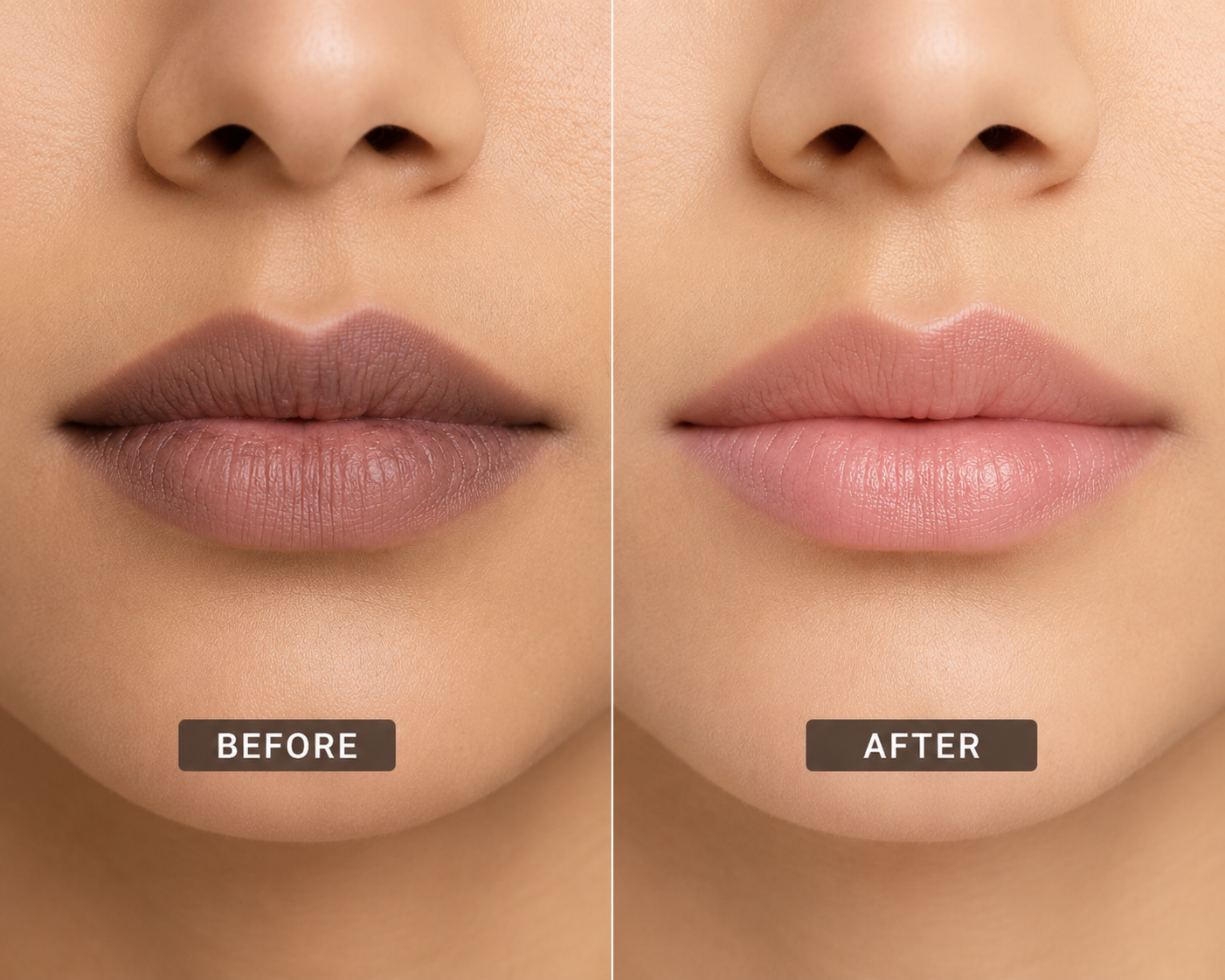
Lip lightening treatment is for hyperpigmentation — lips that have become darker than your natural tone due to a treatable cause such as smoking, sun damage, allergic reactions, certain medications, hormonal pigmentation or nutritional deficiency. It isn’t a treatment to change naturally pigmented lips to look lighter, fairer or more European. If your lip tone is your natural baseline, that’s healthy and there’s genuinely nothing to fix. The goal of every plan here is even, healthy lips — not a different colour.
What Causes Dark Lips? (Why This Matters Before Any Treatment)
Lip pigmentation is one of the most common reasons people search for a dermatology consultation — and it’s one of the easiest to get wrong if the cause isn’t identified first. Common causes we look for during your consultation:
- Smoking (‘smoker’s melanosis’) — the chemicals and heat in tobacco smoke stimulate the melanin cells in the lips. Often the single most important factor; the lips can lighten significantly within months of stopping.
- Allergic contact reactions — ingredients in lipsticks (carmine, fragrance, mica), lip balms, toothpastes (cinnamates, peppermint, sodium lauryl sulphate) and even some mouthwashes can cause a quiet, chronic allergic reaction that darkens the lips over time. Switching products can be transformative — and zero clinics seem to talk about this.
- Sun damage — the lips have very little natural pigment protection. Years of unprotected sun deepens lip colour, especially along the vermillion border.
- Lip licking and chronic dryness — a constantly irritated lip is an inflamed lip, and chronic inflammation drives pigmentation.
- Medications — certain antimalarials, antibiotics, chemotherapy drugs, oral contraceptives and minocycline can darken the lips. Worth reviewing your medication list.
- Hormonal pigmentation / melasma extension — the same hormonal triggers that drive facial melasma can affect the lip area, particularly the upper lip.
- Nutritional deficiency — iron deficiency anaemia, vitamin B12 deficiency and folic acid deficiency can all cause persistent lip darkening. A simple blood test can reveal what no cream will fix.
- Dehydration and caffeine excess — often underrated; lips reflect overall hydration status quickly.
- Inflammatory skin conditions — eczema, lichen planus pigmentosus and other dermatoses can show up as lip pigmentation and need specific dermatological treatment.
- Genetics — some natural variation in lip tone is normal and not a condition to treat.
Benefits of Professional Lip Treatment
- Even, healthier-looking lip tone — the visible result, especially when the underlying cause has also been addressed.
- Cause identified and treated — instead of chasing pigmentation that keeps coming back because the source is still there.
- Smoother lip texture — most lightening protocols also improve dryness, flaking and chapping.
- Reduced lipstick ‘grip’ — less of the dark base showing through nude and warm-toned lipsticks.
- Safe for Indian skin and lips — when conservative settings and the right laser are used. The lip area is delicate; this is where expertise matters.
- Maintained, not chased — once the cause is fixed, the result is stable with simple home care.
- Surgeon-led safety net — if the pigmentation is from a medical condition or rare structural issue, you’re already with the right specialist.
Areas We Treat
Lip pigmentation rarely affects the whole lip uniformly. During your consultation we map the exact areas to treat:
- The vermillion (the coloured body of the lip)
- The vermillion border (the line where lip meets skin)
- The upper lip skin (often involved with melasma)
- The corners of the mouth (angular pigmentation)
- The Cupid’s bow area
- The perioral skin around the mouth
- The mucosal inner border (occasionally, with extra care)
Types of Lip Pigmentation We Treat
Identifying the pattern is half the diagnosis:
- Smoker’s melanosis — diffuse, dusky darkening, often with the lower lip affected most.
- Contact-allergy pigmentation — patchy or rim-distributed darkening, often with mild scaling or burning.
- Sun-induced pigmentation — more even darkening with worse outer lip border.
- Hormonal pigmentation / melasma involving the lip area — typically a symmetrical brownish patch above and around the upper lip.
- Post-inflammatory hyperpigmentation — from previous lip injury, eczema, cold sores or aggressive treatments.
- Drug-induced lip pigmentation — often more bluish-grey; needs a medication review.
- Nutritional pigmentation — seen with iron, B12 or folate deficiency; corrects with the deficiency.
- Labial melanotic macule — a small, well-defined dark spot that needs a clinical eye to distinguish from anything more serious.
- Mucosal pigmentation patterns — benign in most cases but occasionally a marker of a syndrome; medical review matters here.
Things to Fix at Home Before (or Alongside) Any Procedure
Almost every Delhi page on this topic skips the home-care basics and jumps to laser. That order is wrong. These changes alone resolve some cases entirely and make professional treatments work twice as well:
- Stop smoking. This is the single biggest lever for smoker’s lips. Lips visibly lighten within months of quitting.
- Switch your toothpaste. Try a fragrance-free, SLS-free, cinnamate-free toothpaste for 6–8 weeks and see what happens. Surprisingly often, this alone is the answer.
- Audit your lipsticks and lip balms. Note when the darkening worsens. Try a fragrance-free, hypoallergenic balm and rotate your lipstick brands.
- Use SPF on your lips daily. A broad-spectrum SPF 30+ lip balm, applied every morning and reapplied through the day. The single most underused tool.
- Stop the lip-licking habit. Each lick irritates the lip; chronic irritation feeds pigment cells.
- Hydrate and sleep. Dehydrated lips look darker than they are; well-rested lips look brighter than they are.
- Get a basic blood workup if pigmentation seems out of proportion. Iron, ferritin, vitamin B12 and folate are the quick check.
Lip Lightening Treatment Options at Sarayu Clinics
Once the cause is identified and home factors are sorted, the right treatments do the rest. The full ladder we offer:
1. Prescription topicals
Medical-grade creams — carefully chosen for the delicate lip skin — are the quietest, most effective long-term work. Depending on your case we may use kojic acid, niacinamide, vitamin C, azelaic acid, tranexamic acid, retinoids (cautiously) and, for short supervised courses, hydroquinone. These are prescribed and reviewed, not picked off a shelf, because the lip area is more sensitive than facial skin.
2. Lip-safe chemical peels
Gentle peels using lactic, glycolic or mandelic acid carefully formulated for the lip area exfoliate pigmented cells and brighten lip tone. Similar in principle to our carbon peel for skin but at much gentler strengths designed for the vermillion.
3. Q-switched laser toning (the gold-standard procedure)
Low-fluence Q-switched Nd:YAG laser (the same evidence-backed technology we use for melasma) breaks down excess melanin in the lips into tiny particles your body then clears. Delivered with platforms such as Hollywood Spectra, at conservative settings appropriate for Indian skin and the delicate lip area. Most plans involve 4–6 sessions, spaced 3–4 weeks apart.
4. Lip microneedling with brightening serums
Very gentle Dermapen 4 microneedling around the lip area, paired with brightening serums (tranexamic acid, vitamin C, peptides) supports skin renewal and helps the topicals penetrate.
5. Mesotherapy / lip skin boosters
Micro-injections of a tailored mix — typically hyaluronic acid, tranexamic acid, glutathione, vitamin C and peptides — hydrate and brighten the lip area. See our mesotherapy treatment for the broader principle.
6. PRP for the lips
Combining microneedling with PRP (the vampire-facial principle, applied to the lip area) supports collagen, hydration and overall skin quality in the perioral area.
7. Hyaluronic-acid lip hydration boosters / fillers (when shape is part of the story)
Sometimes lips look dark partly because they’re dehydrated, deflated and thinned. A tiny amount of hyaluronic acid filler used purely for hydration and gentle plumping (not over-volumising) can dramatically improve how the lips look — brighter, fresher, more defined — even when the pigment hasn’t changed.
8. Treatment of underlying skin conditions
If lichen planus pigmentosus, contact cheilitis, eczema or another condition is driving the pigmentation, treating the condition itself is what changes the result — not laser. We diagnose and manage these alongside any cosmetic plan.
9. Sun protection — the foundation
A daily broad-spectrum SPF 30+ lip balm is not a nice-to-have; it’s the difference between a result that holds and one that fades. Built into every plan.
10. Lip neutralisation / lip blush (cosmetic option)
For patients who want to neutralise dark lip tone immediately rather than gradually, lip neutralisation — a specialised semi-permanent makeup technique — can balance lip colour with cosmetic pigment. Discussed transparently as a separate option, not a substitute for treating the cause.
Why ‘just laser’ isn’t the answer most of the time ?
Laser is excellent at breaking down excess melanin — but if you laser the lips while still smoking, while still using the allergenic toothpaste, or while iron deficiency is driving the pigment cells, the lips will simply darken again. Combination matters here more than almost anywhere else in dermatology: fix the cause, build a sensible home routine, then layer the right procedures.
What Happens During a Session: Step by Step ?
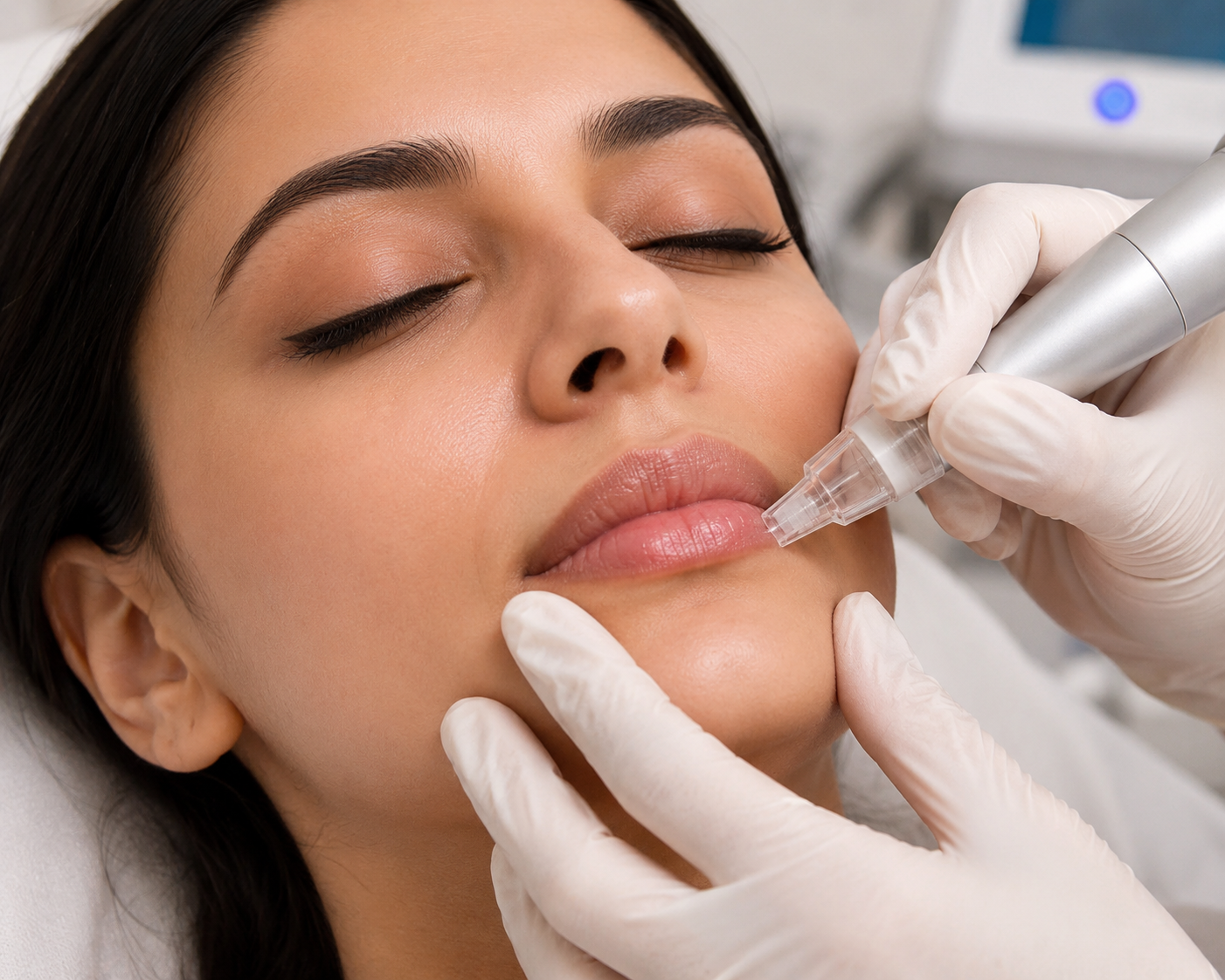
- Consultation & cause assessment. We take a focused history (smoking, medications, toothpaste, lipsticks, recent illness, hormonal changes), examine your lips with good lighting and dermoscopy where useful, and identify the most likely cause.
- Investigations where appropriate. A simple blood test for iron, ferritin, B12 and folate — occasionally a swab or patch test — catches the causes a cream can’t fix.
- Honest plan & expectations. We agree what to address at home, what to add as in-clinic treatment, how many sessions you’re likely to need, and what ‘good’ looks like for you.
- Patch test where needed. For first laser sessions on darker skin, a small test confirms your skin will tolerate the chosen setting.
- Cleansing & numbing. The lip area is gently cleansed; numbing cream is applied for 20 minutes if needed.
- The treatment. Whether it’s a peel, laser pass or microneedling-plus-serum session, the in-clinic part is usually 15–30 minutes.
- Aftercare guidance. Clear, lip-specific instructions: SPF lip balm, gentle cleanser, no harsh products for 48–72 hours, no smoking immediately after.
- Review & next session. Sessions are typically spaced 3–4 weeks apart, with progress reviews at the halfway and end-of-course points.
Downtime & Aftercare
Most lip lightening treatments are walk-in, walk-out. What to expect:
- Topicals: no downtime; occasional mild dryness or peeling in the first week.
- Chemical peels: mild tingling, light flaking for 2–3 days, slightly more sensitive lips for a week.
- Laser toning: brief warmth and mild redness that settles within hours; occasional very mild crusting that heals in days.
- Microneedling: redness and a feeling of tightness around the lips for 24 hours.
- Mesotherapy / boosters: tiny injection marks that settle within hours.
Aftercare matters as much as the procedure:
- SPF 30+ lip balm every morning and through the day — always
- Gentle, fragrance-free lip moisturiser; nothing exfoliating for 48–72 hours
- Avoid spicy, very hot, or acidic foods for 24 hours after laser or peels
- No smoking immediately after a session (and ideally, not at all)
- Don’t pick or rub the lips; let any flaking come away naturally
- Wait 24 hours before lipstick, and use clean, fragrance-free products afterwards
Are You a Good Candidate?
You’re likely a good candidate if you have:
- Lips that are darker than your natural baseline due to an identifiable, treatable cause
- Realistic expectations — even, healthy-looking lips, not a completely changed colour
- Willingness to address contributing habits (smoking, allergenic products, sun)
- Generally healthy lips, free of active infection or cold sores
It may not be suitable, or needs extra caution, if you have:
- Pregnancy or breastfeeding (most procedures and prescription topicals are deferred)
- Active cold sores (herpes labialis) or open lip wounds
- An untreated underlying skin condition such as lichen planus or eczema
- A history of keloid scarring around the lip area
- Bleeding/clotting disorders or strong blood thinners (relevant for needling)
- A medication driving the pigmentation that hasn’t been reviewed yet
- An expectation of changing naturally pigmented lips into a fundamentally different colour — this isn’t what these treatments do, and we’d say so honestly
Lip Lightening Treatment Cost in Delhi
Per session pricing in Delhi varies with the treatment type and area. As a general guide:
Treatment | Typical cost per session (INR)* |
Consultation & cause assessment | ₹2,500 – ₹5,000 |
Prescription topicals (home care) | Product cost; reviewed at follow-ups |
Lip-safe chemical peel | ₹2,500 – ₹5,000 |
Q-switched laser toning (lip area) | ₹6,000 – ₹15,000 |
Lip microneedling with serums | ₹4,000 – ₹8,000 |
Mesotherapy / lip skin boosters | ₹6,000 – ₹12,000 |
PRP for the lip / perioral area | ₹6,000 – ₹14,000 |
Full lip lightening course (4–6 sessions) | ₹20,000 – ₹70,000 (combination plans) |
Lip neutralisation / semi-permanent makeup | Quoted separately after consultation |
Prices shown are for guidance only. Your final treatment cost will be confirmed during the initial consultation, based on your individual needs, concerns, and personalised treatment plan.
Results Timeline: When Will You See a Difference?
Lip pigmentation fades gradually — in a good way. Aggressive, fast lightening risks rebound darkening (a real concern in Indian lips, just like Indian skin). A realistic timeline:
Timeframe | What usually happens |
Week 1–2 | Lips feel softer and more hydrated; lifestyle changes start to register. |
Week 3–6 | Visible early lightening, especially of recent pigmentation. |
Month 2–3 | Clear, photograph-able improvement; lip tone looking more even. |
Month 4–6 | Best result — stable, lighter tone if the underlying cause has been addressed. |
Ongoing | Light maintenance every 6–12 months and good daily SPF and lip care keeps the result. |
Most people need 4–6 sessions, spaced 3–4 weeks apart, plus consistent home care. If you keep smoking, keep using the allergenic toothpaste, or skip your SPF lip balm, results won’t hold no matter how good the laser is.
Comparing Lip Lightening Treatments at a Glance
Where each option fits. Most plans combine two or three of these.
Treatment | Best for | Downtime | Notes |
Lifestyle correction | Smoker’s lips, allergen-driven lips | None | Often the most powerful single lever |
Prescription topicals | Mild to moderate, foundational | None | Quiet, daily, long-term work |
Lip-safe chemical peel | Surface pigment, dullness | 1–3 days | Gentle exfoliation; combines with everything |
Q-switched laser toning | Deeper pigment, stubborn cases | Minimal | Gold-standard procedure; conservative in Indian skin |
Lip microneedling + serums | Combining with topicals | 1 day | Helps active ingredients penetrate |
Mesotherapy / boosters | Hydration + brightening | Minimal | Pairs well with laser plans |
Lip neutralisation / lip blush | Cosmetic colour change | Initial healing | Cosmetic camouflage; not medical treatment |
Why Choose Sarayu Clinics for Lip Lightening in Delhi ?
Dark lips are deceptively simple to treat badly, and easy to chase forever if the cause isn’t found. Treatment at Sarayu Clinics is planned by facial plastic and maxillofacial surgeon Dr. Adarsh Tripathi, alongside co-founder and celebrity facial aesthetician Dr. Nidhi Bhatia.
- Cause-first approach — we find out why your lips have darkened before deciding what to do about it. Often the most useful 10 minutes of the visit.
- Indian-skin expertise — conservative laser settings, lip-safe peel formulations and protocols designed not to cause rebound pigmentation.
- Honest framing — we treat hyperpigmentation; we don’t change your natural lip tone, and we’ll say so plainly if your lips are already healthy.
- Full toolkit — topicals, peels, laser, microneedling, mesotherapy, PRP and — if it actually adds value — hydration fillers, under one roof.
- Surgeon-led safety — if your lip pigmentation is from an inflammatory or medical cause, you’re already with the right specialist to manage it.
- Transparent pricing — clear plans, realistic timelines, no hidden upsells.
Frequently Asked Questions
What is the best treatment for dark lips?
It depends on the cause. The most effective plan usually combines fixing the cause (often smoking, an allergenic toothpaste or lipstick, sun exposure or a nutritional deficiency) with a course of Q-switched laser toning, lip-safe peels and prescription topicals. ‘Laser-only’ is rarely the right answer because the pigment comes back if the cause is still there.
How many sessions will I need?
Most people need 4–6 sessions, spaced 3–4 weeks apart, for a clear result. Deeper or older pigmentation can take longer, and maintenance every 6–12 months is recommended to keep results stable.
Is laser treatment for dark lips safe?
Yes, when it’s the right laser at conservative settings, used by an experienced clinician. Q-switched Nd:YAG (1064 nm) is well-evidenced for lip pigmentation in Indian skin. Excessive fluence risks rebound darkening, so technique matters more than the device alone.
Will my lips really go pink, or just a bit lighter?
The honest answer: lips go back to your natural baseline tone — whatever that is for you. If your natural lips are a deep rose or a healthy mauve, that’s what you’ll see. Treatment removes acquired pigmentation; it doesn’t change inherent ethnic colour. We’d rather set the right expectation than oversell.
How much does lip lightening cost in Delhi?
Per-session prices typically range from ₹2,500 for lip peels to ₹15,000 for Q-switched laser toning. A full combination course (4–6 sessions) usually runs ₹20,000–₹70,000 depending on what’s included. Topical products and lifestyle changes add a small amount to that.
Are the treatments painful?
Most are comfortable. Peels cause mild tingling. Q-switched laser toning feels like quick warm pricks. Microneedling and mesotherapy use numbing cream. The lip area is sensitive but the sessions are short.
Medical Review & Sources
This page is intended for educational purposes and has been medically reviewed by the clinical team at Sarayu Clinics under the guidance of Dr. Adarsh Tripathi. The information provided is not a substitute for a personalized medical consultation, diagnosis, or treatment. Every patient is unique, and treatment recommendations may vary based on individual skin type, medical history, and clinical evaluation.
Our clinical approach is guided by current evidence-based dermatology practices and aligns with recommendations from respected medical organizations and dermatology resources, including:
American Academy of Dermatology (AAD) — Hyperpigmentation Overview
DermNet — Labial Melanotic Macule and Other Pigmented Lesions of the Lip
DermNet — Pigmentation Disorders
How to Reach Us:
Phone: +91 9289111081 , +91 9289111082
Email: sarayuinquiries@gmail.com
Sarayu Clinics website: www.sarayuclinics.com
Facebook: https://www.facebook.com/sarayuclinic
Instagram: https://www.instagram.com/sarayuclinics/
Dr. Adarsh Tripathi’s profile: https://dradarshtripathi.com/
Online Booking: Visit our website https://sarayuclinics.com/contact-us/ to schedule appointments conveniently.
When should I see a doctor rather than try home remedies?
Any of these is worth a consult: pigmentation that started suddenly, that’s clearly worsening despite home care, that’s patchy or asymmetric, that’s associated with burning or scaling, that started with a new medication, or that’s accompanied by fatigue / hair loss / unusual symptoms (which can hint at deficiency or a systemic cause). It’s also worth a visit if you’ve been chasing it for years without results.
What’s the difference between lip lightening and lip blush?
Lip lightening reduces excess pigment so your natural lip tone shows through. Lip blush (also called lip neutralisation) is a semi-permanent makeup procedure that deposits cosmetic pigment to add or balance colour — it doesn’t change underlying pigmentation, it covers it. They can complement each other but they’re different things.
Can I treat dark lips during pregnancy?
Most active treatments — lasers, prescription topicals like hydroquinone or retinoids, and most procedures — are deferred during pregnancy and breastfeeding. The safer plan during this period is gentle lip care, SPF and addressing lifestyle factors; active treatment can begin after breastfeeding.
Can lip pigmentation come back?
Yes — if the original cause is still there. The pigment we clear today doesn’t come back, but new pigment can form if smoking, sun, allergens or deficiencies continue to drive it. That’s why fixing the cause is part of the plan.