
Chemical Peel in Delhi
Chemical Peel in Delhi
A chemical peel is the oldest treatment in aesthetic dermatology and, done properly, still one of the best. The principle has not changed in a century: apply a controlled chemical agent to the skin, remove a precisely determined depth of tissue, and allow the skin beneath to regenerate smoother, clearer and more even than what was taken away.
The whole of the skill is in the words precisely determined depth. Too shallow and nothing happens. Too deep, particularly in Indian skin, and you have created a burn, a scar or a permanent patch of pigment that no amount of subsequent treatment will fully undo. There is no other treatment in aesthetics where the gap between the right answer and the wrong one is measured so finely, and none where that gap is more routinely ignored — in Delhi, most often in a beauty parlour, using an unlabelled bottle.
At Sarayu Clinics in Greater Kailash, chemical peels are prescribed and performed by facial plastic and maxillofacial surgeon Dr. Adarsh Tripathi. Which agent, at what concentration, for how long, on which skin — those four decisions are the treatment. Everything else is aftercare.
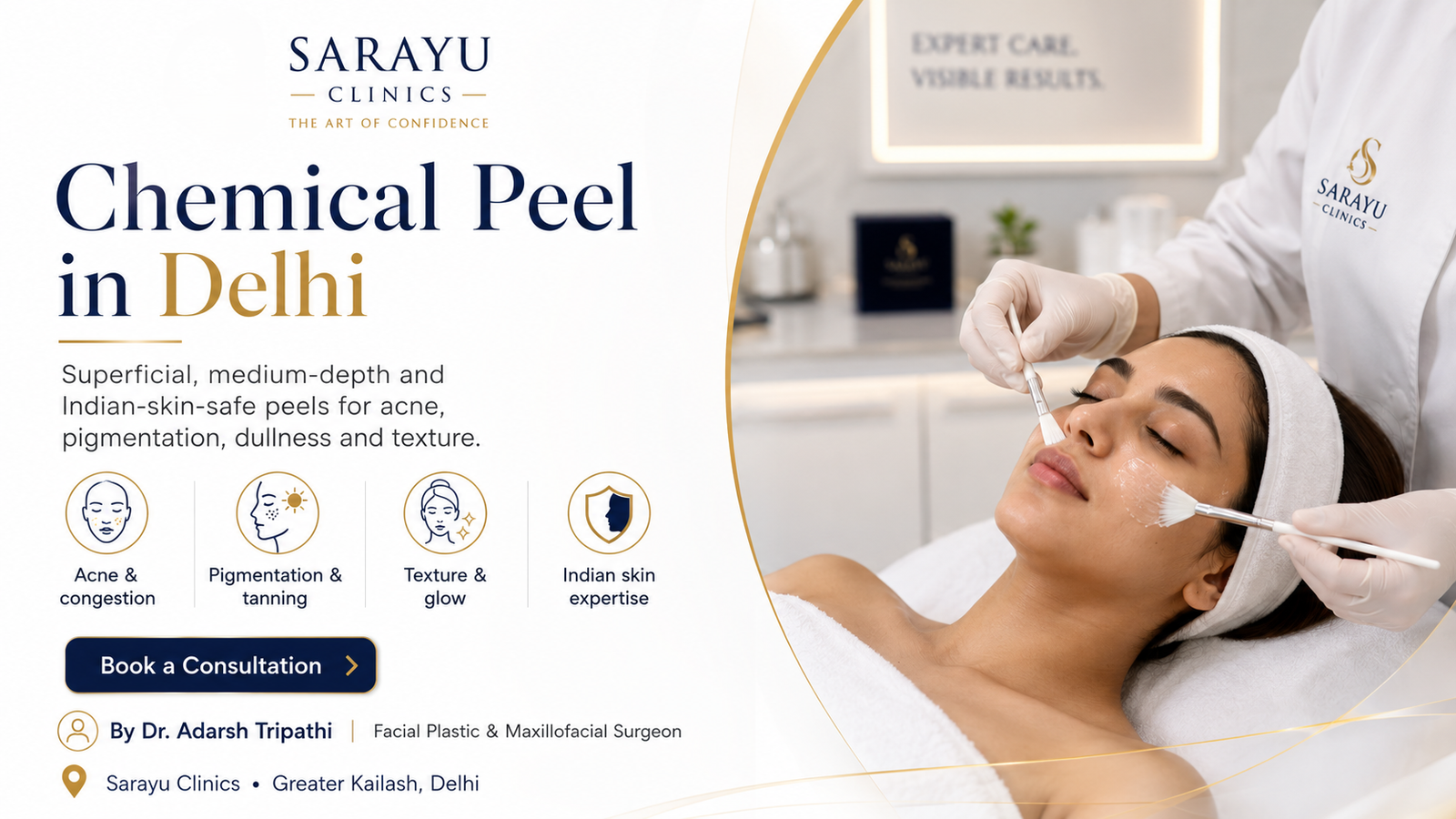
The short answer :A chemical peel applies an acid to the skin to remove a controlled depth of tissue and trigger regeneration. Peels are classified by DEPTH, and depth determines everything: what they treat, how long you recover, and how much risk you carry. SUPERFICIAL peels (glycolic, salicylic, mandelic, lactic) reach the epidermis — safe, repeatable, minimal downtime, good for dullness, acne, mild pigment and texture. MEDIUM peels (TCA 35 percent or above, Jessner’s plus TCA) reach the upper dermis — stronger, real downtime, good for pigmentation, sun damage and superficial scarring. DEEP peels (phenol) reach the mid-dermis, are systemically absorbed, require cardiac monitoring, and cause permanent loss of pigment in darker skin. We do not perform them, and we explain why below. Most Indian patients do best with a course of four to six superficial peels, escalating cautiously if needed. Mandelic acid is the safest starting agent for Fitzpatrick IV–V skin. Delhi cost: Rs 1,500–6,000 per superficial session, Rs 5,000–12,000 for a medium peel. A peel that does not visibly flake has not failed.
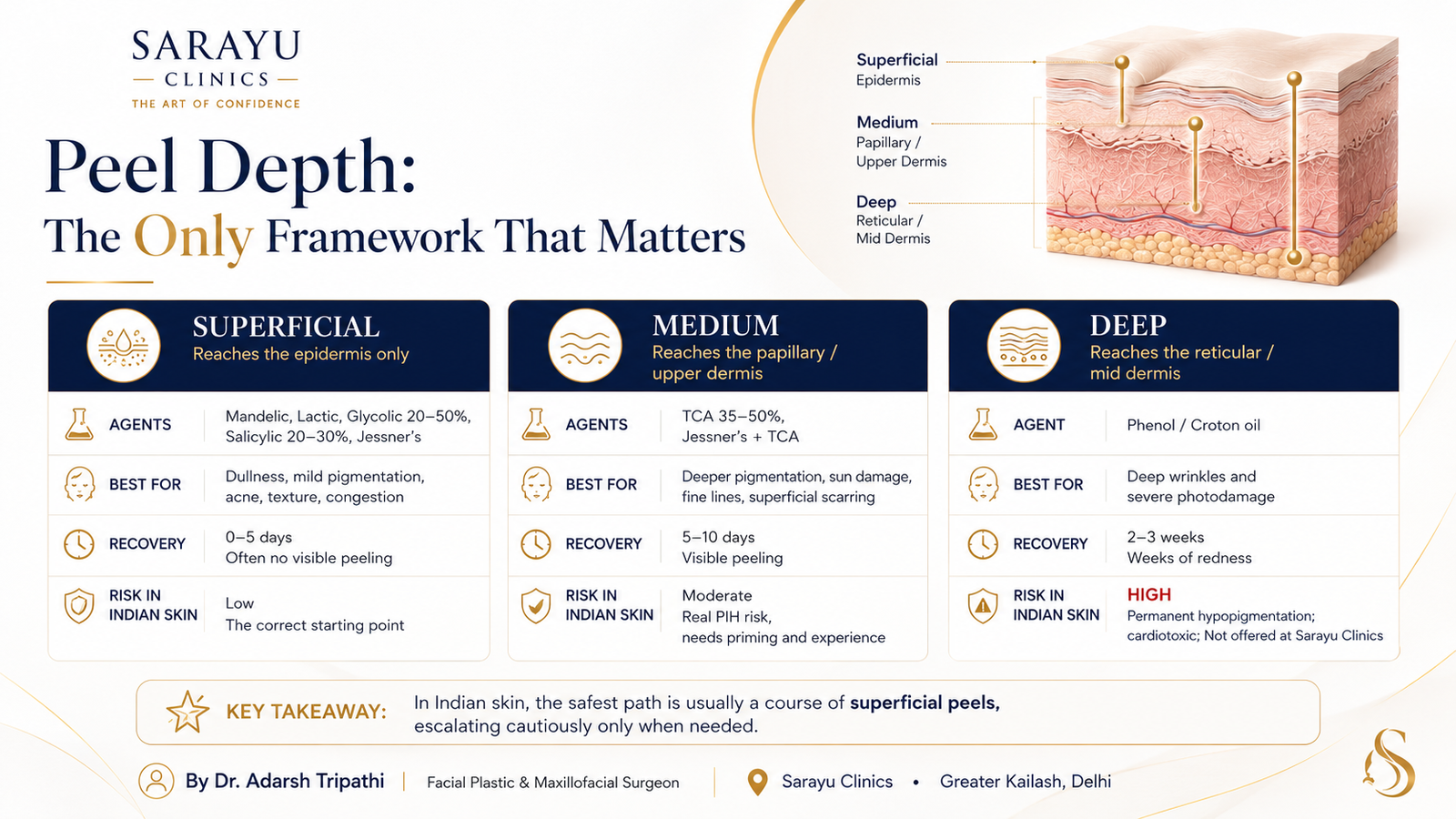
Peel Depth: The Only Framework That Matters
Forget brand names and forget acid names for a moment. Every chemical peel in the world is described by one number: how deep it goes. That number determines what the peel can treat, how long you will be recovering, and how much can go wrong.
Depth | Layer reached | Agents | Treats | Recovery | Risk in Indian skin |
Superficial | Epidermis only | Mandelic, lactic, glycolic 20–50%, salicylic 20–30%, Jessner’s | Dullness, mild pigment, active acne, texture, congestion | 0–5 days; often no visible peeling at all | Low. The correct starting point. |
Medium | Papillary (upper) dermis | TCA 35–50%, Jessner’s + TCA, glycolic 70% + TCA | Deeper pigmentation, sun damage, fine lines, superficial scarring | 5–10 days; visible peeling | Moderate. Real PIH risk. Needs priming and experience. |
Deep | Reticular (mid) dermis | Phenol / croton oil (Baker-Gordon) | Deep wrinkles, severe photodamage | 2–3 weeks; weeks of redness | HIGH. Permanent hypopigmentation. Cardiotoxic. We do not perform these. |
Notice what this means in practice. A patient who wants their melasma gone and is told ‘we’ll do something stronger’ is being offered depth. Depth is exactly what melasma does not want. Aggression in a pigmented skin provokes the melanocyte, and the pigment comes back darker. The correct answer for most Indian skin is not a stronger peel. It is the right peel, repeated patiently, with sunscreen in between.
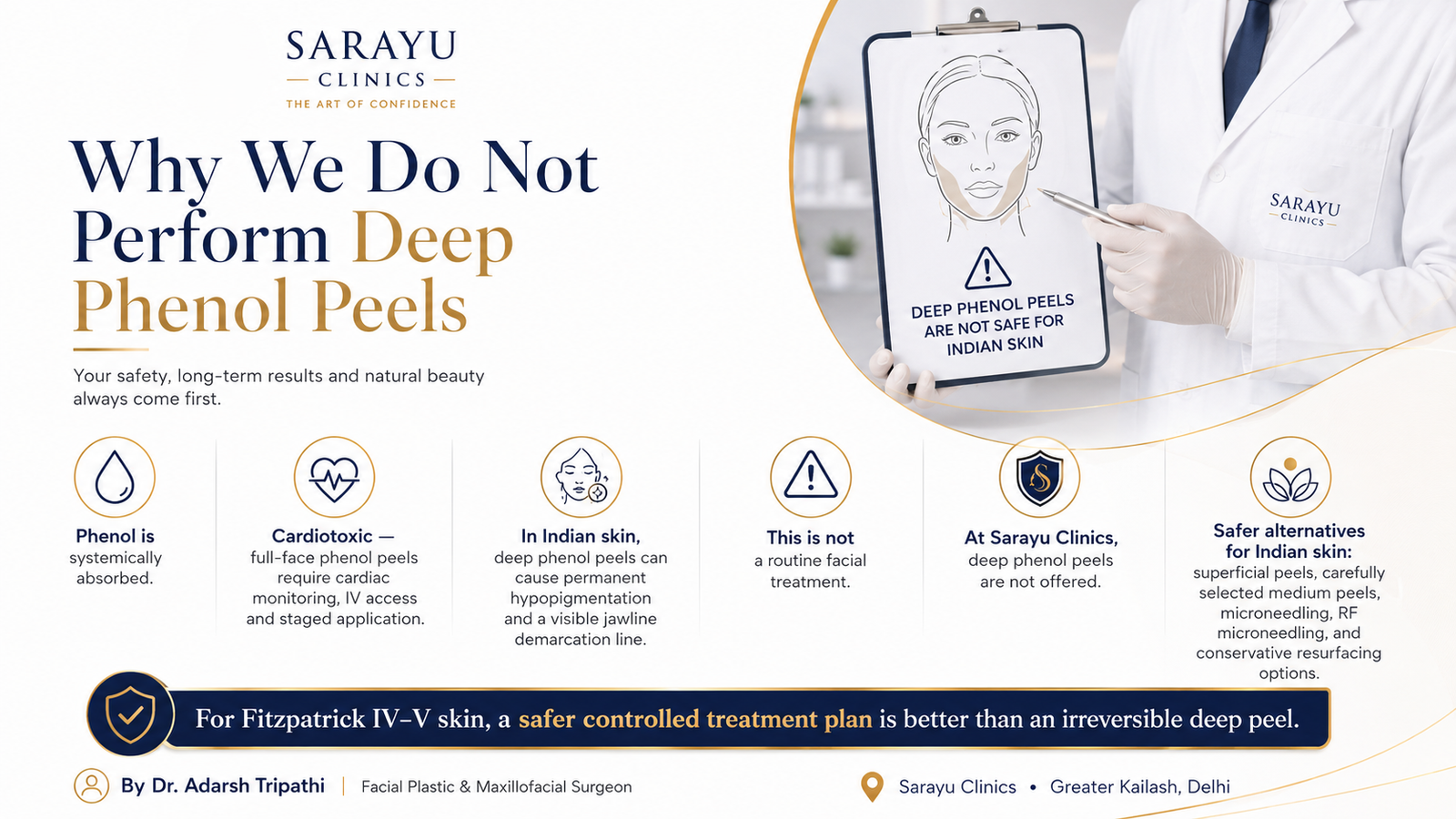
Why We Do Not Perform Deep Phenol Peels ?
This section exists because several clinic websites in Delhi currently advertise deep phenol peels with a price tag, and at least one recommends them for pigmentation. Both of those things worry us, and you deserve to know why.
Phenol is absorbed into the bloodstream, and it affects the heart
A phenol peel is not a stronger version of a glycolic facial. Phenol crosses the skin barrier and enters the systemic circulation, where it is cardiotoxic. Performed properly, a full-face phenol peel is a hospital-grade procedure: the patient has intravenous access, continuous cardiac monitoring, and the face is treated in segments with defined intervals between them, precisely to limit how fast the phenol is absorbed. Cardiac arrhythmias are a documented risk. This is a procedure that requires an anaesthetist’s involvement, not a treatment room and an hour.
Any facility offering phenol peels as a routine item on a treatment menu, priced alongside glycolic peels, has either not understood the pharmacology or is not performing what they are describing.
And in Indian skin, it destroys pigment permanently
Phenol does not merely remove tissue. It damages melanocytes — the pigment-producing cells — irreversibly. In pale skin this produces a porcelain, waxy quality that some patients accept. In Fitzpatrick IV and V skin, which is the majority of our patients, it produces permanent hypopigmentation: a face several shades lighter than the neck it sits on, with a hard demarcation line at the jaw that cannot be reversed, disguised or treated. It is not a risk. It is close to an expected outcome.
What we say to patients who ask for a deep peel ?
That there is no version of this that ends well. If you have deep static wrinkles or significant photodamage, the tools that address them in Indian skin are fractional resurfacing lasers at conservative settings, radiofrequency microneedling, or — where the problem is genuinely structural — surgery. Each of these is controllable, staged, and does not permanently remove your natural skin colour. A deep phenol peel is the aesthetic equivalent of solving a problem with something you cannot switch off. We will not perform one, and if another clinic in Delhi has offered you one, please ask them these three questions: Will I be on a cardiac monitor? Will I have IV access? What is your protocol if I develop an arrhythmia? The answers will tell you everything.
The Peeling Agents, and What Each One Is Actually For
Different acids behave differently. They are not interchangeable, and using the wrong one is the most common reason a peel course disappoints.
Mandelic acid — the right place to start in Indian skin
Derived from bitter almonds, mandelic acid has the largest molecular size of the common alpha hydroxy acids. That single physical property is why it matters here: a larger molecule penetrates the skin more slowly and more evenly, which means less irritation, less inflammation, and correspondingly less post-inflammatory hyperpigmentation in darker skin. It is antibacterial, so it works on acne. It is a tyrosinase inhibitor, so it works on pigment. It is the most forgiving agent in the cabinet and the one we most often reach for first — and it is underused across Delhi because it is unglamorous.
Salicylic acid — for oil and congestion
A beta hydroxy acid, and the important word is lipophilic: it dissolves in oil. That means it penetrates directly into a sebum-filled follicle and dissolves the plug stretching it open, which is why it is the correct agent for active acne, blackheads and congested open pores. It is also anti-inflammatory. It self-neutralises, which is a safety advantage. It is a poor choice for dry or dehydrated skin.
Glycolic acid — the workhorse, and the one that needs watching
The smallest alpha hydroxy acid molecule, and therefore the fastest and deepest-penetrating of the superficial agents. Effective for texture, dullness, fine lines and pigment. It is also the one that will burn you if it is left on too long, because it does not stop working on its own. Glycolic acid must be actively neutralised — usually with a bicarbonate solution — at a time determined by watching the skin, not by watching a clock. See the neutralisation section below, because this is where most peel injuries in India actually happen.
Lactic acid — for sensitive and dry skin
Gentle, hydrating, derived from milk. A good option for reactive skin, rosacea-prone skin, and anyone for whom glycolic is too much. Slower results, fewer problems.
Jessner’s solution — a combination, and a step up
Salicylic acid, lactic acid and resorcinol together. Applied in layers, and the number of layers determines the depth reached. Frequently used as a preparatory coat before TCA, because it disrupts the barrier evenly and lets the TCA penetrate more predictably. Requires a practitioner who can read the skin’s frosting response.
TCA — trichloroacetic acid — the medium-depth agent
At concentrations of 35 per cent and above, TCA reaches the upper dermis. It is the standard medium peel and it produces genuine results for stubborn pigmentation, sun damage, fine lines and superficial scarring. It also produces genuine peeling, genuine downtime, and genuine post-inflammatory hyperpigmentation risk in Indian skin if the patient has not been primed and the depth has not been controlled. TCA self-terminates, which is why it is safer than glycolic in careless hands and more dangerous in careless hands than it looks — because you cannot wash it off once it has gone too deep. It is also the agent used in TCA CROSS, a quite different technique in which high-strength TCA is applied to the base of individual ice-pickacne scars with a fine applicator. That is a scar treatment, not a facial peel, and it should not be confused with one.
Retinol and ‘yellow’ peels
Not acids in the conventional sense. A high-concentration retinoid is applied and left on for hours, then washed off at home; peeling follows several days later. Useful for pigment and texture with a gentler inflammatory profile. Marketed heavily; genuinely useful in the right case.
A correction: Cosmelan and Dermamelan are not chemical peels
They are widely sold as peels in Delhi. They are not. They are depigmenting mask systems — applied in clinic, left on for hours, removed at home, and followed by a strict multi-month topical protocol. They work by inhibiting tyrosinase and suppressing melanin production, not primarily by exfoliating a controlled depth of tissue. Some peeling occurs, incidentally. Calling them peels leads patients to expect a single session and a week of recovery, when what they have actually committed to is a six-month regimen. They can be excellent for resistant melasma, and they belong in the pigmentation conversation, not this one.
Neutralisation: The Question That Should Decide Where You Go
Here is a distinction almost no patient in Delhi knows, and every one of them should.
- Glycolic acid does not stop on its own. It keeps working, and keeps going deeper, until it is actively neutralised with an alkaline solution. The endpoint is judged by the practitioner watching the skin — for erythema, for frosting, for the patient’s response — not by a timer. If it is not neutralised at the right moment, it becomes a chemical burn.
- Salicylic acid and TCA self-terminate. They precipitate skin proteins and stop. They do not need neutralising, which is why they are in some ways more forgiving — and in another way less, because once the depth is reached you cannot take it back.
So the question to ask any facility offering you a glycolic peel is simply: what will you neutralise this with, and where is it? If the answer is vague, or if there is no neutraliser visible in the room, leave. This is not fussiness. It is the single mechanism by which a routine peel turns into a scar.
Parlour peels, unlabelled bottles, and why cheap is expensive
Delhi has a large informal market in chemical peeling, performed by people with no medical training, using solutions decanted into unmarked containers of unknown concentration and unknown pH. We see the results. Chemical burns. Post-inflammatory hyperpigmentation that takes eighteen months to fade. Occasionally, permanent scarring. // Four things worth checking, anywhere: Is the bottle sealed, branded, and does it state the acid and the percentage? Is a doctor prescribing the peel, or is a technician choosing it? Is there neutraliser in the room? Has anyone asked about your skin type, your medications, and whether you have taken isotretinoin in the last six months? // A chemical peel is a medical procedure that happens to be cheap. It is not a cheap procedure. The distinction matters.
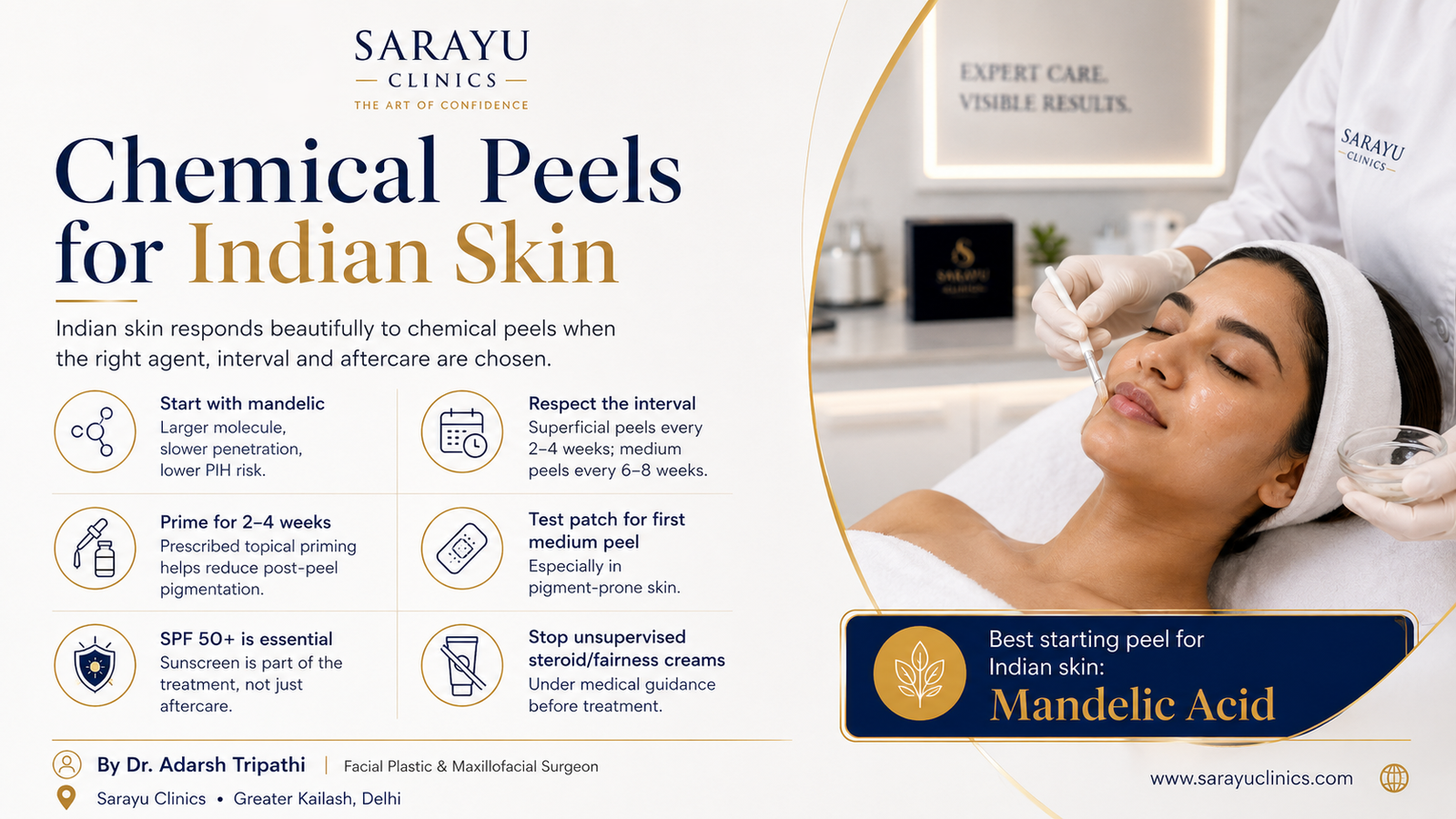
Chemical Peels for Indian Skin
Fitzpatrick IV and V skin has more melanocytes, and those melanocytes respond to inflammation by making more pigment. Every chemical peel is, by design, a controlled inflammatory injury. Read those two sentences together and the entire clinical approach follows.
- Start with mandelic. Largest molecule, slowest penetration, lowest PIH risk. Escalate only if the skin proves it can take more.
- Prime the skin for two to four weeks first. A prescribed topical protocol — typically a retinoid, sometimes with a tyrosinase inhibitor — before the first peel measurably reduces post-peel pigmentation. It also tells us how your skin behaves before we commit to anything. Clinics that bill for priming without explaining it have understood the cost and not the reason.
- Respect the interval. Superficial peels every two to four weeks. Medium peels every six to eight. Peeling more often than the skin can rebuild its barrier produces chronic inflammation, and chronic inflammation in this skin produces pigment.
- A test patch is not paranoia. For a first medium peel, a small area treated and reviewed at two weeks is standard good practice.
- Sunscreen is the treatment, not the aftercare. Broad-spectrum SPF 50+ every morning, reapplied. Freshly peeled skin has lost part of its UV defence, and UV on a peeled Indian face is how PIH is manufactured.
- Stop steroid and fairness creams before we begin. Under supervision. Peeling skin that has been thinned by unsupervised topical steroids is asking for a burn.
If Your Skin Did Not Flake, the Peel Did Not Fail
This is the most persistent misconception in the category, and it drives patients toward stronger peels than they need.
Visible flaking is not the mechanism of a chemical peel. It is an occasional side effect of one. A superficial peel works by accelerating the turnover of cells within the epidermis; in many patients that turnover happens invisibly, cell by cell, with no sheets of skin coming away at all. The peel worked. You simply did not get to watch.
Chasing the flake — asking for a stronger agent, a longer contact time, more layers — is how patients in Delhi talk themselves into a peel their skin did not want. If your practitioner is measuring success by how much you shed, find another practitioner. Success is measured at week six, in the mirror, in even tone and smoother texture.
Benefits of a Chemical Peel
- Genuinely improved texture and tone — the most reliable result, and the one that brings most patients back.
- Real reduction in pigmentation — epidermal pigment, in particular, lifts well across a course of four to six sessions.
- Effective control of active acne — salicylic acid dissolves the follicular plug, which is the origin of the lesion.
- Fewer blackheads and less visible pores — as congestion clears and the follicle contracts.
- Softening of fine lines — medium peels stimulate collagen in the papillary dermis. Superficial peels do not, and do not claim to.
- Better penetration of everything else — a peeled epidermis absorbs topical actives far more efficiently for weeks afterwards.
- Cheap, in the best sense — no capital equipment, no imported consumable. The cost is the acid and the expertise, and only one of those is expensive.
- Well-suited to Indian skin — when the correct agent is chosen. Superficial peels carry less pigmentation risk than most laser modalities.
Areas We Treat
- Full face — the standard treatment
- Neck and décolletage (lower concentrations; the skin here is thinner and less forgiving)
- Back and chest — for acne and post-acne marks
- Underarms — for friction and shaving pigmentation
- Inner thighs and intimate areas — assessed individually
- Elbows, knees and knuckles
- Backs of the hands
- Individual ice-pick acne scars, via TCA CROSS — a distinct technique, not a facial peel
Conditions & Concerns We Treat
- Active acne and congestion — salicylic and mandelic. See acne treatment.
- Post-inflammatory hyperpigmentation — the dark marks left by acne. Mandelic and glycolic, patiently.
- Melasma — gently, and never aggressively. Full detail on the melasma
- Sun spots, tanning and uneven tone — see pigmentation treatment for the depth diagnosis that decides the approach.
- Dullness and rough texture — almost universally responsive.
- Enlarged, congested pores — see open pores.
- Superficial acne scarring — medium peels help; deeper scarring needs Morpheus8, subcision or TCA CROSS.
- Fine lines and early photoageing — medium peels only.
One thing to establish before you book anything: are you treating a mark or a scar? Flat dark patches are pigment and respond to peels. Textural pits are scars and do not. Our guide to acne marks versus acne scars gives the thirty-second test.
The Procedure: Step by Step
- Assessment and agent selection. Tripathi examines your skin type, thickness, concern and history — including any isotretinoin in the last six months, any unsupervised steroid or fairness creams, any history of keloid or cold sores. The agent, concentration and contact time are decided here, not at the sink.
- Priming, for two to four weeks. A prescribed topical protocol before the first peel. This is not upselling. In Fitzpatrick IV–V skin it measurably reduces post-peel pigmentation, and it shows us how your skin behaves before we commit.
- Test patch, where indicated. For a first medium peel, a small area treated and reviewed at two weeks.
- Degreasing and preparation. The skin is cleansed and degreased with acetone or alcohol. Uneven degreasing produces uneven penetration, which produces a patchy result. This unglamorous step decides a great deal.
- The agent is applied in a defined sequence — forehead, cheeks, chin, nose, with the delicate periorbital and perioral skin treated last and most carefully. Contact time is measured, and the skin is watched throughout for erythema and, with stronger agents, for frosting.
- Neutralisation, or self-termination. Glycolic peels are actively neutralised at an endpoint judged from the skin’s response. Salicylic and TCA are allowed to self-terminate. You will feel stinging and warmth; a hand-held fan and cool compresses help.
- Post-peel care. Bland moisturiser, sunscreen, and written instructions. The appointment takes 30 to 45 minutes.
- The course, at proper intervals. Four to six superficial peels at two-to-four-week intervals; medium peels every six to eight weeks. The interval is not a scheduling convenience. It is how long your barrier takes to rebuild.
Downtime & Aftercare
- Superficial peel: mild redness and tightness for a few hours. Light flaking from day two to four, in some patients — and in many, none at all. This is normal and not a failure.
- Medium peel: visible redness, then sheets of peeling from day three to seven. Skin is fully re-epithelialised by around day ten. Plan social commitments accordingly.
- Do not pick, pull or exfoliate the peeling skin. Pulling away skin that is not ready removes living epidermis. In Indian skin this reliably produces post-inflammatory hyperpigmentation, and occasionally a scar. Let it come away on its own.
- No actives for five to seven days. No retinoids, no acids, no vitamin C, no scrubs, no facial hair removal or threading in the treated area.
- No heat for 48 hours. Sauna, steam, hot yoga, hot showers on the face. Heat drives inflammation and, in melasma, drives pigment.
- Bland moisturiser, frequently. A damaged barrier heals with moisture and nothing clever.
- SPF 50+ every morning, without exception, for at least four weeks. This is the single behaviour that determines whether your peel improves your pigmentation or worsens it.
- Tell us before you book if: you have taken isotretinoin in the last six months, get cold sores, have a keloid tendency, are pregnant, or are using any prescription or chemist-bought cream on your face.
Chemical Peel Cost in Delhi
Peels are the most affordable meaningful treatment in aesthetic dermatology, which is precisely why they are so often performed by people who should not be performing them. Verified Delhi ranges:
Treatment | Typical cost per session (INR)* |
Consultation & skin assessment | Often nominal — confirmed when you book |
Superficial peel — mandelic / lactic | Rs 1,500 – Rs 5,000 |
Superficial peel — salicylic (acne) | Rs 2,000 – Rs 6,000 |
Superficial peel — glycolic | Rs 2,000 – Rs 6,000 |
Combination / cocktail peel | Rs 3,000 – Rs 8,000 |
Jessner’s peel | Rs 4,000 – Rs 9,000 |
Medium peel — TCA 35%+ | Rs 5,000 – Rs 12,000 |
Retinol / yellow peel | Rs 4,000 – Rs 10,000 |
TCA CROSS (per session, ice-pick scars) | Rs 5,000 – Rs 15,000 |
Body peel — underarms, back, knees | Rs 3,000 – Rs 8,000 |
Priming protocol (topicals, per month) | Rs 1,500 – Rs 4,000 |
Course of 4–6 superficial peels | Package pricing after assessment — usually more economical |
Chemical Peel Per Session | Rs 25,000 |
*Indicative ranges only. Most peel plans need four to six sessions plus a priming protocol and medical-grade sunscreen, so compare on total cycle cost rather than headline session price. A peel offered at a fraction of these numbers has saved money on the acid, the practitioner, or both.
Results Timeline
Timeframe | What usually happens |
Day 0 | Redness, tightness, a mild stinging that settles within an hour. No result yet. |
Day 2–5 | Light flaking (superficial) or visible peeling (medium). In many superficial peels, nothing visible at all — which is fine. |
Day 7–10 | Skin fully re-epithelialised. It looks brighter, feels smoother. This is the first honest change. |
After session 2–3 | Clear, photographable improvement in tone and texture. Acne lesions reducing. |
After session 4–6 | The realistic endpoint of a superficial course. Epidermal pigment substantially lifted. |
Month 3 | Full benefit, including whatever collagen response a medium peel triggered. |
Ongoing | Maintenance every six to eight weeks for pigment-prone skin. Sun spots, once cleared, stay cleared — if sunscreen is worn. |
A note on weddings, because it is asked constantly. Never book a medium peel within two weeks of an event; never book any peel within one week. Start a peel course three months out. The bride shedding skin in her photographs is a real and preventable outcome.
Chemical Peel vs Laser vs Microneedling
Treatment | How it works | Best for | Indian skin safety | Downtime | Cost/session |
Superficial peel | Chemical exfoliation of epidermis | Acne, dullness, epidermal pigment | Excellent | 0–5 days | Rs 1,500–6,000 |
Medium peel (TCA) | Chemical injury to upper dermis | Deeper pigment, fine lines, superficial scars | Moderate — needs priming | 5–10 days | Rs 5,000–12,000 |
Carbon laser peel | Q-switched laser + carbon | Oily, congested, pigment-prone skin | Excellent | None | Rs 4,000–8,000 |
Microneedling | Physical micro-injury | Texture, scars, collagen | Excellent | 1–2 days | Rs 5,000–10,000 |
RF microneedling | Micro-injury + heat | Scars, laxity, deep texture | Excellent | 2–5 days | Rs 10,000–45,000 |
Fractional CO2 | Ablative resurfacing | Significant scarring, deep texture | Caution — real PIH risk | 5–10 days | Rs 8,000–20,000 |
These are not rivals. A peel course often runs alongside carbon laser peel for oily pigment-prone skin, or precedes microneedling and MNRF where texture is the dominant concern. Where scarring is significant, fractional CO2 or Morpheus8 does what no peel can. And for hydration and glow rather than exfoliation, the skin booster family answers a different question entirely.
Are You a Good Candidate?
You are likely well-suited if you have:
- Active acne, congestion, blackheads or enlarged pores
- Post-acne dark marks, uneven tone, dullness or tanning
- Rough texture and early fine lines
- Epidermal pigmentation — the kind that responds
- Any Fitzpatrick type, with the agent chosen accordingly
- Realistic expectations and the patience for a four-to-six-session course
- A genuine willingness to wear sunscreen daily — this decides the outcome
A different plan, or a delay, applies if you:
- Have taken isotretinoin within the last six months — the skin heals abnormally and scarring risk rises
- Are using an unprescribed steroid or fairness cream — this needs supervised withdrawal first
- Have active infection, eczema, open lesions or cold sores in the treatment area
- Have a history of keloid or hypertrophic scarring
- Have a history of cold sores — antiviral prophylaxis may be needed before a medium peel
- Are pregnant or breastfeeding — most peels are deferred; some superficial agents are permitted after assessment
- Have had recent facial surgery, laser or waxing in the area
- Have deep dermal pigment or textural scarring — a peel is the wrong tool and we will say so
- Have hypopigmentation such as vitiligo — an entirely different condition, requiring referral rather than exfoliation
Why Choose Sarayu Clinics for a Chemical Peel in Delhi ?
A chemical peel is the cheapest treatment we perform and the one most capable of doing permanent harm. Those two facts are related. At Sarayu Clinics, peels are prescribed and performed by facial plastic and maxillofacial surgeon Dr. Adarsh Tripathi, alongside co-founder and celebrity aesthetician Dr. Nidhi Bhatia.
- A doctor chooses the peel, not a technician. Agent, concentration, contact time and endpoint are clinical decisions made after examining your skin.
- Sealed, branded, labelled solutions. Stated acid, stated percentage, stated pH. Ask to see the bottle. We would rather you did.
- Neutraliser in the room, always. And an endpoint judged by watching your skin rather than a clock.
- Mandelic first in Indian skin. We escalate when the skin has earned it, not when the patient asks for something stronger.
- Priming explained, not just billed. Two to four weeks of topical preparation before the first peel, because it demonstrably reduces post-inflammatory pigmentation.
- We do not perform deep phenol peels. They are cardiotoxic, they require cardiac monitoring, and in Fitzpatrick IV–V skin they cause permanent hypopigmentation. We will explain the alternatives instead.
- An honest ‘no’. If your pigment is dermal, or your scarring is textural, a peel will not fix it. You will hear that at the consultation rather than after session six.
Medical Review & Sources
This page is for general information and is medically reviewed by the team at Sarayu Clinics under Dr. Adarsh Tripathi. It is not a substitute for an in-person clinical assessment. Chemical peels are medical procedures and should be prescribed and performed under medical supervision. Deep phenol peels carry systemic and cardiac risk and are not performed at this clinic. Sources:
How to Reach Us:
Phone: +91 9289111081 , +91 9289111082
Email: sarayuinquiries@gmail.com
Sarayu Clinics website: www.sarayuclinics.com
Facebook: https://www.facebook.com/sarayuclinic
Instagram: https://www.instagram.com/sarayuclinics/
Dr. Adarsh Tripathi’s profile: https://dradarshtripathi.com/
Online Booking: Visit our website https://sarayuclinics.com/contact-us/ to schedule appointments conveniently.
How much does a chemical peel cost in Delhi?
Superficial peels — mandelic, lactic, salicylic, glycolic — run Rs 1,500 to Rs 6,000 per session. Combination and Jessner’s peels are Rs 3,000 to Rs 9,000. Medium-depth TCA peels are Rs 5,000 to Rs 12,000. Most plans need four to six sessions plus a priming protocol and medical-grade sunscreen, so compare clinics on total cycle cost rather than the headline session price. A peel offered far below these ranges has saved money somewhere, usually on the acid or on the person applying it.
Which chemical peel is best for Indian skin?
Mandelic acid is the safest starting point. It has the largest molecule of the common alpha hydroxy acids, so it penetrates slowly and evenly, causing less inflammation — and less inflammation means less post-inflammatory hyperpigmentation in Fitzpatrick IV–V skin. Salicylic acid is the correct choice for oily, acne-prone skin. Glycolic is effective but penetrates fast and must be actively neutralised. Medium TCA peels are appropriate in Indian skin only with proper priming and an experienced practitioner.
Is a deep chemical peel safe?
Deep peels use phenol, and there are two serious problems with them. First, phenol is absorbed into the bloodstream and is cardiotoxic — a proper phenol peel requires intravenous access, continuous cardiac monitoring and staged application, because cardiac arrhythmias are a documented risk. Second, phenol destroys melanocytes permanently, which in Fitzpatrick IV–V skin produces permanent hypopigmentation and a visible demarcation line at the jaw. We do not perform them. Any Delhi clinic offering a phenol peel as a routine menu item, priced alongside glycolic peels, should be asked whether you will be on a cardiac monitor.
My skin didn't peel after the treatment. Did it not work?
It almost certainly worked. Visible flaking is a side effect of a chemical peel, not its mechanism. Superficial peels accelerate cell turnover within the epidermis, and in many patients that happens invisibly. Judging a peel by how much skin comes away is how people talk themselves into stronger peels than their skin needs. Judge it at week six, in the mirror.
How many chemical peel sessions will I need?
Typically four to six superficial peels at two-to-four-week intervals, or two to three medium peels at six-to-eight-week intervals. The interval matters — it is how long your skin barrier takes to rebuild. Peeling more frequently produces chronic inflammation, and in Indian skin chronic inflammation produces pigment. Melasma and pigment-prone skin need ongoing maintenance rather than a finite course.
Do chemical peels hurt?
Superficial peels sting and feel warm for a few minutes; most patients describe it as entirely tolerable, and a hand-held fan helps. Medium TCA peels burn more intensely for several minutes before settling. No anaesthetic is normally needed for either. If a peel is genuinely painful, something has gone too deep.
Can chemical peels treat melasma?
They help, and they can also make it worse. Melasma is a chronic, hormonally-driven condition that responds badly to aggression — an over-strong peel provokes the melanocytes into producing more pigment, not less. The correct approach is gentle agents, generous intervals, rigorous sun protection and topical maintenance between sessions. Cosmelan and Dermamelan, often called peels, are actually depigmenting mask systems and belong to a different treatment conversation.

What's the difference between a glycolic peel and a salicylic peel?
Glycolic acid is an alpha hydroxy acid: water-soluble, smallest molecule, penetrates fast, and must be actively neutralised or it keeps going deeper. It suits texture, dullness and pigment. Salicylic acid is a beta hydroxy acid: oil-soluble, so it penetrates directly into sebum-filled follicles and dissolves the plug. It suits acne, blackheads and congested pores, and it self-terminates rather than needing neutralising.
Are peels from a beauty parlour safe?
Frequently not. A chemical peel is a medical procedure that happens to be inexpensive. Four checks, anywhere in Delhi: is the bottle sealed, branded, and labelled with the acid and percentage? Is a doctor choosing the peel, or a technician? Is neutraliser physically present in the room? Has anyone asked about isotretinoin, steroid creams and your skin type? Chemical burns, prolonged hyperpigmentation and occasionally permanent scarring are what we see from unlabelled solutions applied by untrained hands.
Can I have a chemical peel before my wedding?
Yes, with correct timing. Start a peel course three months before the event. Never have a medium-depth peel within two weeks of the wedding, and no peel at all within the final week — shedding skin in the photographs is a real and entirely preventable outcome. A superficial hydrating peel roughly ten days out is a reasonable final step, provided your skin already knows what to expect from it.