
Dermal Fillers in Delhi
- Home
- Dermal Fillers in Delhi
Dermal Fillers in Delhi
Dermal fillers are the most versatile tool in non-surgical aesthetics, and also the most misunderstood. Used well, a filler restores the volume a face loses with age, sharpens a soft jawline, lifts a flattening cheek, smooths a deep fold, or balances a feature that has always sat slightly off — all in twenty minutes, with a result you can see the same day. Used badly, it produces the puffy, overfilled, faintly startled look that has given the whole category a bad name, and, very rarely, something far more serious.
The difference between those two outcomes is not the filler. It is the anatomy in the hands holding the needle. A dermal filler is a gel injected close to the blood vessels and nerves of the face; where it goes, how deep, in what quantity, and along which plane are decisions that separate a natural result from an obvious one, and a safe procedure from a dangerous one.
At Sarayu Clinics in Greater Kailash, dermal fillers are administered by facial plastic and maxillofacial surgeon Dr. Adarsh Tripathi, alongside co-founder Dr. Nidhi Bhatia. This page is the honest, complete guide to fillers in Delhi — what they are, which type does what, what each area needs, what it costs, and the safety facts that most clinic pages leave out because they complicate the booking.

The short answer : Dermal fillers are injectable gels that restore volume, smooth folds and refine facial contours. Most are hyaluronic acid (HA) — the same substance your skin makes naturally — which is safe, versatile, and crucially REVERSIBLE: it can be dissolved with an enzyme called hyaluronidase if there is overcorrection or a complication. Other types (Radiesse/calcium hydroxylapatite and Sculptra/poly-L-lactic acid) stimulate your own collagen and last longer, but cannot be dissolved. Fillers treat lips, cheeks, jawline, chin, nose, tear troughs, folds and facial asymmetry, and last roughly 6–18 months depending on type and area. The procedure takes 15–30 minutes with little downtime. The most important safety fact: fillers are injected near facial arteries, and a rare complication called vascular occlusion can, in the worst case, threaten vision — which is why fillers should be done by a medically qualified injector who carries hyaluronidase and knows how to use it, never by a salon. Delhi cost is roughly Rs 15,000–50,000+ per syringe by area and product. The right filler is the one matched to your anatomy — and sometimes the honest answer is that filler is not what you need.
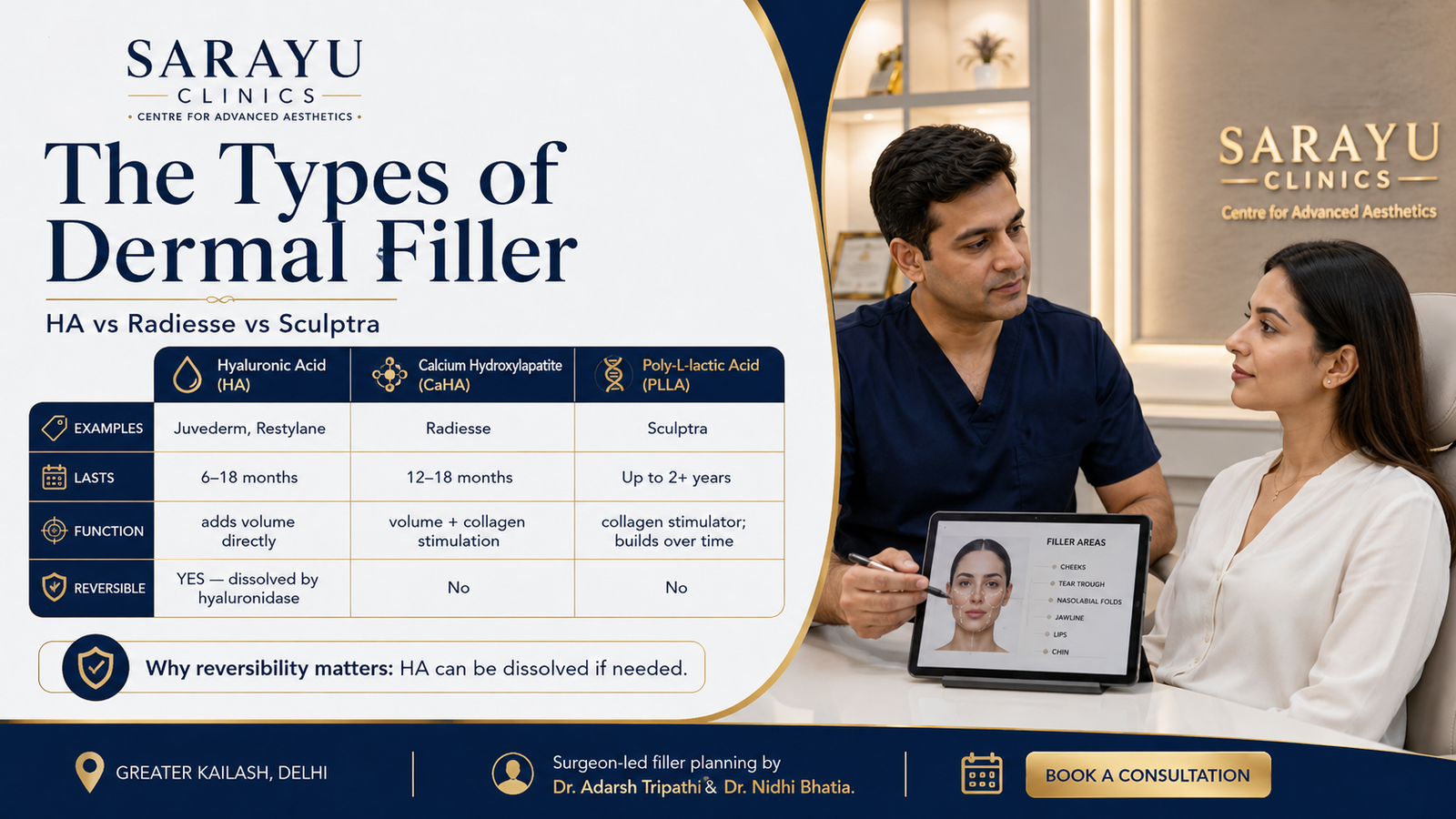
The Types of Dermal Filler
Not all fillers are the same substance, and the differences matter — for how long your result lasts, for what it can treat, and above all for whether it can be reversed in an emergency. This is the first thing a good consultation establishes.
Filler type | Examples | Lasts | How it works | Reversible? |
Hyaluronic acid (HA) | Juvederm, Restylane | 6–18 months | Adds volume directly; holds water | YES — dissolved by hyaluronidase |
Calcium hydroxylapatite (CaHA) | Radiesse | 12–18 months | Adds volume AND stimulates your own collagen | No |
Poly-L-lactic acid (PLLA) | Sculptra | Up to 2+ years | A collagen stimulator; result builds over months | No |
Why reversibility is the fact that should guide most patients : Hyaluronic acid accounts for the large majority of filler procedures worldwide for one overriding reason: it can be dissolved. If the result is overcorrected, if a lump forms, or — critically — if a blood vessel is compromised, an injection of hyaluronidase breaks the HA down and reverses it. Radiesse and Sculptra cannot be dissolved this way; a poor result or a complication with them is far harder to manage. For this reason, HA is almost always the right choice for a first-time filler patient, and it is what we reach for in the great majority of cases. Radiesse and Sculptra have genuine roles — for collagen stimulation and longer structural support — but they are decisions made with a clear understanding of the trade-off, not defaults.
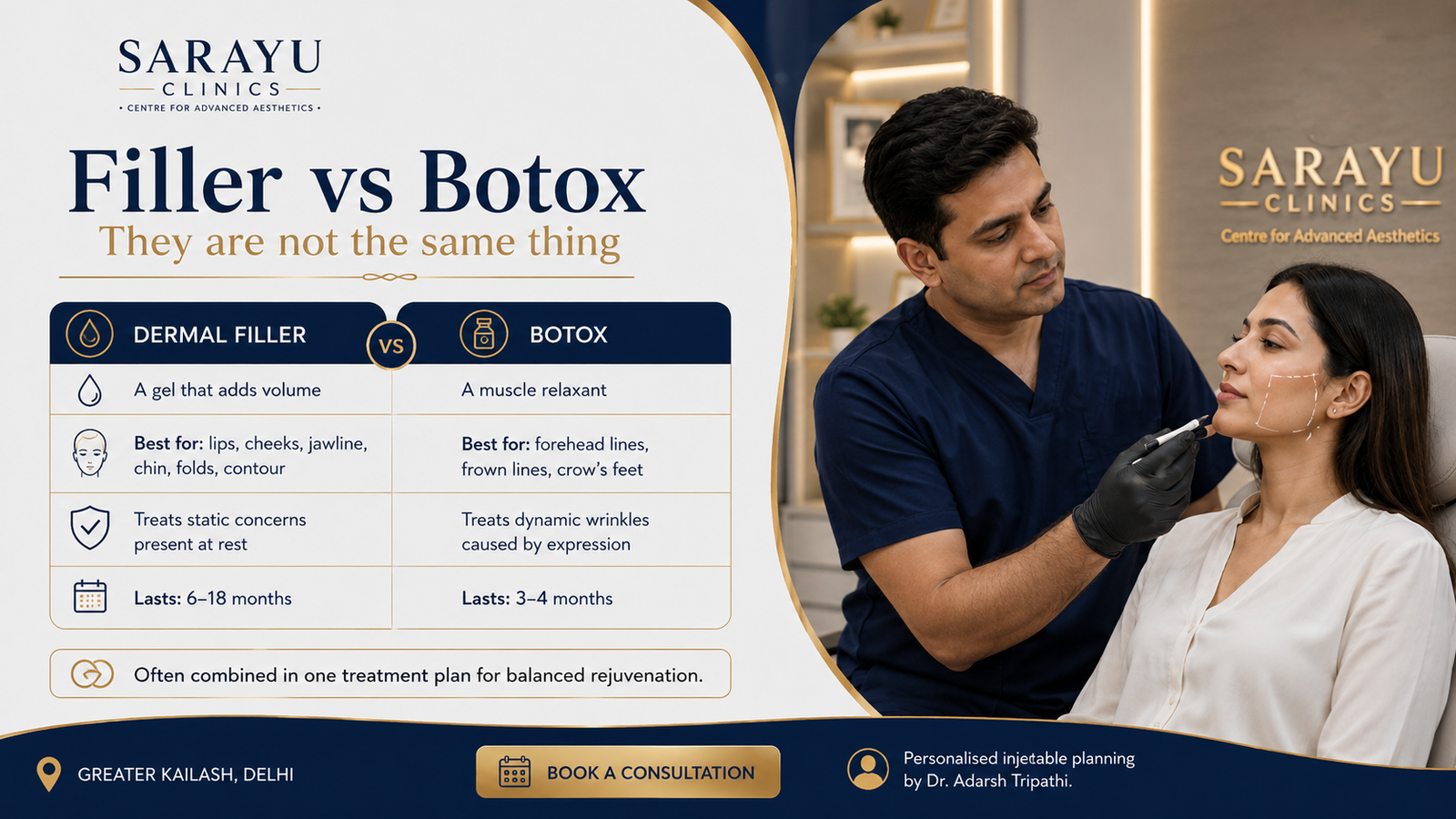
Filler vs Botox: They Are Not the Same Thing
The two most common injectables are constantly confused, and they do opposite jobs. Getting this straight tells you immediately whether you are even on the right page.
| Dermal Filler | Botox |
What it is | A gel that adds volume | A muscle relaxant |
What it treats | Volume loss, folds, contour, shape — STATIC concerns present at rest | Dynamic wrinkles caused by muscle movement (frown, forehead, crow’s feet) |
The test | If the line is there when your face is still, it is a filler concern | If the line appears only when you make an expression, it is a Botox concern |
Lasts | 6–18 months | 3–4 months |
The two are frequently used together — filler to restore volume, Botox to soften expression lines — as part of a single plan. But they are different tools for different problems, and a clinic that reaches for one when you need the other is not assessing you properly.
Benefits of Dermal Fillers
- Immediate, visible results — with HA fillers you see the change on the table, unlike collagen-stimulating treatments that build over months.
- Restores age-related volume loss — the cheeks, temples and mid-face hollow with age; filler puts the structure back.
- Sharpens contour and definition — jawline, chin and cheekbones can be defined without surgery.
- Softens folds and lines — nasolabial folds, marionette lines and other static creases.
- Corrects asymmetry — small, precise adjustments to balance a feature that sits slightly off.
- Reversible, with HA — a safety net no surgical option offers: if you dislike it, it can be dissolved.
- Minimal downtime — most people return to normal activity immediately, with mild swelling or bruising at most.
- Collagen stimulation — some fillers improve skin quality over time as well as adding volume.
Areas We Treat with Fillers
Fillers are used across the face, and each area has its own considerations. Several have dedicated pages with the full detail — follow the links.
- Lips — volume, definition, shape and hydration. See lip fillers in Delhi.
- Cheeks — restoring mid-face volume and lifting a flattened cheek. See cheek fillers in Delhi.
- Jawline — definition and contour along a soft or undefined jaw. See jawline enhancement in Delhi.
- Chin — projection and balance for a recessed or weak chin. See chin enhancement in Delhi.
- Nose — smoothing a bump or refining the tip without surgery. See non-surgical rhinoplasty in Delhi.
- Under-eyes / tear trough — filling a hollow that casts a shadow. The most technically demanding and highest-risk area. See dark circle treatment in Delhi.
- Nasolabial folds and marionette lines — softening the deep creases from nose to mouth and mouth to chin.
- Temples — restoring hollowing at the sides of the forehead that ages the upper face.
- Facial asymmetry — balancing features that sit unevenly. See fillers for facial asymmetry in Delhi.
Conditions & Concerns Fillers Address
- Age-related volume loss — the hollowing of cheeks, temples and mid-face.
- Thin or asymmetric lips — shape, volume and balance.
- A weak or recessed chin, or undefined jawline — structure and projection.
- Deep static folds — nasolabial and marionette lines present at rest.
- Under-eye hollows — shadow-casting tear troughs, treated with great caution.
- A dorsal hump or drooping nasal tip — in suitable candidates, without surgery.
- Facial asymmetry — congenital or acquired imbalance.
- Acne-scar depressions — selected rolling scars, as one part of a scar plan.
The Procedure: Step by Step
- Consultation and facial assessment. Tripathi assesses your whole face — not just the area you mention — because balance depends on the relationships between features. Your goals, medical history, allergies and any previous filler are reviewed.
- Choosing the filler and the plan. The type (usually HA), the product, the amount and the placement are matched to your anatomy and goal, and explained to you. You are told which product is going where, and why.
- Most fillers contain lidocaine, and a topical numbing cream is applied as well. Discomfort is minimal.
- The filler is injected with a fine needle or a cannula, depending on the area — a cannula is often safer in high-risk zones because it is less likely to pierce a vessel. Small amounts, placed deliberately, assessed as we go.
- Moulding and review. The filler is gently shaped, and the result checked for symmetry in an upright position and good light.
- Written instructions, and a review. Hyaluronidase is on the premises throughout, for the rare event it is needed.
Downtime & Aftercare
- Swelling: peaks in the first 24–48 hours and settles over one to two weeks. Lips swell the most.
- Bruising: possible at injection points, usually fading within 5–7 days. Avoid blood-thinning supplements beforehand where medically appropriate.
- Temporary lumps or unevenness: usually settle as the filler integrates over a week or two.
- Avoid for 24–48 hours: strenuous exercise, sauna, steam, hot yoga and alcohol, all of which worsen swelling.
- Do not massage the area unless specifically instructed.
- Cold sore history: tell us before lip filler — antiviral cover may be needed, as injection can trigger a flare.
- Don’t book right before an event: allow two weeks before a wedding or shoot, in case of swelling or bruising.
- Know the warning signs: severe or increasing pain, blanching (white skin), a dusky or mottled colour, or any vision change is not normal — contact us immediately. These are the signs of the complication described below.
The Procedure: Step by Step
- Skin assessment and honest suitability check. Tripathi assesses hydration, texture, skin quality and the specific area of concern. If your dominant problem is volume, sagging, pigment or scarring, SkinVive is the wrong treatment and you will hear that before you book it.
- Allergy screening. Specifically for lidocaine allergy, previous allergic reaction to hyaluronic acid fillers, a history of anaphylaxis or multiple severe allergies, and allergy to Gram-positive bacterial proteins. All four are contraindications.
- Product verification. Ask to see the sealed Allergan syringe, its batch number and packaging — whether it is labelled SkinVive or Juvéderm Volite. We will show you before it is opened.
- Topical anaesthetic is applied, though SkinVive contains 0.3% lidocaine itself, which does much of the work. This is the most comfortable of the skin-quality injectables.
- Microdroplet injection. An ultrafine 32-gauge needle deposits many small droplets across the cheek, spaced roughly five millimetres to a centimetre apart, so the gel distributes evenly. A typical session uses two to three millilitres and takes well under an hour.
- Immediate aftercare. Small bumps and mild redness are expected and settle within hours. A cool compress, and written instructions before you leave.
- Optional touch-up at one month. Assessed at review rather than assumed. Some patients need it; many do not.
- Every six to nine months to sustain the result.
Downtime & Aftercare
- First few hours: small bumps at the injection points and mild redness. These are the most common effects and they settle quickly — this is the lowest-downtime injectable in the skin-quality category.
- Possible for 1–4 weeks: mild swelling, small lumps, bruising, tenderness. Uncommon, usually minor, and self-resolving. Reported in the clinical data and worth knowing about.
- First 24 hours: avoid strenuous exercise, extensive sun or heat exposure, saunas, steam and alcohol.
- Do not book laser, chemical peel or other procedures immediately afterwards without telling your doctor. There is a possible risk of an inflammatory reaction at the treatment site. This is in the manufacturer’s own safety information and it is routinely ignored.
- Delay treatment if you have skin sores, pimples, rashes, hives, cysts or infection in the area.
- SPF 50+ daily. Standard, and non-negotiable.
- Return to work: the same day, in almost every case.
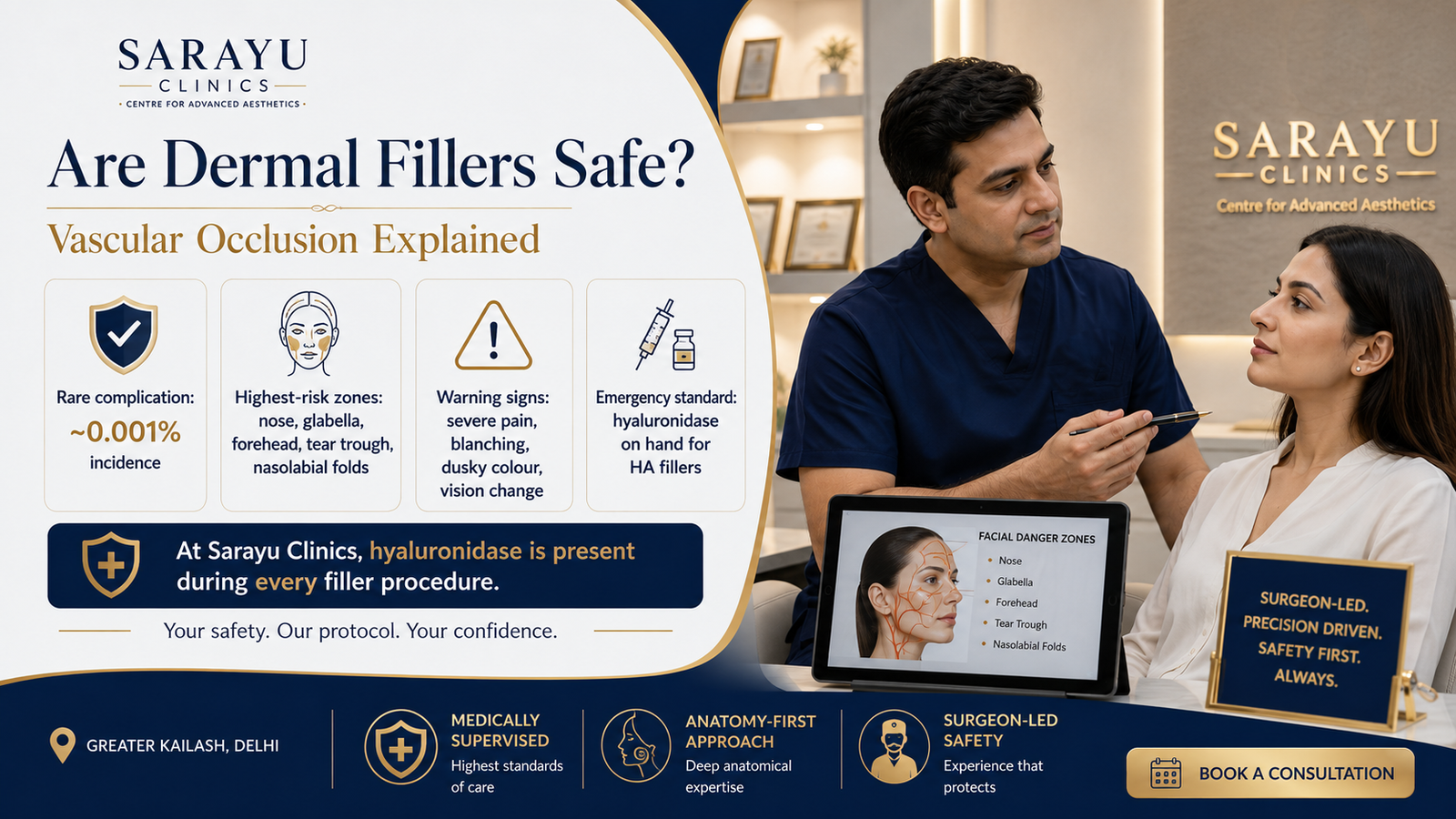
Are Dermal Fillers Safe? Vascular Occlusion Explained
Dermal fillers have an excellent safety record when performed correctly. But there is one serious complication every patient deserves to understand before being injected — and which most Delhi clinic pages do not mention, because it complicates the sale. Understanding it is exactly what lets you choose a safe injector.
The complication is called vascular occlusion. It happens when filler is injected into, or presses on, a blood vessel, cutting off blood supply to the tissue it feeds. In most cases this threatens the skin, causing pain, blanching and, if untreated, tissue damage. In the rare worst case — when filler reaches an artery connected to the eye — it can cause visual loss. The overall incidence is very low, on the order of 0.001 percent, but the consequences are severe, and the risk is real enough that it should govern who you let inject you.
- The danger zones are known. Systematic reviews consistently identify the glabella (between the brows), the nose, the forehead, the tear trough and the nasolabial folds as the highest-risk sites. The artery that supplies the eye can be reached from the nose and the glabella — which is exactly why non-surgical nose filler and under-eye filler must be done by someone who knows the vasculature intimately.
- The reversal agent must be present. For HA fillers, high-dose hyaluronidase can dissolve the blockage — but the window matters enormously. For threatened vision, reversing the occlusion within roughly 90 minutes is critical. Hyaluronidase is useless in a drawer across town. At Sarayu, it is present during every single filler procedure. This is non-negotiable.
- Technique reduces the risk. Cannulas rather than needles in high-risk areas, small boluses, slow injection, aspiration where appropriate, and deep and deliberate placement all lower the odds. These are learned skills, not settings on a machine.
- This is the whole argument for a medically qualified injector. A beauty technician in a non-clinical setting cannot recognise a vascular event early, does not carry hyaluronidase, and cannot manage the emergency. This single fact is the most important reason to choose a doctor over a salon for any filler.
The questions to ask any clinic before filler — anywhere : Is a doctor performing my injection? Is hyaluronidase physically in this room right now? Do you know the signs of vascular occlusion and have a written emergency protocol? What filler are you using, is it a sealed branded product, and is it HA (reversible) or not? A clinic that answers these easily is a clinic that has thought about your safety. A clinic that becomes uncomfortable has answered you.

How Much Do Dermal Fillers Cost in Delhi?
Fillers are usually priced per syringe (typically 1ml), and the number of syringes depends on the area and the correction. Indicative Delhi ranges:
Area / product | Typical cost (INR)* |
Consultation & facial assessment | Often nominal — confirmed when you book |
HA filler — per syringe (1ml), by brand | Rs 18,000 – Rs 40,000 |
Lip filler (per syringe) | Rs 18,000 – Rs 35,000 |
Cheek filler (per syringe) | Rs 20,000 – Rs 50,000 |
Jawline / chin (often 2–4 syringes) | Rs 40,000 – Rs 1,20,000 |
Under-eye / tear trough (per syringe) | Rs 18,000 – Rs 45,000 |
Non-surgical rhinoplasty | Rs 20,000 – Rs 45,000 |
Radiesse (CaHA) — per syringe | Rs 25,000 – Rs 50,000 |
Sculptra (PLLA) — per vial, course of 2–3 | Rs 25,000 – Rs 45,000 per session |
Full-face / liquid facelift plan | Individualised after assessment |
*Indicative ranges only. With fillers, the cheapest quote is the one to be most wary of — it usually means a cheaper or unbranded product, fewer syringes than the correction needs, or a non-medical injector without hyaluronidase on hand. The product, the injector’s qualification, and the availability of the reversal agent are not upgrades. They are the baseline of a safe treatment. Ask to see the sealed, branded syringe.
Prices shown are for guidance only. Your final treatment cost will be confirmed during the initial consultation, based on your individual needs, concerns, and personalised treatment plan.
Results Timeline
Timeframe | What usually happens |
Day 0 | Immediate visible result (HA). Some swelling; the area may look slightly overfilled. |
Day 1–2 | Swelling peaks, especially lips. This is not the final result — do not judge it yet. |
Day 3–7 | Bruising fades; swelling subsides; the result begins to look natural. |
Week 2 | Filler has settled and integrated. This is your true result — the point to review. |
Month 1 | Any small unevenness has resolved. A top-up, if needed, is assessed now. |
Month 6–18 | Gradual, even reabsorption depending on filler type and area. Top up before it fully fades for the simplest maintenance. |
Note the Sculptra exception: it is a collagen stimulator, so there is no immediate result — it builds gradually over two to three months across a course of sessions, and lasts longest of all.
When Filler Is NOT the Answer ?
A hub page that only sells filler is not being honest. Fillers are the right tool for volume, contour and static folds — and the wrong tool for several things they are routinely mis-sold for.
- Significant sagging needs lifting, not filling. Overfilling a sagging face to ‘lift’ it produces the heavy, distorted look everyone fears. Real laxity needs HIFU, a thread lift, or a surgical facelift.
- Dynamic wrinkles need Botox, not filler. Frown lines, forehead lines and crow’s feet are muscle movement. Filling them is the wrong mechanism.
- True eye bags need surgery, not filler. A herniated fat pad can be worsened by filler; it needs eyelid surgery.
- Pigment and skin quality are not filler problems. Dark circles that are pigmented, dull skin, and texture need pigment and skin treatments, not gel.
If filler is not what you need, you will be told so at the consultation. That is the advantage of being assessed by a surgeon who can offer the alternative rather than by a clinic that only sells the injectable.
Why Choose Sarayu Clinics for Dermal Fillers in Delhi ?
Fillers are easy to inject and hard to inject well, and the difference is measured in millimetres and in anatomy. At Sarayu Clinics they are administered by facial plastic and maxillofacial surgeon Dr. Adarsh Tripathi, alongside co-founder Dr. Nidhi Bhatia.
- A surgeon’s knowledge of facial anatomy. Fillers sit beside arteries and nerves. Knowing exactly where they run is what keeps the procedure safe and the result natural.
- Hyaluronidase on hand, every single time. The reversal agent for HA filler is present during every procedure, and our clinicians are trained to recognise and manage a vascular event. This is non-negotiable, and it is not universal in Delhi.
- Sealed, branded, quality product. You may ask to see the syringe. HA by default, for its reversibility, unless there is a specific reason to choose otherwise — explained to you.
- The whole face, assessed together. Balance comes from relationships between features. We assess all of it, not just the area you booked.
- Natural results, by restraint. The goal is that people notice you look well, not that you have had filler. Less, placed correctly, beats more.
- An honest ‘no’. If your concern is sagging, dynamic lines, pigment or something surgical, we will tell you filler is the wrong tool — and offer the right one.
Medical Review & Sources
This page is for general information and is medically reviewed by the team at Sarayu Clinics under Dr. Adarsh Tripathi. It is not a substitute for an in-person clinical assessment. Dermal fillers should be administered only by a medically qualified injector with hyaluronidase available and knowledge of periorbital and facial vascular anatomy. Warning signs of vascular occlusion — severe pain, blanching, dusky discolouration or any vision change — require immediate medical attention. Sources:
- Vascular Occlusion Following Dermal Filler Injections: A Systematic Review of Clinical Evidence and Emergency Management (2025)
- Hyaluronidase for Dermal Filler Complications: Review of Applications and Dosage Recommendations — PMC
- Vascular Complications after Facial Filler Injection: A Literature Review and Meta-analysis — JCAD
- American Society of Plastic Surgeons — Dermal fillers
- American Academy of Dermatology — Fillers
How to Reach Us:
Phone: +91 9289111081 , +91 9289111082
Email: sarayuinquiries@gmail.com
Sarayu Clinics website: www.sarayuclinics.com
Facebook: https://www.facebook.com/sarayuclinic
Instagram: https://www.instagram.com/sarayuclinics/
Dr. Adarsh Tripathi’s profile: https://dradarshtripathi.com/
Online Booking: Visit our website https://sarayuclinics.com/contact-us/ to schedule appointments conveniently.
How much do dermal fillers cost in Delhi?
Most fillers are priced per syringe (usually 1ml), at roughly Rs 18,000–40,000 for hyaluronic acid depending on brand and area. Lips run Rs 18,000–35,000; cheeks Rs 20,000–50,000; jawline or chin often needs two to four syringes at Rs 40,000–1,20,000; Radiesse and Sculptra are Rs 25,000–50,000. Because the number of syringes depends on the correction, compare on the total plan, and be wary of the cheapest quote — it usually means a cheaper product, too little of it, or a non-medical injector without the reversal agent on hand.
What are dermal fillers made of?
Most are hyaluronic acid (HA), a sugar molecule your skin makes naturally, which adds volume and holds water — and can be dissolved with an enzyme if needed. Others are calcium hydroxylapatite (Radiesse), which adds volume and stimulates collagen, and poly-L-lactic acid (Sculptra), a collagen stimulator that builds results over months. HA is by far the most common because it is reversible, which makes it the safest choice for most patients.
Are dermal fillers safe?
When performed by a medically qualified injector, yes — fillers have an excellent safety record. The serious complication to understand is vascular occlusion, where filler blocks a blood vessel; it is rare (about 0.001%) but can, in the worst case involving the arteries near the eye, threaten vision. This is why fillers should be done by a doctor who knows the facial anatomy, uses safe technique, and — crucially — keeps hyaluronidase on hand to reverse HA filler in an emergency, never by a salon. Ask whether the reversal agent is in the room before you are injected.
How long do dermal fillers last?
It depends on the type and area. Hyaluronic acid fillers last roughly 6–18 months — shorter in mobile areas like the lips, longer in stable areas like the cheeks. Radiesse lasts 12–18 months, and Sculptra can last over two years because it stimulates your own collagen. Metabolism, the area treated and how much movement it gets all affect longevity.
What's the difference between fillers and Botox?
They do opposite things. Filler is a gel that adds volume — for volume loss, folds, and contour that are visible when your face is at rest. Botox is a muscle relaxant — for dynamic wrinkles that appear when you make an expression, like frown and forehead lines. A simple test: if the line is there when your face is still, it is usually a filler concern; if it appears only when you move, it is a Botox concern. They are often combined in one plan.
Do dermal fillers hurt?
Not much. Most fillers contain lidocaine, a local anaesthetic, and a topical numbing cream is applied beforehand, so discomfort is minimal — usually a brief pinch or pressure. The lips are the most sensitive area. A cannula, used in some areas, is often more comfortable than a needle as well as safer.
Can dermal fillers be dissolved or reversed?
Hyaluronic acid fillers can — an injection of hyaluronidase breaks the filler down within hours, whether for overcorrection, a lump, or an emergency. This reversibility is the single biggest safety advantage of HA and the reason it is the default choice. Radiesse and Sculptra cannot be dissolved this way, which is one reason they are used more selectively and why the choice of filler type matters.

How long is the downtime after fillers?
Little. Most people return to normal activity immediately. Mild swelling and possible bruising at the injection points are the main effects; swelling peaks at 24–48 hours (most in the lips) and settles over one to two weeks, and bruising usually fades in 5–7 days. Avoid strenuous exercise, alcohol, sauna and steam for a day or two, and don’t book within two weeks of an important event.
Will fillers make me look overfilled or fake?
Not when done well and with restraint — that look comes from too much filler, placed poorly, chasing a result filler cannot give (such as ‘lifting’ a sagging face by overfilling it). The goal of a good injector is that people notice you look well-rested, not that you have had work done. This is largely about the judgement and anatomical knowledge of the person injecting, which is why the choice of injector matters more than the choice of product.
Can dermal fillers lift sagging skin?
Only to a very limited degree, and trying to lift significant sagging with filler is a common and costly mistake — it produces a heavy, overfilled look rather than a lift. Filler restores volume; it does not remove excess skin or reposition deep tissue. Genuine sagging needs skin-tightening such as HIFU, a thread lift, or a surgical facelift. A clinic that offers all of these can tell you honestly which you need; one that only sells filler cannot.