BEARD HAIR TRANSPLANT IN DELHI
- Home
- BEARD HAIR TRANSPLANT IN DELHI
Beard Hair Transplant in Delhi
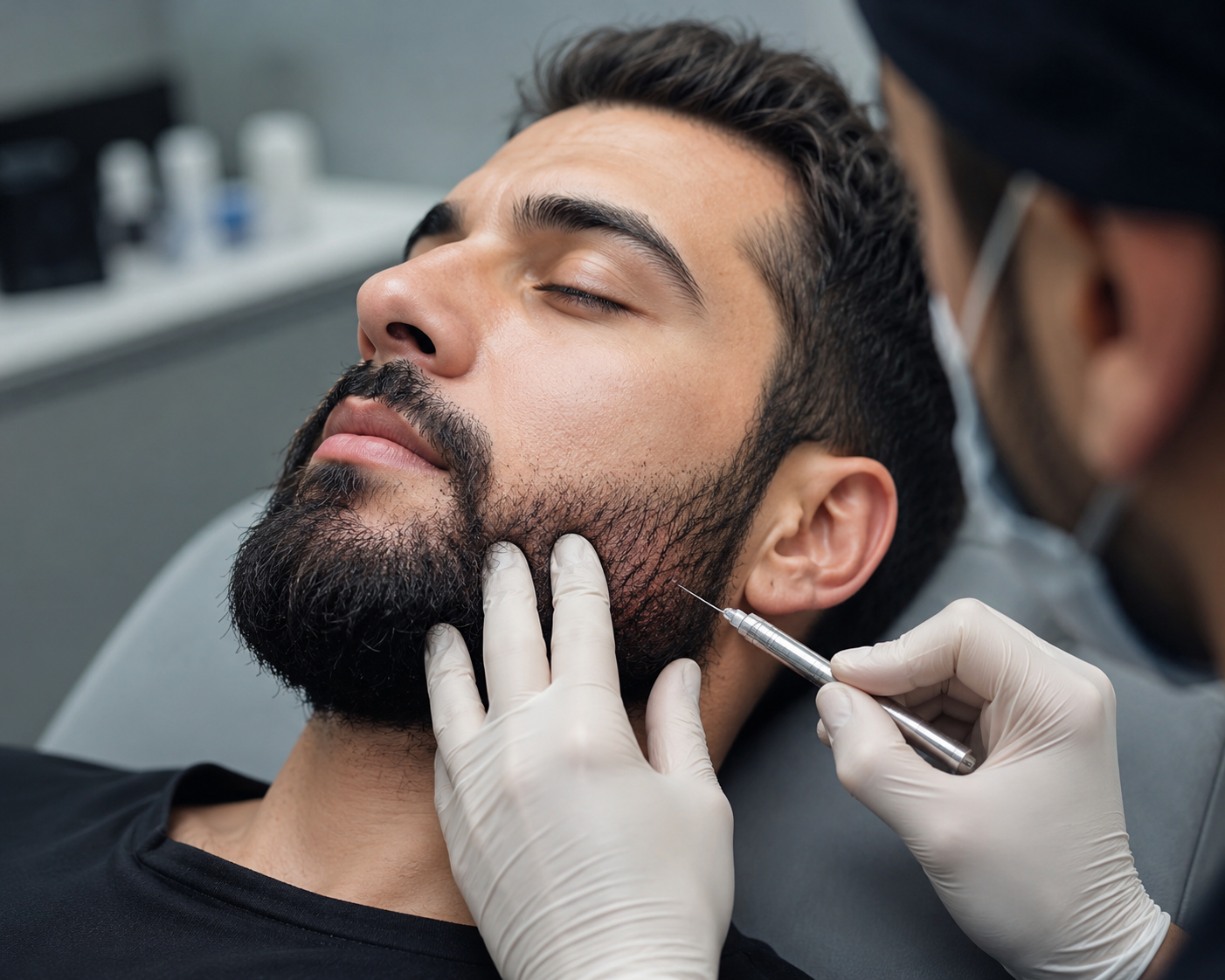
A good beard does something no razor or grooming product can do on its own — it changes the way a face reads. A well-defined jaw looks stronger. Features appear more proportionate. And for men who have spent years hoping the patches would fill in, or who have never been able to grow facial hair at all, the absence of a beard is something that occupies far more mental space than it should.
Beard hair transplantation is one of the most technically precise — and most personally rewarding — procedures in aesthetic surgery. It is not about chasing trends. It is about giving a man the face he was meant to have.
At Sarayu Clinics in Greater Kailash-1, New Delhi, Dr. Adarsh Tripathi — a Facial Plastic and Maxillofacial Surgeon with over 18 years of clinical experience — performs beard transplants using FUE (Follicular Unit Extraction), DHI (Direct Hair Implantation), and the clinic’s own BIO-FUE graft enhancement protocol. Every beard is designed individually, mapped to your facial structure, natural hair direction, and the result you actually want — not a generic template.
This page covers everything: how the procedure works, how long it takes, how much it costs, what results to realistically expect, and what makes Sarayu Clinics one of the most trusted names for beard restoration in India. Read through it, and when you are ready, come in and talk to us.
What Exactly Is a Beard Hair Transplant?
A beard hair transplant is a surgical procedure in which individual hair follicles — typically extracted from the back or sides of the scalp (and sometimes from the nape of the neck, which closely matches beard hair texture) — are carefully implanted into the beard area of the face. The follicles are taken from areas that are genetically resistant to hair loss, meaning once transplanted, they grow permanently.
Unlike a scalp hair transplant where the recipient surface is flat and follicle direction is relatively uniform, a beard transplant involves placing each follicle at a very specific angle and direction that changes zone by zone across the face — the chin grows differently from the cheek, which grows differently from the jaw, moustache, and sideburns. This multi-directional precision is what separates an experienced beard surgeon from a general hair transplant technician.
Key Facts About Beard Hair Transplant
Procedure type: Minimally invasive surgical procedure (local anaesthesia)
Duration: 4–8 hours depending on graft count and technique
Graft source: Back/sides of scalp or nape of neck (most common); body hair if needed
Techniques used at Sarayu: FUE, DHI (Choi pen), BIO-FUE enhanced protocol
Recovery: 7–10 days for visible healing; full social presentability
Results: Visible from 3–4 months; full result at 10–14 months
Permanence: Yes — transplanted follicles are DHT-resistant and grow for life
Graft count: 500–2,500 grafts depending on coverage area and desired density
Suitable for: Patchy beard, absent beard, post-scar, post-trauma, alopecia (stable cases)
Why More Men in Delhi Are Choosing Beard Transplants ?
The numbers do not lie: beard transplant requests have grown faster than any other aesthetic procedure among men in India over the past five years. And the reasons are straightforward.
The Bollywood-influenced beard aesthetic — the shaped, full, contoured beard seen on actors and athletes — has become the benchmark for male grooming. For men who cannot achieve this naturally, no amount of grooming, minoxidil, or beard oils will create what genetics have not provided. A transplant does.
Reason for Choosing a Beard Transplant | What It Really Means |
Genetics | Some men simply cannot grow a full beard — no product in the world changes that. A transplant is the only permanent solution. |
Patchy, Uneven Growth | Patchy beards are more frustrating than no beard at all — the irregularity draws attention. A targeted transplant fills specific zones. |
Post-Acne Scarring | Severe acne scars on the face can destroy follicles in localised areas, creating permanent bald patches within the beard region. |
Burns, Trauma, or Surgery | Facial burns, accidents, or previous surgical incisions (including jaw surgery) can permanently damage follicles in specific areas. |
Alopecia Areata (stable) | Patchy autoimmune hair loss in stable cases can be addressed with transplantation once the condition is confirmed inactive. |
Personal Confidence | A beard is one of the most visible expressions of male identity. Its absence — when you want one — affects confidence in a very real, daily way. |
Professional & Social Appearance | Many clients cite professional environments, social media presence, and life milestones (weddings, career changes) as motivating events. |
Correcting Previous Transplant | Patients unhappy with previous procedures (poor angle, low density, unnatural pattern) come to Sarayu Clinics for corrective restoration. |
Benefits of Beard Hair Transplant – What You Actually Gain
Here is an honest look at what a well-performed beard transplant delivers — not the marketing version, the clinical version:
Benefit | Clinical Reality |
Permanent Result | Transplanted follicles are taken from DHT-resistant scalp zones. They are genetically programmed to grow for life — no repeat procedures, no ongoing treatment required. |
Completely Natural Look & Feel | When placed at correct angles with correct density distribution, transplanted beard hair is biologically identical to native facial hair — it grows, feels, and behaves exactly the same. |
Shave, Trim & Style Normally | From about 3 months post-procedure, the transplanted hair can be shaved, shaped, and styled completely normally. A razor does not know the difference. |
Precisely Designed, Not Generic | At Sarayu Clinics, every beard is designed around your face — its shape, proportions, existing hair direction, and what you actually want. Not a template. Not a stock result. |
Single Investment | Compared to years of minoxidil, derma rollers, and beard serums that rarely work for genetic beard loss, one transplant delivers a lifetime result at a fraction of the cumulative spend. |
Minimal Downtime | Most patients are back at their desk within 3–5 days. Social downtime (visible redness/scabbing) is 7–10 days for most beard cases. |
High Success Rate | With BIO-FUE graft preservation and microscopic follicle assessment, graft survival at Sarayu Clinics exceeds 95%. Failed grafts are extremely rare when the protocol is followed correctly. |
Confidence — Not Trivial | Clinical studies consistently link facial hair satisfaction in men with measurable improvements in social confidence and reduced appearance-related anxiety. This is not a vanity claim. |
No Visible Donor Scar | FUE extraction leaves tiny dot marks at the back of the scalp that are imperceptible once the hair is at normal length. No linear scar, no visible evidence of the procedure. |
Beard Zones Treated – And How Many Grafts Each Requires
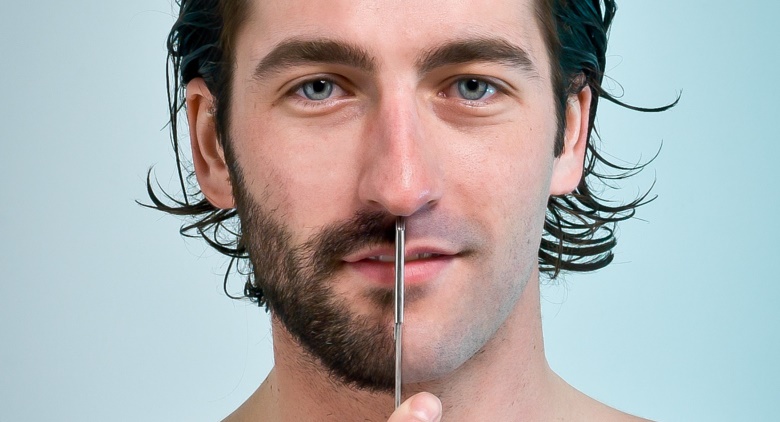
This is one of the most important sections on this page — and one that most competing clinics skip entirely. Understanding how the beard is divided into zones, and how many grafts each zone requires, is essential for planning your procedure and understanding the cost.
Every zone of the beard has a different natural growth direction, angle, density, and hair calibre. The chin grows forward and slightly downward. The cheeks grow downward and slightly outward. The jawline grows diagonally. The moustache has multiple directions converging at a central part. Getting these angles wrong — even slightly — is what creates the ‘pluggy’ or ‘unnatural’ beard look. Getting them right is surgical artistry.
Beard Zone | Typical Graft Count | Growth Angle | Clinical Notes |
Moustache (Upper Lip) | 350–500 grafts | Radial from centre, 30–45° | Single-hair grafts only; direction flips left and right of philtrum — critical precision zone |
Chin (Central) | 500–700 grafts | Forward & downward, 40–50° | Central anchor of the beard; mix of 1 and 2-hair grafts; highest density zone for most patients |
Jawline (Left & Right) | 200–350 grafts per side | Diagonal downward, 35–45° | Creates the ‘frame’ of the jaw; single and 2-hair grafts; angle changes as it approaches ear |
Cheeks (Left & Right) | 300–700 grafts per side | Downward, 20–35° | Most variable zone — depends on desired coverage; single-hair grafts; acute angle critical to avoid ‘doll’ look |
Goatee (Full) | 600–900 grafts | Multi-directional | Combination of chin + surrounding area; popular standalone request |
Sideburns | 200–250 grafts per side | Downward, 25–40° | Transition zone between scalp hair and beard; requires careful blend with existing sideburn hair |
Neck Beard | 200–400 grafts | Upward angle, 20–30° | Often neglected in planning; important for a ‘full beard’ look from below; grows opposite to face |
Full Beard (Complete) | 1,500–2,500 grafts | Zone-specific | Full restoration across all zones; 2-day procedure if combined with density sessions; most common request |
Beard Conditions & Concerns Treated at Sarayu Clinics
- Genetic inability to grow a beard — no follicles present in specific zones
- Patchy facial hair growth — specific areas sparse while others grow normally
- Post-acne scar alopecia — follicles destroyed by severe cystic acne scarring
- Post-trauma scarring — burns, accidents, or sports injuries damaging facial follicles
- Post-surgical scarring — jaw surgery, cleft lip repair, facelift incisions affecting beard zones
- Alopecia areata of the beard — stable, inactive cases only (assessed medically before surgery)
- Traction-related patching — from tight facial hair manipulation or chronic irritation
- Asymmetric beard growth — one side significantly denser than the other
- Thin, fine beard — follicles present but hair shaft calibre too thin for visible density
- Corrective beard transplant — dissatisfaction with a previous procedure at another clinic
- Moustache restoration — partial or full moustache absence
- Goatee area thinning — central chin and surrounding zones
- Sideburn loss — after surgical incisions or scarring in the pre-auricular area
Are You a Good Candidate for Beard Transplant?
This is one of the most important questions — and the honest answer is that not every man who wants a beard transplant is ready for one right now. Here is what the assessment involves:
✓ You Are Likely a Good Candidate If… | ✗ You May Not Be Ready If… |
Your hair loss is stable — not actively progressing | Your beard patches are new or appeared recently (wait for stability) |
You have adequate scalp donor density | Donor area is very thin or previously depleted by scalp transplants |
You are aged 22 or above with a predictable facial hair pattern | You are under 22 — beard patterns are still developing |
You are in good general health with no uncontrolled conditions | Active skin conditions on the face (active acne, dermatitis, rosacea) |
Your expectations are realistic about density achievable | Expecting 100% density from a single session (unrealistic for very advanced cases) |
Alopecia areata — stable for 12+ months with no new patches | Alopecia areata that is active, spreading, or treated less than 12 months ago |
Non-smoker or willing to stop smoking 2+ weeks before surgery | Nicotine use — significantly affects graft survival (reduces by 20–40%) |
Realistic about the 12–18 month timeline to full results | Expecting results in a few weeks (biologically impossible) |
If you are not currently a candidate, Dr. Tripathi will tell you that directly — and give you a clear plan for what needs to happen before you are ready. This is the right approach; pushing forward when the timing is wrong leads to poor outcomes and wasted money.
Beard Transplant Techniques at Sarayu Clinics
Sarayu Clinics offers three distinct approaches to beard transplantation. Each has specific advantages for specific scenarios. The right choice is determined by your beard zone requirements, skin type, desired density, and whether you want to avoid shaving any part of your head.
FUE – Follicular Unit Extraction (Most Common for Beard)
FUE is the primary technique for beard transplantation worldwide, and the reason is straightforward: precision. Individual follicular units are extracted one by one from the donor area using a micro-punch (0.6–0.9 mm diameter), leaving no linear scar. Each extracted graft is then implanted individually into the beard area at a pre-determined angle and direction.
For beard transplants specifically, FUE offers the flexibility to extract different calibre grafts from different parts of the scalp — matching finer grafts to hairline beard zones and coarser grafts to chin or jaw zones where density is paramount.
Why FUE works especially well for beards:
- No linear scar at the donor site — important for patients who keep hair short
- Surgeon can select individual follicle calibres to match different beard zones
- Comfortable recovery — donor area heals within 7–10 days
- Can harvest from nape of neck — this area most closely matches beard hair texture
- Combined with BIO-FUE protocol for maximum graft survival during the procedure
DHI – Direct Hair Implantation (Choi Pen) for Beard
DHI (Direct Hair Implantation) uses the Choi implanter pen — a device that simultaneously creates the recipient site and inserts the graft in a single motion, eliminating the separate recipient-site-creation step used in standard FUE. For beard transplants, this is a significant advantage.
In a beard, every single hair has a different angle and direction depending on its exact location on the face. The Choi pen allows the surgeon to control the angle, depth, and direction of each graft with exceptional precision — more so than with standard slits. The result is a more natural-looking beard where each hair follows the exact pattern it would in a naturally grown beard.
DHI advantages specific to beard transplant:
- Superior angle control — critical in the moustache, sideburn, and cheek zones
- Reduced trauma to the implantation site — less bleeding, faster healing
- Higher graft density achievable per cm² — important in thin beard zones
- Can be performed without shaving the recipient area (unshaved beard DHI) — completely discreet
- Grafts spend less time outside the body — improved survival rate
When Dr. Tripathi recommends DHI over FUE for beards:
- Patients requiring very precise hairline-zone beard definition (upper lip, sideburn edge)
- Those who cannot shave the beard area before the procedure (social or professional constraints)
- Adding density to existing beard without visible procedural evidence
- Cheek zone work where angle precision is most critical
BIO-FUE – Biological Graft Enhancement Protocol
BIO-FUE is not a separate surgical technique but an enhancement layer applied over FUE or DHI. Extracted grafts are stored and processed in a biologically enriched solution containing growth factors from the patient’s own PRP or validated GFC preparation, antioxidants, and ATP (adenosine triphosphate — the molecule that keeps cells alive) during the out-of-body period.
Why does this matter for beard transplants specifically? A beard session typically involves 1,000–2,500 grafts placed in a complex multi-directional pattern. The procedure takes 5–8 hours. During that time, the earliest-extracted grafts may be waiting 3–5 hours before implantation. BIO-FUE significantly reduces the oxidative damage and cell death that occurs during this waiting period.
At Sarayu Clinics, BIO-FUE is applied as standard to all beard transplant procedures of 1,000+ grafts — not as a premium add-on, but as a protocol the clinic believes every patient deserves.
Factor | Standard FUE (No Enhancement) | BIO-FUE at Sarayu Clinics |
Graft storage | Saline (standard practice) | Growth factor enriched bio-solution |
Out-of-body survival | Grafts degrade from hour 2 onward | ATP + antioxidants maintain viability |
Graft survival rate | 85–92% (varies by session length) | 95%+ consistently |
Re-vascularisation speed | Standard | Faster — growth factors accelerate |
Hair thickness post-growth | Standard calibre | Often noticeably thicker shaft |
Ideal for long sessions | Riskier for 5+ hour procedures | Specifically designed for long beard sessions |
Beard Design – The Step Most Clinics Skip
The single biggest differentiator between a good beard transplant and a transformative one is not the technique — it is the design. This is what most competing clinics’ pages do not cover, and it is why results vary so dramatically between surgeons.
A beard design consultation at Sarayu Clinics begins with an analysis of your face shape, existing hair direction, skin tone, age, and your specific reference images or goals. Dr. Tripathi then maps the planned beard zones on your face with surgical markers in a seated, natural-light position — because gravity and facial muscle movement both affect how the beard will look in real life.
Face Shape | Recommended Beard Design | Common Mistake to Avoid |
Oval | Most beard styles suit; full coverage or goatee both work well | None specifically — most flexible face shape |
Round | Elongated goatee with defined vertical chin zone; minimal cheek density to avoid widening | Full cheek coverage — makes face appear wider |
Square | Soft, rounded chin zone; moderate cheek density; keep jawline clean | Heavy jawline definition — exaggerates squareness |
Diamond / Angular | Full cheek coverage to balance wide forehead; chin definition to anchor the face | Sparse cheeks — makes mid-face appear too narrow |
Oblong / Long | Full horizontal coverage — chin growth kept moderate; side and cheek density emphasised | Goatee-only style — elongates the face further |
Heart-Shaped | Chin and lower jaw density; minimal temple beard to avoid emphasising wider forehead | High sideburn density — draws attention to forehead width |
There is no single ‘best’ beard style — there is the beard that works best for your face. Dr. Tripathi’s dual training in facial plastic surgery and maxillofacial surgery means beard design is approached from a facial harmony perspective, not just a hair placement perspective.
Your Beard Transplant – Step by Step at Sarayu Clinics
Here is exactly what happens on the day of your procedure, with nothing left out:
- PRE-PROCEDURE CONSULTATION & MAPPING — Dr. Tripathi conducts a detailed assessment: existing beard density analysis using trichoscopy, scalp donor zone evaluation, follicular density count, and a comprehensive design session. Reference images reviewed. Expectations aligned in writing.
- BLOOD WORK REVIEW & CONSENT — Pre-operative blood tests are reviewed (typically done 1–2 weeks before the procedure). Full informed consent is obtained after questions are answered. Photographs are taken from multiple angles under standardised lighting — these are your baseline before-images.
- BEARD DESIGN MARKING — On the day, the beard design is drawn with a surgical marker while you are seated upright. You review it in a mirror. Any adjustments are made before any procedure begins. Nothing is irreversible until you agree.
- DONOR AREA PREPARATION — The donor area at the back or sides of the scalp is trimmed short to allow precise extraction visibility. For nape-based extraction (when beard texture matching is required), the nape is trimmed instead.
- LOCAL ANAESTHESIA — Tumescent local anaesthesia is administered to the donor site first, then the recipient beard area. A topical numbing agent is applied first to minimise the injection sensation. Most patients describe it as mild stinging for 2–3 minutes — after which the entire area is numb and the rest of the procedure is comfortable.
- GRAFT EXTRACTION — Individual follicular units extracted using the micro-punch (FUE) or Choi pen preparation (DHI). Extraction is performed under magnification to minimise follicle damage. Grafts are transferred immediately to the BIO-FUE preservation solution.
- 4K UHD MICROSCOPIC GRAFT ASSESSMENT — Each extracted graft is assessed under high-magnification microscopy. Grafts are sorted: fine single-hair units for hairline beard zones; coarser multi-hair units for chin and jaw. Damaged grafts are identified and discarded — this step, not available at many clinics, directly determines result naturalness.
- RECIPIENT SITE CREATION — Dr. Tripathi personally creates each recipient incision in the beard area using custom-angled blades or DHI channels. Angle, depth, and direction are controlled precisely for each zone — this is the most artistically critical step of the entire procedure.
- GRAFT IMPLANTATION — Grafts are placed zone by zone. Finest single-hair grafts at the edges and hairline zones for naturalness. Multi-hair grafts in density zones for fullness. The sequence moves systematically to ensure no zone sits without grafts for too long.
- IMMEDIATE REVIEW — Before dressings are applied, the result is reviewed by Dr. Tripathi. Any asymmetry or missed zones are addressed in the same session.
- DRESSING, REST & DISCHARGE — Donor area dressed lightly. You rest for 30–45 minutes in the recovery area. Written aftercare instructions, a follow-up date, all medications, and direct emergency contact provided before you leave.
Downtime & Recovery – Day by Day (The Honest Version)
No surgery comes without a recovery period. The good news with beard transplants is that recovery is genuinely manageable, and most of the healing happens in the first week and a half. Here is exactly what to expect:
Timeline | What Is Happening | What You Will See / Feel |
Day 0 (Procedure Day) | Grafts freshly implanted, vascularisation begins immediately | Redness and mild swelling on beard area; donor site covered with dressing; some tightness |
Days 1–3 | Grafts beginning to anchor; swelling may peak | Face may be puffier — can extend to under the eyes; normal. Tiny scab formation beginning at each implant site. |
Days 3–5 | Swelling subsiding; grafts setting in position | Visible improvement in puffiness; scabs forming properly; redness fading. Return to desk work possible for most. |
Days 5–10 | Scab crust forming and naturally beginning to separate | Face looking more presentable; scabs falling off during gentle washing; donor area essentially healed. |
Days 10–14 | Most external healing complete | Remaining redness resolving; most patients comfortable in social situations at this point. |
Weeks 2–4 (Shock Loss) | Transplanted hair shafts shed — NORMAL PHASE | The hairs fall out. This is not graft loss — the follicle is alive, the shaft sheds. This is telogen effluvium post-transplant and is completely expected. |
Months 1–2 | Follicles in dormant (telogen) phase | Minimal visible beard. Most discouraging phase — but biological process is on track. |
Months 2–4 | Anagen phase — new hair shafts emerging | Fine, soft new hairs visible. First signs of the result you came for. Very exciting phase. |
Months 4–7 | Hair shafts thickening and maturing | Significant visible beard growth; most patients shaving the transplanted area for the first time at month 4–5. |
Months 7–10 | Near-final result emerging | Beard at close to full density and length. Most patients completely satisfied at this stage. |
Months 10–18 | Complete maturation of all transplanted follicles | FINAL RESULT. Permanent full beard. Photos compared to pre-procedure baseline. |
Critical aftercare rules for beard transplants specifically:
- Days 1–5: Do not touch, scratch, or disturb the implanted beard area — even when washing your face
- Days 3–10: Gentle directed saline spray washing as instructed — no face wash products near the implanted zone yet
- Do NOT apply any beard oils, serums, or topical products until cleared by Dr. Tripathi at your follow-up
- Avoid sleeping face-down for the first 5–7 days — side or back sleeping only
- No shaving the beard area for the first 30 days — allow shock loss phase to complete
- SPF 30+ on the face when going outdoors — UV exposure can cause pigmentation in healing skin
- Avoid alcohol for 7 days post-procedure — it dilates blood vessels and increases bleeding/swelling risk
- Absolutely no smoking for 2 weeks pre and 4 weeks post-procedure — nicotine constricts vessels that supply new grafts
Beard Hair Transplant Cost in Delhi – Transparent 2025 Breakdown
Cost is the most searched question about beard transplants — and the most opaque one in the industry. Here is a genuinely transparent breakdown, including what the competitive market looks like, what drives price differences, and what you should expect to pay at Sarayu Clinics.
Procedure Scope | Graft Count | Sarayu Clinics (₹) | Delhi Market Range (₹) |
Moustache Only | 350–500 | ₹20,000–₹35,000 | ₹18,000–₹40,000 |
Chin / Goatee Only | 600–900 | ₹35,000–₹55,000 | ₹30,000–₹60,000 |
Jawline + Chin | 900–1,400 | ₹50,000–₹75,000 | ₹45,000–₹90,000 |
Full Beard (All Zones) | 1,500–2,500 | ₹75,000–₹1,40,000 | ₹50,000–₹2,00,000 |
BIO-FUE Enhancement (add-on) | Included | Standard Protocol | ₹15,000–₹30,000 extra at other clinics |
PRP (post-transplant) | N/A | ₹8,000–₹18,000 per session | ₹6,000–₹25,000 |
Corrective / Repair Beard Transplant | Varies | Assessed at consultation | ₹60,000–₹2,00,000 |
Budget Clinics (₹20–40/graft) | Mid-Range Clinics (₹40–80/graft) | Sarayu Clinics (₹60–100+/graft) |
Technician-led implantation | Mixed surgeon + technician involvement | 100% surgeon-designed & supervised |
Basic saline graft storage | Standard protocol | BIO-FUE growth factor preservation |
No microscopic graft assessment | Basic graft counting | 4K UHD microscopic quality check |
Generic beard designs | Basic beard mapping | Face-shape & zone-specific design |
Limited aftercare support | Standard follow-up | 12-month follow-up programme |
Prices shown are for guidance only. Your final treatment cost will be confirmed during the initial consultation, based on your individual needs, concerns, and personalised treatment plan.
Beard Transplant Results Timeline – What to Expect and When
The most important thing to understand about beard transplant results is this: the result is real, permanent, and worth waiting for. But it does not arrive in weeks. Here is the honest, accurate timeline:
Timeline | What Is Happening Biologically | What You Can See |
Day 0–14 | Grafts anchoring; wound healing; vascularisation beginning | Redness, scabbing, mild swelling resolving |
Week 2–4 | Shock loss — hair shafts entering telogen; follicles dormant but alive | Transplanted hairs shed — expected and normal; alarming to most first-time patients |
Month 1–2 | Follicular dormancy phase | Minimal beard visible — do not judge the result here |
Month 2–3 | Early anagen — follicles reactivating | Fine, soft new hairs beginning to emerge — first visible progress |
Month 3–5 | Active hair shaft growth | Noticeable beard growth; texture softening from fine to normal calibre |
Month 5–7 | Hair maturing, thickening | First shave possible; beard looking genuinely impressive at this stage |
Month 7–10 | Near-complete result | Beard at close to final density; can be styled and shaped |
Month 10–18 | Final follicle maturation complete | PERMANENT FINAL RESULT — grows, behaves, and styles like native beard |
FUE vs DHI vs BIO-FUE for Beard Transplant – Which Is Right for You?
All three techniques produce excellent results when performed correctly. The decision depends on your specific beard goals, lifestyle, and the degree of precision required. Here is a direct comparison:
Factor | FUE | DHI (Choi Pen) | BIO-FUE (FUE Enhanced) |
Procedure | Individual extraction + pre-made slits | Extraction + simultaneous implant | FUE with biological graft protection |
Angle Control | High | Very High (best for beard) | High |
Beard Shaving Required | Yes — beard area trimmed | Optional — unshaved DHI possible | Yes — beard area trimmed |
Graft Density | Very High | Highest | Very High + better survival |
Graft Survival | 85–92% | 88–94% | 95%+ (biological enhancement) |
Best For | Most beard zones, large sessions | Moustache, cheeks, sideburns; unshaved | Large sessions; coarse hair; max survival |
Cost (relative) | Moderate | 15–20% higher | Moderate (included at Sarayu) |
Recovery | 7–10 days | 7–10 days (slightly faster recipient) | 7–10 days |
Dr Tripathi’s Recommendation | Standard beard restoration | Precision zones + unshaved cases | All sessions 1,000+ grafts |
The most common combination at Sarayu Clinics: BIO-FUE for the bulk graft extraction and DHI for the precision zones (moustache, cheek edges, sideburn lines). This combination delivers the highest graft survival and the most natural-looking result for comprehensive beard transplants.
Frequently Asked Questions – Beard Hair Transplant in Delhi
Q1. Is a beard transplant permanent?
Yes. The follicles used for beard transplantation are taken from the DHT-resistant zone of the scalp — meaning they are genetically programmed not to miniaturise or fall out with age. Once transplanted to the beard area, they retain this characteristic and grow for life. You will not need a repeat procedure. The beard you grow after a successful transplant is yours permanently.
Q2. Does a beard transplant look natural?
When designed and performed correctly, a beard transplant is completely undetectable — even to another person touching your beard. The key is multi-directional follicle placement following the exact growth pattern of each beard zone. Poor results (the ‘dolly’ or ‘pluggy’ look) come from incorrect angulation, generic placement, or grafts placed by technicians rather than surgeons. At Sarayu Clinics, every recipient site is made personally by Dr. Tripathi.
Q3. Can I shave my beard after a transplant?
Yes — after the first 30 days. In the first month, the transplanted area is healing and the follicles are anchoring. After that initial period, you can shave the beard area completely normally. The transplanted hair responds to a razor exactly like native facial hair. Most patients shave for the first time around months 4–5 when the new growth is long enough to need it — and describe it as one of the most satisfying moments of the entire journey.
Q4. Is the procedure painful?
No — not during the procedure itself. Local anaesthesia numbs both the donor scalp area and the recipient beard area completely. The only discomfort is the initial anaesthetic injections, which feel similar to dental injections and last about 2–3 minutes. Post-procedure, the beard area feels tight and slightly sensitive for 2–3 days, managed comfortably with standard pain relief. Most patients are surprised by how manageable the recovery is.
Q5. How many sessions do I need?
Most patients achieve their desired result in a single session. For very advanced cases requiring very high density across all beard zones (2,500+ grafts), or for patients who want to add density after an initial session, a second session may be recommended 12–18 months after the first. Dr. Tripathi will tell you at consultation whether a single session can achieve your goals or whether staging is more appropriate.
Q6. Will the transplanted beard hair match my existing facial hair?
This depends on donor selection. Scalp hair has a slightly different texture from beard hair — it tends to be finer in shaft diameter. Dr. Tripathi preferentially extracts from the nape of the neck for beard transplants when possible, as nape hair most closely matches the calibre and texture of natural beard hair. For patients with coarser beards, this distinction matters significantly. The blend improves over time as transplanted hair adapts somewhat to its new environment.
Q7. What is the difference between a beard transplant and beard fillers?
Beard ‘fillers’ are injectable treatments (typically hyaluronic acid or sometimes PRF/PRP) that provide a very temporary visual improvement in beard appearance. They do not grow actual hair — they either add volumising material between existing hairs or stimulate some growth in early-stage thinning. Results last weeks to a few months at most. A beard transplant moves actual living hair follicles that then grow permanently. The two are not comparable in terms of outcome.
Q8. I had a beard transplant elsewhere and am not happy with the result. Can Sarayu help?
Yes — corrective beard transplant is one of the growing specialities at Sarayu Clinics. The most common issues with previous procedures include: incorrect growth angle (hairs pointing the wrong direction), poor design (unnatural shape or hairline), inadequate density, or visible ‘plug’ patterns from outdated techniques. Dr. Tripathi assesses the existing transplant, plans a corrective approach, and in most cases can significantly improve or completely transform the result. An honest assessment of what is achievable is always provided.
Q9. How soon can I return to work after a beard transplant?
For desk-based or work-from-home roles: 3–5 days is sufficient for most patients. The beard area is red and has visible scabs during this period, but it is not incapacitating. For client-facing, on-camera, or public-facing roles: 10–14 days allows the scabs to clear and the redness to resolve significantly. For physically demanding outdoor work: 2 weeks minimum, primarily due to sweat and dust contamination risk to the healing grafts.
Q10. Can I grow a full beard if I could not grow one before?
Yes — if you have sufficient donor hair. A man who has never been able to grow a beard due to genetic absence of follicles in the beard zones can, after a beard transplant, grow a full, dense beard that he can shave, style, and trim like anyone else. This is perhaps the most dramatic and emotionally significant outcome of the procedure — and it is one that the before-and-after gallery at Sarayu Clinics demonstrates repeatedly.
Q11. Is a beard transplant suitable for all skin tones?
Yes. Beard transplantation is safe for all skin tones including Indian, South Asian, African, and Middle Eastern skin. The primary consideration with darker skin is the healing pigmentation response in the recipient area — which is why the gentle, staged washing protocol and sun protection guidance matters particularly for darker-skinned patients. Dr. Tripathi’s experience with Indian skin tones across thousands of procedures means this is managed effectively as standard.
Q12. What happens to the donor area after extraction?
The donor area (typically the back of the scalp or nape of the neck) heals completely within 7–10 days. FUE leaves tiny circular extraction marks that are imperceptible at normal hair length — typically 1–1.5 cm. These fade to small, nearly invisible dots over 3–6 months. There is no linear scar, no sutures, and no visible evidence of the procedure once hair is at a normal length. Most patients return to their haircut of choice within 2–3 weeks of the procedure.
Why Sarayu Clinics for Beard Transplant in Delhi?
There are dozens of clinics offering beard transplants in Delhi. Here is what genuinely differentiates Sarayu Clinics — not marketing language, but clinical specifics:
Differentiator | Why It Changes Your Result |
Dr. Adarsh Tripathi – Facial Plastic & Maxillofacial Surgeon | Designing a beard requires understanding how a face works — its proportions, muscle movements, skin elasticity, and aesthetic harmony. Dr. Tripathi’s dual surgical specialisation means beard design is informed by deep facial structural knowledge that most hair transplant surgeons simply do not have. |
18+ Years of Clinical Experience | Experience builds pattern recognition — knowing what works for which face, which extraction points give the best beard-matching hair, and how to plan for how the beard will look in 2, 5, and 10 years. |
Pioneer of 4K UHD Microscopic Technique in India | Graft quality assessment under ultra-high-definition microscopy means every implanted follicle is verified to be viable before it goes in. This is the single most impactful variable in graft survival rates. |
BIO-FUE as Standard (Not an Add-On) | At most clinics, biological graft enhancement is charged separately or not available. At Sarayu, it is included in all beard sessions of 1,000+ grafts because Dr. Tripathi considers it standard of care. |
DHI + BIO-FUE Combination for Beard | The most precise technique (DHI Choi pen for angle control) combined with the best graft preservation (BIO-FUE) — this combination is not widely available and produces the highest quality beard outcomes. |
Trusted by Honey Singh & Technical Guruji | Men whose public image depends on looking completely natural chose Sarayu Clinics. Celebrity patients are not chosen randomly — they choose based on trust, track record, and results. |
Transparent Pricing & Written Quote | Your consultation ends with a written graft plan and cost breakdown. No hidden charges on the day, no pressure to decide immediately, and EMI options for larger procedures. |
International Patient Programme | Patients fly in from the UAE, UK, USA, Canada, and Australia specifically for beard transplants at Sarayu Clinics. Virtual pre-consultations, airport coordination, and remote follow-ups are all available. |
12-Month Follow-Up Programme | Included in every beard transplant. Review appointments at 1 month, 3 months, 6 months, and 12 months — with photography to track progress. If growth is below expectations at 12 months, eligible cases receive a complimentary touch-up assessment. |
How to Reach Us:
Phone: +91 9289111081 , +91 9289111082
Email: sarayuinquiries@gmail.com
Sarayu Clinics website: www.sarayuclinics.com
Facebook: https://www.facebook.com/sarayuclinic
Instagram: https://www.instagram.com/sarayuclinics/
Dr. Adarsh Tripathi’s profile: https://dradarshtripathi.com/
Online Booking: Visit our website https://sarayuclinics.com/contact-us/ to schedule appointments conveniently.
Am I a good candidate for a beard hair transplant?
Ideal candidates for a beard hair transplant are individuals with sparse or patchy facial hair growth who have sufficient donor hair on the scalp. A consultation with Dr. Tripathi will help determine if you are a suitable candidate for the procedure.
How is the Beard Hair Transplant in Delhi performed?
During the procedure, Dr. Tripathi will extract individual hair follicles from the donor area using a specialized technique, such as Follicular Unit Extraction (FUE). These follicles are then carefully implanted into the desired areas of the beard to create a fuller, more even appearance.
Is the Beard Hair Transplant in Delhi painful?
Most patients experience minimal discomfort during the procedure, as local anesthesia is used to numb the treatment area. Some mild discomfort may be felt during the extraction and implantation process, but it is generally well-tolerated.
How long does the Beard Hair Transplant in Delhi procedure take?
The duration of the procedure depends on the number of grafts being transplanted, but it typically takes several hours to complete. Dr. Tripathi will provide an estimated timeline during your consultation.
How are grafts selected and placed to ensure a natural beard pattern?
Grafts are chosen based on hair texture, thickness, and growth angle, typically taken from the scalp where donor hair closely matches facial hair. During placement, the surgeon aligns each follicle to follow the direction of your natural beard growth so that the final look feels seamless and realistic.
What should I expect during the first few weeks after my transplant?
In the initial 1-2 weeks you’ll notice small crusts where the grafts were placed; these shed naturally. Mild swelling or redness may occur and settle down gradually. Hair shedding of the transplanted follicles is normal in this phase – this is part of the growth cycle before new hair starts appearing.
Can I customize the style and shape of my beard with this treatment?
Yes — you can choose the shape, density, and style during your consultation. Whether you want a full thick beard, a well-defined goatee, or just fill in certain patchy spots, the transplant can be tailored to your facial features and grooming preferences so it complements your look.