Botox treatment in Delhi
- Home
- Botox treatment in Delhi
Botox treatment in Delhi
Botox is the most popular cosmetic treatment in the world — and has been for well over a decade. There are good reasons for that. It works. It’s fast. And in experienced hands, it doesn’t make you look like you’ve had anything done. The fear of looking frozen or overdone is real, and valid — but it’s almost always a consequence of poor technique rather than the treatment itself. In skilled hands calibrated to your face, Botox makes you look like a well-rested, subtly refreshed version of yourself.
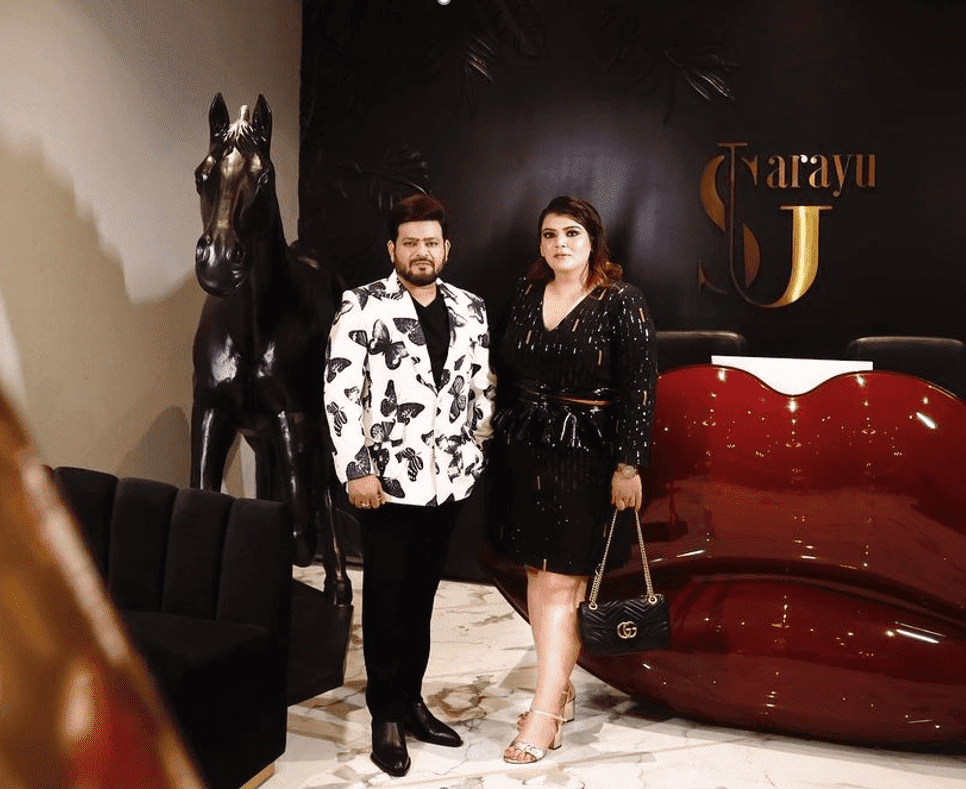
At Sarayu Clinics in Greater Kailash, Botox treatments are planned and administered by facial plastic and maxillofacial surgeon Dr. Adarsh Tripathi, alongside co-founder and celebrity aesthetician Dr. Nidhi Bhatia. This is worth noting, because the anatomy underneath your skin — where the facial nerve branches run, how the muscles of expression interact, and how injecting one area affects the adjacent ones — is exactly the training a facial plastic surgeon is built on. The difference between a natural result and a frozen one, a lifted brow and a dropped one, often comes down to that anatomical knowledge.
The short answer : Botox is a purified protein (botulinum toxin type A) that temporarily relaxes specific muscles by blocking the nerve signal that tells them to contract. Cosmetic uses include forehead lines, frown lines, crow’s feet, brow lift, jaw slimming (Jawtox), neck bands, lip flip and gummy smile correction. Medical uses include hyperhidrosis (excessive sweating), bruxism (teeth grinding), TMJ pain and migraine prevention. Results appear in 3–14 days, last 3–6 months (longer for masseter and hyperhidrosis), and are fully reversible when they wear off. Cost in Delhi: Rs 350–600 per unit for Allergan Botox; typical 2–3 area cosmetic session Rs 12,000–35,000. No downtime.

What Is Botox and How Does It Work?
Botox is the brand name for botulinum toxin type A produced by Allergan (AbbVie). Other brands of the same molecule — Dysport, Xeomin, Letybo, Nuceiva — work through the same mechanism and are equally legitimate; the choice of brand is a clinical decision based on the area being treated and the clinic’s protocols.
The mechanism is precise: botulinum toxin blocks the release of acetylcholine at the point where a nerve meets a muscle. Without that chemical signal, the muscle can’t contract. When a muscle that’s been repeatedly contracting to form a frown line or forehead crease is relaxed this way, the overlying skin smooths out. The effect is temporary — as the nerve regenerates its connection over 3–6 months, normal muscle function gradually returns.
Why you won’t look frozen (when it’s done right) ?
The ‘frozen’ look comes from one specific mistake: too many units delivered without leaving enough muscle function for natural expression. When dosed correctly, only the specific muscle targeted is relaxed — you still frown, raise your brows, smile and squint normally, just without the excessive contraction that was creating lines. The skill is knowing exactly how many units each muscle needs in your specific face — which is why injector anatomy knowledge matters more than brand.
What Is Botox and How Does It Work?
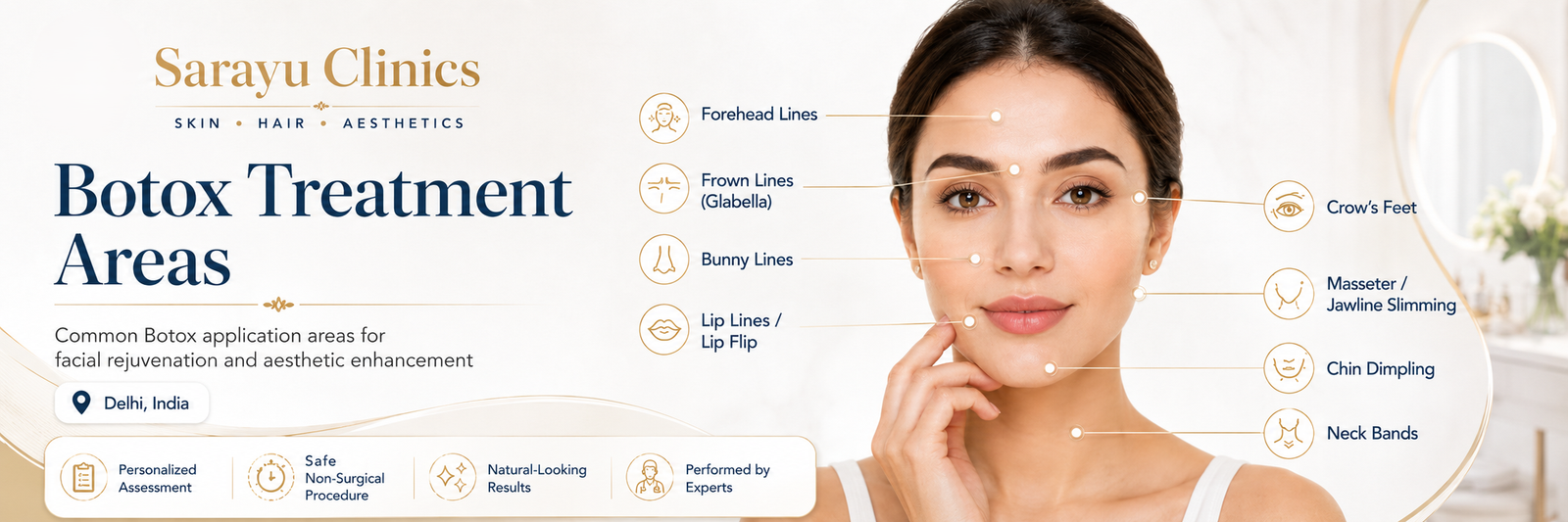
Most Delhi pages cover 5–8 uses of Botox. Here’s the complete map of everything a facial plastic surgeon can offer:
Cosmetic Botox treatments
1. Forehead lines
The horizontal lines across the forehead (frontalis muscle). The most commonly treated area, and the one that needs the most nuance: over-treating the frontalis can drop the brows. Units required: typically 10–20 units depending on muscle strength. We always treat forehead in conjunction with frown lines to maintain brow position.
2. Frown lines / glabellar lines (‘11 lines’)
The vertical creases between the brows (procerus, corrugators). Often the lines that make people look angry or permanently worried. Units required: typically 15–25 units. Frequently the most satisfying area to treat — removing the resting ‘scowl’ changes how people respond to you.
3. Crow’s feet
The fan of lines at the outer corners of the eyes when you smile or squint (orbicularis oculi, lateral part). Units required: typically 10–15 units per side (20–30 total). One of the most reliable Botox results — crow’s feet respond well and consistently.
4. Chemical / Botox brow lift
Precise placement of small doses at the outer orbicularis relaxes the downward-pulling muscle, allowing the brow to lift a few millimetres. A subtle, reversible ‘preview’ of a surgical brow lift. Units required: 2–8 units. Full technique detail on the brow lift page.
5. Bunny lines
The diagonal lines on the nose when you scrunch it (nasalis muscle). Often appear or worsen after frown-line treatment as the muscle compensates. Units required: 4–8 units.
6. Lip flip
A small dose into the orbicularis oris relaxes the upper lip’s outer edge, causing it to roll slightly outward and appear fuller. Not the same as lip filler — no volume is added; this is purely reshaping. Units required: 4–8 units. Subtle, temporary, and a good entry option for patients wary of filler.
7. Perioral lines (lip lines)
The fine vertical lines above the upper lip (‘smoker’s lines’ — though they also appear in non-smokers). Small doses relax the muscle that creates them. Often combined with a tiny bit of filler in the lines themselves for best effect. Units required: 4–10 units.
8. Gummy smile
A small dose into the levator labii superioris alaeque nasi (the muscle that pulls the upper lip upward) reduces how much gum is visible when smiling. A precise, anatomically-specific injection. Units required: 2–6 units. Very satisfying result for the right patient.
9. Chin dimpling (‘peau d’orange’)
An overactive mentalis creates a bumpy, dimpled texture on the chin at rest. Relaxing it smooths the chin skin. Units required: 4–8 units.
10. Downturned mouth corners
The depressor anguli oris (DAO) pulls the mouth corners down, contributing to a sad or stern resting expression. Relaxing it gently lifts the corners. Usually combined with chin work. Units required: 3–6 units per side.
11. Nefertiti neck lift (neck bands)
Platysmal bands — the vertical cords that appear on the neck, especially visible when the neck is tense or the head is turned — respond well to Botox. The ‘Nefertiti lift’ combines neck band relaxation with jawline injection to give a gentle lifting effect along the jaw. Units required: 25–50 units. Often combined with dermal fillers or a thread lift for a more complete neck rejuvenation.
12. Micro-Botox / Mesobotox (for skin quality)
Very small intradermal doses of Botox — not injected into muscles, but into the superficial dermis — reduce sebaceous gland activity and fine superficial muscle fibres, improving skin texture, reducing oiliness and minimising pore size. Detailed further on our open pores treatment page. Units required: 30–60 units (distributed very superficially).
Botox for Jaw Slimming (Jawtox) in Delhi
13. Masseter Botox / Jawtox
The most talked-about Botox treatment in Delhi right now — and for good reason. Injecting the masseter (the chewing muscle at the jaw angle) causes it to gradually reduce in bulk over 4–6 weeks, slimming the lower face from a wide or square shape into a softer V-shape. The same treatment also relieves teeth grinding (bruxism) and jaw tension — making it a genuine two-for-one. Units required: 40–80 units total (20–40 per side), depending on masseter bulk. Duration: typically 4–6 months; with repeat sessions, the muscle stays smaller and sessions may become less frequent. Full guide: Jawtox vs buccal fat removal | Face slimming treatments.
Medical Botox in Delhi
Botox is not just a cosmetic treatment — it’s an FDA-approved medical therapy for several conditions. A surgeon-led clinic with a full clinical setup is the appropriate setting for these applications:
14. Hyperhidrosis (excessive sweating)
Botox injected into the skin of the underarms, palms or soles blocks the nerve signal to the sweat glands, dramatically reducing excessive sweating. One of the most life-changing applications of Botox — patients who’ve struggled with social anxiety around sweating often describe it as transformative. Results last 6–12 months in the underarms (longer than cosmetic Botox). Units required: 50–100 units per underarm (200+ units for palms/feet). Note: palm and sole injections are more uncomfortable and usually require nerve blocks.
15. Bruxism and TMJ disorder
Exactly the same injection as Jawtox, medically framed: relaxing the masseter reduces the grinding forces during sleep, protecting teeth and relieving jaw pain, morning headaches and neck tension. Often covered partly by health insurance when prescribed for a medical indication. Check with your insurer with a proper consultation note.
16. Chronic migraine prevention
FDA-approved for chronic migraine (15+ headache days/month) under the PREEMPT protocol: 155–195 units administered across 31–39 specific injection sites in the head and neck, repeated every 12 weeks. Meaningful reduction in headache days in most patients. Requires proper neurological assessment; not a cosmetic session.
Botox Brands: What’s the Difference?
All Botox-family products contain botulinum toxin type A and work through the same mechanism. The differences matter clinically:
Brand | Manufacturer | Key characteristic | Typical Delhi per-unit cost |
Botox (onabotulinumtoxinA) | Allergan / AbbVie (USA) | Gold standard; most clinical data; most predictable spread | Rs 350–600 |
Dysport (abobotulinumtoxinA) | Galderma / Ipsen (UK) | Spreads slightly wider; more units needed for same effect | Rs 280–500 |
Xeomin (incobotulinumtoxinA) | Merz (Germany) | No complexing proteins; lower allergic reaction risk | Rs 300–550 |
Nuceiva / Letybo (prabotulinumtoxinA) | Evolus / Hugel (Korea) | Newer; similar efficacy to Botox; growing clinical evidence | Varies |
Important: because Dysport requires more units per area than Botox (roughly 2.5:1 conversion), a lower per-unit Dysport price does not automatically mean a cheaper session. Always ask for the total units planned, not just the per-unit price. Ask to see the vial. A clinic confident in their product answers these questions easily.
Prices shown are for guidance only. Your final treatment cost will be confirmed during the initial consultation, based on your individual needs, concerns, and personalised treatment plan.
Benefits of Botox
- Smooths dynamic wrinkles without surgery — forehead lines, frown lines and crow’s feet that haven’t become permanent improve dramatically.
- No downtime — the treatment takes 15–30 minutes and most people return to normal activities immediately.
- Preventive as well as corrective — consistent Botox from the 30s slows the deepening of dynamic wrinkles into permanent static lines.
- Natural-looking results in the right hands — the gold standard for ‘refreshed without surgery’ appearance.
- Multiple concerns in one session — forehead, brows, jaw slimming and bruxism are often addressed in the same 20-minute visit.
- Fully reversible — the effect wears off completely in 3–6 months; there’s no permanent commitment.
- Medical benefits alongside cosmetic — masseter treatment fixes teeth grinding; brow treatment can improve headaches from overworked frontalis muscle.
The Procedure: What Happens at Your Botox Session
- Consultation & facial mapping. Tripathi assesses your muscle activity, asks you to make specific expressions, and maps exactly which muscles and how many units to target for a natural result. This includes a discussion of what you’d like to improve, what you want to keep (your natural expression) and what to avoid.
- Precise injection points are identified based on your specific anatomy — the same area looks different on different faces, and the marks vary accordingly.
- The treatment area is cleansed; topical numbing cream can be applied 20–30 minutes before if desired, though most patients find the tiny injections well-tolerated without it.
- The injections. Very fine needles deliver small, precise doses into each targeted muscle. A full forehead + frown + crow’s feet session takes around 15 minutes. You feel a small sting or pressure — most people describe it as minimal.
- Post-injection guidance. Stay upright for 4 hours; don’t massage or rub the area; no strenuous exercise for 24 hours; avoid lying face-down.
- Two-week review. We schedule a follow-up at 2 weeks — when Botox has fully settled — to assess the result and make any small corrections. This is standard good practice; if a clinic doesn’t offer it, that’s a gap in their protocol.
Downtime & Aftercare
- Immediately after: small, temporary bumps at injection sites settle within 20–30 minutes. Occasional minor bruising for 1–2 days.
- For 24 hours after: no rubbing or massaging the treated area; stay upright; skip strenuous gym sessions; avoid facials, saunas and heat.
- For 4 hours: avoid lying down (helps the toxin stay precisely placed).
- Most people: return to work, social activity and light exercise the same day or the next morning.
Botox Treatment Cost in Delhi
Botox is priced per unit, and the number of units depends on the area and your muscle strength. Verified Delhi pricing for 2025–26:
Area / use | Approx. units needed | Approx. session cost (INR)* |
Consultation & facial mapping | — | Often nominal — confirmed when you book |
Forehead lines | 10–20 units | Rs 5,000 – Rs 12,000 |
Frown lines / ‘11 lines’ | 15–25 units | Rs 7,000 – Rs 15,000 |
Crow’s feet (both sides) | 20–30 units | Rs 8,000 – Rs 18,000 |
Classic 3-area (forehead + frown + crow’s feet) | 40–70 units | Rs 14,000 – Rs 35,000 |
Botox brow lift | 2–8 units | Rs 2,000 – Rs 5,000 |
Bunny lines | 4–8 units | Rs 2,000 – Rs 5,000 |
Lip flip | 4–8 units | Rs 3,000 – Rs 6,000 |
Gummy smile | 2–6 units | Rs 3,000 – Rs 7,000 |
Chin / downturned corners | 4–12 units | Rs 3,000 – Rs 8,000 |
Nefertiti neck lift | 25–50 units | Rs 15,000 – Rs 30,000 |
Masseter / Jawtox (jaw slimming + bruxism) | 40–80 units | Rs 15,000 – Rs 45,000 |
Micro-Botox / Mesobotox (skin quality) | 30–60 units | Rs 12,000 – Rs 25,000 |
Hyperhidrosis (underarms) | 100–200 units | Rs 30,000 – Rs 60,000 |
Chronic migraine (PREEMPT protocol) | 155–195 units | Rs 40,000 – Rs 80,000 |
*Based on Allergan Botox (Rs 350–600 per unit) at a surgeon-led Delhi clinic. Dysport and Xeomin have different unit conversion ratios — a lower per-unit price does not mean a cheaper session. Always ask for the total planned unit count before agreeing to treatment.
Results Timeline
Timeframe | What usually happens |
Day 3–5 | First visible softening of treated lines; muscles beginning to relax. |
Day 7–10 | Clear improvement; the full effect is reaching peak. |
Day 14 | Full result settled — this is when we schedule the review and any corrections. |
Month 1–2 | Peak result: expressions remain natural, lines are smooth at rest. |
Month 3–4 | Gradual return of muscle movement; lines begin to re-form lightly. |
Month 4–6 | Effect has worn off; time to re-treat if desired. (Masseter and hyperhidrosis often last 6–12 months.) |
With regular treatments over time, the intervals between sessions often lengthen: the muscle learns to contract less forcefully with repeated relaxation, so lines form more slowly. Some patients find every 4–6 months becomes every 6–8 months after a few years.
Botox vs Other Anti-Ageing Treatments
Option | What it addresses | Permanent? | Downtime | Cost range |
Botox | Dynamic wrinkles, jaw slimming, medical uses | No (3–6 months) | None | Rs 5,000–80,000+ |
Dermal fillers | Volume loss, static lines, contour | No (6–18 months) | Minimal | Rs 18,000–50,000/syringe |
Thread lift | Mild sagging, subtle lift | No (12–18 months) | Minimal | Rs 30,000+ |
HIFU | Skin tightening, early laxity | No (repeatable) | Minimal | Rs 15,000+ |
Surgical brow/facelift | Significant descent | Yes (years) | 2–3 weeks | Rs 70,000–5,00,000+ |
Botox and dermal fillers are the natural pair: Botox treats movement-based lines; fillers treat volume loss and static lines. Combined, they address almost everything non-surgical rejuvenation can achieve. For concerns that require structural lifting or actual tissue tightening, HIFU, Morpheus8 and eventually surgery take over where injectables reach their ceiling.
Are You a Good Candidate?
You’re likely a good candidate for Botox if you have:
- Dynamic wrinkles (lines that appear with expressions, not yet permanent at rest)
- A wide or square lower face from a bulky masseter muscle
- Teeth grinding or jaw tension
- Excessive sweating in the underarms, palms or soles
- Chronic migraine (15+ headache days per month)
- A wish to subtly lift and refresh the face without surgery or downtime
Botox is generally very safe, but extra caution or deferral applies with:
- Known allergy to any botulinum toxin product or human albumin
- Neuromuscular conditions (myasthenia gravis, Eaton-Lambert syndrome)
- Active infection in the treatment area
- Pregnancy or breastfeeding (elective cosmetic Botox is deferred; medical Botox is assessed case by case)
- Current antibiotic or blood-thinner use (discuss at consultation)
Why Choose Sarayu Clinics for Botox in Delhi ?
Botox is technically simple to administer. Getting the result right is not. The difference between a natural, refreshed appearance and a frozen or dropped one often comes down to how well the injector understands the muscles underneath. At Sarayu Clinics, Botox is planned and administered by facial plastic and maxillofacial surgeon Dr. Adarsh Tripathi, alongside co-founder Dr. Nidhi Bhatia.
- Anatomical precision. Surgical training in facial anatomy gives Dr. Tripathi an understanding of how muscles, nerves and adjacent structures interact — critical for avoiding the complications that result from poor placement.
- The complete injection menu. All 17 cosmetic and medical applications — not just the three most popular areas.
- A natural-results philosophy. Conservative first, always. The two-week review lets us correct any asymmetry or under-dosing — it’s harder to undo too much.
- Authentic products. Only verified, cold-chain-maintained brands. You can ask to see the vial at every appointment.
- Transparent unit pricing. We tell you the unit count planned before treatment, not just the total price. You can compare fairly and know exactly what you’re getting.
- Two-week review included. Standard practice at Sarayu; not all clinics offer this.
Medical Review & Sources
This page is for general information and is medically reviewed by the team at Sarayu Clinics under Dr. Adarsh Tripathi. It is not a substitute for an in-person consultation. The clinical approach reflects current aesthetic medicine and facial plastic surgery guidance, including:
How to Reach Us:
Phone: +91 9289111081 , +91 9289111082
Email: sarayuinquiries@gmail.com
Sarayu Clinics website: www.sarayuclinics.com
Facebook: https://www.facebook.com/sarayuclinic
Instagram: https://www.instagram.com/sarayuclinics/
Dr. Adarsh Tripathi’s profile: https://dradarshtripathi.com/
Online Booking: Visit our website https://sarayuclinics.com/contact-us/ to schedule appointments conveniently.
How much does Botox cost in Delhi?
Botox in Delhi is priced per unit: typically Rs 350–600 per unit for Allergan Botox at a reputable surgeon-led clinic. A standard 3-area treatment (forehead + frown lines + crow’s feet, approximately 40–70 units) costs around Rs 14,000–35,000 in total. Jaw slimming (masseter Botox) runs Rs 15,000–45,000. Medical applications like hyperhidrosis are Rs 30,000–60,000. Always ask for the total unit count planned before agreeing to treatment — it’s the only way to compare clinics fairly.
How long does Botox last?
Most cosmetic Botox lasts 3–6 months. The masseter (jaw slimming) and hyperhidrosis (sweating) applications often last longer — up to 6–12 months. With regular treatment over time, many patients find intervals gradually extend as the muscle learns to contract less forcefully.
Will Botox make me look frozen?
Only if too many units are used without calibration for your specific muscles. The frozen look comes from over-treatment, not from Botox itself. In the right dose, placed correctly, you still frown, smile and raise your brows naturally — just without the excessive contraction that was creating permanent lines. This is why injector skill and anatomical knowledge matter more than brand.
How many units of Botox do I need?
It depends entirely on the area and your muscle strength. Forehead: 10–20 units. Frown lines: 15–25 units. Crow’s feet: 20–30 units (both sides). Jaw slimming: 40–80 units. Hyperhidrosis underarms: 100–200 units. These are ranges — the exact number for your face is decided at consultation after assessing your muscle activity.
Is there any downtime after Botox?
Essentially none for most patients. You may have small bumps at injection sites for 20–30 minutes and occasional minor bruising for 1–2 days. Most people return to work and social activities the same day. Avoid rubbing the area, strenuous exercise and lying down for the first 4–24 hours.
What’s the difference between Botox and dermal fillers?
They treat different things and work best together. Botox relaxes muscles to smooth dynamic expression lines (forehead, frown, crow’s feet). Fillers add volume to restore lost structure (cheeks, under-eyes, lips, jawline) and fill static lines (nasolabial folds, marionette lines). Botox wears off; fillers dissolve. Combined, they cover most of what non-surgical facial rejuvenation can achieve.
Is Botox safe for Indian skin?
Yes — Botox doesn’t interact with skin pigmentation or melanocytes, so Indian Fitzpatrick IV-V skin has no specific extra risk. The main considerations are the same as for any skin type: injector skill, correct dosing, and authentic products.
Can Botox treat sweating (hyperhidrosis)?
Yes — Botox is FDA-approved for primary axillary hyperhidrosis (excessive underarm sweating). It blocks the nerve signals to the sweat glands, dramatically reducing sweating for 6–12 months. Palms and soles can also be treated but require more units and may need nerve blocks for comfort.
What is Jawtox and how is it different from regular Botox?
Jawtox is the social-media name for Botox injected into the masseter (jaw chewing) muscle. The mechanism is identical to cosmetic Botox — the muscle is relaxed and gradually reduces in bulk over 4–6 weeks, slimming the lower face. As a bonus, it simultaneously treats bruxism (teeth grinding) and jaw tension. It’s a subset of Botox treatment, not a different product.
Does Botox prevent wrinkles if started early?
Yes, with good evidence. Starting Botox in the early-to-mid 30s, before expression lines have become permanently etched into the skin, prevents those lines from deepening into static wrinkles. Many patients who start young find they need less correction over time — though it’s a maintenance commitment, not a cure.