
Facelift Surgery in Delhi
- Home
- Page Title
Facelift Surgery in Delhi
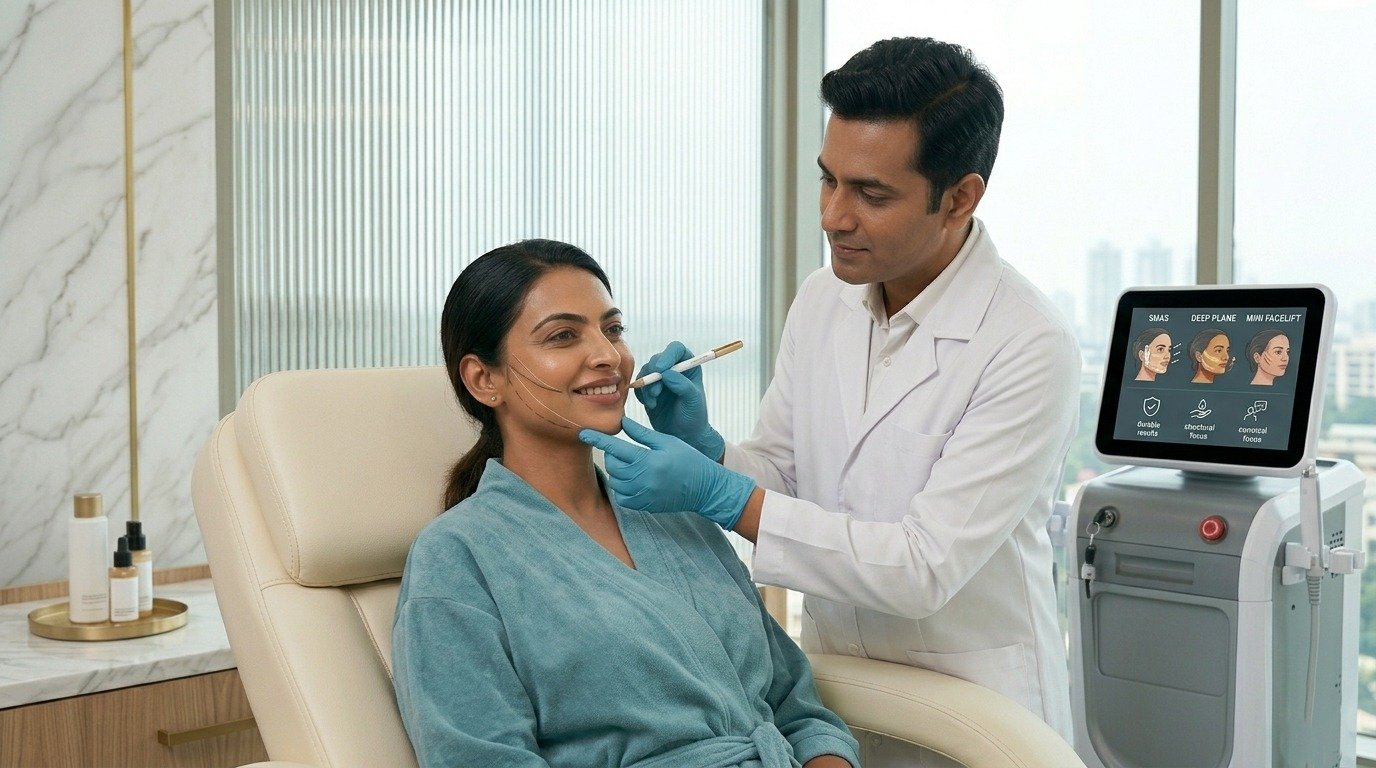
There comes a point when the things that used to work — the creams, the lasers, the occasional Botox, even HIFU — don’t quite do it anymore. The cheek has dropped. The jawline has blurred. The neck has loosened. The face you see in the mirror at rest looks tired and older than you feel. When that point arrives, a facelift is what actually fixes it. Done well, by the right surgeon, it doesn’t change who you look like — it gives you back the face you remember.
At Sarayu Clinics in Greater Kailash, facelift surgery is performed by facial plastic and maxillofacial surgeon Dr. Adarsh Tripathi. The clinic offers the full ladder — from non-surgical tightening for early concerns right through to mini, SMAS and deep plane facelifts — so the recommendation is based on what your face needs, not what we sell. The guiding principle is the one that matters most for this procedure: the result should look like rest, good lighting, and good genes. Never tight. Never operated-on.
What Is a Facelift, Really?
A facelift — medically called a rhytidectomy — is the surgical procedure that re-elevates the deeper structures of the face, repositions sagging tissue, and removes excess skin. The keyword in modern facelifts is deeper. Old-style facelifts pulled on skin alone, which gave that wind-tunnel look people fear. Today’s techniques work on the layer underneath the skin called the SMAS (Superficial Musculo-Aponeurotic System) — a fibrous sheet that holds the structure of your lower face. Lifting the SMAS, not the skin, is what gives the modern facelift its natural look.
That’s why the technique you choose matters more than almost anything else — and why the same name (‘facelift’) covers procedures with very different results. The most modern technique, deep plane, works even deeper than SMAS for the most natural and lasting result. The skill of the surgeon — in particular, knowing the safe planes around the facial nerve — is what separates a beautiful result from a botched one.
A facelift doesn’t replace your face — it restores it The single most important thing to understand: a good facelift is not designed to make you look different. It’s designed to make you look like the well-rested, healthier version of yourself you were ten or fifteen years ago. Friends and family should say you look refreshed, not ask what you’ve had done. That’s the goal, the standard, and the test of whether the work was done well. |
Benefits of a Facelift
- A naturally younger face — the jawline returns, the cheek lifts, the neck cleans up. The whole lower face looks 10–15 years younger.
- Genuine, lasting results — a modern facelift typically lasts 8–12 years with SMAS, 10–15+ years with deep plane. Far longer than any injectable.
- Restored, not stretched — modern techniques re-elevate the deep structures, so the look is rested rather than tight.
- A defined jawline and neck — most facelifts now include a neck lift component because the two ageing patterns travel together.
- Softer nasolabial folds and marionette lines — the static lines that fillers can only partially address are dramatically improved when the upstream structures are lifted.
- A genuine confidence return — the face you see in photos and the mirror matches how you actually feel inside.
- Combines naturally with other procedures — eyelid surgery, brow lift and neck lift are commonly done together for complete facial rejuvenation — a single recovery for a complete result.
- Ages gracefully from here — you don’t ‘reset and start over’ — you continue ageing from a younger starting point.
Areas Treated in a Facelift
A facelift addresses the lower two-thirds of the face and (usually) the neck. The specific areas depend on the technique chosen and what your face needs:
- Cheeks and midface (sagging, hollowing, descent of the cheek fat pad)
- Nasolabial folds (the lines from nose to mouth)
- Marionette lines (corners of mouth to chin)
- Jawline (jowls, loss of definition)
- Pre-jowl area (the dip in front of the jowl)
- Upper neck (loose skin, neck banding)
- Submental area (under the chin)
For the upper face — eyelids and brow — a facelift is commonly combined with eyelid surgery (blepharoplasty) and brow lift surgery, because facial ageing rarely respects the boundary between thirds of the face.
Conditions & Concerns a Facelift Treats
People come for a facelift in Delhi for one or more of:
- Sagging cheeks and midface descent — the cheek fat pad has slid down, creating hollows above and heaviness below.
- Jowls along the jawline — the soft pouches that blur the once-clean jaw.
- Deep nasolabial folds — etched-in lines from nose to mouth that fillers can no longer fully address.
- Marionette lines — downward-sloping lines from mouth corners that age the face dramatically.
- Neck banding and loose neck skin — the platysmal bands and submental fullness that make a ‘turkey neck’ look.
- Loss of the jaw-to-neck angle — the crisp angle that ages out into a blurred lower face.
- A tired or angry resting expression — not matching how you feel inside.
- Previous non-surgical work that’s reached its ceiling — when HIFU, threads and fillers can’t keep pace with progressive descent anymore.
Types of Facelift: Which Technique Is Right for You?
This is the most important section on this page — and the one most competitors won’t give you straight. ‘Facelift’ is a category, not a procedure. Different techniques produce different results, cost different amounts, and suit different faces. Here’s the honest map:
Technique | Best for | Result | Recovery | Lasts |
Mini facelift | 40s-early 50s; mild sagging | Subtle refinement of jowls/jawline | 1–2 weeks | 5–8 years |
SMAS facelift | Mid-40s-60s; moderate descent | Strong, balanced rejuvenation | 2–3 weeks | 8–12 years |
Deep plane facelift | Significant descent; most natural look | Most natural, longest-lasting | 2–3 weeks | 10–15 years |
MACS lift | Short-scar variant for moderate cases | Focused lift, smaller scar | 1–2 weeks | 6–10 years |
Neck lift | Almost always part of a facelift | Cleans up jawline & neck angle | Combined with above | Combined with above |
Deep Plane Facelift in Delhi
The deep plane facelift is the modern gold standard — and worth understanding properly because some clinics now market ‘deep plane’ loosely. Done correctly, this technique releases the deep ligaments that anchor the cheek and jowl, allowing the surgeon to reposition the deeper structures rather than just pulling them back. The skin, fat, and SMAS layer move together as a single unit, which is why the result looks remarkably natural and lasts the longest of any facelift technique.
It’s a longer, more technically demanding procedure that requires specific training and a deep understanding of facial anatomy — particularly the course of the facial nerve through the deep facial spaces. When you see clinics offering deep plane facelifts, the right question is: how many has the surgeon actually performed? It’s not a technique to learn on you.
- Best for: moderate-to-significant facial descent; patients who’ve previously had non-surgical work that no longer holds; anyone wanting the most natural and longest-lasting result.
- Result: the most natural and durable of all facelift techniques — typically 10–15 years.
- Recovery: 2–3 weeks of meaningful social downtime; final result at 6 months.
SMAS Facelift in Delhi
The SMAS facelift has been the long-standing modern standard, and remains an excellent choice for many patients. The surgeon lifts and tightens the SMAS layer (the same layer HIFU targets non-surgically, but to a far stronger degree), then redrapes the skin neatly over the new contour. Results are strong and last 8–12 years. It’s a technically demanding procedure that requires excellent training, but is more widely performed than the deep plane.
- Best for: most patients with moderate descent; the workhorse facelift technique.
- Result: strong, balanced, natural-looking rejuvenation; 8–12 years.
Mini Facelift in Delhi
The mini facelift (sometimes called a ‘short-scar’ facelift) is the entry-level surgical option — a focused, shorter procedure for patients with mild-to-moderate sagging who aren’t yet ready for a full facelift but want more than injectables can deliver. The incisions are shorter (around the ears), the recovery faster, and the result more subtle. It’s a beautiful option for the right candidate, usually in their 40s or early 50s.
- Best for: early sagging; people not yet ready for a full lift; lower cost entry to surgical rejuvenation.
- Result: subtle, focused refinement of jowls and jawline; 5–8 years.
Neck Lift (Almost Always Part of the Plan)
Here’s something most facelift pages skim over: the neck almost always needs attention alongside the face. A perfectly lifted face on top of an unaddressed neck looks incomplete and obviously surgical — because facial ageing and neck ageing travel together. A neck lift addresses the loose skin, the platysmal bands (vertical cords) and submental fat that create the ‘turkey neck’ look. At Sarayu, most facelifts include a neck lift component as part of the same procedure — one recovery, one complete result.
Non-Surgical ‘Facelift’ — The Honest Truth
Several Delhi clinics market ‘non-surgical facelift’ packages — combinations of HIFU, threads, dermal fillers and Botox. These treatments are genuinely valuable and we offer all of them — but they aren’t the same as a facelift, and the marketing language can be misleading.
Here’s the truth: non-surgical treatments work brilliantly for early ageing (your 30s and 40s, mild laxity) and as maintenance. They cannot fix significant tissue descent. By the time your jowls are visible and your neck has loose skin, HIFU and threads are extending what you already have — not replacing what’s gone. An honest assessment tells you which camp you’re in, and a clinic that’s only equipped with non-surgical tools has every incentive to put you in the wrong one. We do both, so we’re free to tell you the truth.
When non-surgical is enough — and when it isn’t Non-surgical is enough: you’re in your 30s–40s, your laxity is mild, your skin is still elastic, and you want gradual maintenance. The right plan is HIFU, RF microneedling, threads, and well-placed Botox/filler. // Non-surgical isn’t enough: you’re in your 50s–early 60s, your jowls and neck have visibly changed, and previous injectables/HIFU no longer hold their result. A facelift is the right answer, and continuing to spend on non-surgical work just delays the inevitable while costing more in the long run. |
The Facelift Procedure: Step by Step
- Detailed consultation & facial analysis. Tripathi assesses your facial structure, skin quality, the specific patterns of descent in your face and neck, and reviews your medical history. He’ll recommend the right technique — mini, SMAS, deep plane, or a combination with neck/eyelid/brow — based on your anatomy and goals. Photographs are taken for planning.
- Pre-operative workup. Blood tests, ECG, and any other clearances are arranged. You’ll be asked to stop smoking 4–6 weeks before (non-negotiable for facelift safety and result), stop blood thinners, and avoid alcohol for several days pre-op.
- Surgery day. The procedure is performed under general anaesthesia (deep plane and SMAS), or sometimes sedation for a mini facelift. Surgery takes 3–5 hours depending on technique and whether neck and other procedures are combined.
- The lift itself. Incisions are placed precisely — around the ear, into the hairline, and (for the neck) sometimes under the chin — designed to be virtually invisible once healed. The deeper structures are repositioned according to the chosen technique, then any excess skin is gently redraped and trimmed.
- Closure & drains. Fine sutures, sometimes small drains for 24–48 hours to minimise swelling, and a soft head dressing.
- Overnight observation. Most patients stay overnight for monitored recovery; some go home the same day depending on the procedure.
- Structured follow-up. Reviews at 1 week, 2 weeks, 1 month, 3 months and 6 months. Recovery is partly the surgery and partly how well you follow the plan — we walk it with you.
Downtime & Recovery: The Honest Picture
This is where many competitor pages oversell with cheery ‘1 week’ claims. The truthful version:
- Week 1: the toughest. Swelling and bruising peak around days 2–4. You’ll feel tight, drained, and probably look worse than you expected (this is normal). Drains, if used, come out around 24–48 hours.
- Week 2: bruising fades from purple to yellow; swelling steadily eases; most sutures come out around day 7–10. Most people start feeling like themselves.
- Week 3: most people are ready to be back in public and at desk work, often with mild makeup to camouflage any residual yellowing.
- Weeks 4–6: the lifted shape starts looking truly natural; numbness around the ears and incisions gradually resolves.
- Months 3–6: the final, settled result emerges. Scars continue to fade for up to a year.
Aftercare rules that matter: don’t smoke (it’s not optional — it dramatically increases the risk of skin loss along the incisions), keep your head elevated for the first week, avoid heavy exercise for 4–6 weeks, protect scars from sun, and attend every follow-up. The result is half the surgery and half what you do afterwards.
Facelift Cost in Delhi
Cost depends mainly on the technique, whether the neck is included, anaesthesia, facility, and surgeon experience. As a general guide for Delhi:
Procedure | Typical cost in Delhi (INR)* |
Consultation & detailed assessment | ₹2,500 – ₹5,000 |
Mini facelift | ₹1,50,000 – ₹2,50,000 |
SMAS facelift | ₹1,80,000 – ₹3,50,000 |
Deep plane facelift | ₹2,50,000 – ₹5,00,000 |
Neck lift (added to a facelift) | ₹80,000 – ₹1,50,000 additional |
Full face + neck (combined) | ₹3,00,000 – ₹5,50,000 |
Facelift + eyelid surgery + brow lift (combined) | Quoted after assessment; combining is more economical than staged |
*Indicative ranges only. Your actual cost depends on the technique, complexity, anaesthesia, facility standards, and the surgeon’s experience and training. You’ll get a clear, itemised quote after consultation — with no hidden charges.
Prices shown are for guidance only. Your final treatment cost will be confirmed during the initial consultation, based on your individual needs, concerns, and personalised treatment plan.
A word on facelift pricing — the cheapest option is rarely the wisest A facelift is a major surgical procedure that will be on your face for the rest of your life. The price spread in Delhi reflects real differences — in surgeon training, facility standards, anaesthesia safety, the actual technique used, and the time spent. A ‘cheap deep plane facelift’ is often a SMAS facelift marketed differently, or worse, a technically inadequate lift that may need expensive revision. Choose the surgeon and the technique you trust — not the lowest quote. |
Results Timeline: When Will You Look Like Yourself Again?
Recovery is a slope, not a switch. Realistic expectations help:
Timeframe | What usually happens |
Day 1–3 | Peak swelling and bruising. You’ll look worse than you expected. This is normal. |
Week 1 | Drains out (if used); swelling starts easing. Resting is the work. |
Week 2 | Sutures out (day 7–10); bruising fades. You start feeling like yourself. |
Week 3 | Most patients ready to return to public/desk work; mild makeup helps. |
Week 6 | The lifted shape looks natural. Numbness around incisions improving. |
Month 3 | Final swelling resolves; the real settled result emerges. |
Month 6–12 | Scars continue to fade; final aesthetic outcome reached. |
8–15 years | Surgical lift holds; you continue ageing from a younger starting point. |
Facelift vs Non-Surgical — The Real Comparison
The honest side-by-side competitors avoid:
Surgical Facelift | Non-Surgical Combination (HIFU + threads + fillers) | |
Best for | Moderate-to-significant descent; 50s+ | Mild laxity; 30s–40s; maintenance |
Result | Dramatic, restorative | Subtle, preventive |
Lasts | 8–15 years | 12–18 months per round |
Cumulative 10-yr cost | One-time ₹2–5 lakh | ₹5–10 lakh in repeated sessions |
Recovery | 2–3 weeks social downtime | Little to none |
Reversible | No | Yes (mostly) |
Addresses descent | Yes — truly | No — only prevents/extends |
These aren’t really competitors — they’re tools for different stages. The right answer depends on where your face actually is. Many Sarayu patients pair a facelift with eyelid surgery, a brow lift, and continue with HIFU and skincare maintenance afterwards for the best long-term outcome.

Are You a Good Candidate for a Facelift?
You’re likely a good candidate if you have:
- Moderate-to-significant facial sagging, jowls, and/or neck laxity that bother you
- Reasonable skin elasticity (the skin needs to redrape over the new contour)
- A stable, healthy weight
- Realistic expectations — a refreshed, younger version of yourself, not a different face
- Good general health and willingness to fully stop smoking around surgery
Extra caution or a deferred plan may apply with: significant uncontrolled medical conditions (hypertension, diabetes), bleeding disorders, history of poor wound healing, unstable weight, or unrealistic expectations. The age range is typically 45–70 but can extend either side based on individual anatomy.
Why Choose Sarayu Clinics for Facelift Surgery in Delhi
A facelift is the procedure where surgeon choice matters most — because the result is on your face permanently, and the gap between an excellent and a mediocre facelift is enormous. At Sarayu Clinics, facelift surgery is performed by facial plastic and maxillofacial surgeon Dr. Adarsh Tripathi, alongside co-founder and celebrity aesthetician Dr. Nidhi Bhatia.
- Technique matched to your anatomy. Mini, SMAS, deep plane or combined — chosen for your face, not a default. The same surgeon offers all options, so there’s no incentive to push one over another.
- The full ladder under one roof. From HIFU and threads through mini facelift to deep plane — we recommend what your face genuinely needs, not just what we sell.
- A natural-results philosophy. Restored, not stretched. The goal is for friends to say you look well, not ask what you’ve had done.
- Combination planning. Eyelid, brow, neck and facelift addressed together where indicated — one recovery, one complete result.
- No-pressure, honest consultations. If you’re not ready for surgery, we’ll say so. If non-surgical won’t get you what you want, we’ll say that too.
- Transparent pricing. Itemised quotes covering surgeon, anaesthesia, facility, follow-ups — no surprise add-ons.
More about our clinic and team.
Book Your Facelift Consultation in Delhi
A facelift is a decision worth taking time over. The best place to start is an honest, in-person consultation. Book with Dr. Adarsh Tripathi at Sarayu Clinics, Greater Kailash, and find out which technique — if any — fits your face, your timing, and your goals.
📍 Greater Kailash: R-87, Greater Kailash-1, Block R, New Delhi 110048
📞 +91 9289111081, +91 9289111082
✉️ sarayuinquiries@gmail.com
Frequently Asked Questions
How much does a facelift cost in Delhi?
A facelift in Delhi typically costs ₹1,50,000–₹5,00,000+, depending on the technique and whether the neck is included. A mini facelift starts around ₹1,50,000, a SMAS facelift around ₹1,80,000–₹3,50,000, and a deep plane facelift ₹2,50,000–₹5,00,000. Adding a neck lift (almost always recommended for a complete result) is ₹80,000–₹1,50,000 more. You’ll get an itemised quote after consultation.
What’s the difference between SMAS and deep plane facelift?
Both work on the deeper SMAS layer rather than the skin alone. The SMAS facelift lifts the SMAS as a separate layer from the skin. The deep plane facelift goes a layer deeper, releasing the deep ligaments and lifting skin, fat and SMAS as a single unit — which gives a more natural, longer-lasting result. The deep plane technique is more technically demanding and requires specific training.
How long does a facelift last?
It depends on the technique: a mini facelift lasts 5–8 years, a SMAS facelift 8–12 years, and a deep plane facelift 10–15 years or more. Natural ageing continues, so you don’t ‘reset’ — you continue ageing from a younger starting point. Good skincare, sun protection and ongoing maintenance with HIFU or skin treatments extends the result.
Will I look ‘tight’ or ‘done’ after a facelift?
Not with a modern technique done well. The wind-tunnel look comes from old-style facelifts that pulled on skin alone. Modern SMAS and deep plane techniques lift the deeper structures, so the skin redrapes naturally rather than being stretched. Done by a trained surgeon with restraint, the result should look like rest, not surgery.
What’s the recovery like? How long until I can be in public?
Most people are ready to be back in public and at desk work around 2–3 weeks, with mild makeup camouflaging any residual yellowing. The first week is the toughest — swelling and bruising peak around days 2–4. Sutures come out around day 7–10. The final settled result appears at 3–6 months. Anyone promising ‘back to normal in a week’ is misleading you.
Can a facelift be combined with eyelid surgery or a brow lift?
Yes, very commonly — in fact it’s often the right approach. Facial ageing rarely respects the boundary between thirds of the face, and combining procedures means one recovery period and one harmonious result rather than staged surgeries. Eyelid surgery (blepharoplasty), brow lift, and neck lift are the most common combinations.
Are facelift scars visible?
When properly placed and healed, scars are very well hidden. The main incision runs along the natural lines around the ear and into the hairline. In skilled hands, scars are barely perceptible at 6–12 months — most people, even close friends, won’t notice them. Hairline-preserving techniques are used where relevant.
Can I have a facelift if I’ve had HIFU, threads or fillers before?
Yes — in fact many facelift patients have a history of non-surgical work that has reached its limit. Previous HIFU, threads and fillers don’t preclude surgery. The surgeon will assess what’s been done and plan accordingly. After a facelift, you can also continue with HIFU and skincare maintenance to extend the result.
Is a facelift painful?
Most patients describe discomfort and tightness rather than sharp pain, particularly in the first few days. It’s well controlled with prescribed medication. The neck can feel tight for a few weeks. Pain is generally less than people expect; the tougher parts of recovery are the swelling, bruising and patience required for the final result.
What’s the best age for a facelift?
There’s no single ‘best’ age — it depends on your anatomy and the rate at which you’ve aged. Most patients are in their late 40s to early 70s. The right time is when sagging genuinely bothers you, when non-surgical options no longer give you the result you want, and when you’re in good general health for surgery. Done at the right time, a facelift gives you many more years of looking like yourself.
Medical Review & Sources
This page is for general information and is medically reviewed by the team at Sarayu Clinics under Dr. Adarsh Tripathi. It is not a substitute for an in-person consultation. The clinical approach reflects current facial plastic surgery guidance, including: