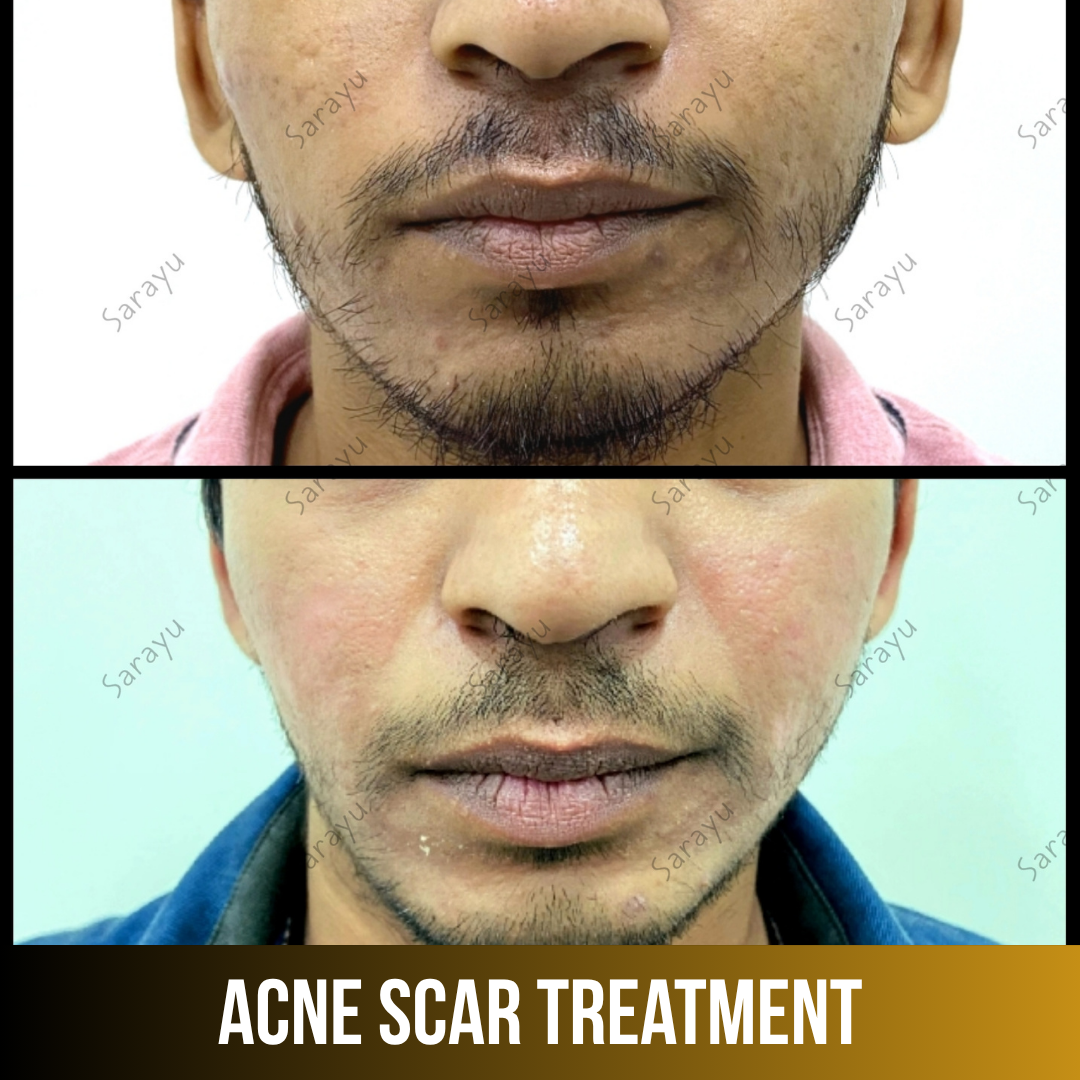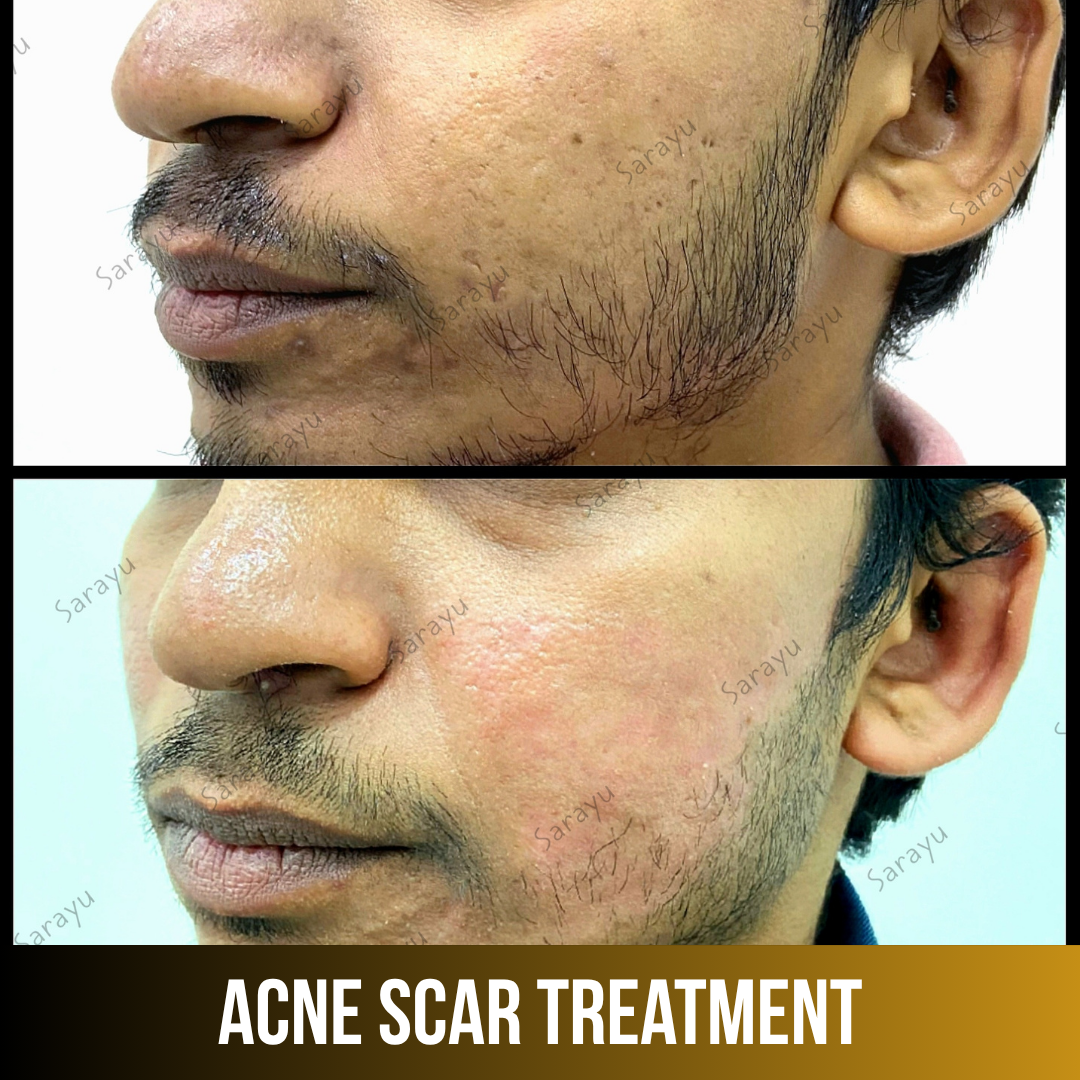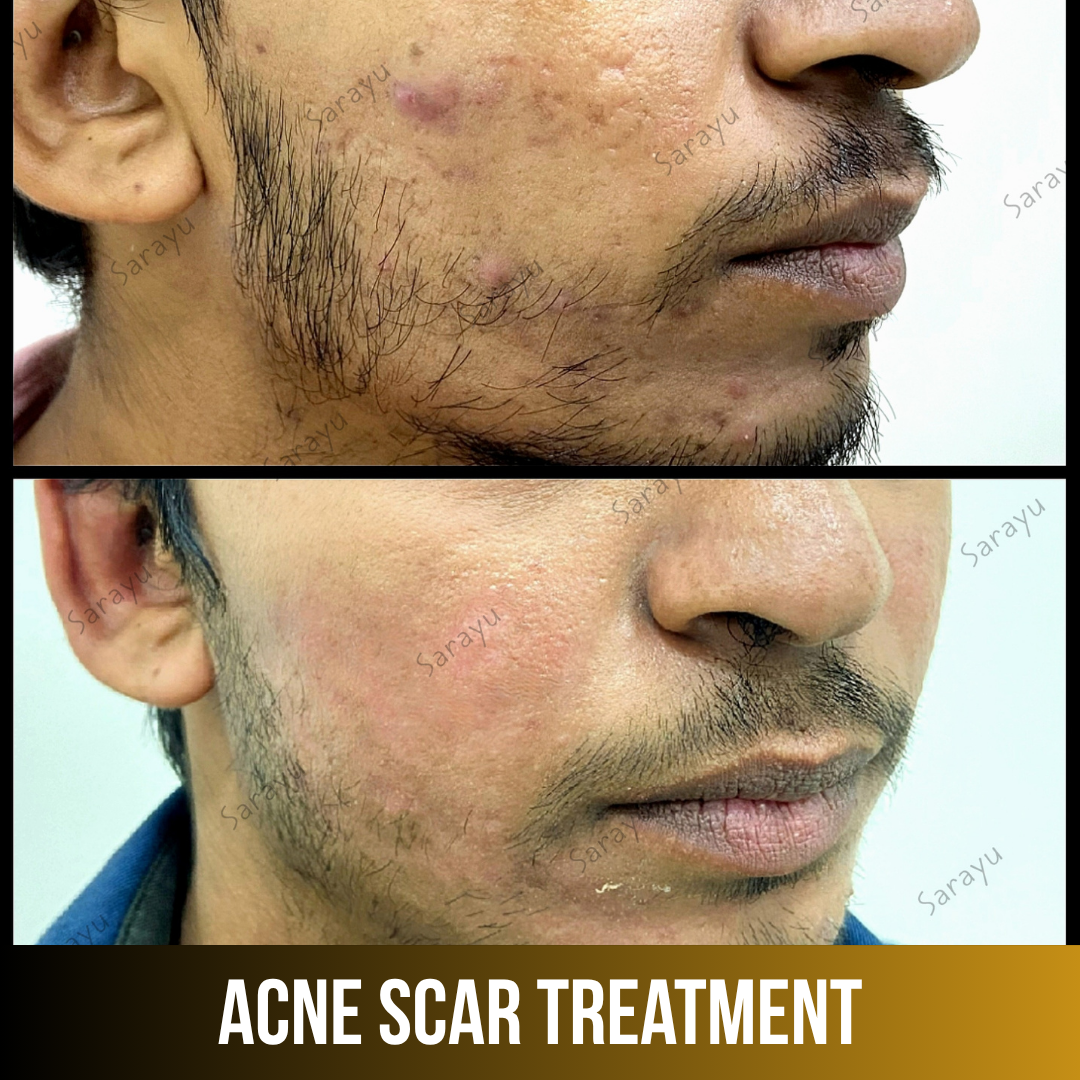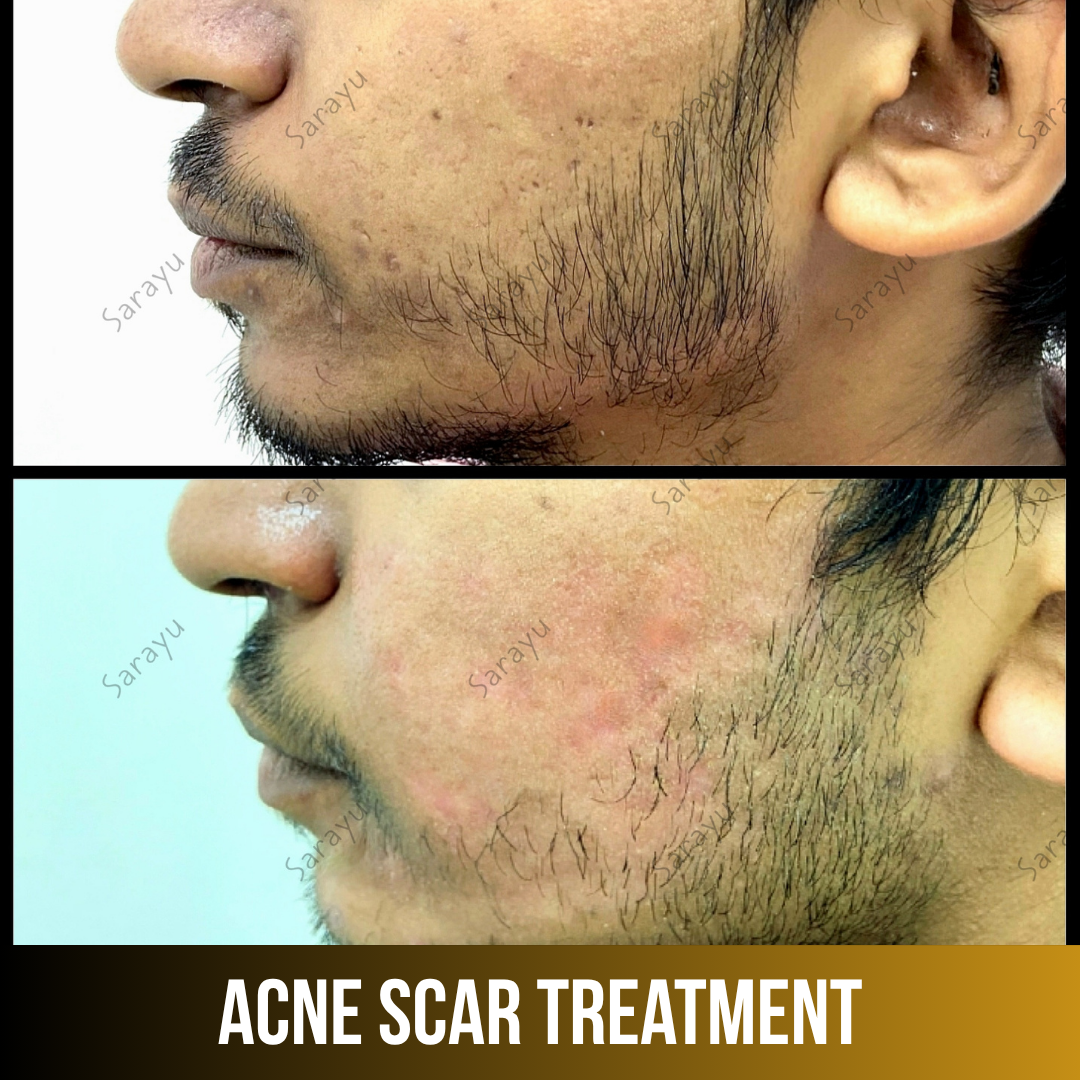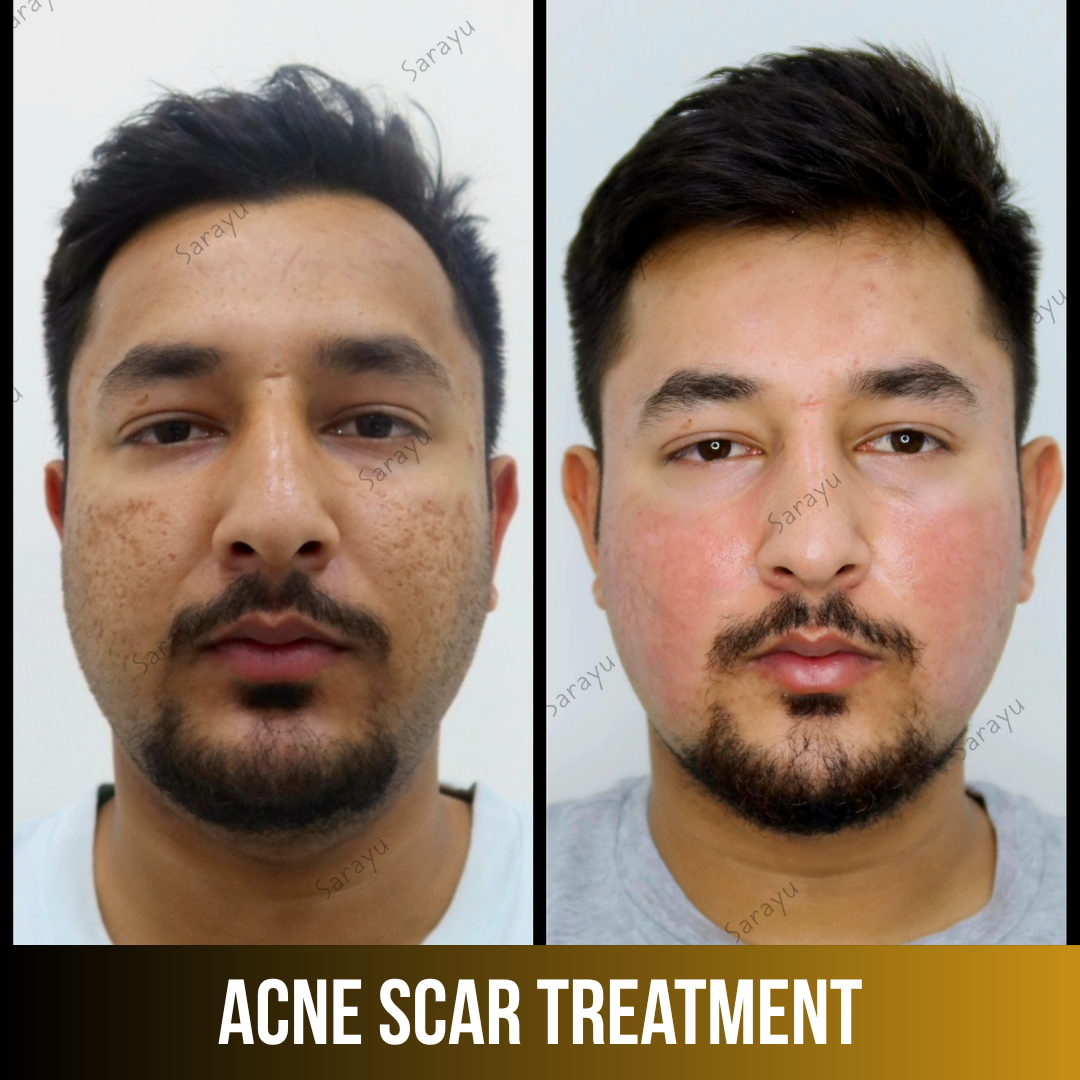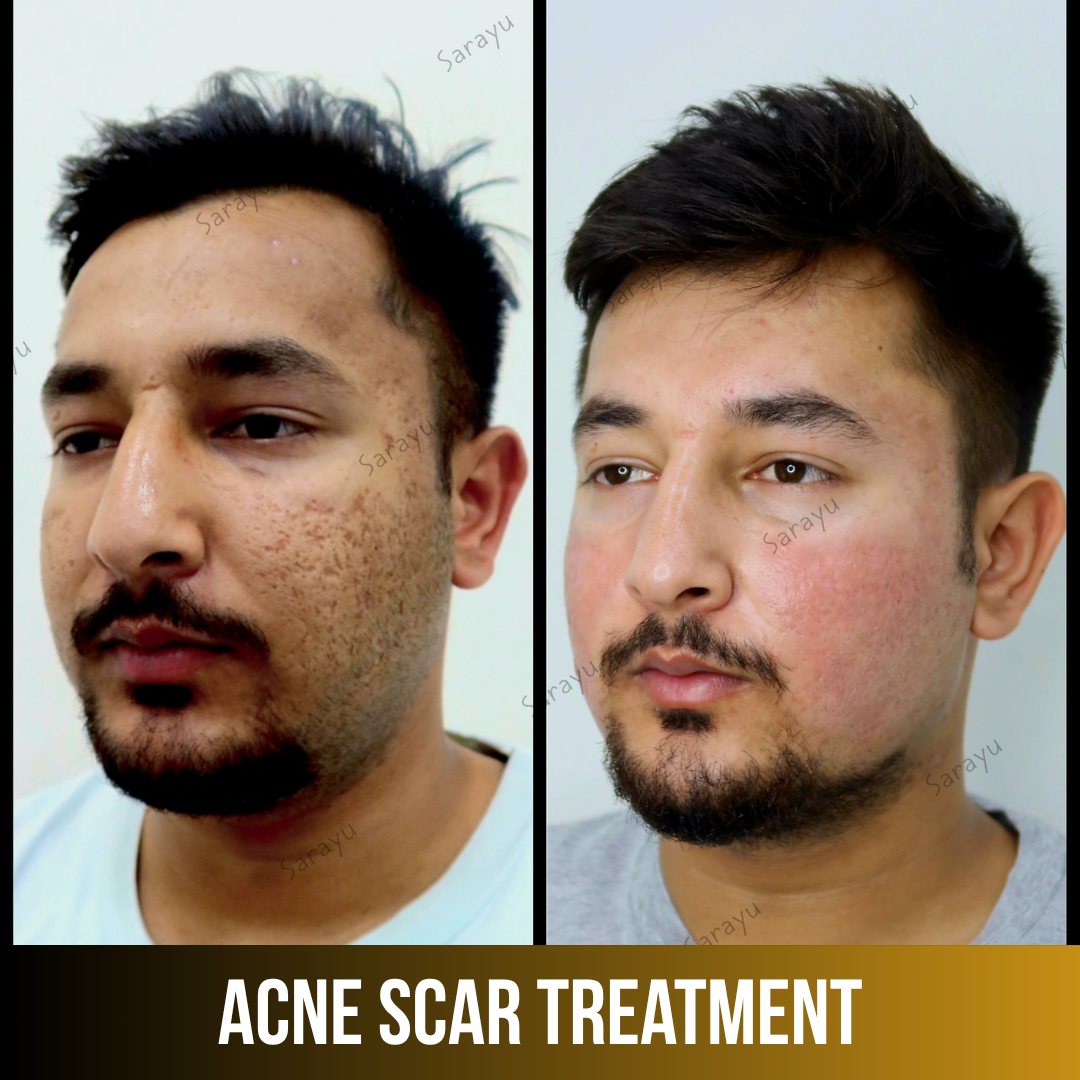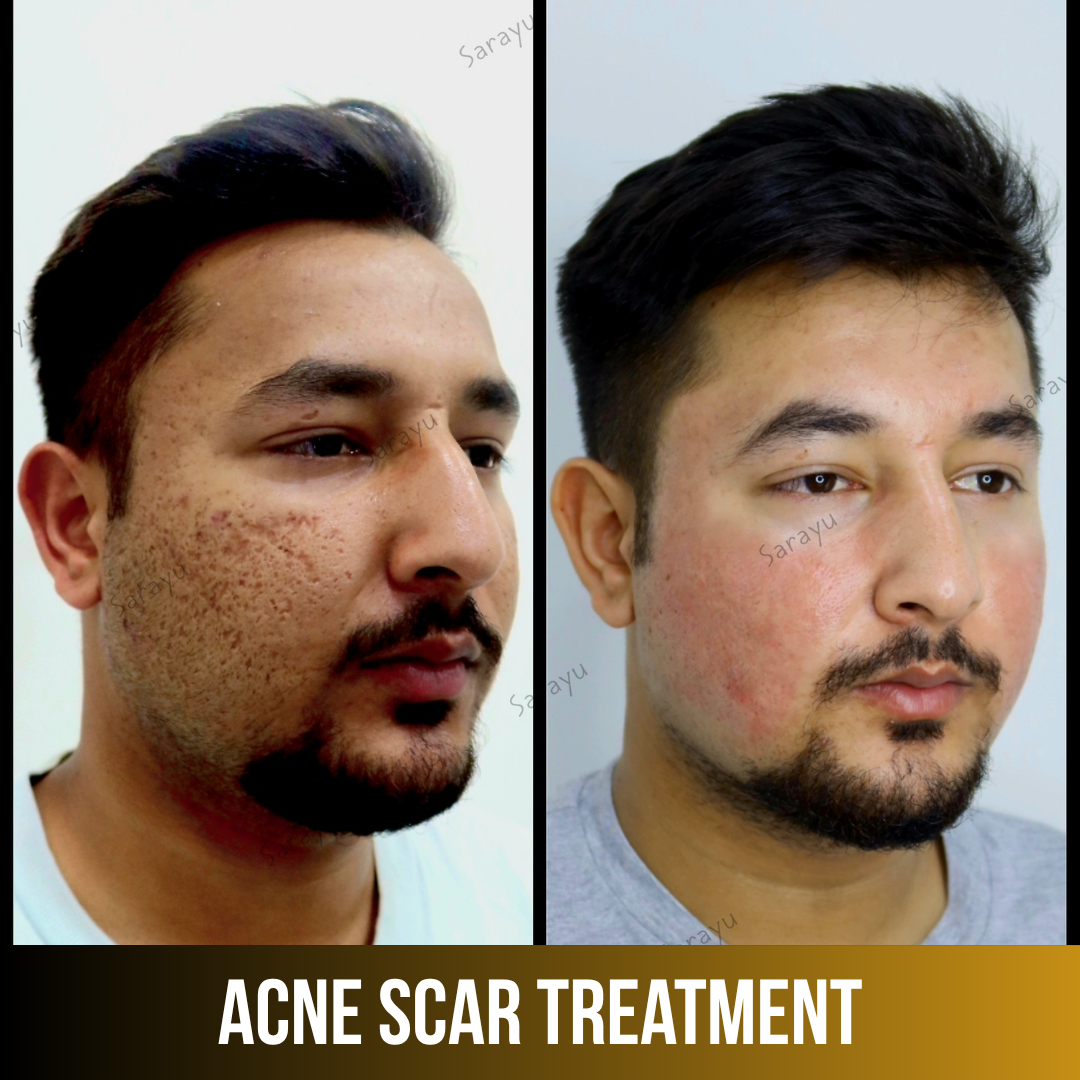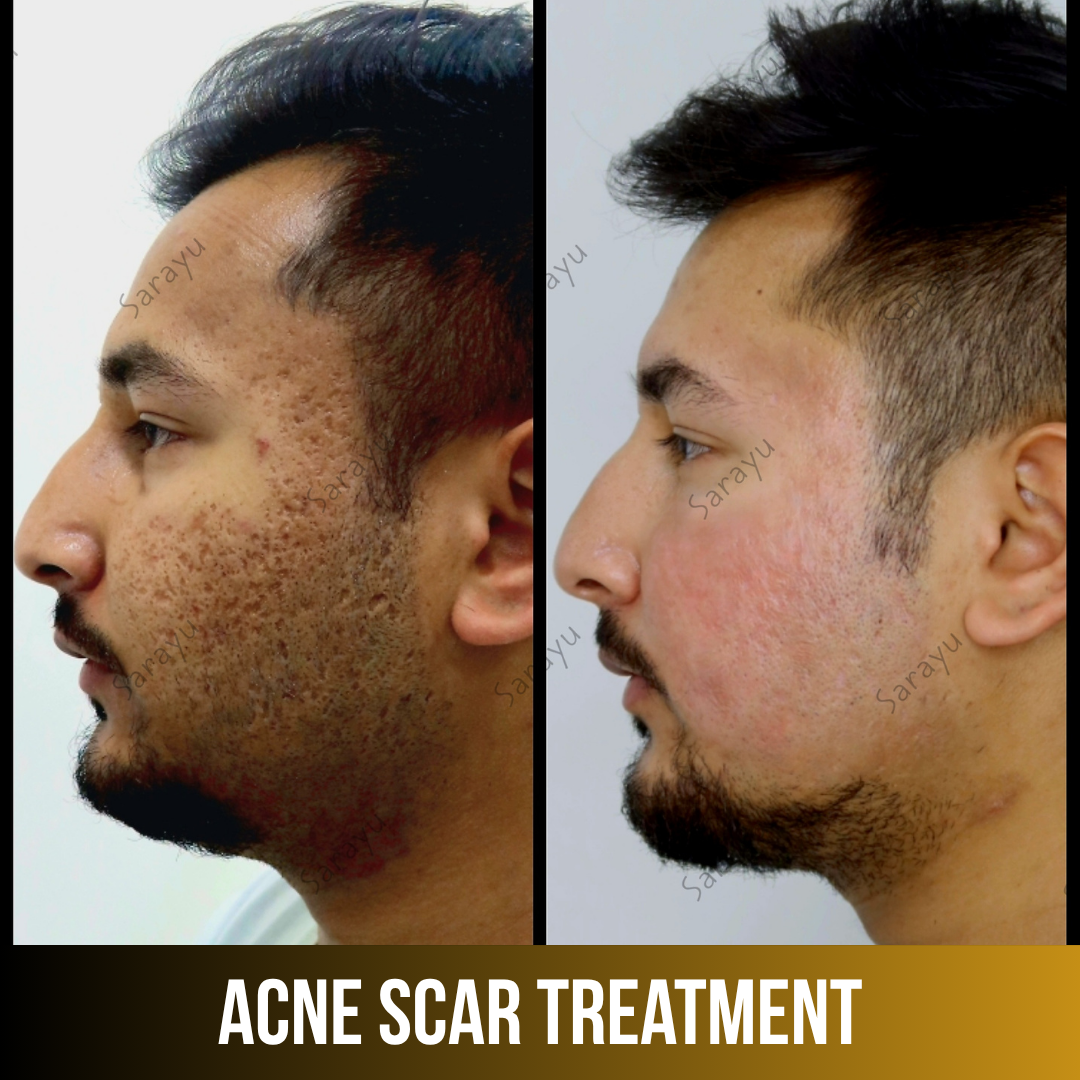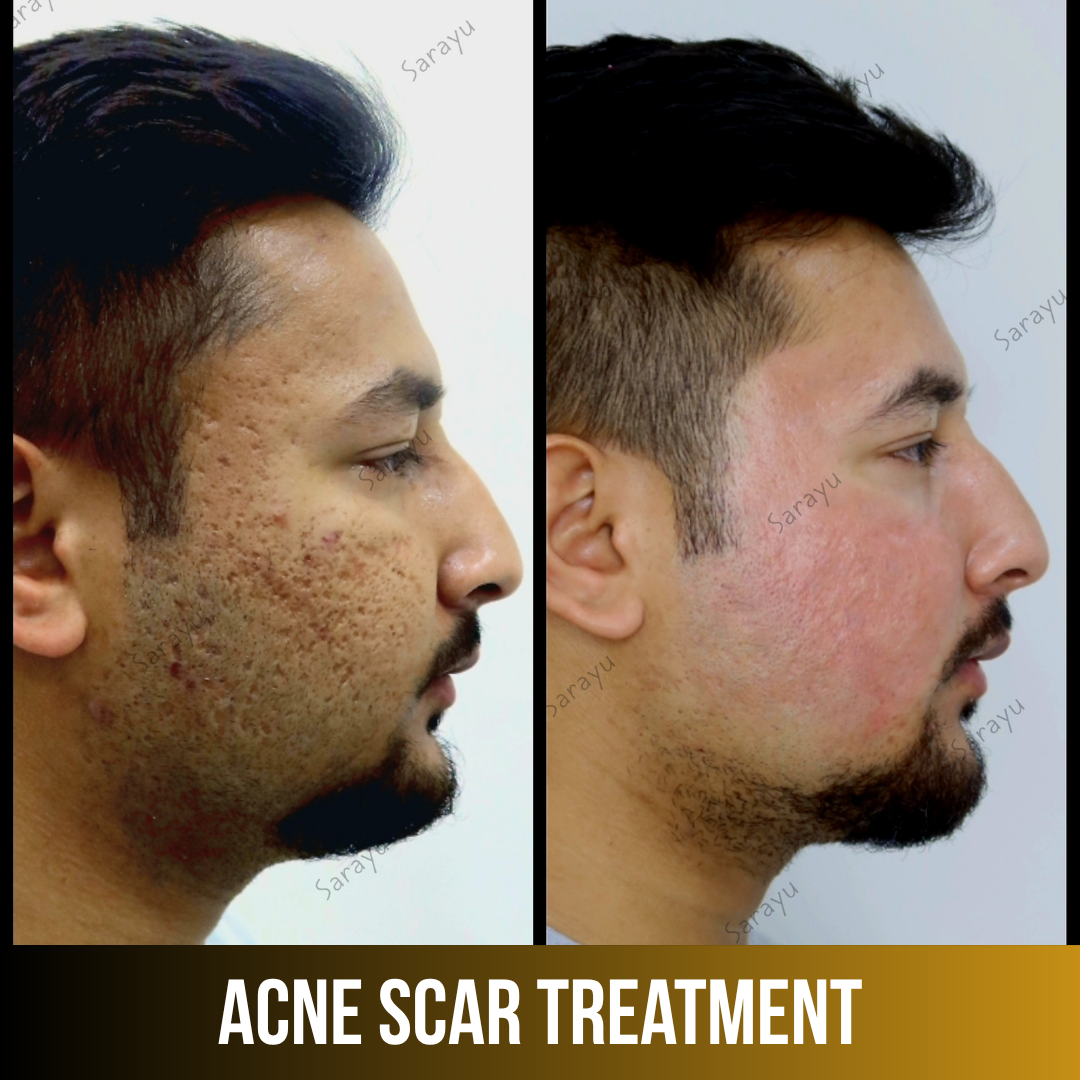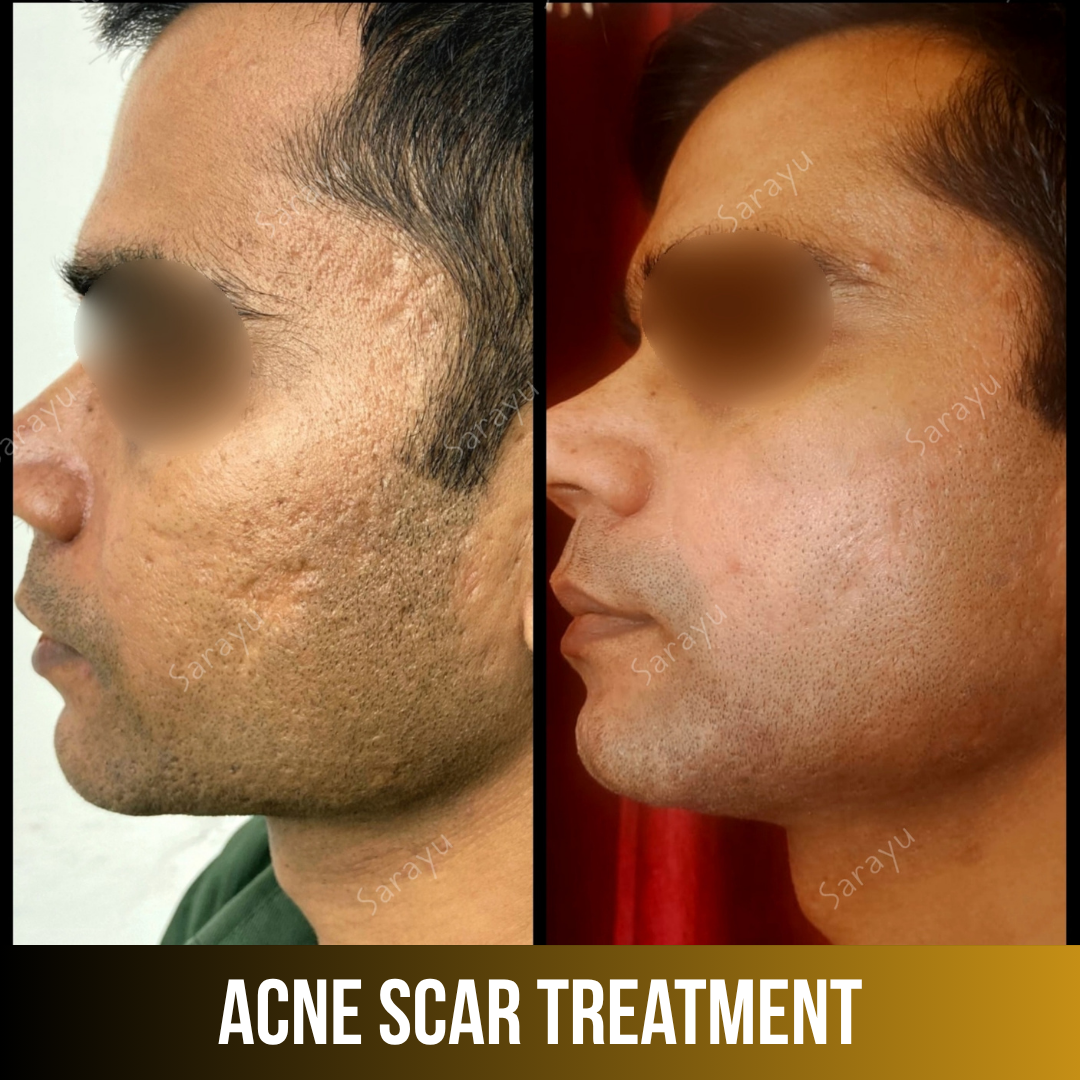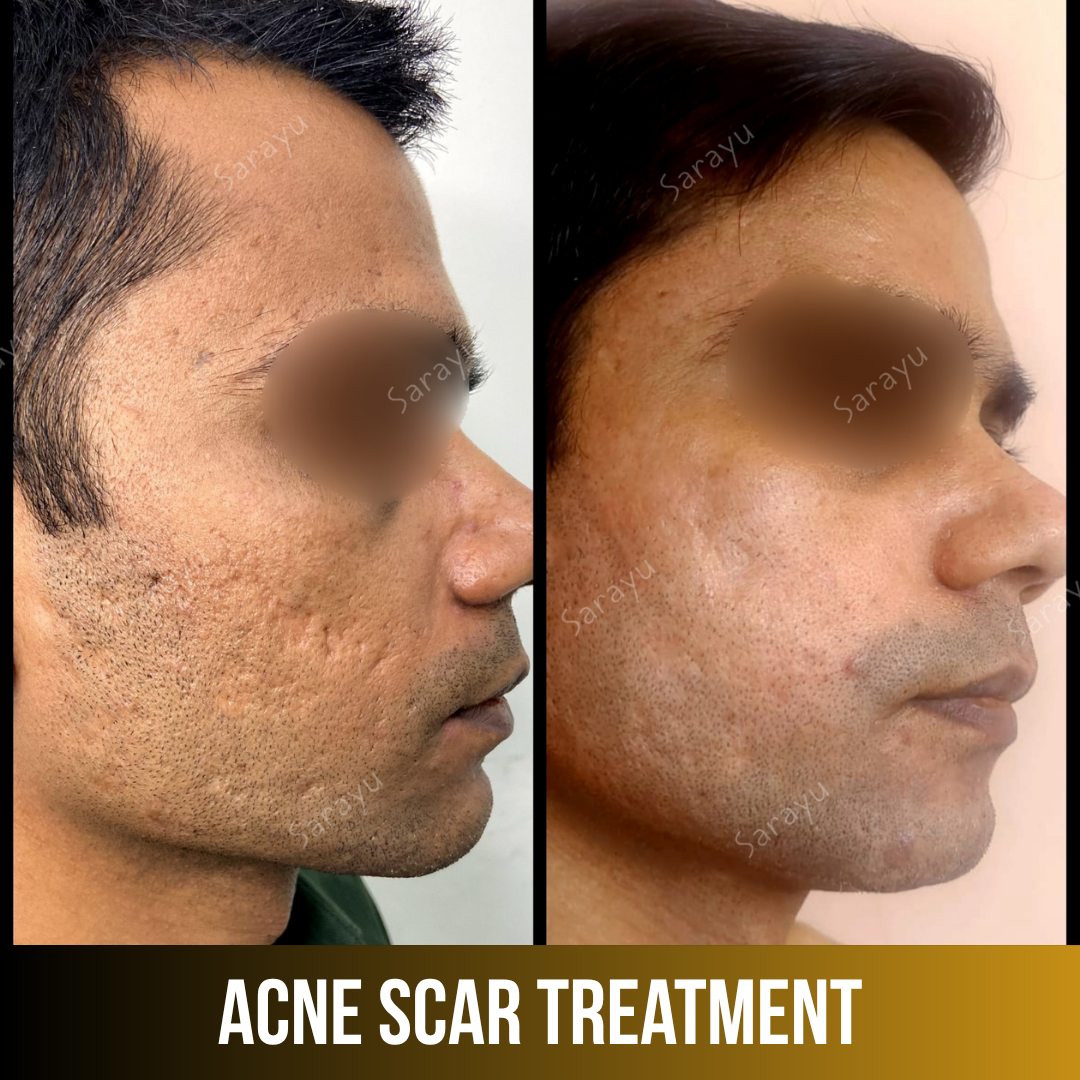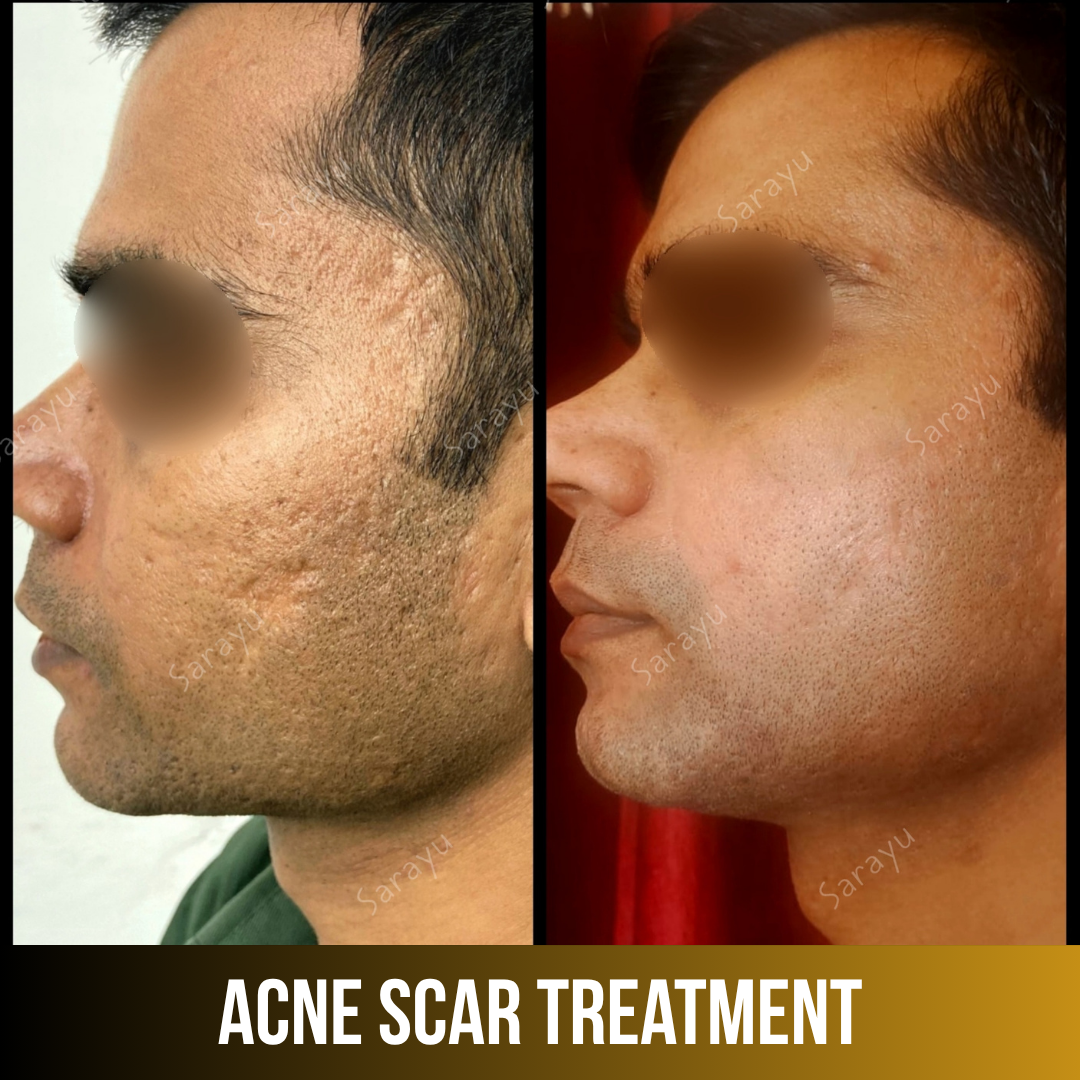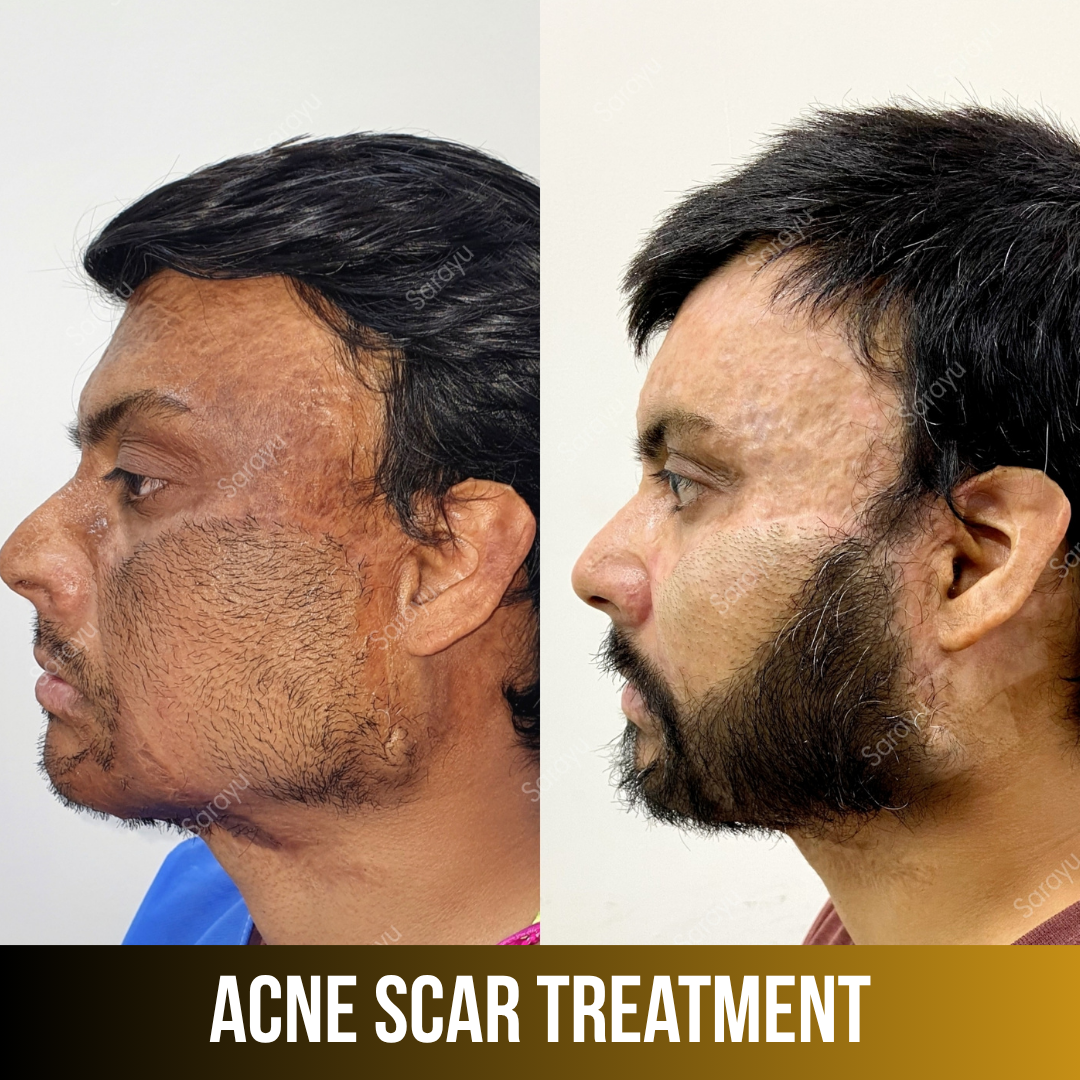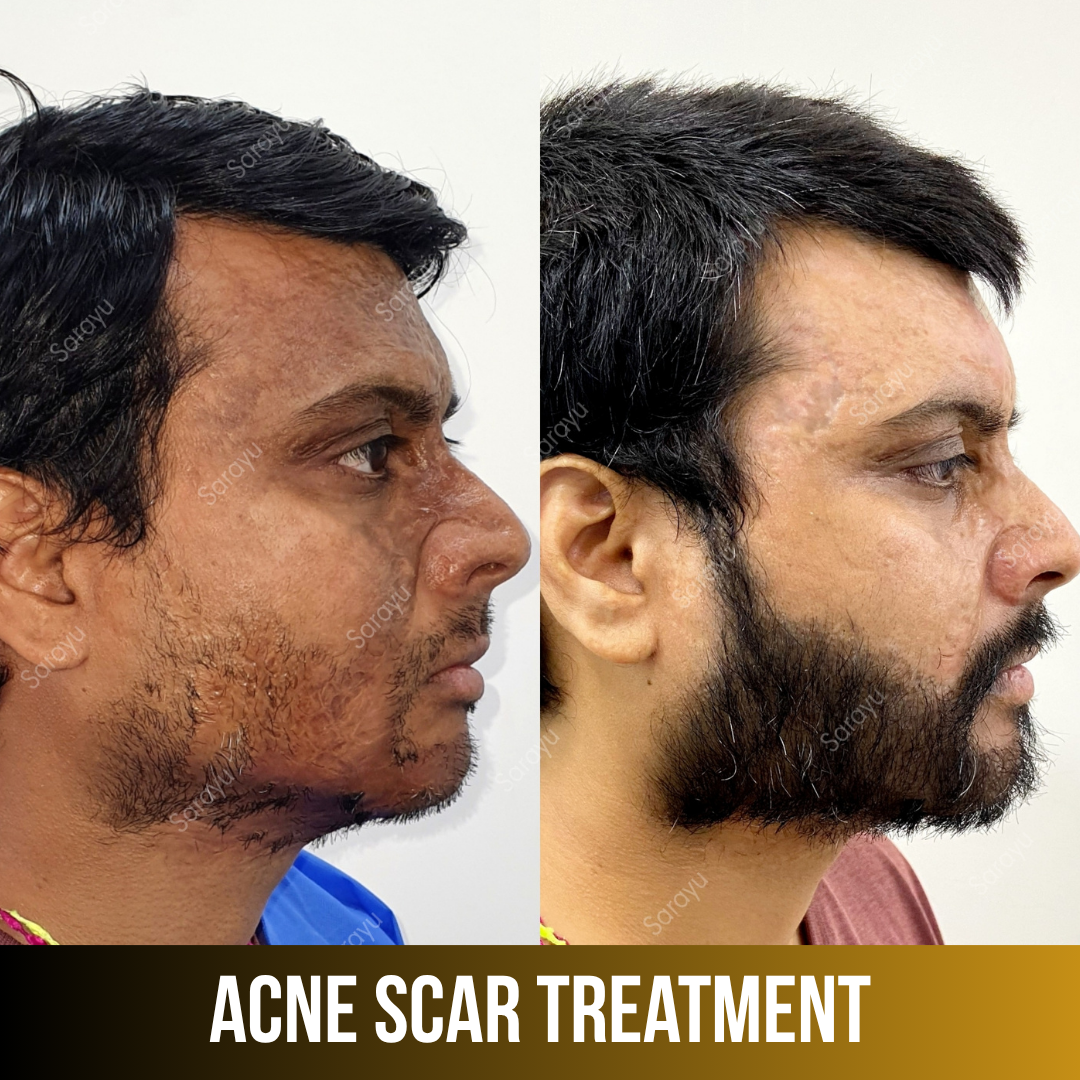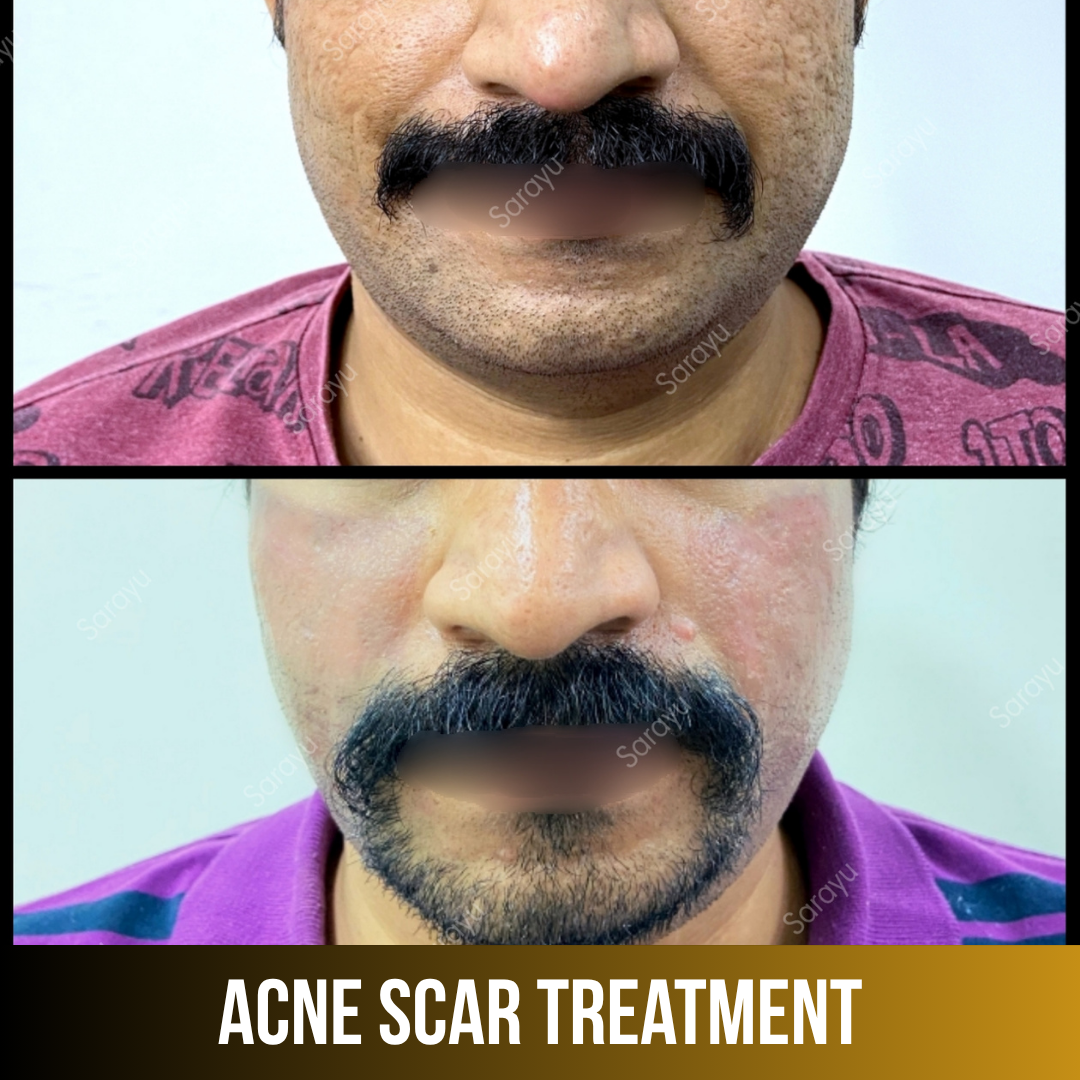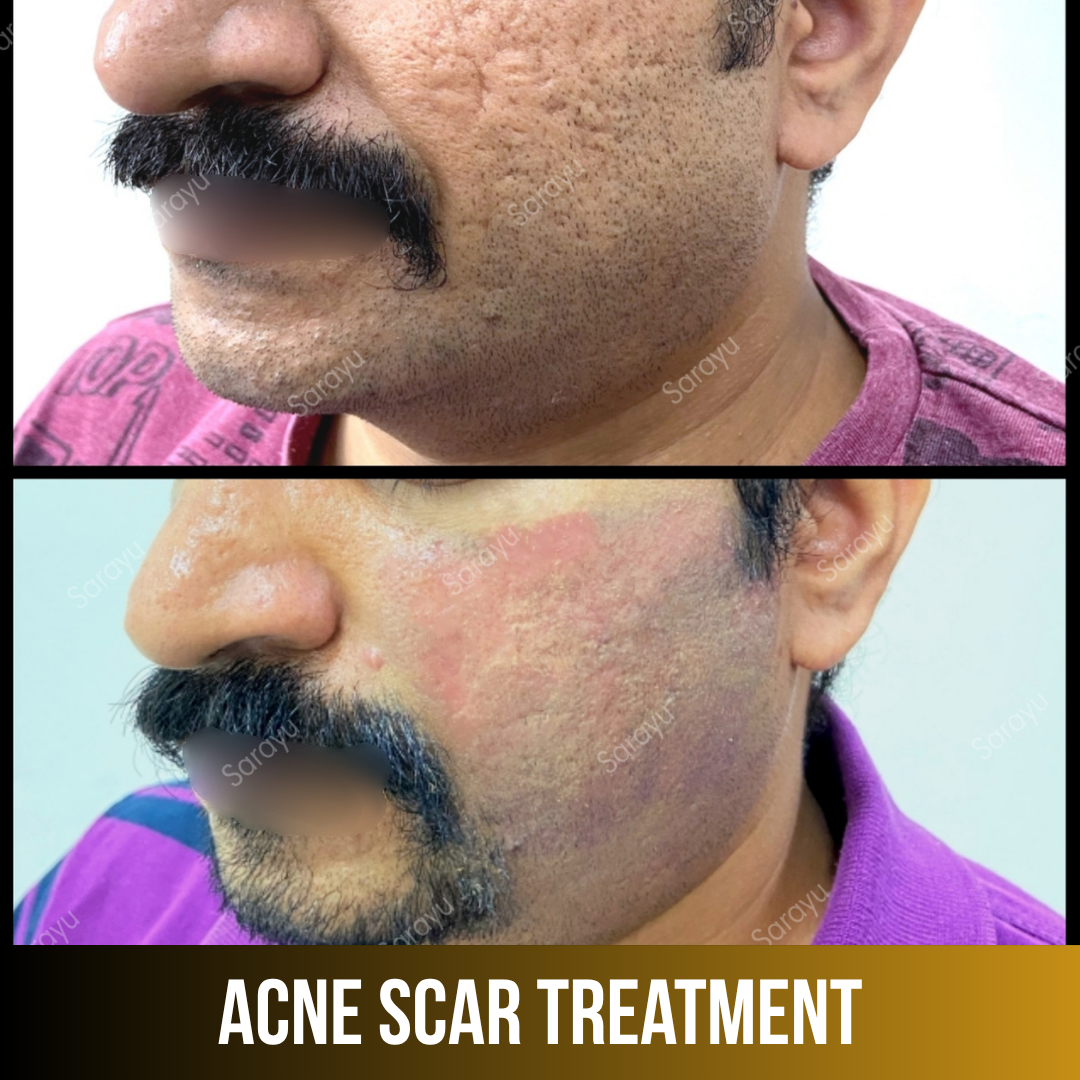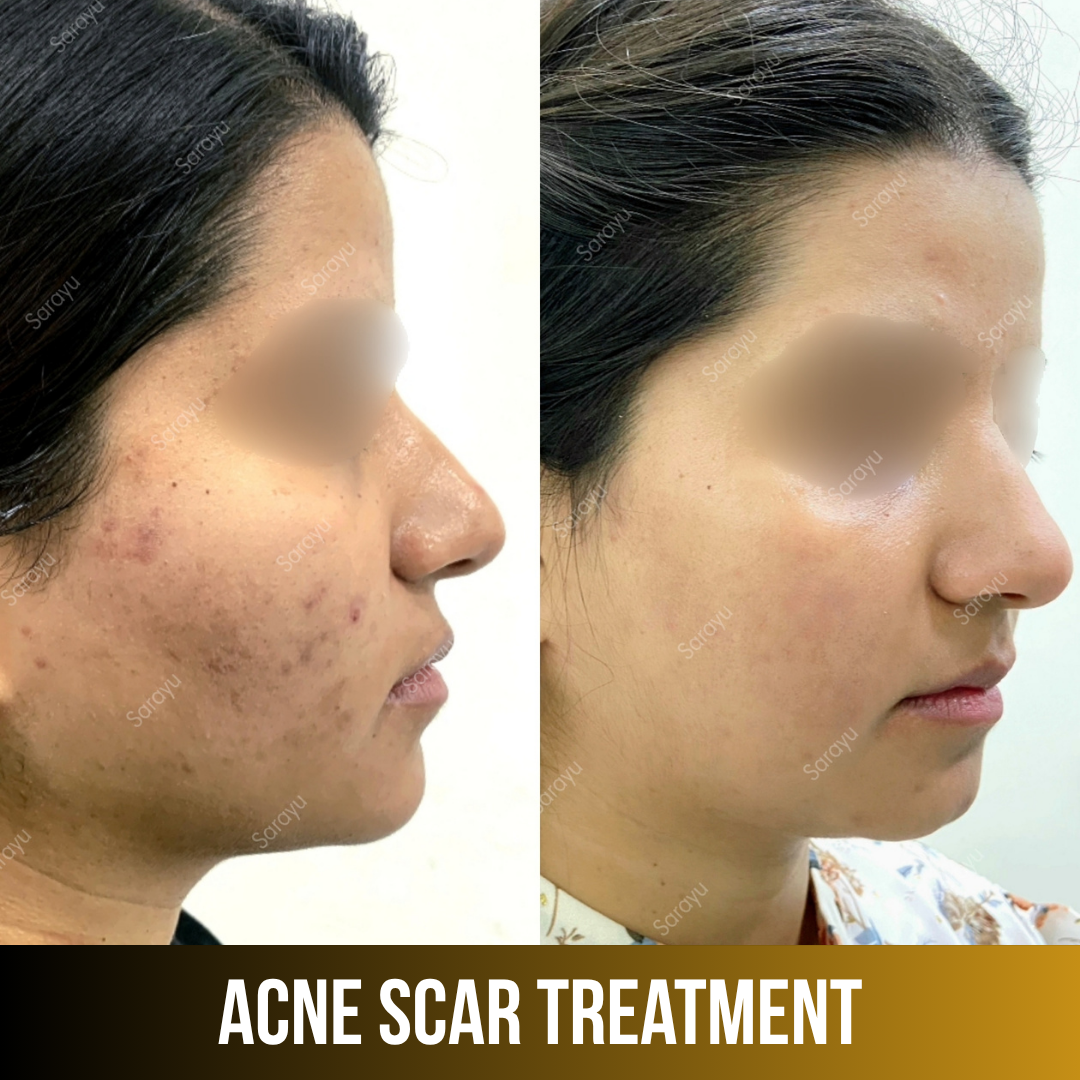
Acne Scar Removal Treatment in Delhi
Acne Scar Removal Treatment in Delhi
Before we talk about treatment, one question decides almost everything: are you actually looking at scars? A great many people who come to us convinced they have acne scars have something else — flat brown or red marks that will fade on their own within a year. Treating those as scars means spending money on a problem that time would have solved for free.
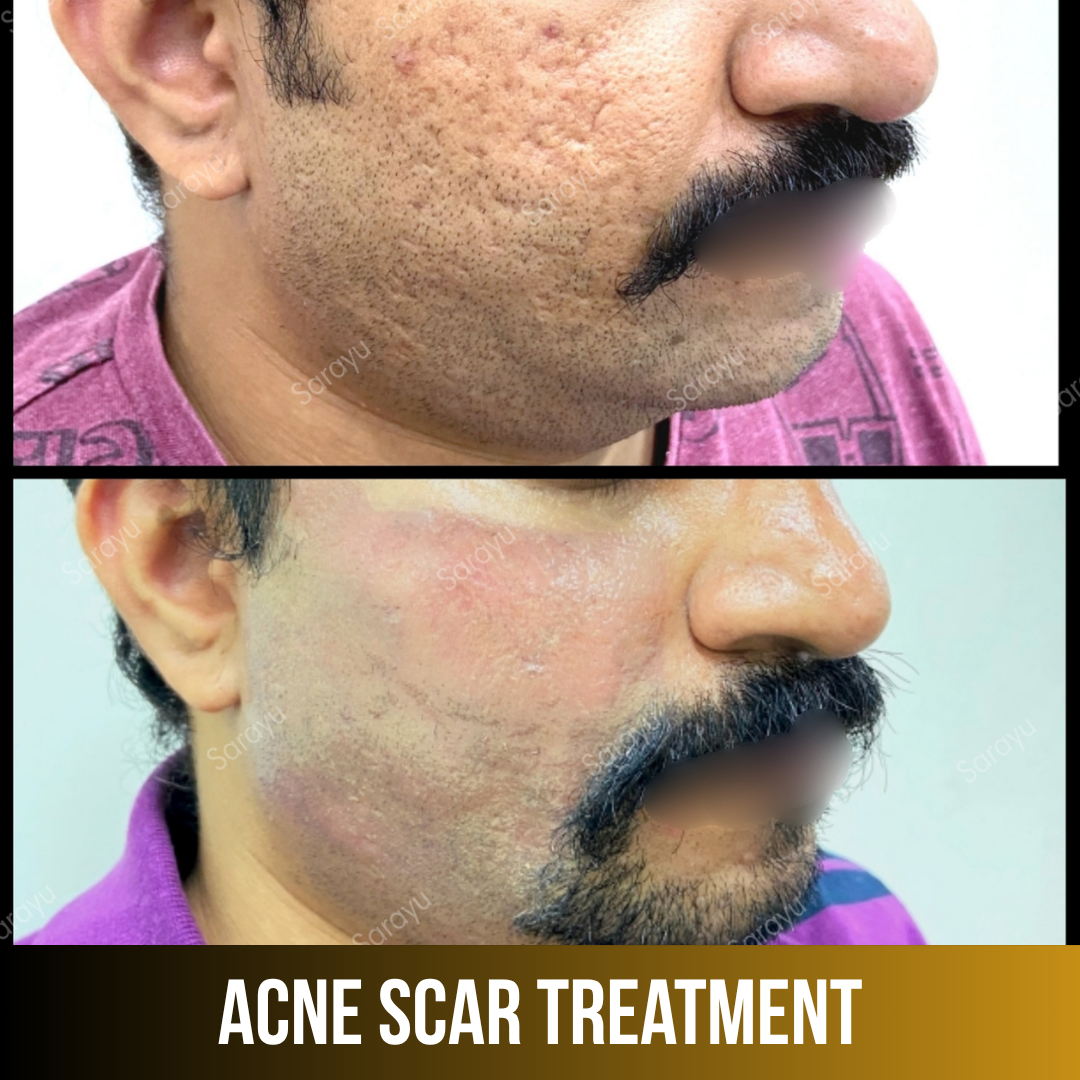
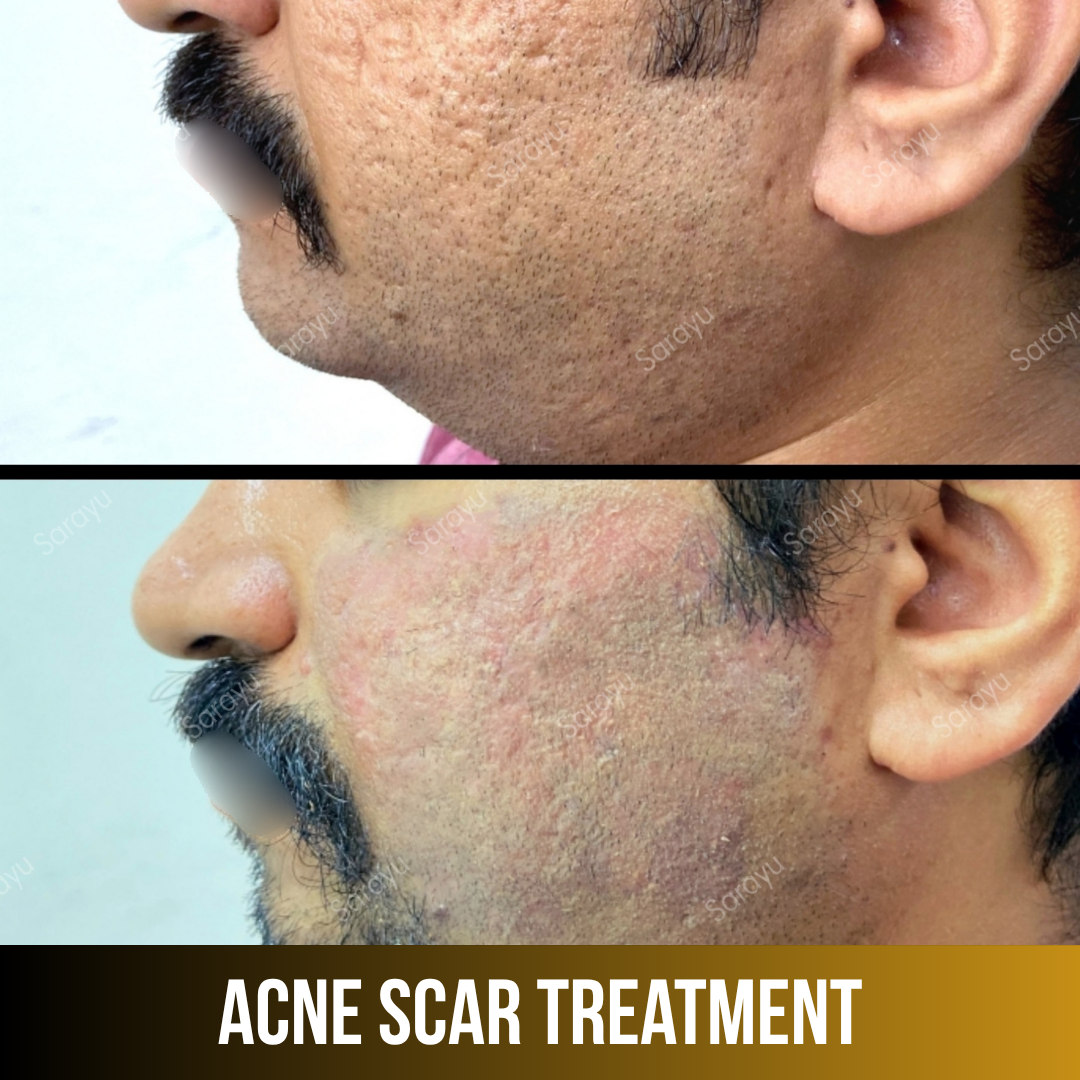
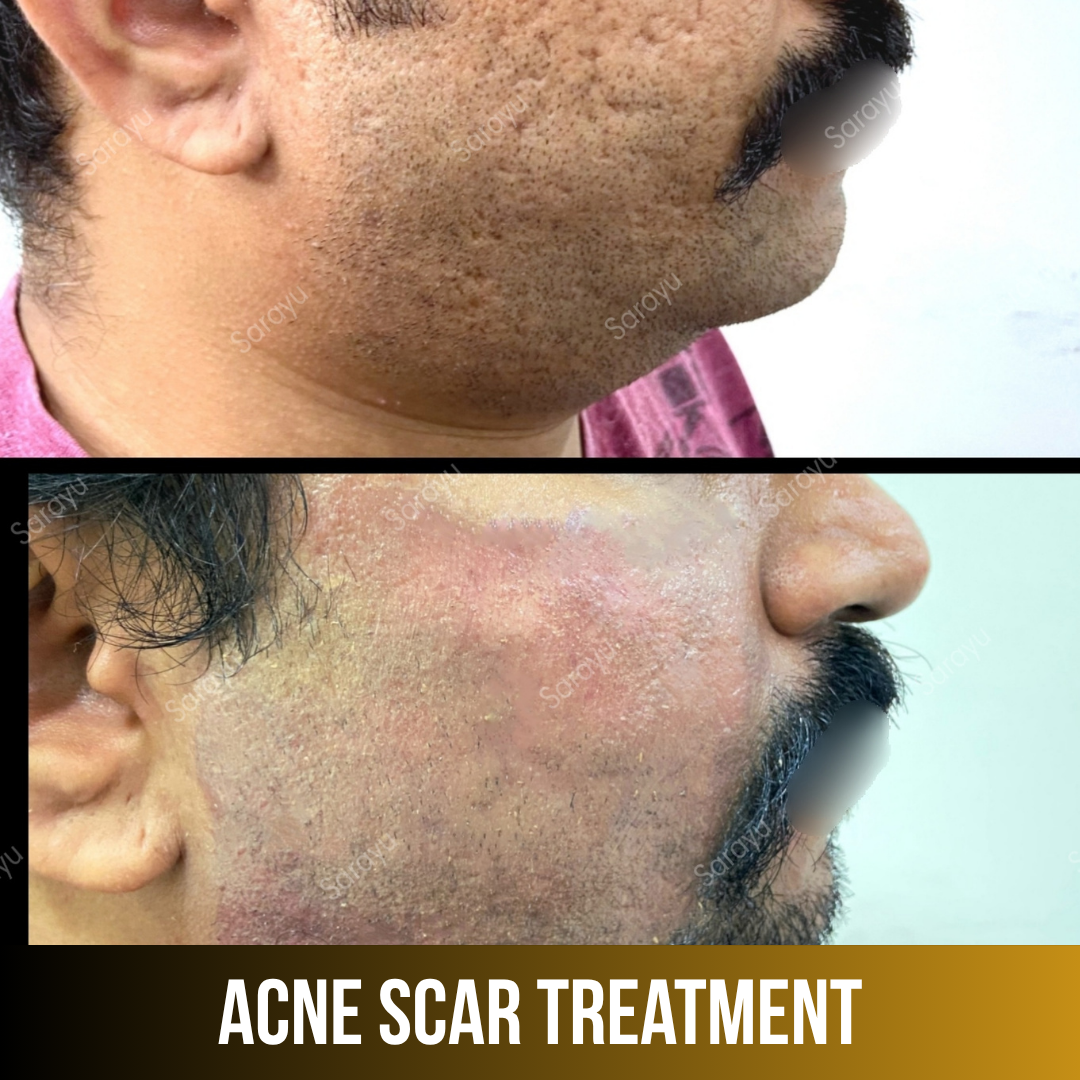
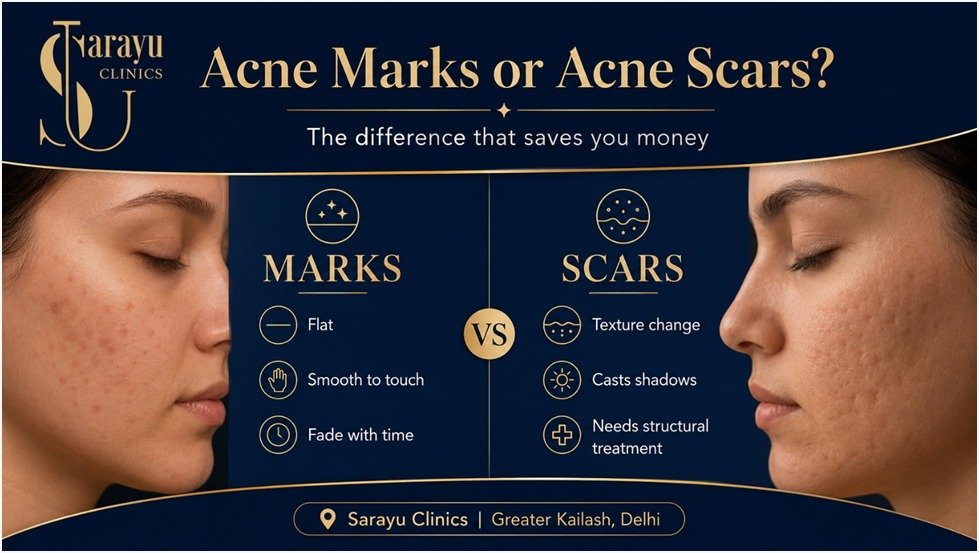
A true acne scar is a change in the texture of the skin — a pit, a depression, a raised lump. Run your fingertip over it and you feel it. Look at the area in side-lighting and you see a shadow. That is structural damage: collagen was destroyed during inflammation and the skin healed imperfectly. Marks, by contrast, are flat. You cannot feel them. They are pigment or lingering redness, and they are temporary.
That distinction is where honest acne scar treatment begins, and it is why this page starts with diagnosis rather than a menu of lasers. At Sarayu Clinics in Greater Kailash, acne scarring is assessed and treated by facial plastic and maxillofacial surgeon Dr. Adarsh Tripathi — which matters here because deep scars often need surgical techniques that most skin clinics simply do not offer.
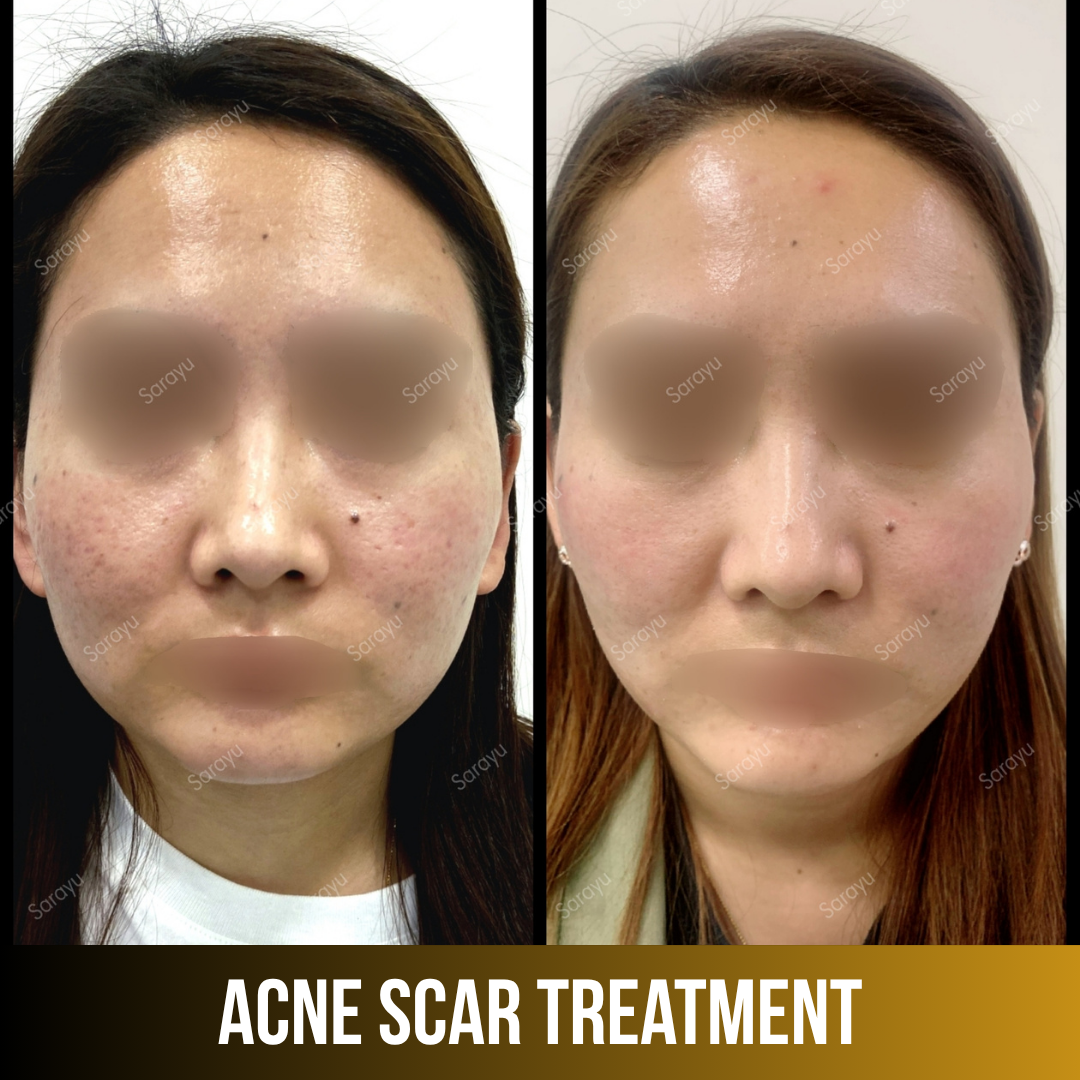
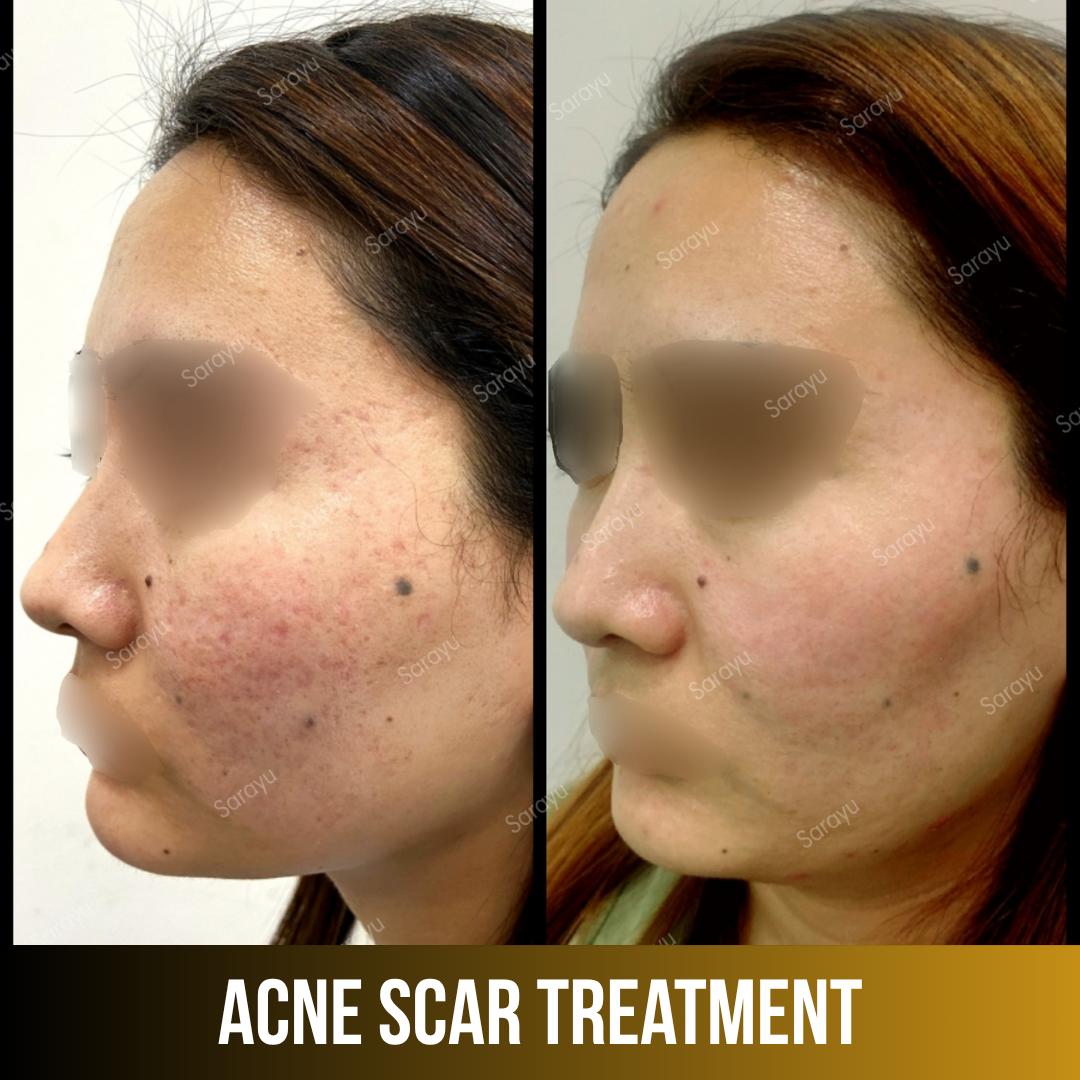
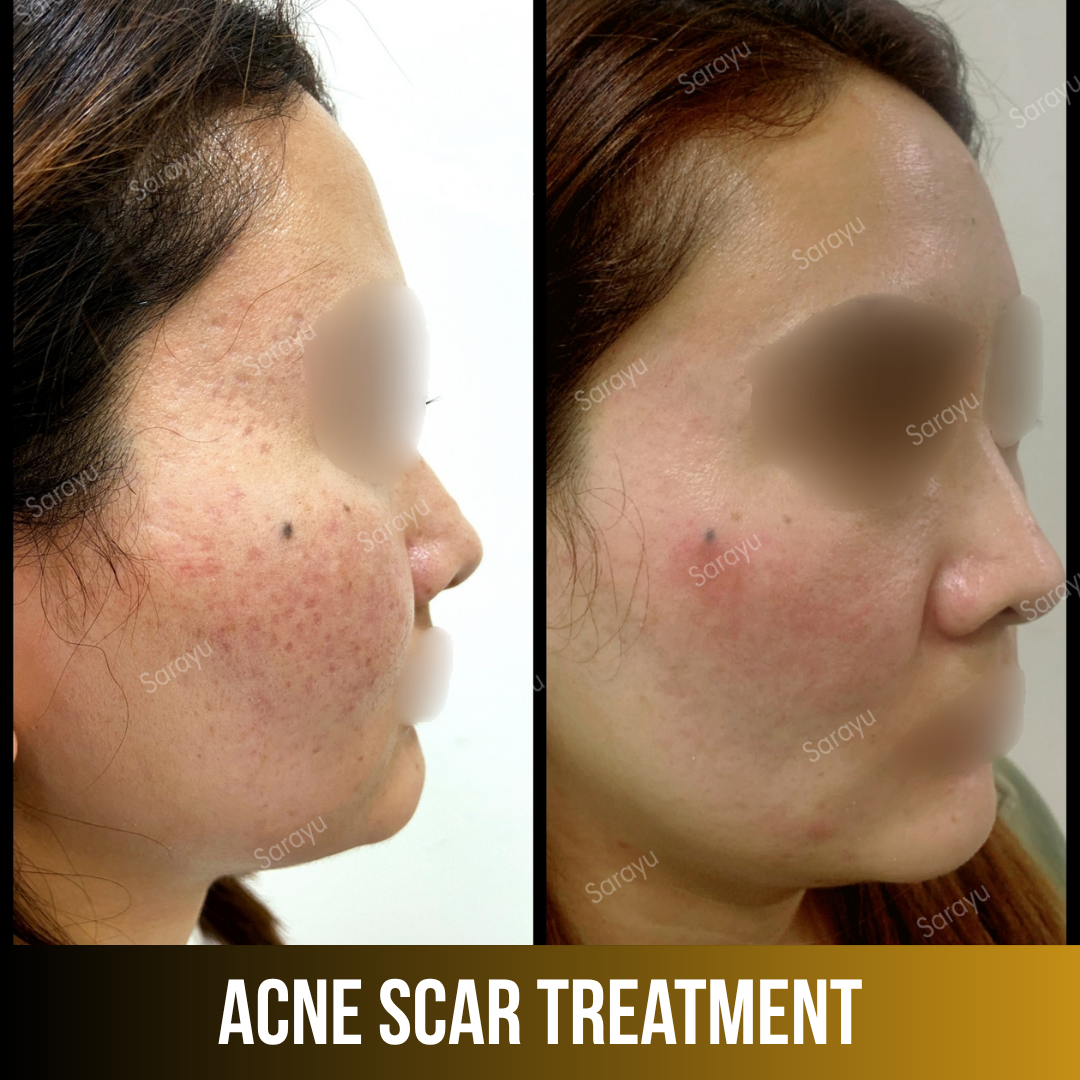
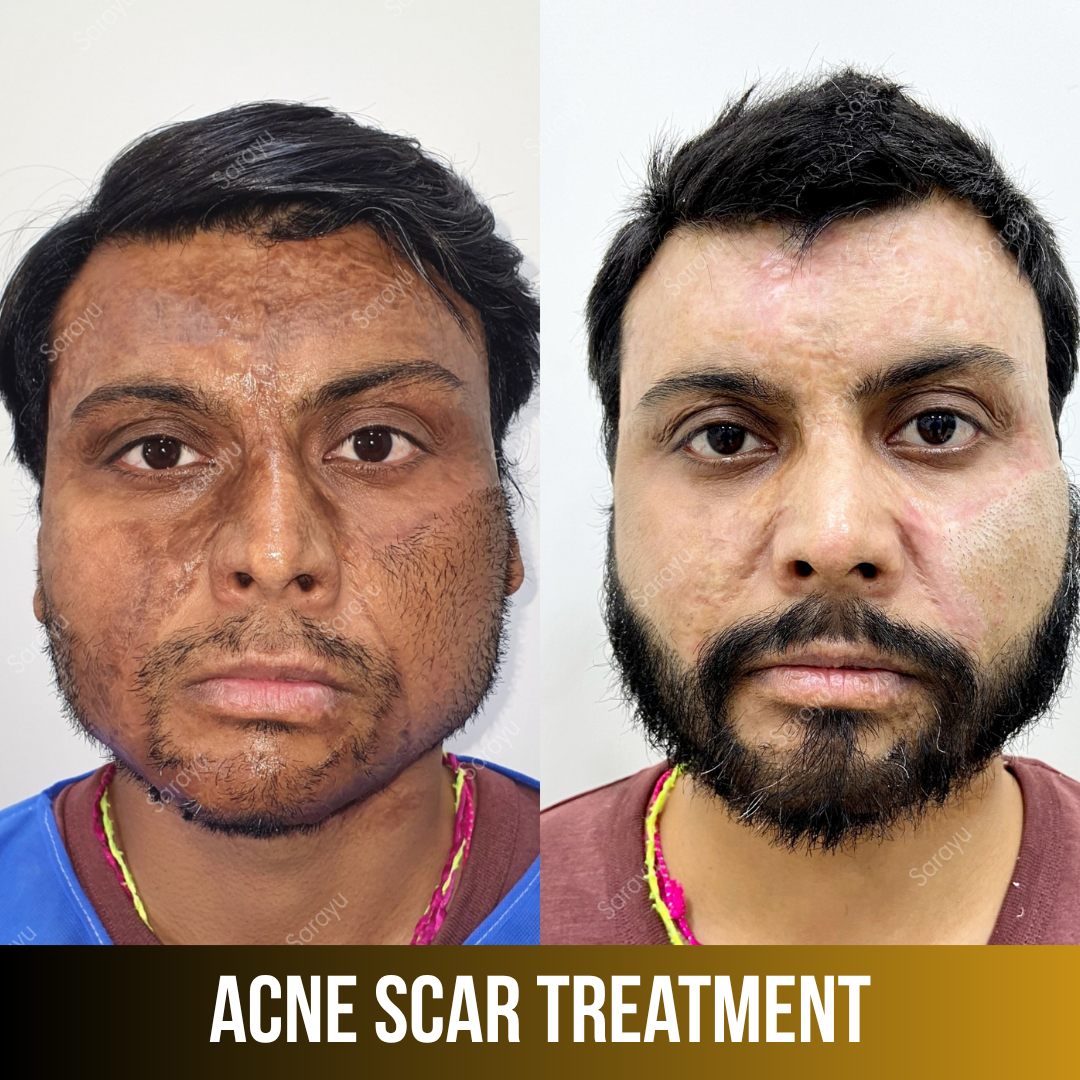
The short answer : Acne scars are permanent structural damage — flat brown or red marks are NOT scars and fade in 3-12 months. True scars are atrophic (ice pick, boxcar, rolling) or raised (hypertrophic, keloid), and each type needs a different treatment: TCA CROSS or punch excision for ice pick, subcision plus resurfacing for rolling, subcision or punch elevation plus laser for boxcar, and steroid injections rather than resurfacing for raised scars. The single most important principle: rolling scars are held down by fibrous tethers beneath the skin, so lasers alone will not lift them — subcision must release the tether first. Active acne must be controlled before scar work begins. Most people need a COMBINATION of 3-6 sessions across several months. In Delhi, expect roughly Rs 3,000-10,000 per subcision or TCA CROSS session, Rs 12,000-30,000 per laser or MNRF session, and Rs 60,000-2,00,000 for a complete combination course. Honest expectation: a 50-80% improvement is an excellent result. No treatment erases acne scars completely, and any clinic promising that is selling you something.
Marks or Scars? The Difference That Saves You Money
Two simple tests, done at a mirror in good light, tell you which you have.
- The touch test. Close your eyes and run a fingertip lightly over the area. If you feel a dip, a pit or a raised bump, that is a scar — a texture change. If the skin feels perfectly smooth, it is a mark.
- The side-light test. Stand beside a window so light falls across your face rather than onto it. Scars cast small shadows and become more obvious; flat marks look the same in any light.
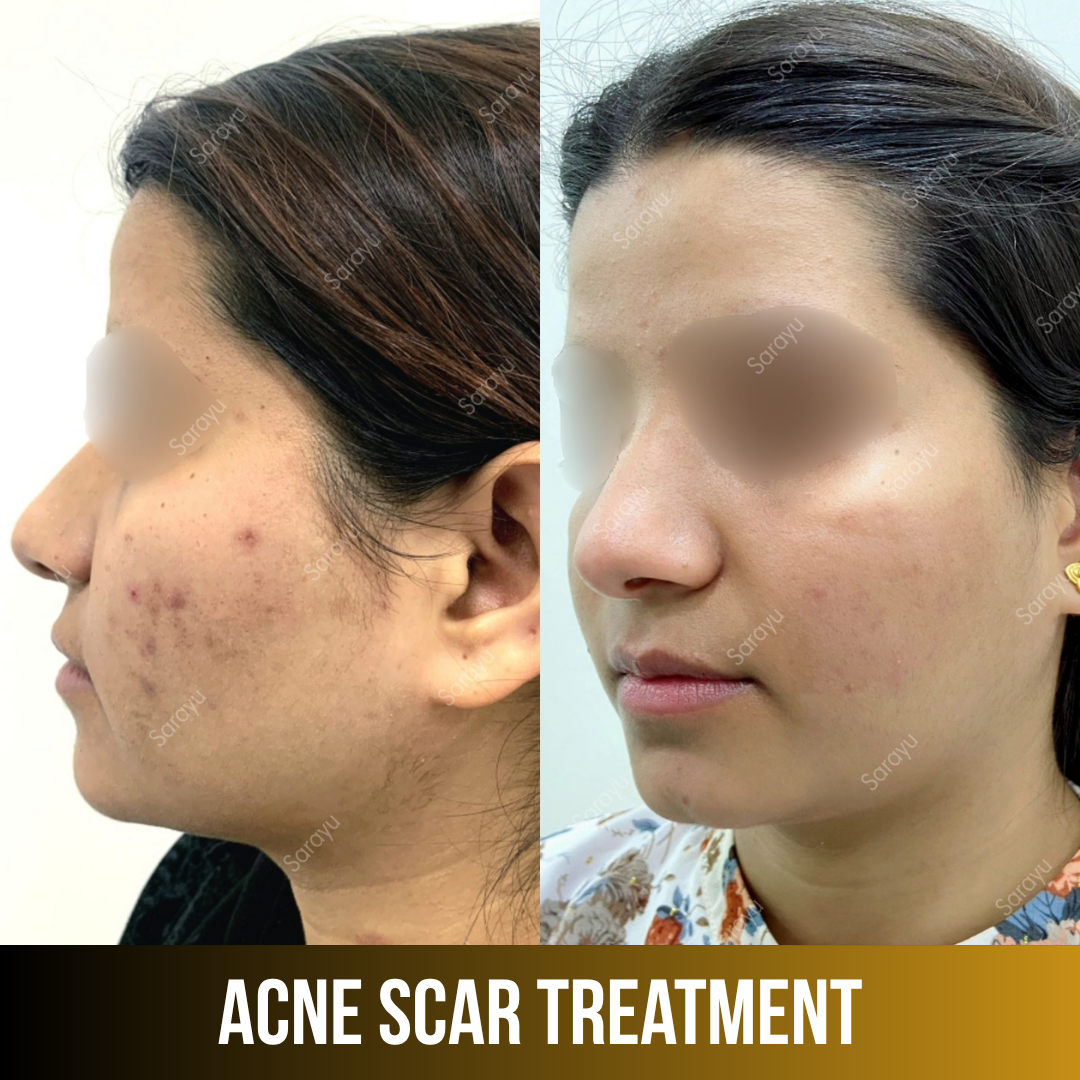
If the answer is marks — the brown patches of post-inflammatory hyperpigmentation or the red-pink of post-inflammatory erythema — the honest advice is patience, sun protection and a good topical routine. Most fade substantially within three to twelve months. If they are stubborn, they belong on the pigmentation treatment pathway, not on a scar-revision pathway. We wrote a fuller guide to this distinction on our blog, and it is worth reading before you book anything.
The rule we apply before taking anyone’s money
If your acne is still active, scar treatment waits. Treating scars while new lesions are still forming is futile — you create fresh scars while paying to fix old ones, and several scar procedures are unsafe over inflamed skin. Getting the acne genuinely under control first is not a delay tactic; it is the first step of the scar plan. If you still have active breakouts, start with acne treatment and come back to this page in a few months.
Which Type of Acne Scar Do You Have?
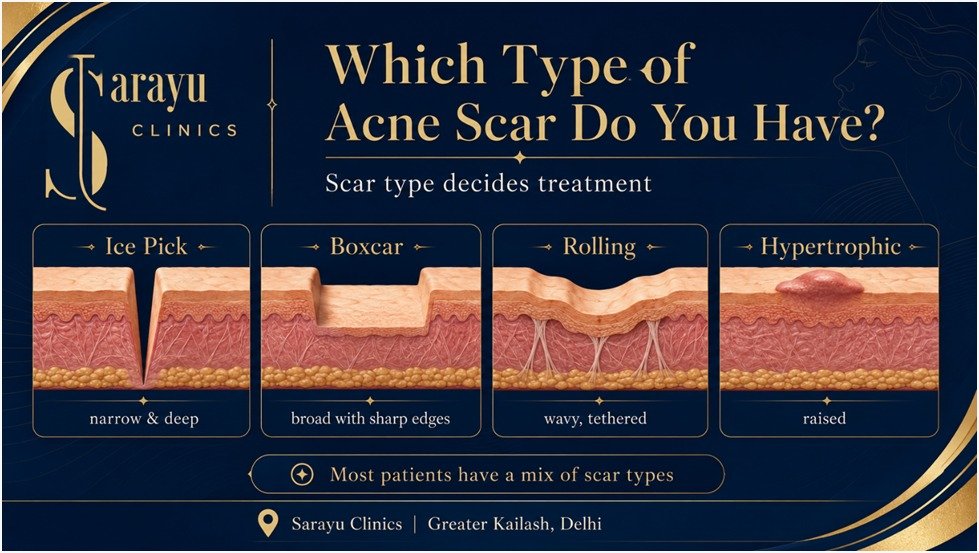
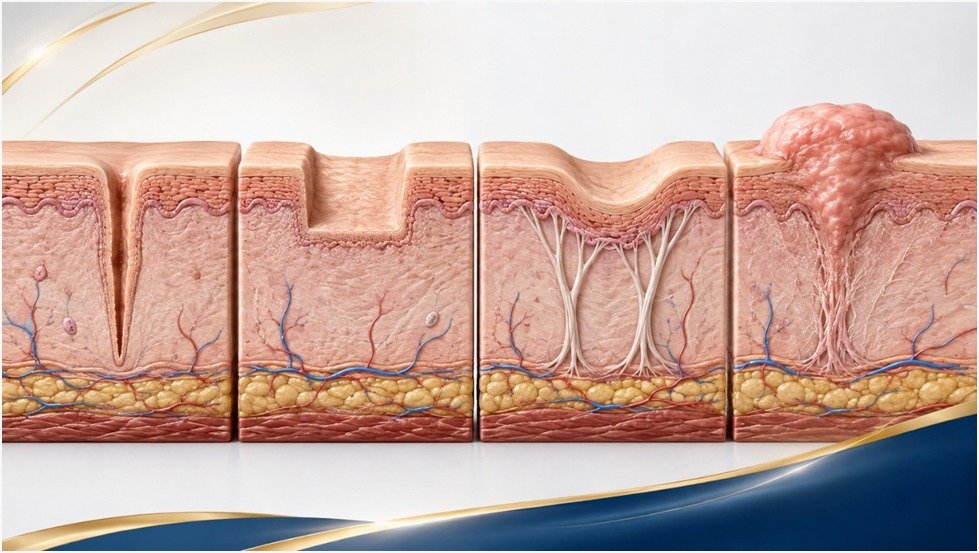
Scar type decides treatment more than anything else. Most faces carry a mixture, which is why single-treatment plans disappoint.
Scar type | What it looks like | What actually works |
Ice pick | Narrow, deep, sharp — like a puncture or an enlarged pore that goes deep | TCA CROSS; punch excision for the deepest. Resurfacing alone cannot reach the base |
Boxcar | Wide depressions with sharp, defined edges — small craters | Subcision or punch elevation, then fractional resurfacing |
Rolling | Wavy, undulating, soft-edged dips giving an uneven surface | SUBCISION first to release the tether, then resurfacing. Lasers alone fail here |
Hypertrophic / keloid | Raised, firm, thickened — commoner on jaw, chest and back | Intralesional steroid (± 5-FU), silicone, pulsed-dye laser. NOT resurfacing |
Atrophic with volume loss | Broad, sunken areas rather than discrete scars | Dermal filler, biostimulators or fat grafting to restore volume |
PIH / PIE (not a scar) | Flat brown or red marks, no texture change | Time, sun protection, topicals. Fades in 3-12 months |
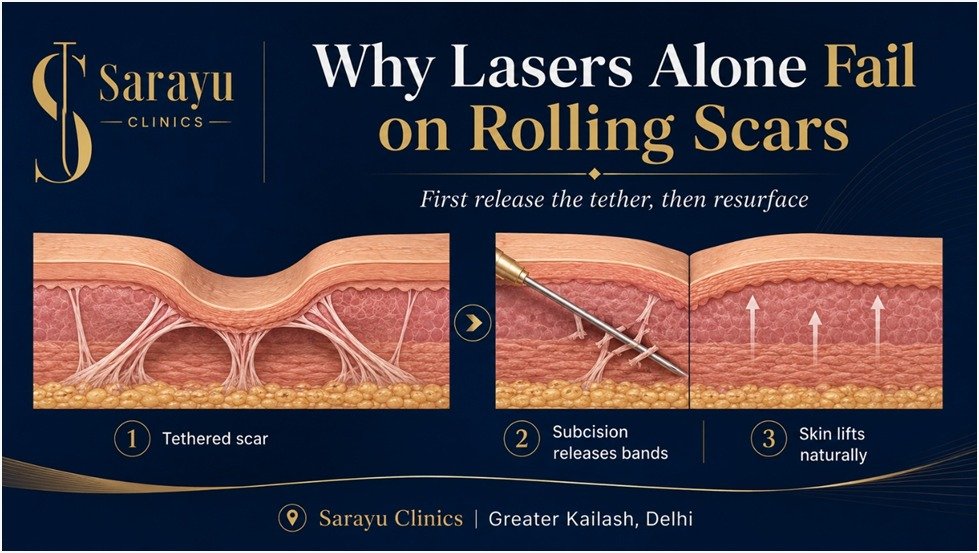
Why Lasers Alone Fail on Rolling Scars ?
This is the most useful thing on this page, and the reason so many people finish an expensive laser package feeling let down.
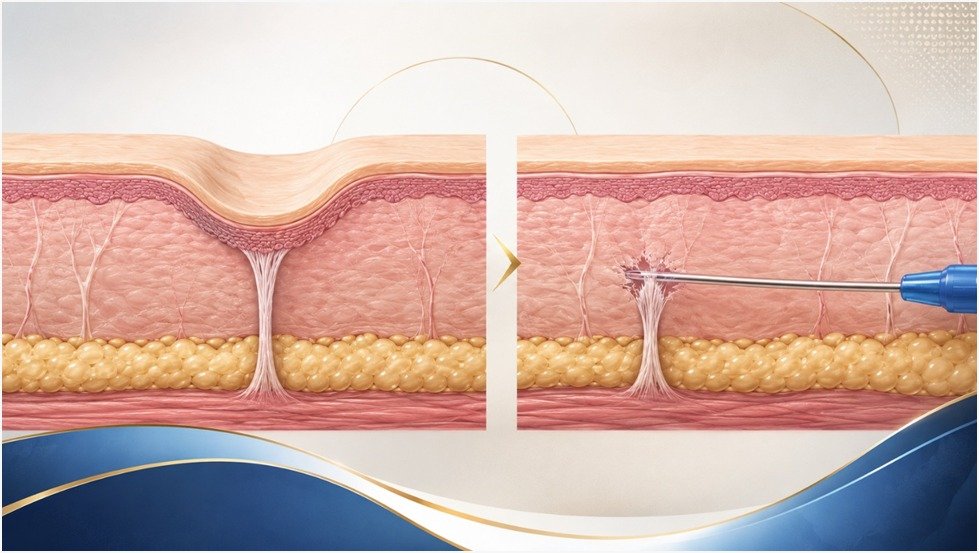
A rolling scar is not really a surface problem. Beneath it, bands of fibrous tissue tether the skin down to the deeper layers, like a button stitched through a cushion. The dip you see is the skin being pulled from underneath. Resurface the surface with a laser and you smooth the top — but the tether is untouched, so the skin is still being pulled down, and the dip returns. You have polished a dimple.
The fix is subcision: a fine needle or cannula is passed under the scar to cut those tethering bands. Released, the skin lifts to its natural level, and the controlled injury underneath stimulates new collagen to fill the space. Only then does resurfacing make sense — now you are smoothing skin that is actually sitting where it should. Sequence matters more than equipment, and this is why.
The Treatments We Use
Release and remodel
- Subcision — the foundation for rolling and many boxcar scars. Releases the fibrous tethers so the skin can lift. Often combined with filler or PRP to keep the space open while collagen forms.
- TCA CROSS — high-concentration trichloroacetic acid placed precisely into the base of ice-pick scars, so they heal from the bottom up and narrow. Precise, low-cost, and excellent for the one scar type lasers struggle with.
Resurfacing
Once tethers are released, resurfacing rebuilds the surface. Fractional CO2 laser is the strongest option, with real downtime of 5-10 days. MNRF (microneedling radiofrequency) achieves much of the same collagen benefit with 1-3 days of redness and a lower pigmentation risk in Indian skin — often the smarter choice here. Microneedling, sometimes with PRP, is the gentlest rung and useful for milder texture.
Surgical scar revision — what most skin clinics cannot offer
Some scars are simply too deep or too discrete for any energy device. These need to be removed rather than resurfaced, and that is a surgical decision:
- Punch excision — the scar is cut out with a tiny circular blade and the skin closed with a fine suture, converting a pit into a linear mark that fades.
- Punch elevation — for boxcar scars with a good base: the floor of the scar is lifted to skin level and secured, preserving your own skin colour and texture.
- Punch grafting — the scar is removed and the gap filled with a small graft, usually taken from behind the ear.
- Surgical scar revision — for larger or irregular scars, reoriented and closed so they sit along natural lines and become far less visible.
Volume restoration
Where scarring has left broad hollows rather than discrete pits, dermal fillers lift depressed areas immediately (lasting months to a couple of years), biostimulators build collagen gradually, and fat grafting offers a longer-term option for extensive volume loss.
Benefits of a Properly Planned Scar Plan
- Treatment matched to your scar type — not a generic laser package sold to everyone.
- No money wasted on marks that would have faded — diagnosis first, always.
- Tethers released before resurfacing — the sequencing that makes the difference between real lift and a polished dimple.
- Access to the surgical tier — punch techniques and scar revision for scars no device can reach.
- Smoother texture and even light reflection — scars stop catching shadows, which is what makes skin read as clear.
- Safer in Indian skin — conservative settings and pigment-aware protocols, because aggressive resurfacing in Fitzpatrick IV-V causes the very marks you came to remove.
- Honest expectations from day one — you will know what 50-80% improvement looks like before you spend anything.
Areas We Treat
- Cheeks — the commonest and most visible site
- Temples — often overlooked, frequently scarred
- Jawline and chin — hormonal acne scarring; also where raised scars form
- Forehead
- Nose — enlarged pores and ice-pick scars
- Back and shoulders — where hypertrophic and keloid scars are commonest
- Chest — high keloid risk, treated cautiously
Conditions & Concerns
- Atrophic scars — ice pick, boxcar and rolling, the great majority of acne scarring.
- Hypertrophic and keloid scars — raised, firm scars needing injection rather than resurfacing.
- Post-inflammatory hyperpigmentation and erythema — flat marks, not scars, managed differently.
- Enlarged pores and rough texture — frequently accompany scarring.
- Volume loss from severe cystic acne — broad hollowing needing filler or fat.
- Old scars from years ago — age is no barrier; a twenty-year-old scar responds much like a two-year-old one.
- Scars in darker Indian skin — treatable, with pigment-aware planning.
The Process: Step by Step
- Assessment and scar mapping. Tripathi examines your skin in side-lighting, identifies which scar types you have and where, checks whether acne is still active, and assesses your skin type and pigment history. Photographs are taken, because progress in scars is gradual and memory is unreliable.
- Control active acne first. If breakouts continue, we treat those before starting scar work. This is non-negotiable.
- A sequenced, written plan. Which procedures, in which order, how many sessions, over what timeline, at what total cost. You should leave the consultation knowing all five.
- Release phase — subcision and TCA CROSS. Under local anaesthesia. Tethers released, ice-pick scars treated at their base.
- Resurfacing phase. Fractional CO2, MNRF or microneedling, at settings chosen for your skin type, spaced 4-8 weeks apart.
- Surgical revision for outliers. The handful of scars too deep for devices are excised, elevated or grafted, usually once the rest has settled.
- Volume and refinement. Filler, biostimulator or fat grafting for residual hollows, once the structural work is done.
- Maintenance and sun protection. Collagen keeps remodelling for months; daily SPF protects both the result and against new pigmentation.
Downtime & Aftercare
- Subcision: bruising and swelling for 3-7 days, sometimes longer. It looks worse than it is and is the most bruise-prone step.
- TCA CROSS: small white frosted dots that darken into tiny scabs, falling off over 5-10 days.
- Fractional CO2: 5-10 days of visible peeling and redness, with residual pinkness for weeks. Plan around events.
- MNRF: redness and mild swelling for 1-3 days. The most work-friendly option.
- Microneedling: redness for 1-2 days.
- Punch excision or revision: sutures for about a week; the fine line continues to fade over months.
- Universal rules: SPF 50+ daily without exception, no picking or scrubbing, no actives until cleared, and no gym, sauna or swimming for 5-7 days after resurfacing.
How Much Does Acne Scar Removal Cost in Delhi?
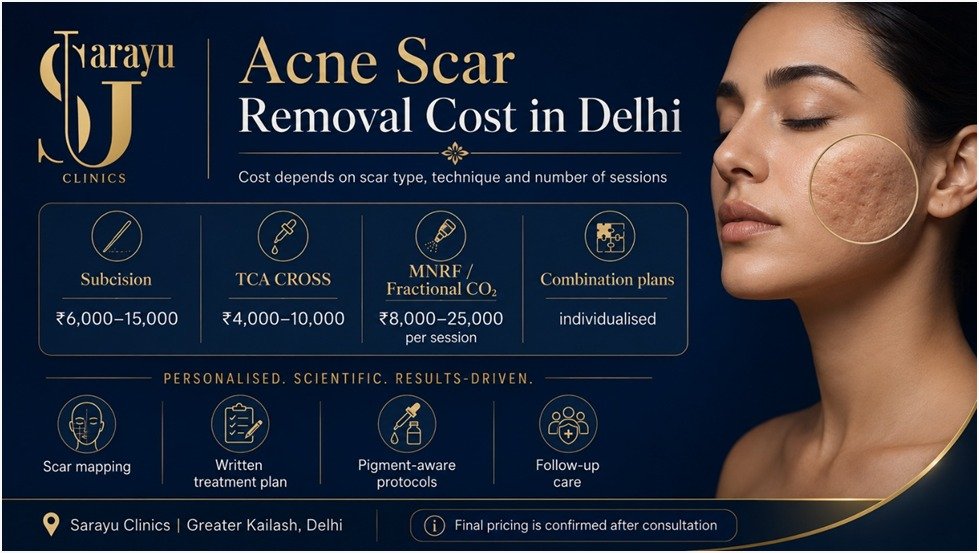
The cost and price of acne scar removal treatment in Delhi vary widely, and the reason is straightforward: acne scar treatment is not one procedure. It is a combination plan across several months, and what you pay depends on which procedures your scars actually need. Here are honest, indicative ranges.
Procedure | Typical cost in Delhi (INR)* |
Consultation & scar mapping | Often nominal — confirmed when you book |
Subcision (per session) | Rs 3,000 – Rs 10,000 |
TCA CROSS (per session) | Rs 3,000 – Rs 8,000 |
Microneedling ± PRP (per session) | Rs 5,000 – Rs 15,000 |
MNRF / Morpheus8 (per session) | Rs 12,000 – Rs 25,000 |
Fractional CO2 laser (per session, full face) | Rs 15,000 – Rs 30,000 |
Chemical peel course (per session) | Rs 1,500 – Rs 6,000 |
Punch excision / elevation (per scar) | Rs 1,500 – Rs 5,000 |
Dermal filler for scars (per syringe) | Rs 18,000 – Rs 40,000 |
Complete combination course (3–6 sessions) | Rs 60,000 – Rs 2,00,000 |
*Indicative ranges only, confirmed at consultation.
What actually moves the price ?
- How many scar types you have. A face with rolling, boxcar and ice-pick scars needs three different procedures, not one.
- Severity and area. Scattered scars on the cheeks cost less to treat than extensive scarring across the whole face.
- Number of sessions. Most people need 3-6 across several months. Per-session pricing looks cheap; the honest comparison is total plan cost.
- Whether surgery is involved. Punch techniques and scar revision are billed per scar and need a surgeon.
- Who performs it. Subcision near facial vessels and punch excision on a visible face are physician-level procedures. Pricing reflects that, and so does the outcome.
Ask for the total, not the session price
The single most useful question at any consultation is: ‘What is the complete plan, and what will it cost in total?’ A clinic that can answer that has actually diagnosed you. A clinic that quotes only a per-session laser price has sold you a package before examining your scars. Be especially wary of very cheap laser packages for acne scars — they usually mean settings too gentle to change deep scars, and no subcision, which is where most of the real improvement comes from.
What Results Are Actually Realistic?
Here is the number no Delhi page will print: with a well-planned combination approach, a 50 to 80 percent improvement is an excellent, achievable result. Not 100 percent. Not ‘scar-free’.
The reason is simple biology. A scar is permanent structural damage — collagen was destroyed and the architecture of the skin changed. We can release what is tethered, rebuild collagen, resurface the top, remove individual scars surgically and refill lost volume. All of that produces a dramatic visible difference. What none of it does is restore the skin to a state as though acne never happened. Anyone promising to erase your scars forever is either using the word loosely or is not being straight with you.
What patients actually report at the end of a good course is this: the skin catches light evenly instead of casting little shadows, makeup sits flat instead of settling into pits, and they stop thinking about it. That is what success looks like, and it is worth having — but you should walk in knowing it, not discover it at session five.
Comparison: Which Treatment for Which Scar
| Subcision | TCA CROSS | MNRF | Fractional CO2 | Punch excision |
Best for | Rolling, tethered boxcar | Ice pick | Boxcar, rolling, texture | Deep, widespread scars | Deep isolated scars |
Type | Needle release | Focal acid | RF microneedling | Ablative laser | Surgery |
Downtime | 3–7 days bruising | 5–10 days scabs | 1–3 days | 5–10 days | ~1 week sutures |
PIH risk (Indian skin) | Low | Moderate | Low | Highest | Low |
Sessions | 1–3 | 2–4 | 3–4 | 1–3 | One per scar |
Almost nobody needs only one of these. A typical plan combines two or three, sequenced correctly — which is the entire argument for being assessed properly rather than buying a package.
Results Timeline
Timeframe | What to expect |
Weeks 1–2 | Recovery from the first procedures. Bruising or peeling. No result visible yet. |
Month 1 | Skin settled. First subtle smoothing, especially after subcision as tethers stay released. |
Months 2–3 | Collagen remodelling becomes visible. Scars look shallower; texture is improving. |
Months 3–6 | Sessions completed and compounding. This is where most of the visible improvement appears. |
Months 6–12 | Continued remodelling. Surgical revision lines fade. Final assessment and any refinement. |
Beyond 12 months | Results are permanent, provided acne stays controlled. Sun protection maintains skin quality. |
Acne scar treatment is a project measured in months, not an appointment. Anyone offering to fix deep scars in one session is describing a disappointment.
How to Choose the Best Clinic for Acne Scar Treatment in Delhi ?
Instead of claiming to be the best, here is what genuinely separates a clinic that will improve your scars from one that will sell you a package. Apply it to us and to everyone else you consult.
- Do they diagnose your scar TYPES before quoting? If a price arrives before an examination, walk away. Different scars need different procedures.
- Do they offer subcision — and explain why it comes first? A clinic that only sells laser sessions cannot fix rolling scars, and should say so.
- Can they perform surgical scar revision? Punch excision, elevation and grafting need a surgeon. A clinic without that tier will resurface scars that should have been removed.
- Do they tell you to control active acne first? A clinic that starts scar work over active breakouts is prioritising the booking over your result.
- Are they honest about outcomes? You want to hear a realistic percentage and the words ‘improve, not erase’. Promises of scar-free skin are a red flag.
- Do they discuss pigmentation risk in Indian skin? Aggressive resurfacing in Fitzpatrick IV-V can cause the marks you came to remove. The right answer involves conservative settings and priming.
- Do they take before photographs? Progress is gradual; without photographs neither of you can judge it fairly.
- Do they quote a total plan cost? Not just a session price.
Why Choose Sarayu Clinics ?
Acne scars sit exactly where dermatology and surgery meet, and the best results usually need both. At Sarayu Clinics your scars are assessed and treated by facial plastic and maxillofacial surgeon Dr. Adarsh Tripathi, alongside co-founder Dr. Nidhi Bhatia.
- Diagnosis before treatment. Scars mapped by type in side-lighting and photographed, so the plan fits your face rather than our calendar.
- The full ladder, including surgery. Subcision, TCA CROSS, MNRF, fractional CO2, microneedling, fillers — plus punch excision, punch elevation, grafting and formal scar revision that most skin clinics cannot offer.
- Correct sequencing. Release the tethers, then resurface, then revise, then restore volume. Order is what separates real improvement from expensive polishing.
- Pigment-aware protocols for Indian skin. Conservative settings and priming, because provoking PIH undoes the point of the exercise.
- Honest numbers. A realistic improvement range and a total plan cost, before you commit.
- Acne controlled first. We will ask you to wait if breakouts are active — and tell you why.
Medical Review & Sources
This page is for general information and is medically reviewed by the team at Sarayu Clinics under Dr. Adarsh Tripathi. It is not a substitute for an in-person clinical assessment. Acne scar treatment outcomes vary with scar type, skin type and adherence to aftercare; realistic improvement is typically partial rather than complete. Sources:
How to Reach Us:
Phone: +91 9289111081 , +91 9289111082
Email: sarayuinquiries@gmail.com
Sarayu Clinics website: www.sarayuclinics.com
Facebook: https://www.facebook.com/sarayuclinic
Instagram: https://www.instagram.com/sarayuclinics/
Dr. Adarsh Tripathi’s profile: https://dradarshtripathi.com/
Online Booking: Visit our website https://sarayuclinics.com/contact-us/ to schedule appointments conveniently.
How much does acne scar removal treatment cost in Delhi?
It depends on which procedures your scars need, because acne scar treatment is a combination plan rather than one procedure. Indicative Delhi ranges: subcision Rs 3,000-10,000 per session; TCA CROSS Rs 3,000-8,000; microneedling with PRP Rs 5,000-15,000; MNRF Rs 12,000-25,000; fractional CO2 Rs 15,000-30,000 per session; punch excision Rs 1,500-5,000 per scar. A complete course of three to six sessions typically totals Rs 60,000-2,00,000. Always ask for the total plan cost rather than a per-session price.
What is the price difference between clinics, and why?
Because you may not be buying the same treatment. A cheap ‘acne scar laser package’ often means settings too gentle to affect deep scars and no subcision — which is where much of the real improvement comes from. Higher pricing usually reflects proper diagnosis, physician-performed subcision and surgical options, appropriate device settings for Indian skin, and follow-up. The honest comparison is total plan cost against what is actually included, not the headline session rate.
Can acne scars be removed permanently?
They can be substantially improved and the improvement is permanent, but they cannot be erased. A scar is permanent structural damage where collagen was destroyed, so a realistic excellent outcome from a well-planned combination approach is roughly 50-80% improvement. Individual deep scars can be removed surgically by punch excision, which replaces a pit with a fine line. Any clinic promising completely scar-free skin is overselling.
Which treatment is best for my type of acne scar?
It depends entirely on the type. Ice pick scars respond to TCA CROSS or punch excision, because lasers cannot reach their narrow base. Rolling scars need subcision first to release the fibrous tethers pulling the skin down, then resurfacing. Boxcar scars usually need subcision or punch elevation plus fractional resurfacing. Raised hypertrophic or keloid scars need steroid injections, not resurfacing. Most people have a mixture, which is why combination plans outperform any single treatment.
Why didn't my laser treatment fix my acne scars?
Most often because the scars were rolling scars and no subcision was done. Rolling scars are held down by fibrous bands beneath the skin, so resurfacing the surface without releasing those bands smooths the top while the skin is still being pulled down — the dip returns. The other common reasons are settings too conservative to affect deep scars, too few sessions, or scars that actually needed surgical removal rather than resurfacing.

FAQ's : People Generally Ask
What is subcision and why does it matter so much?
Subcision is a procedure where a fine needle or cannula is passed under a depressed scar to cut the fibrous bands tethering it to deeper tissue. Once released, the skin lifts to its natural level, and the controlled injury stimulates collagen to fill the space. It matters because it is the only way to address the actual cause of rolling and tethered boxcar scars. It is also the step most commonly missing from laser-package approaches, which is why those approaches so often disappoint.
Should I treat my acne scars while I still have active acne?
No. Scar treatment should wait until active acne is genuinely controlled. Treating scars while new lesions are still forming means creating fresh scars while paying to fix old ones, and several scar procedures are unsafe over inflamed skin. Getting acne under control is the first step of the scar plan, not a delay — expect to spend a few months on that first if breakouts are ongoing.
Are these dark marks acne scars?
Probably not. Flat brown marks (post-inflammatory hyperpigmentation) and flat red-pink marks (post-inflammatory erythema) are not scars — they are pigment and lingering inflammation, and they typically fade over three to twelve months with sun protection and a good topical routine. A true scar is a texture change you can feel with a fingertip and that casts a shadow in side-lighting. Treating marks as scars is one of the commonest ways people waste money.
Is acne scar treatment safe for Indian skin?
Yes, with pigment-aware planning. The main consideration is that darker Indian skin is prone to post-inflammatory hyperpigmentation after aggressive treatment — so conservative laser settings, priming before resurfacing, longer intervals and strict sun protection matter. Notably, subcision, TCA CROSS and punch techniques carry relatively low pigmentation risk, which is one reason a combination approach often suits Indian skin better than heavy laser resurfacing alone.
How long does the whole process take?
Plan for six to twelve months. Most people need three to six sessions spaced four to eight weeks apart, and collagen remodelling continues for months after each. Visible improvement usually begins around month two to three, with most of the change appearing between months three and six, and further refinement up to a year. It is a project rather than an appointment — but the results, once achieved, are permanent as long as acne stays controlled.
Our Patients