
Mole Removal in Delhi
- Home
- Mole Removal in Delhi | Laser Mole Removal | Sarayu Clinics
Mole Removal in Delhi
Most moles are completely harmless and stay that way for life. Some people want them removed for cosmetic reasons — a prominent mole on the face, one that catches on clothing, or simply one that has always bothered them. Others have moles that are changing, irregular or concerning enough that removal (and biopsy) is medically sensible. Either way, the how matters — especially on the face, where the difference between a procedure done well and one done carelessly is a barely-visible fine line versus an obvious, permanent scar.
At Sarayu Clinics in Greater Kailash, mole removal is performed by facial plastic and maxillofacial surgeon Dr. Adarsh Tripathi. The approach starts the same way every time: a proper clinical assessment of the mole before deciding on a technique. Not every mole should be lasered, and not every mole needs surgery. The right tool depends on the mole’s type, size, depth, location, and whether the tissue needs to be examined under a microscope.
The short answer : Most moles can be safely removed in a single clinic visit under local anaesthesia. Technique choices: surgical excision (gold standard for any suspicious or deep mole — specimen sent for histopathology), shave excision (for raised, dome-shaped moles), punch excision (for small round moles), laser ablation (CO2 or Q-switched — for clearly benign, flat moles; no specimen can be sent), radiofrequency ablation (for raised benign moles), or plasma pen (newer, non-contact technique). The critical safety rule: any mole showing ABCDE warning signs should be surgically excised so the specimen can be biopsied — never lasered or ablated without proper clinical assessment first. Delhi cost: Rs 2,500–25,000 per mole depending on technique and size. Skin tags and warts are separate conditions covered at the bottom of this page.

Before Anything Else: The ABCDE Check
This is the most important section on this page, and the one most cosmetic clinics skip in their rush to sell a treatment. Before any mole removal, a proper clinical assessment should identify whether the mole has any features that might indicate melanoma or other skin cancer. The ABCDE rule is the standard screening framework:
Letter | What to check | Warning sign |
A — Asymmetry | Is one half a mirror image of the other? | Asymmetric halves that don’t match |
B — Border | Are the edges smooth and regular? | Irregular, notched, blurred or ragged edges |
C — Colour | Is the colour even throughout? | Multiple colours — brown, black, red, white, or blue within one mole |
D — Diameter | Is it smaller than 6mm (roughly the size of a pencil eraser)? | Larger than 6mm, or growing |
E — Evolution | Has it changed in size, shape, colour or surface texture? | Any recent change, bleeding or itching |
When to see a doctor urgently — not a cosmetic clinic ?
If your mole ticks any of the ABCDE boxes above — particularly if it’s changing, bleeding, or has multiple colours — the first step is a proper clinical assessment, not booking a laser session. Laser ablation and RF ablation destroy the tissue, making histopathological examination impossible. A mole that turns out to be melanoma and has been lasered without a biopsy is a missed diagnosis. A qualified doctor should examine any atypical mole with dermoscopy before any removal technique is chosen.
Types of Skin Lesions We Remove
Not everything people call a ‘mole’ is the same thing. Here’s what we commonly treat and how they differ:
- Melanocytic naevi (true moles) — clusters of pigment-producing cells. Can be flat (junctional), slightly raised (compound) or dome-shaped (intradermal). The concern is malignant transformation to melanoma — rare, but the reason proper assessment matters.
- Seborrhoeic keratoses — common, waxy, ‘stuck-on’ brown patches that appear with age. Always benign, but can look alarming. Very treatable with shave, RF or laser.
- Skin tags (acrochordons) — soft, flesh-coloured growths on a thin stalk; completely benign. Common on the neck, underarms and eyelids. Easily removed.
- Warts (verrucae) — caused by the human papillomavirus (HPV). Rough-surfaced, can occur anywhere. May recur after removal because the virus can persist in the surrounding skin.
- Dermatofibromas — firm, brownish nodules, usually on the legs. Benign; often best left alone unless cosmetically bothersome or symptomatic.
- Syringomas / milia — small, flesh-coloured or whitish bumps around the eyes and cheeks. Can be removed for cosmetic reasons with fine needle RF or laser.
Mole Removal on the Face: Why a Facial Plastic Surgeon Matters
On the body, a mole removal scar that heals as a flat, pale line is generally acceptable. On the face — where it may be visible in conversation, in photographs, and in direct light — the quality of the closure matters disproportionately. A facial plastic surgeon’s approach to facial mole excision is different in three specific ways:
- Incision along relaxed skin tension lines (RSTLs). Every zone of the face has natural lines of minimal skin tension. Placing the incision along these lines — rather than perpendicular to them — allows the scar to heal as a fine, nearly invisible line rather than a puckered one.
- Elliptical excision geometry. The precise ellipse-to-circle ratio and angle of the excision determines how the wound edges close. Getting this wrong creates ‘dog-ear’ bunching at the ends. Getting it right gives a flat, smooth, imperceptible closure.
- Layered closure. Closing only the surface skin produces a visible ridge over time. A properly layered closure — deep sutures that bring the dermis together first, then fine surface sutures — distributes tension and heals flat.
For very large facial moles, local flap reconstruction (borrowing adjacent skin) may be the best approach to close the defect without distorting surrounding structures like the eyelid or lip. This is plastic surgery territory — and it’s exactly what this clinic offers.
Mole Removal Techniques: The Decision Matrix
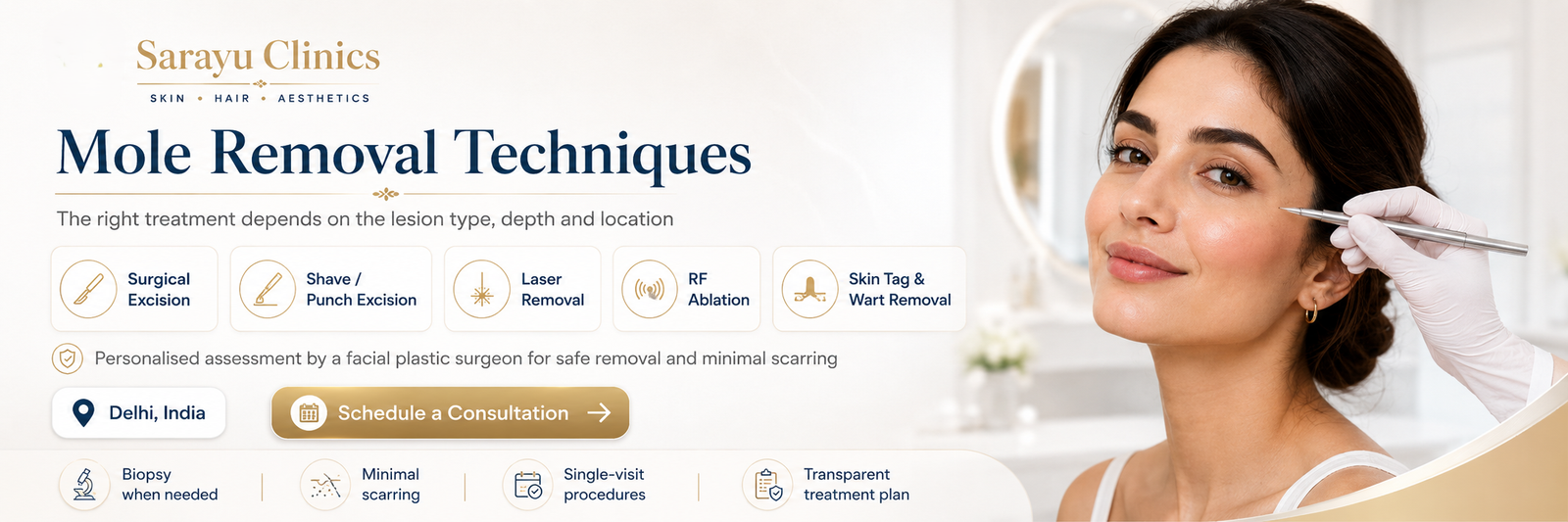
The right technique depends on the mole’s type, size, depth, location and whether the tissue needs to be examined. Here’s the honest map:
Technique | Best for | Specimen for biopsy? | Scarring |
Surgical excision with sutures | Any suspicious or large mole; gold standard | Yes — full specimen | Fine line, fades well |
Shave excision | Raised, dome-shaped, clearly benign moles | Yes — partial specimen | Flat, pale mark |
Punch excision | Small, round, deep moles | Yes — full core | Minimal; single suture |
Laser (CO2 / Er:YAG) | Flat, clearly benign, pigmented moles | No — tissue destroyed | Minimal if done right |
Radiofrequency (RF) ablation | Raised, benign moles and skin tags | Partial possible | Minimal |
Plasma pen | Superficial benign lesions | No | Minimal; newer technique |
Cryotherapy (liquid nitrogen) | Superficial keratoses, skin tags | No | Possible pigment change |
The rule about laser and biopsy :
Laser ablation, RF ablation, plasma pen and cryotherapy all destroy or significantly damage the mole tissue, making proper histopathological examination impossible or unreliable. For any mole with atypical features (ABCDE warning signs), these techniques should NOT be the first choice. Surgical or shave excision preserves the specimen. This isn’t overcaution — it’s the standard of care that protects you from a missed diagnosis.
Laser Mole Removal in Delhi
For flat, clearly benign moles that have been properly assessed by a clinician, CO2 laser or Er:YAG laser ablation is a precise, low-downtime option with minimal scarring. The laser vaporises the mole tissue layer by layer, with no sutures and a small scab that heals over 1–2 weeks. It’s an excellent option for small, benign, cosmetically bothersome flat moles — with the critical caveat that the mole must be clinically assessed first. We also use the Q-switched laser (Hollywood Spectra) for superficial pigmented lesions and post-removal pigmentation management.
Benefits of Professional Mole Removal
- Peace of mind — for moles that were concerning, a confirmed benign histopathology result removes the ongoing anxiety of monitoring.
- Cosmetic clarity — a mole that has always bothered you, simply gone.
- Minimal scarring — in skilled hands, especially a facial plastic surgeon on facial moles, the scar is fine, flat and fades significantly within 6–12 months.
- No recurrence — properly performed surgical excision removes the mole in full; shave excision may occasionally leave a faint trace but rarely a visible recurrence.
- Quick, in-clinic procedure — most mole removals take 15–45 minutes under local anaesthesia, as a day-care procedure.
- Eliminates physical irritation — moles that catch on jewellery, collars, bra straps or are repeatedly irritated are genuinely uncomfortable; removal ends that.
Areas We Treat
Mole and skin lesion removal at Sarayu Clinics covers:
- Face (cheeks, forehead, nose, chin, periorbital area)
- Neck
- Scalp
- Eyelids (with special care; technique-specific)
- Chest and decolletage
- Back and shoulders
- Arms and legs
- Underarms (common for skin tags)
- Intimate/skin-fold areas (assessed individually)
The Procedure: Step by Step
- Clinical assessment. The mole is examined clinically and (where indicated) with dermoscopy. ABCDE features are assessed; the history of any change is documented. This assessment determines the technique.
- Informed consent. The procedure, likely outcome, scar pattern and biopsy plan are discussed before you agree to proceed. Nothing happens until you understand exactly what will be done and why.
- Local anaesthesia. A small injection of local anaesthetic numbs the area completely. Most people feel a brief sting from the anaesthetic, then nothing during the procedure.
- The technique is carried out as planned — surgical excision, shave, punch, laser or RF. For surgical excision, the incision is placed along skin tension lines for minimal scarring.
- Specimen handling (where relevant). Excised tissue is placed in formalin and sent to a certified histopathology laboratory. You receive the report and a follow-up review.
- Closure and dressing. Sutures are placed in layers for surgical excision (if required); a small dressing is applied. You leave with written aftercare instructions.
- Review and suture removal. Facial sutures are typically removed at 5–7 days; body sutures at 7–14 days. We review the histopathology result at this appointment.
Downtime & Aftercare
- Surgical excision: small dressing for 24–48 hours; sutures out at 5–7 days (face) or 7–14 days (body); avoid strenuous activity for a week; no swimming for 2 weeks.
- Shave / punch excision: a small scab forms and falls off over 7–10 days; very manageable.
- Laser / RF / plasma pen: a small crust at the treated site that falls off in 7–14 days; treat gently, no picking.
- All methods — sunscreen (SPF 50+): non-negotiable for 3–6 months. Sun exposure on a healing scar or post-ablation site causes pigmentation that takes months to fade.
- Scar maturation: surgical scars look their worst at 4–6 weeks (pink and slightly firm) before fading significantly over 6–12 months. Silicone gel and SPF accelerate this.
Mole Removal Cost in Delhi
Cost depends on the technique, mole size and complexity, and whether histopathology is needed. As a general guide for Delhi:
Procedure | Typical cost in Delhi (INR)* |
Consultation & clinical assessment | Rs 2,500 – Rs 5,000 |
Shave excision (per mole) | Rs 2,500 – Rs 7,000 |
Punch excision (per mole) | Rs 3,000 – Rs 8,000 |
Surgical excision with sutures (per mole) | Rs 5,000 – Rs 25,000 |
Histopathology / biopsy (if specimen sent) | Rs 800 – Rs 2,500 additional |
Laser mole removal CO2 (per mole) | Rs 3,000 – Rs 10,000 |
Radiofrequency (RF) ablation (per mole) | Rs 3,000 – Rs 8,000 |
Plasma pen (per mole) | Rs 3,000 – Rs 8,000 |
Skin tag / wart removal (per lesion) | Rs 1,000 – Rs 5,000 |
Multiple lesions (package pricing) | Quoted after assessment — usually more economical |
*Indicative ranges only. Larger, deeper or atypically located moles (e.g. eyelid) cost more. Multiple-mole packages are usually more economical than individual removals. You’ll receive a clear, itemised quote after assessment.
Prices shown are for guidance only. Your final treatment cost will be confirmed during the initial consultation, based on your individual needs, concerns, and personalised treatment plan.
Results Timeline
Timeframe | What usually happens |
Immediately | The mole is gone; a small dressing covers the site. |
Days 1–7 | Sutures (if any) in place; scab forming on ablation/shave sites; mild redness around the area. |
Days 7–14 | Sutures removed; scab falls off; fresh pink skin visible. Histopathology result usually back. |
Week 2–4 | Pink, slightly firm scar (normal wound maturation). This is often the worst it looks. |
Month 2–6 | Scar flattens, fades from pink to pale. Most surgical scars become very faint at this stage. |
Month 6–12 | Final scar appearance — usually a fine, pale, nearly invisible line on the face. |
Skin Tags & Warts: The Honest Difference
Skin tags (acrochordons)
Soft, fleshy, benign growths on a thin stalk. Always harmless. Extremely common — most adults develop them at some point, particularly on the neck, eyelids, underarms and under breasts. Options for removal: RF ablation (neat, bloodless, no sutures), fine scissors/snip (with local anaesthetic), cryotherapy. Multiple skin tags can be treated in one session. No histopathology is needed.
Warts (verrucae)
Caused by human papillomavirus (HPV). Options: cryotherapy (liquid nitrogen), laser, RF ablation, or electrocautery. Important honest note: warts can recur after removal because the virus may persist in surrounding skin. Multiple treatments may be needed. There is no guaranteed one-session cure for warts, and any clinic that promises permanent removal in one session is overpromising.
Both skin tags and warts are covered within the existing Sarayu mole removal service and can be treated in the same consultation.

Why Choose Sarayu Clinics for Mole Removal in Delhi ?
Mole removal sounds simple until it’s done wrong — wrong technique for the mole type, wrong assessment, wrong closure, or a missed diagnosis. At Sarayu Clinics, all lesion removal is performed by facial plastic and maxillofacial surgeon Dr. Adarsh Tripathi, alongside co-founder Dr. Nidhi Bhatia.
- Proper clinical assessment before any technique is chosen. ABCDE screening and dermoscopy where indicated — not a rubber-stamp yes to every booking.
- Surgical expertise for facial moles. Incisions along skin tension lines, proper elliptical geometry, layered closure — techniques that minimise facial scarring.
- Histopathology when it matters. Excised specimens are sent to a certified lab. You get a report, not just a procedure.
- The right tool for each lesion. Laser for flat benign moles; excision for anything requiring biopsy; RF for raised benign lesions; plasma pen where suitable — not a one-treatment-fits-all approach.
- Transparent pricing. Clear quotes including histopathology costs before you proceed.
Medical Review & Sources
This page is for general information and is medically reviewed by the team at Sarayu Clinics under Dr. Adarsh Tripathi. It is not a substitute for an in-person clinical assessment. Any mole showing ABCDE warning features should be assessed by a qualified medical professional before removal. Sources:
How to Reach Us:
Phone: +91 9289111081 , +91 9289111082
Email: sarayuinquiries@gmail.com
Sarayu Clinics website: www.sarayuclinics.com
Facebook: https://www.facebook.com/sarayuclinic
Instagram: https://www.instagram.com/sarayuclinics/
Dr. Adarsh Tripathi’s profile: https://dradarshtripathi.com/
Online Booking: Visit our website https://sarayuclinics.com/contact-us/ to schedule appointments conveniently.
How do I know if my mole is dangerous?
Use the ABCDE rule: Asymmetry, Border irregularity, Colour variation (multiple colours in one mole), Diameter over 6mm, Evolution (any change in size, shape or colour). If your mole ticks any of these boxes — or bleeds, itches or crusts — see a doctor for a proper assessment before any removal. Do not let any clinic laser or ablate a changing mole without examining it first.
Is mole removal covered by insurance in India?
Cosmetic mole removal is generally not covered. Removal that is medically necessary — for a mole showing features of potential malignancy — may be covered by some health insurance policies. Check with your insurer with a proper medical consultation note documenting the clinical indication.
Can I remove multiple moles in one visit?
Yes — multiple moles can often be addressed in one session, particularly if they’re small and clearly benign. Package pricing for multiple moles is usually more economical than individual sessions. Moles requiring different techniques (some for excision, some for laser) may sometimes need separate visits.
How long does mole removal take?
Most mole removal procedures take 15–45 minutes as a day-care procedure under local anaesthetic. You arrive, are assessed, treated, dressed and given written aftercare instructions before leaving — usually in under an hour for a single mole.
Can moles grow back after removal?
With proper surgical excision, recurrence is very unlikely — the mole is removed in full with a clear margin. Shave excision may occasionally leave a faint pigmented trace, rarely a visible recurrence. Laser/RF ablation has a slightly higher chance of incomplete removal in deeper moles if the depth was underestimated. Warts can recur because the virus may persist in surrounding skin.
Do I need a biopsy when removing a mole?
Not always — but for any mole that has atypical features, is changing, or cannot be confidently assessed as benign by clinical examination, sending the specimen for histopathology is the medically correct standard. A clinician should assess every mole before deciding whether the tissue needs examination. Never accept laser removal of a mole without a proper clinical assessment first.
Does mole removal hurt?
The procedure itself does not hurt — the area is numbed with local anaesthetic before anything begins. You may feel a brief sting from the anaesthetic injection, then pressure and pulling during removal but no pain. Mild soreness for a day or two after the anaesthetic wears off is normal and managed easily with simple painkillers.

How much does mole removal cost in Delhi?
Cost depends on the technique and mole size. Shave excision starts from Rs 2,500; surgical excision with histopathology from Rs 5,000–25,000; laser mole removal Rs 3,000–10,000; RF ablation Rs 3,000–8,000. Histopathology (biopsy) is usually Rs 800–2,500 additional when the specimen needs to be sent. Multiple mole packages are usually more economical.
Is laser mole removal safe?
Yes, for clearly benign moles that have been properly clinically assessed. The important caveat: laser ablation destroys the tissue, making histopathological examination impossible. For any mole with atypical features (changing colour, irregular border, bleeding), surgical excision that preserves the specimen is the medically correct approach — not laser.
Will mole removal leave a scar?
All mole removal leaves some trace; the goal is to make it as minimal and inconspicuous as possible. Laser, RF and plasma pen on small superficial moles leave a flat, pale patch that fades well. Surgical excision leaves a fine line — on the face, this is placed along skin tension lines by a plastic surgeon and fades to near-invisibility over 6–12 months. The larger and deeper the mole, the more visible the initial mark.