HAIR FALL MESOTHERAPY TREATMENT IN DELHI
- Home
- HAIR FALL MESOTHERAPY TREATMENT IN DELHI
Hair Fall Mesotherapy Treatment in Delhi – What You Need to Know
Hair fall is rarely one thing. It is usually several things at once — stress, nutrition, hormones, genetics, and scalp health — colliding quietly over months before you notice how much is gone. By the time most people start researching treatments, they have already lost significantly more than the average 100 hairs a day that is considered normal.
Mesotherapy for hair fall is one of the most clinically effective non-surgical responses to this problem. It works by delivering precisely formulated nutrients, growth factors, and scalp-specific actives directly into the tissue where your hair follicles live — the mid-dermis of the scalp — bypassing the inadequate absorption of topical products and the systemic dilution of oral supplements.
At Sarayu Clinics in Greater Kailash-1, New Delhi, mesotherapy is not a standalone quick-fix treatment — it is part of a comprehensive hair health programme designed by Dr. Adarsh Tripathi (Facial Plastic and Maxillofacial Surgeon, 18+ years experience) and Dr. Nidhi Bhatia (Celebrity Facial Aesthetician, international board affiliations). Every mesotherapy plan here is built around the specific cause of your hair loss, not a generic protocol applied to every patient.
This page tells you exactly what mesotherapy involves, what goes into the injection, how many sessions you need, what results look like — and crucially, when it is the right treatment for your situation and when a different approach would serve you better. That kind of honest information is what you deserve before making a decision.
What Is Hair Fall Mesotherapy? The Science Behind It
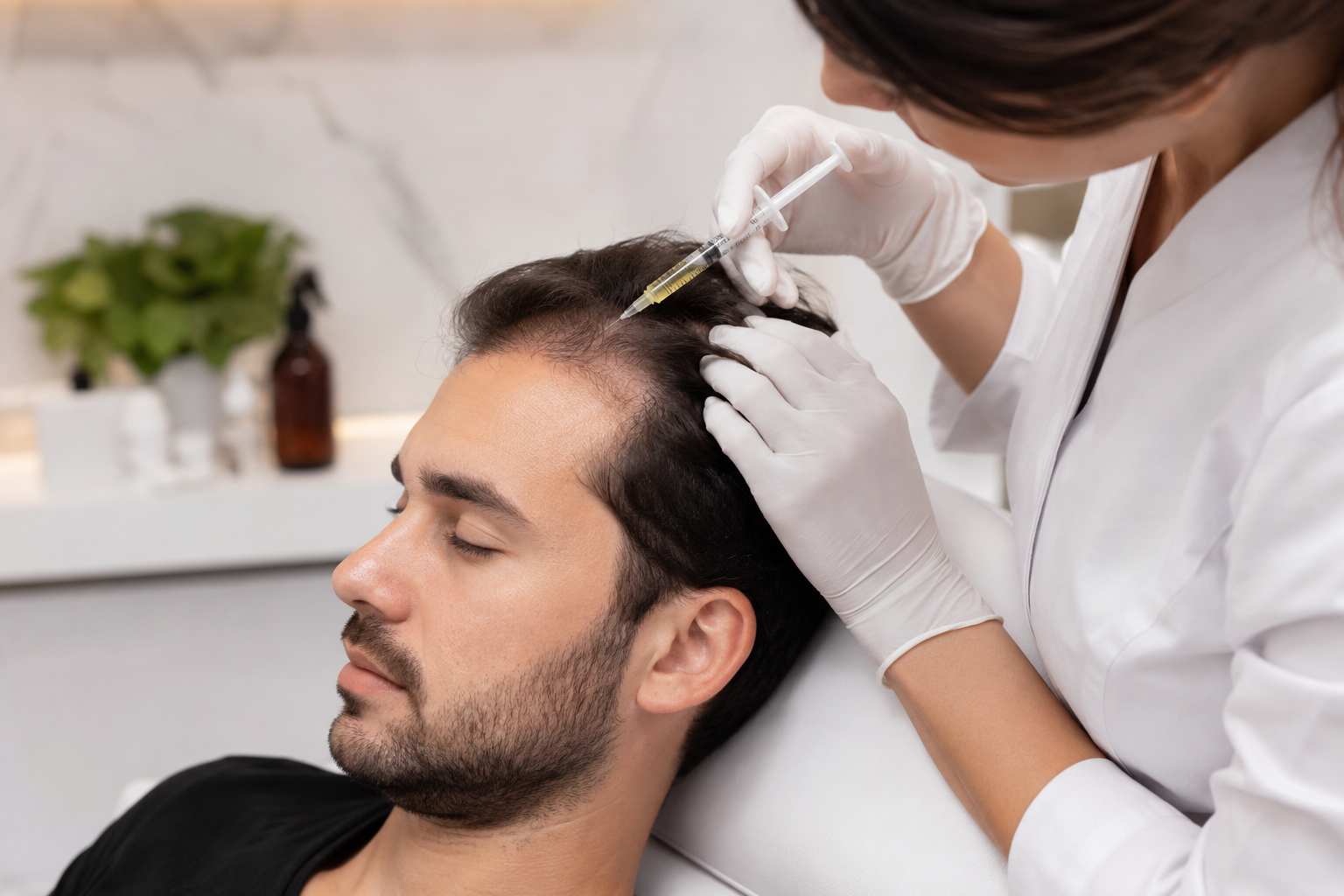
Mesotherapy was developed in France in 1952 by Dr. Michel Pistor as a technique for delivering therapeutic substances directly into the mesoderm — the middle layer of tissue. Applied to hair loss, scalp mesotherapy uses a series of micro-injections (using very fine needles, typically 4mm depth) to deliver a customised cocktail of active ingredients into the mid-dermis of the scalp — the exact anatomical layer where the hair follicle bulge resides.
This is the fundamental advantage of mesotherapy over every oral supplement or topical serum you have tried: it bypasses the barriers. Oral supplements are metabolised before reaching the scalp in meaningful concentrations. Topical products cannot penetrate the scalp’s stratum corneum (the outer protective layer) at the concentrations needed to stimulate follicles. Mesotherapy eliminates both barriers.
Treatment Method | Absorption Route | Follicle Concentration Reached |
Oral supplements / tablets | Digestive system → bloodstream → systemic dilution | Very low — most metabolised before reaching scalp |
Topical serums / oils | Stratum corneum barrier — limited penetration | Minimal — cannot reach follicle bulge depth |
Scalp Mesotherapy | Direct injection into mid-dermis at follicle level | High — delivered precisely where follicles live |
The result of this direct delivery: follicles receive the nutrients and growth signals they need to exit the resting (telogen) phase, re-enter active growth (anagen), and produce thicker, stronger hair shafts. The scalp’s microcirculation — often poor in patients with hair loss — is simultaneously stimulated, improving the follicle’s ongoing nutrient supply between sessions.
What Goes Into the Mesotherapy Cocktail? (Ingredient Breakdown)
This is the section that most competing pages skip entirely — and it is one of the most important. The mesotherapy ‘cocktail’ is not a fixed formula. It is customised based on the patient’s hair loss type, severity, bloodwork findings, scalp condition, and whether they are male or female. Here is what the full ingredient range includes:
Vitamins – The Foundation Layer
Vitamin | Role in Hair Health | Deficiency Effect |
Biotin (Vitamin H / B7) | Keratin infrastructure — the structural protein of hair | Brittle, thin hair shafts; increased breakage |
Vitamin B12 | Red blood cell production — oxygen delivery to follicles | Follicle under-oxygenation; telogen effluvium; very common in vegetarians |
Vitamin B5 (Pantothenic Acid) | Follicle metabolism; hair shaft hydration | Dull, dry, fragile hair; early greying |
Vitamin B6 (Pyridoxine) | Protein metabolism — critical for keratin synthesis | Hair loss; seborrhoeic dermatitis of scalp |
Vitamin B1 (Thiamine) | Cellular energy (ATP) production in follicle cells | Slowed follicle metabolism; hair cycle disruption |
Vitamin B3 (Niacin) | Scalp blood circulation; follicle vasodilation | Poor scalp perfusion; miniaturisation acceleration |
Vitamin C | Collagen synthesis for hair follicle dermal papilla | Weakened follicle structure; increased shedding |
Vitamin E | Antioxidant protection against oxidative follicle damage | Oxidative stress acceleration of follicle miniaturisation |
Minerals & Trace Elements
Mineral | Role | Clinical Note |
Zinc | DHT metabolism regulation; protein synthesis | One of the most common deficiencies in hair loss patients; especially important in AGA |
Iron / Ferritin | Oxygen transport to follicles via haemoglobin | Low ferritin is the most common reversible cause of hair fall in women — even without anaemia |
Selenium | Antioxidant enzyme production; thyroid function | Excess AND deficiency both cause hair loss; dosing precision matters |
Copper | Melanin production; follicle enzyme function | Deficiency linked to premature greying and weakened follicle matrix |
Silicon | Connective tissue and hair shaft strength | Improves hair tensile strength and shine |
Amino Acids – Protein Building Blocks
- Cysteine — primary sulphur-containing amino acid in keratin; direct structural component of hair shaft
- Methionine — essential amino acid; precursor to cysteine and SAM (affects follicle gene expression)
- Lysine — collagen formation for follicle dermal papilla; improves iron absorption in the scalp
- Arginine — nitric oxide precursor; vasodilator for scalp microcirculation improvement
- Proline and Glycine — collagen support for follicle anchoring structure
Growth Factors & Signalling Molecules
- VEGF (Vascular Endothelial Growth Factor) — stimulates new blood vessel formation around follicles
- IGF-1 (Insulin-like Growth Factor-1) — promotes hair follicle cell proliferation and anagen extension
- KGF (Keratinocyte Growth Factor) — stimulates follicle keratinocyte activity
- FGF-7 — follicle growth cycle regulation; studied in alopecia areata
DHT-Blocking & Scalp-Specific Actives
- Dutasteride (microinjected, localised) — 5-alpha reductase inhibitor; blocks DHT at follicle level without systemic side effects
- Finasteride (microinjected, localised) — targeted DHT suppression in AGA patients
- Saw Palmetto extract — natural 5-alpha reductase inhibitor in natural-preference protocols
- Caffeine — caffeine solution shown in clinical studies to counteract DHT effects at follicle level
Additional Active Components
- Hyaluronic acid — improves scalp hydration and follicle micro-environment; reduces scalp inflammation
- Minoxidil (microinjected) — vasodilator; extends anagen phase; targets follicle-level directly
- Tretinoin (micro-dose) — enhances minoxidil absorption and follicle response in selected protocols
- ATP (Adenosine Triphosphate) — cellular energy for follicle metabolic activity
- Coenzyme A — mitochondrial function in hair follicle cells
- Nucleic acids (DNA/RNA bases) — cellular repair and division signals

Benefits of Mesotherapy for Hair Fall – The Clinical Evidence
Here is an honest assessment of what mesotherapy for hair fall genuinely delivers — not aspirational claims, but what clinical data and consistent patient outcomes show:
Benefit | Clinical Reality |
Stops Active Hair Shedding | In most patients with nutritional or stress-related hair loss, mesotherapy significantly reduces daily hair fall within 4–6 sessions. It addresses the deficiency at source rather than masking it. |
Reactivates Dormant Follicles | Follicles in the telogen (resting) phase can be stimulated to re-enter anagen (active growth) — especially when their dormancy is caused by nutrient deprivation rather than permanent miniaturisation. |
Thickens Existing Hair Shafts | Many patients notice hair becoming noticeably denser and thicker per strand — not just reduced shedding but visibly fuller hair even before new growth is significant. |
Improves Scalp Microcirculation | Poor blood supply to follicles is a common contributor to hair loss. Vasodilatory components open capillaries and create a better nutrient environment for follicle health long-term. |
No Systemic Side Effects | Because actives are delivered locally (at the scalp), they do not circulate systemically. Oral finasteride’s hormonal side effects, for example, are not associated with injectable localised mesotherapy protocols. |
Complements Hair Transplant | Pre-transplant mesotherapy improves scalp vascularisation and follicle health, potentially increasing graft survival. Post-transplant, it supports native hair maintenance and new graft nourishment. |
Safe for All Skin Tones | Mesotherapy has no skin tone-related contraindications. The injections are into the subcutaneous tissue, not the epidermis — making it equally suitable for Indian, South Asian, Middle Eastern, and African skin types. |
Suitable for Men and Women | Protocols are gender-differentiated. Women’s formulations typically address iron, B12, and hormonal contributors. Men’s formulations incorporate more targeted DHT-blocking components. |
Visible Results Without Surgery | For patients who are not ready or suitable for a hair transplant, mesotherapy offers meaningful, clinically measurable improvement — particularly in early-stage hair loss and nutritional deficiency cases. |
Boosts Results of Other Treatments | Mesotherapy works synergistically with PRP, GFC, minoxidil, finasteride, and low-level laser therapy. Combination approaches consistently outperform single treatments. |
Types of Scalp Mesotherapy Available at Sarayu Clinics
Mesotherapy is not a single-delivery-method treatment. At Sarayu Clinics, the delivery system is chosen based on patient tolerance, hair loss severity, and the specific actives being used:
Conventional Needle Mesotherapy (Classic Technique)
The gold-standard delivery method. A series of microinjections using a 30-gauge, 4mm needle are placed across the scalp at 1–2 cm intervals into the mid-dermis. Each injection delivers a micro-dose of the customised cocktail directly to follicle level. The injections are administered systematically across all affected scalp zones.
Best for:
- Moderate to severe hair loss where maximum ingredient concentration at follicle level is needed
- Patients with confirmed nutritional deficiencies requiring targeted supplementation
- Those combining mesotherapy with PRP or GFC in the same session
Derma Pen / Microneedle Mesotherapy
A motorised microneedling device (derma pen) creates hundreds of micro-channels in the scalp per pass, through which the mesotherapy solution is applied. The device controls needle depth (1–2mm for scalp), speed, and coverage — allowing faster treatment of larger scalp areas with consistent micro-channel creation.
The dual mechanism here is important: the micro-injuries trigger the scalp’s own wound-healing response (stimulating growth factors and collagen) while the channels allow simultaneous topical absorption of the applied mesotherapy solution at greater-than-surface-level depth.
Best for:
- Patients who are needle-anxious but still want effective mesotherapy delivery
- Combination with scalp rejuvenation (texture improvement alongside hair growth)
- Diffuse hair thinning across the entire scalp where broad coverage is needed
Needle-Free Mesotherapy (Electroporation / Iontophoresis)
Needle-free delivery uses either electroporation (electrical pulses that temporarily open channels in cell membranes) or iontophoresis (mild electrical current that drives charged molecules through skin) to push the mesotherapy solution deeper into the scalp tissue without needles.
While penetration depth and concentration are lower than needle-based delivery, needle-free mesotherapy is valuable for patients with needle phobia, those requiring frequent maintenance sessions, or patients in the early stages of hair loss where less aggressive delivery is appropriate.
Best for:
- Needle-phobic patients
- Maintenance sessions between standard mesotherapy or PRP treatments
- Very early-stage hair loss (thinning only; no visible patches)
PRP-Meso Hybrid (Platelet-Enriched Mesotherapy)
The most advanced delivery option: the mesotherapy cocktail is combined with the patient’s own Platelet-Rich Plasma (PRP) or Growth Factor Concentrate (GFC) before injection. This adds the patient’s own concentrated growth factors to the external active ingredients — a synergistic combination that outperforms either treatment alone in clinical outcomes.
At Sarayu Clinics, the PRP-Meso Hybrid is typically recommended for moderate to severe hair loss, patients who have not responded adequately to standalone mesotherapy, and as a pre-transplant scalp priming protocol.
Related: PRP Hair Treatment in Delhi | GFC Hair Treatment
Scalp Zones Treated – Where Mesotherapy Is Applied
Mesotherapy is applied across the full scalp or in targeted zones depending on the hair loss pattern. Here is how the scalp is approached:
Scalp Zone | Hair Loss Pattern | Mesotherapy Approach |
Frontal / Hairline | Receding hairline; miniaturisation at temporal corners | Targeted high-density injection zone; DHT-blocking actives prioritised |
Mid-Scalp | Widening parting (women); central thinning (men) | Broad coverage injections; growth factor and circulation focus |
Vertex / Crown | Classic male pattern crown thinning; Ludwig pattern in women | Highest injection density; minoxidil-containing formulations common here |
Temporal Regions | Recession at temples; often first visible area of AGA | Vasodilatory actives; lighter density of injection to avoid facial penetration |
Occipital / Donor Zone | Rarely affected by AGA; important in post-transplant maintenance | Maintenance protocol to preserve donor zone health after FUE/FUT |
Diffuse Full Scalp | Telogen effluvium; nutritional deficiency; stress-related | Systematic full scalp treatment; nutritional cocktail focus |
Hair Loss Conditions Treated with Mesotherapy at Sarayu Clinics
Condition | How Mesotherapy Helps |
Androgenetic Alopecia (AGA) – Male Pattern | DHT-blocking actives directly target the hormonal pathway at follicle level; slows miniaturisation; must be combined with medical management for best results |
Female Pattern Hair Loss (FPHL) | Nutritional cocktail addresses common female deficiencies (iron, B12, Vitamin D); growth factors support follicle reactivation in the widening-parting pattern |
Telogen Effluvium | Most responsive condition to mesotherapy — stress, illness, or post-pregnancy hair shedding responds rapidly to targeted nutritional delivery; often shows results within 2–3 sessions |
Nutritional Deficiency Hair Loss | Iron, ferritin, B12, Vitamin D, zinc deficiencies are directly addressed through the mesotherapy cocktail; faster response than oral supplementation alone |
Alopecia Areata (mild/stable) | Adjunct to primary medical treatment; mesotherapy with corticosteroid micro-injections or growth factors supports regrowth in patchy stable cases |
Post-Illness / Post-COVID Hair Fall | COVID-19-related telogen effluvium has become a significant presentation; mesotherapy provides targeted recovery support for follicles stressed by systemic illness |
Chemotherapy-Related Hair Loss (post-recovery) | After chemotherapy cycle completion and initial regrowth, mesotherapy supports follicle recovery and shaft quality improvement |
Scalp Seborrhoeic Dermatitis | Chronic scalp inflammation destroys follicles over time; mesotherapy with anti-inflammatory actives addresses both hair loss and underlying scalp condition |
Post-Transplant Maintenance | Preserves native hair around transplanted grafts; nourishes transplanted follicles during the critical first 6 months of recovery |
Generalised Hair Thinning (early stage) | Most amenable to mesotherapy — follicles are still present and responsive; highest chance of significant density recovery |
Who Is a Good Candidate for Hair Mesotherapy?
✓ Good Candidate | ✗ Not Suitable / Needs Evaluation First |
Early to moderate hair thinning with follicles still present | Complete follicle death — no follicle, mesotherapy cannot create one |
Telogen effluvium or stress/nutritional hair loss | Active scalp infection (fungal, bacterial) — must be treated first |
Post-pregnancy hair fall (after 4 months post-delivery) | Pregnancy — mesotherapy is contraindicated during pregnancy |
AGA patients seeking to slow progression alongside medical treatment | Bleeding disorders or patients on blood thinners — requires medical clearance |
Patients wanting to maintain/improve hair transplant results | Known allergy to any component in the mesotherapy cocktail |
Early alopecia areata in stable phase | Active autoimmune flare — wait for stabilisation |
Post-illness hair fall recovery | Keloid-prone scalp patients — assess carefully before proceeding |
Patients not yet ready for hair transplant | Unrealistic expectations — mesotherapy cannot restore a completely bald scalp |
The candidacy assessment at Sarayu Clinics begins with a trichoscopy (dermatoscopic scalp analysis) and a review of your blood work. If your hair loss has an identifiable, treatable cause — which many patients do not discover until they visit a specialist — mesotherapy combined with the right medical management often delivers results that surprise even sceptical patients.
Step-by-Step: Your Mesotherapy Session at Sarayu Clinics
Here is exactly what happens from the moment you arrive for your mesotherapy session:
- CONSULTATION & SCALP ANALYSIS — On your first visit, Dr. Tripathi or Dr. Nidhi Bhatia conducts a comprehensive assessment: trichoscopy (video dermatoscopy that magnifies the scalp 50–200x), hair pull test, and review of bloodwork. Hair loss stage, pattern, and probable cause are documented.
- COCKTAIL FORMULATION — Based on the diagnosis, the mesotherapy formulation is customised for your session. Patients with confirmed deficiencies have them incorporated directly into the solution. First-time patients receive the standard protocol; formulation is refined based on session response.
- SCALP PREPARATION — Hair is parted and the scalp is cleaned with a medical-grade antiseptic solution. Photographs are taken from standardised angles for progress tracking. If using topical anaesthetic, it is applied now and given 20–30 minutes to take effect.
- ANAESTHESIA (if needed) — Most patients tolerate mesotherapy with only topical numbing cream. Patients with a low pain threshold, those having the full scalp treated, or those with very sensitive scalps can opt for an injected local anaesthetic. Vibration devices (Buzzy® technique) are also used to distract nerve signals during injection.
- SYSTEMATIC INJECTION — Using a 30-gauge, 4mm needle or a multi-needle mesotherapy gun (for faster, more even delivery), injections are placed systematically across all affected zones. Each injection delivers 0.05–0.1ml of the cocktail at 1–2 cm intervals. A full scalp session involves approximately 100–200 individual microinjections, depending on the area treated.
- IMMEDIATE POST-TREATMENT CARE — After all injections are complete, a mild soothing serum may be applied to the scalp. No occlusive dressings needed. You sit upright for 10–15 minutes in the clinic before leaving.
- DISCHARGE & AFTERCARE INSTRUCTIONS — Written instructions provided. You are told exactly what to do and avoid for the next 24–48 hours. Your next session date is scheduled based on the protocol (typically every 2–4 weeks initially).
Session Duration by Treatment Area
Targeted zone only (e.g., crown or frontal only): 30–40 minutes
Full scalp mesotherapy: 45–60 minutes
PRP-Meso Hybrid (including blood draw and processing): 75–90 minutes
Microneedle / derma pen mesotherapy (full scalp): 45–60 minutes
All sessions are outpatient — no hospitalisation or recovery room time required
Downtime & Aftercare – What to Expect After Each Session
One of the most appreciated features of mesotherapy is its minimal downtime. Here is the honest, complete picture:
Timeframe | What to Expect | What to Do / Avoid |
First 1–4 hours | Scalp may feel tight, warm, slightly tender. Tiny injection bumps visible. | Do not wash hair. Do not touch or rub scalp. Stay out of direct sun. |
Hours 4–24 | Redness fading. Scalp may itch mildly as product is absorbed. Most bumps resolving. | First hair wash allowed after 6–8 hours (or next morning) with gentle sulphate-free shampoo. |
Day 1–3 | Scalp essentially back to normal. Occasional mild tenderness at injection sites. | Avoid swimming pools (chlorine), saunas, steam rooms, and intense exercise (excessive sweating). |
Day 3 onward | No visible evidence of the procedure. Normal scalp appearance. | Resume all normal activities. Continue prescribed topical treatments if recommended. |
Return to work | Same day or next day for most patients. No procedure-related limitations. | Hair styling possible within 24 hours. No blow-dry immediately after. |
Important aftercare rules for every mesotherapy session:
- No alcohol for 24 hours post-session — dilates vessels and may increase injection site swelling
- No strenuous exercise for 24 hours — excessive sweating introduces bacteria to micro-injection sites
- Avoid chemical treatments (hair colour, relaxers, perms) for 72 hours post-session
- Use only recommended / gentle hair care products during your mesotherapy programme
- Apply SPF 30 if scalp is exposed to sun — the injected scalp is slightly more photosensitive for 48 hours
- Do not apply any topical hair products (oils, serums) to the scalp for 24 hours after injection
Hair Fall Mesotherapy Cost in Delhi – Transparent 2025 Pricing
Mesotherapy pricing in Delhi varies significantly depending on the clinic type, the quality and composition of the cocktail, the delivery method, and whether the sessions include a specialist physician’s assessment. Here is a fully transparent breakdown:
Session Type | Sarayu Clinics (₹) | Delhi Market Range (₹) | Key Pricing Variable |
Scalp Mesotherapy – Single Session | ₹5,000 – ₹12,000 | ₹3,000 – ₹15,000 | Area covered, cocktail complexity |
Starter Programme (3 sessions) | ₹13,000 – ₹30,000 | ₹9,000 – ₹36,000 | Package discount typically 10–15% |
Standard Programme (6 sessions) | ₹25,000 – ₹55,000 | ₹18,000 – ₹65,000 | Most recommended for AGA / FPHL |
Full Programme (8–10 sessions) | ₹38,000 – ₹80,000 | ₹28,000 – ₹1,00,000 | Significant package savings; annual result |
PRP + Mesotherapy Hybrid Session | ₹12,000 – ₹25,000 | ₹10,000 – ₹30,000 | Includes blood draw and processing |
GFC + Mesotherapy Session | ₹14,000 – ₹28,000 | ₹12,000 – ₹35,000 | GFC preparation kit + mesotherapy |
Microneedle Mesotherapy Session | ₹6,000 – ₹14,000 | ₹4,000 – ₹18,000 | Device type and solution quality |
Maintenance Session (monthly) | ₹4,000 – ₹9,000 | ₹3,000 – ₹12,000 | After initial programme completed |
Prices shown are for guidance only. Your final treatment cost will be confirmed during the initial consultation, based on your individual needs, concerns, and personalised treatment plan.
Hair Mesotherapy Results Timeline – What to Expect and When
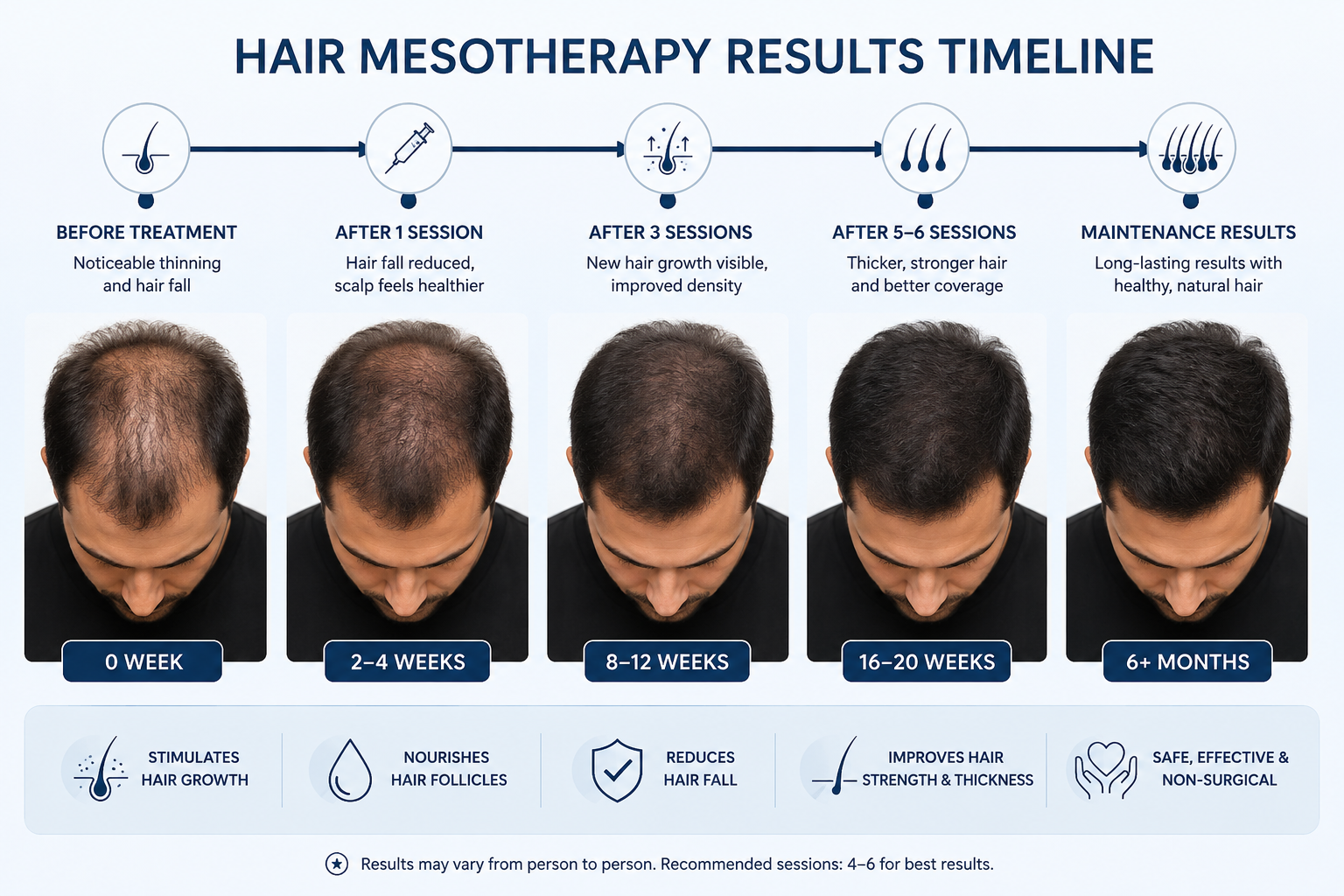
Managing expectations is half the treatment plan. Mesotherapy works progressively — not dramatically in one session. Here is the honest, biologically accurate timeline:
Timeline | What Is Happening Biologically | What You Notice |
Sessions 1–2 (Weeks 1–4) | Scalp microcirculation improving; follicle cells receiving increased nutrient supply | Reduced daily hair fall in many patients; scalp feels healthier |
Sessions 3–4 (Weeks 5–8) | Follicles in early telogen phase being coaxed into anagen; DHT inhibition taking effect in AGA patients | Hair fall continues to reduce; early reports of ‘baby hairs’ in some patients |
Sessions 5–6 (Weeks 9–12) | Anagen phase accelerating; new hair shafts growing; existing hair thickening | New fine hairs visible at hairline and parting; existing hair feeling fuller |
Session 7–8 (Months 3–5) | New growth at full pace; hair shaft calibre improving | Clearly visible improvement in density; reduced parting width; improved texture |
Month 5–8 (Post-Programme) | Follicle health improved and maintaining; scalp microcirculation established | Peak visible result; hair significantly denser and stronger than at start |
Month 8–12 (Maintenance Phase) | Monthly maintenance sessions maintain follicle environment | Results sustained; progression of any underlying AGA/FPHL significantly slowed |
Mesotherapy vs PRP vs GFC vs Minoxidil vs LLLT vs Hair Transplant
One of the most searched questions online is ‘which hair treatment is best?’ — and the honest answer is always: it depends on your hair loss type, stage, and goals. Here is the most complete comparison available:
Factor | Mesotherapy | PRP | GFC | Minoxidil (Topical) | LLLT | Hair Transplant |
Mechanism | Cocktail delivery | Own growth factors | Concentrated growth factors | Vasodilator + anagen extension | Photobiomodulation | Follicle relocation |
Needle / Procedure | Yes – micro-injections | Yes – injections | Yes – injections | No – topical | No – light device | Surgical procedure |
Works for AGA? | Partially (slows) | Yes (slows / improves) | Yes (best for AGA) | Yes (daily use) | Yes (mild improvement) | Yes (permanent fix) |
Works for Nutritional Loss? | Yes – best option | Partially | Partially | Limited | Limited | Not indicated |
Session Frequency | Every 2–4 weeks | Every 4–6 weeks | Every 4–6 weeks | Daily application | 3x/week minimum | One session (usually) |
Downtime | Same day / next day | Same day / next day | Same day / next day | None | None | 7–21 days |
Permanence | Maintenance required | Maintenance required | Longer lasting than PRP | Daily – stops if stopped | Ongoing use needed | Permanent |
Customisation | High – cocktail varied | Moderate – PRP only | High – concentration adjustable | Fixed formula | Fixed protocol | High – design led |
Cost (annual) | ₹40,000 – ₹1,20,000 | ₹40,000 – ₹1,20,000 | ₹50,000 – ₹1,50,000 | ₹5,000 – ₹15,000 | ₹30,000 – ₹80,000 (device) | ₹60,000 – ₹5,00,000 (once) |
Best Used As | Primary or adjunct | Primary or adjunct | Primary or adjunct | Daily maintenance | Adjunct / maintenance | Definitive treatment |
The most effective hair loss programmes at Sarayu Clinics combine two or more of these approaches. The combination of mesotherapy + PRP or GFC + a stabilising medical treatment (finasteride / minoxidil based on suitability) consistently outperforms any single modality. A hair transplant, when indicated, is preceded by a mesotherapy programme to prime the scalp.
Male vs Female Hair Fall – Different Mesotherapy Protocols
Hair loss in men and women has different hormonal, nutritional, and genetic drivers — and mesotherapy protocols must reflect these differences. Most clinics apply the same cocktail to all patients. Sarayu Clinics formulates gender-differentiated protocols:
Protocol Element | Male Protocol (AGA-Focused) | Female Protocol (FPHL / TE-Focused) |
DHT Blockers | Primary focus — dutasteride / finasteride micro-injection or saw palmetto | Included at lower concentration; females less DHT-sensitive in most FPHL cases |
Iron / Ferritin | Secondary — unless specifically deficient on bloodwork | PRIMARY ingredient — low ferritin is the single most common treatable cause of hair fall in women |
Vitamin B12 | Included as standard | Priority ingredient — especially in vegetarian/vegan women or those on metformin |
Zinc | High priority — zinc plays key role in DHT metabolism regulation | Included — especially important in PCOS-associated hair loss in women |
Minoxidil (microinjected) | Common inclusion for crown and vertex zones | Used in diffuse thinning cases; formulation adjusted for female scalp |
Hormonal Considerations | Testosterone / DHT pathway primary driver | Thyroid, oestrogen, progesterone, PCOS — assessed and addressed in formulation |
Session Frequency | Every 2–3 weeks initially for AGA | Every 3–4 weeks for TE; every 2 weeks for active FPHL |
Typical Programme Length | 6–10 sessions for initial programme | 6–8 sessions for TE; 8–12 for chronic FPHL |
Combination Therapy Programmes at Sarayu Clinics
Mesotherapy works best as part of a programme — not as a standalone treatment. Here are the combination approaches most commonly recommended at Sarayu Clinics:
Programme 1: Mesotherapy + PRP (Most Popular)
Alternating mesotherapy and PRP sessions, typically scheduled 2–3 weeks apart. PRP provides the biological growth factor stimulus; mesotherapy provides the nutritional and pharmacological support. The two together address both the cellular signalling (PRP) and the building-block supply (mesotherapy) that follicles need.
Programme 2: Mesotherapy + GFC (Best for AGA)
GFC (Growth Factor Concentrate) is a more refined, cell-free version of PRP with higher growth factor concentration. Combined with mesotherapy, this is the most potent non-surgical hair treatment programme available and is recommended for patients with moderate AGA or FPHL where significant improvement is needed.
Programme 3: Pre-Transplant Scalp Priming
Four to six mesotherapy sessions (with or without PRP) in the 3 months before a hair transplant surgery. This improves scalp vascularity, reduces follicle miniaturisation in native hair, and creates a healthier receiving environment for transplanted grafts — associated with improved graft survival rates in clinical observation.
Programme 4: Post-Transplant Maintenance
Monthly mesotherapy sessions for the first 6–12 months after a hair transplant. Supports transplanted graft recovery, nourishes native hair to prevent further loss around grafts, and maintains the overall scalp health that determines the long-term quality of the transplant result.
Related pages: FUE Hair Transplant Delhi | PRP Hair Treatment | Stem Cell Therapy Delhi
Frequently Asked Questions – Hair Fall Mesotherapy in Delhi
Q1. How many mesotherapy sessions do I need to see results?
Most patients notice reduced hair shedding within 3–4 sessions. Visible new growth typically begins around sessions 5–6. A standard initial programme is 6–8 sessions spaced every 2–4 weeks, followed by monthly maintenance. The exact number depends on your hair loss type — telogen effluvium responds faster than androgenetic alopecia, for example. At your first session, Dr. Tripathi or Dr. Nidhi Bhatia will give you a personalised session plan with realistic milestones.
Q2. Is mesotherapy for hair painful?
Honestly — it is mildly uncomfortable, not painful. The needles are extremely fine (30-gauge, finer than a standard blood draw needle) and the injection depth is shallow (4mm). Most patients describe the sensation as quick pinpricks. Topical anaesthetic cream reduces this further. Patients who have had both mesotherapy and a blood test consistently rate mesotherapy as less uncomfortable. Very needle-sensitive patients can opt for needle-free delivery methods.
Q3. Is mesotherapy better than PRP for hair fall?
Neither is universally ‘better’ — they work differently and work best together. PRP delivers your own concentrated growth factors directly to follicles and works best for stimulating follicle activity and growth factor signalling. Mesotherapy delivers a customisable mix of vitamins, minerals, amino acids, and pharmacological actives — better suited when nutritional deficiency, DHT excess, or scalp health is the primary driver. For most patients, combining both produces results superior to either alone.
Q4. Can mesotherapy regrow hair that has completely fallen out?
Mesotherapy can only work where follicles still exist — even if dormant. If a follicle is completely dead (as in long-standing bald patches where the skin is smooth and shiny), no amount of mesotherapy can regenerate it. For areas with miniaturised but still-present follicles, or for patients with temporary hair loss (telogen effluvium), mesotherapy can restore growth. For completely bald areas, only a hair transplant can restore hair permanently.
Q5. Are there any side effects of hair mesotherapy?
Temporary side effects include: mild redness at injection sites (resolves in 1–4 hours), minor tenderness for 24–48 hours, and occasionally small bruising at individual injection points. These are minor and temporary. Serious side effects (infection, allergic reaction) are rare and minimised by sterile technique and a pre-session allergy check. At Sarayu Clinics, all mesotherapy is performed under sterile clinical conditions by trained practitioners.
Q6. How long does one mesotherapy session last?
A targeted zone session (e.g., crown only) takes 30–40 minutes. A full scalp session takes 45–60 minutes including preparation and post-treatment care time. If you are having a PRP-Meso hybrid, add 20–30 minutes for the blood draw and processing. Most patients schedule sessions during a lunch break or before/after work without disruption to their day.
Q7. Can I use mesotherapy alongside my existing hair loss medication?
In most cases, yes — and it is often recommended. Mesotherapy works alongside topical minoxidil (apply minoxidil in the morning; do not apply on the day of the mesotherapy session and wait 24 hours before resuming). Oral finasteride is compatible and often included in the cocktail in localised form for additional DHT suppression. Always disclose all current medications at consultation — some blood-thinning supplements (omega-3, vitamin E, aspirin) should be paused 5–7 days before sessions.
Q8. How long do mesotherapy results last?
Initial programme results (6–8 sessions) typically last 4–6 months before hair loss begins to gradually resume — because the underlying cause (genetics, hormones, chronic deficiency) has not been permanently eliminated. Monthly maintenance sessions sustain the results. For patients with telogen effluvium from a resolved cause (e.g., post-pregnancy, post-illness), results after a full programme can last significantly longer as the cause is no longer active.
Q9. Is mesotherapy safe for all hair types?
Yes — hair type (straight, wavy, curly, coily) does not affect mesotherapy suitability or outcomes. The injection is into the scalp dermis, not the hair shaft. Indian hair types — including thick, coarse, or tightly curled — respond very well to mesotherapy because the follicle structure is the same regardless of hair shaft morphology. The cocktail may be adjusted based on specific scalp oiliness patterns common in Indian skin, but the procedure itself is universally suitable.
Q10. Can women get mesotherapy during their period?
Yes — menstruation is not a contraindication for mesotherapy. However, some women find they are slightly more sensitive to injections in the few days before or during their period. If you have a choice, scheduling your session in the week after your period ends is optimal. Pregnancy is the absolute contraindication — mesotherapy should not be performed at any point during pregnancy.
Q11. Can I wash my hair after a mesotherapy session?
Yes — but not immediately. We recommend waiting 6–8 hours (or washing the next morning) to allow the injected solution to absorb properly and the micro-injection points to close. When you do wash, use a gentle, sulphate-free shampoo and avoid vigorous scalp rubbing for the first wash. Normal hair-washing routine resumes from day 2 onward.
Q12. How is Sarayu Clinics’ mesotherapy different from other clinics in Delhi?
Three things: the formulation, the assessment, and the physician. Most clinics use a pre-filled standard mesotherapy vial. At Sarayu Clinics, the cocktail is formulated based on your bloodwork, hair loss cause, scalp condition, and gender. Every patient’s first session is preceded by trichoscopy and a clinical assessment. And the treatment plan is designed by either Dr. Adarsh Tripathi (with 18+ years of surgical experience) or Dr. Nidhi Bhatia (with international aesthetics board qualifications) — not delegated to a technician.
Why Sarayu Clinics for Hair Fall Mesotherapy in Delhi?
Why Sarayu | What This Means for Your Hair |
Bespoke Cocktail Formulation | No pre-filled vials. The mesotherapy solution is formulated specifically for you based on your bloodwork, hair loss type, gender, and scalp condition. This is the fundamental difference between mesotherapy that works and mesotherapy that does not. |
Physician-Led, Not Technician-Led | Dr. Tripathi and Dr. Nidhi Bhatia personally design and review every mesotherapy programme. Injections are administered by trained clinicians — not beauty technicians. |
Trichoscopy-Based Diagnosis | Every new patient receives a dermatoscopic scalp analysis (50–200x magnification) before treatment begins. This tells us exactly what type of hair loss you have and informs the formulation — rather than guessing. |
Bloodwork Integration | Hair loss is often a window into internal health. Sarayu Clinics reviews relevant blood markers (ferritin, B12, D3, thyroid, hormones) and addresses confirmed deficiencies in the mesotherapy formula. |
Dr. Adarsh Tripathi – 18+ Years, Facial Plastic Surgeon | Understanding hair loss at a surgical level — scalp anatomy, follicle biology, vascular supply — informs how mesotherapy is delivered and combined. His dual training in facial plastic and maxillofacial surgery brings a precision rarely found in aesthetics-only practices. |
Dr. Nidhi Bhatia – International Board Affiliations | Co-founder Dr. Nidhi Bhatia (SACDAM, International Peelings Society) leads the non-surgical and skin health programme with specialised expertise in female hair loss patterns, hormonal contributors, and combination aesthetic treatments. |
PRP-Meso Hybrid Available | Many clinics offer either PRP or mesotherapy. Sarayu Clinics offers both individually and as a combined protocol — delivering synergistic results that standalone treatments cannot match. |
Transparent Programme Structure | You receive a written treatment plan after your first consultation: number of sessions recommended, session schedule, expected milestones, and all-in cost. No hidden fees. No pressure to add services. |
Surgical Continuity if Needed | If your assessment indicates that mesotherapy alone cannot achieve your goals and a hair transplant is ultimately needed, that continuity of care is available within the same clinic with the same surgeon. You do not start over. |
About Dr. Adarsh Tripathi: dradarshtripathi.com | About Sarayu Clinics
How to Reach Us:
Phone: +91 9289111081 , +91 9289111082
Email: sarayuinquiries@gmail.com
Sarayu Clinics website: www.sarayuclinics.com
Facebook: https://www.facebook.com/sarayuclinic
Instagram: https://www.instagram.com/sarayuclinics/
Dr. Adarsh Tripathi’s profile: https://dradarshtripathi.com/
Online Booking: Visit our website https://sarayuclinics.com/contact-us/ to schedule appointments conveniently.
How does mesotherapy work?
Mesotherapy works by delivering a customized blend of active ingredients directly into the mesoderm layer of the skin. This stimulates the skin’s natural healing process, promoting collagen production, improving blood circulation, and reducing inflammation.
What can I expect during a mesotherapy treatment session?
During a mesotherapy treatment, a numbing cream may be applied to the treatment area for comfort. Dr. Tripathi will then use a series of fine needles to inject the customized solution into the skin. The entire process typically takes 30-45 minutes, depending on the size of the treatment area.
How many sessions of mesotherapy are required?
The number of sessions required varies depending on the individual’s skin concerns and goals. Generally, a series of 3-6 sessions spaced 2-4 weeks apart is recommended for optimal results. Maintenance sessions may be needed to sustain the effects.
Are there any side effects associated with mesotherapy?
Mesotherapy is generally safe, but some patients may experience mild side effects such as redness, swelling, or bruising at the injection sites. These side effects are usually temporary and resolve within a few days.
What is Mesotherapy, and how does it promote hair growth?
Mesotherapy is a non-invasive treatment that involves microinjections of a customized blend of vitamins, minerals, amino acids, and other nutrients directly into the scalp. This cocktail stimulates blood circulation, strengthens hair follicles, and encourages natural hair growth. At Sarayu Clinics, our mesotherapy sessions are designed to rejuvenate your scalp and revitalize dormant hair follicles.
What sets Sarayu Clinics apart in providing Mesotherapy for hair loss?
At Sarayu Clinics, we prioritize personalized care and utilize advanced techniques to ensure effective results. Our team of experienced professionals conducts thorough consultations to assess individual needs and customize treatment plans accordingly. We use high-quality, FDA-approved products and maintain strict hygiene standards to ensure patient safety and satisfaction. With a track record of successful outcomes, Sarayu Clinics stands out as a trusted provider of mesotherapy for hair restoration in Delhi.
How does Mesotherapy compare to other hair restoration treatments like PRP or hair transplants?
Mesotherapy is a non-invasive procedure that utilizes microinjections to deliver nutrients directly to the scalp, promoting hair growth. Unlike hair transplants, which involve surgical procedures, mesotherapy offers a less invasive option with minimal downtime. PRP (Platelet-Rich Plasma) therapy involves using the patient’s own blood to stimulate hair growth, while mesotherapy delivers a customized blend of nutrients tailored to individual needs. The choice between these treatments depends on various factors, including the extent of hair loss and individual preferences.