
Vampire Facial in Delhi
Vampire Facial in Delhi
The vampire facial got its name from a photograph — a celebrity, face streaked with her own blood, posted to social media around 2013. The name stuck, the treatment went global, and somewhere in the noise a fairly ordinary medical procedure acquired a reputation it did not entirely earn, in both directions. It is not the miracle the name implies. It is also not a gimmick. It is microneedling, combined with a concentrate of the growth factors in your own blood, and it works reasonably well for skin texture, early acne scarring and general skin quality.
What it is, unavoidably, is a procedure involving human blood. Your blood is drawn, spun in a centrifuge, and reapplied to skin that has just been perforated thousands of times. Done in a licensed medical facility with sterile single-use equipment, that is entirely safe and has been for years. Done by an unlicensed operator reusing disposable needles, it is a route for transmitting bloodborne infection — and in 2024 the United States Centers for Disease Control published the investigation proving exactly that.
We put that on this page, near the top, because you deserve to know it before you book anywhere. At Sarayu Clinics in Greater Kailash, the vampire facial is performed by facial plastic and maxillofacial surgeon Dr. Adarsh Tripathi — in a clinical environment, with single-use kits, by someone qualified to handle blood. That is not a marketing claim. For this particular treatment it is the whole of the question.
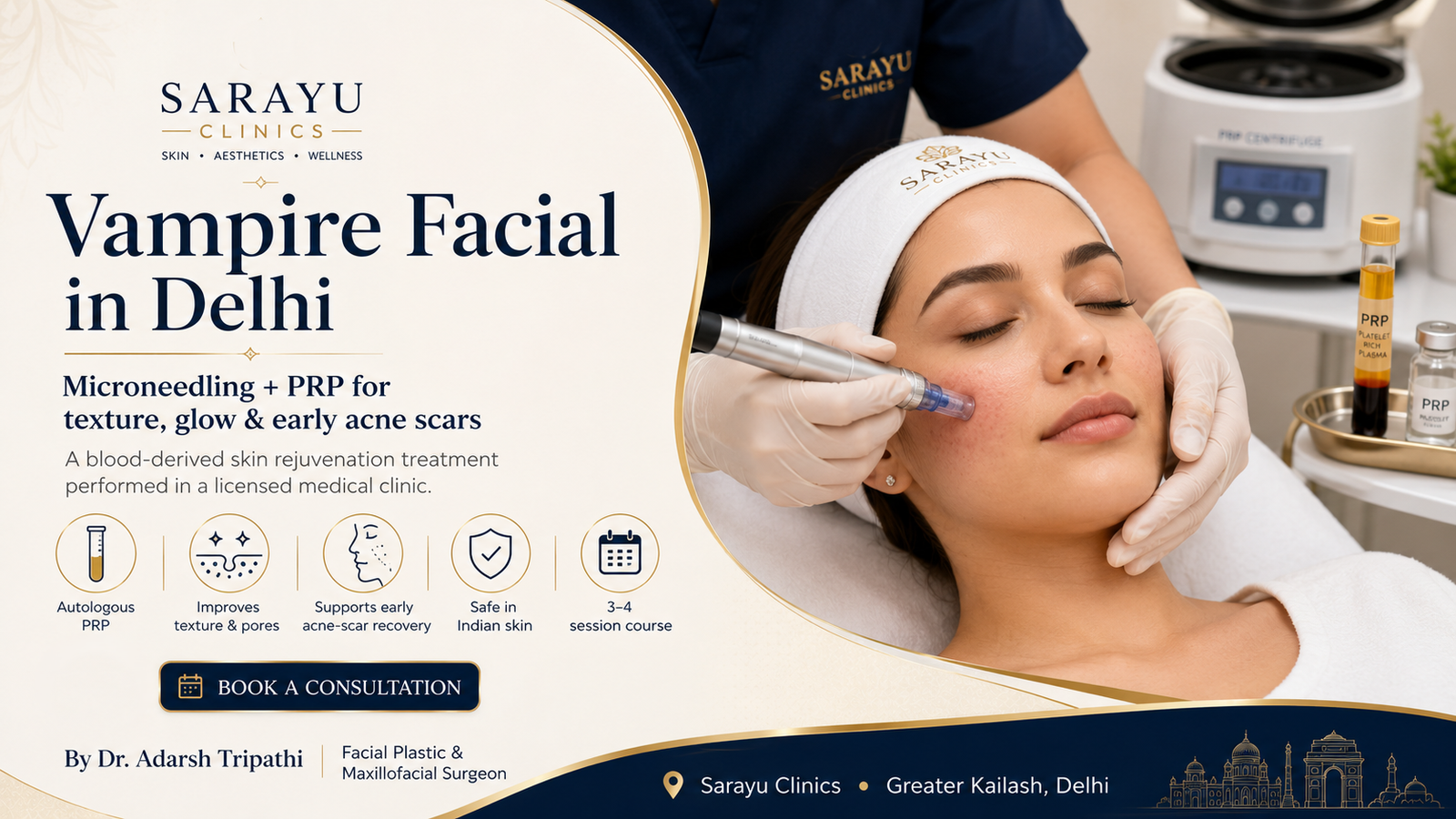
The short answer : A vampire facial is microneedling combined with platelet-rich plasma (PRP) drawn from your own blood. Roughly 10–20ml of blood is taken, spun in a centrifuge to separate and concentrate the platelets, and the resulting plasma — dense with growth factors — is applied to the skin during and after microneedling, so it penetrates through the micro-channels. It improves skin texture, fine lines, early acne scarring, pore appearance and overall skin quality. A course is typically three to four sessions spaced four weeks apart, with results building over three to six months. Downtime is one to three days of redness. Delhi cost is roughly Rs 6,000–20,000 per session. It is autologous — made from you — so allergy is not a concern. The real safety question is not the blood. It is who is handling it, and whether the facility is licensed and sterile.
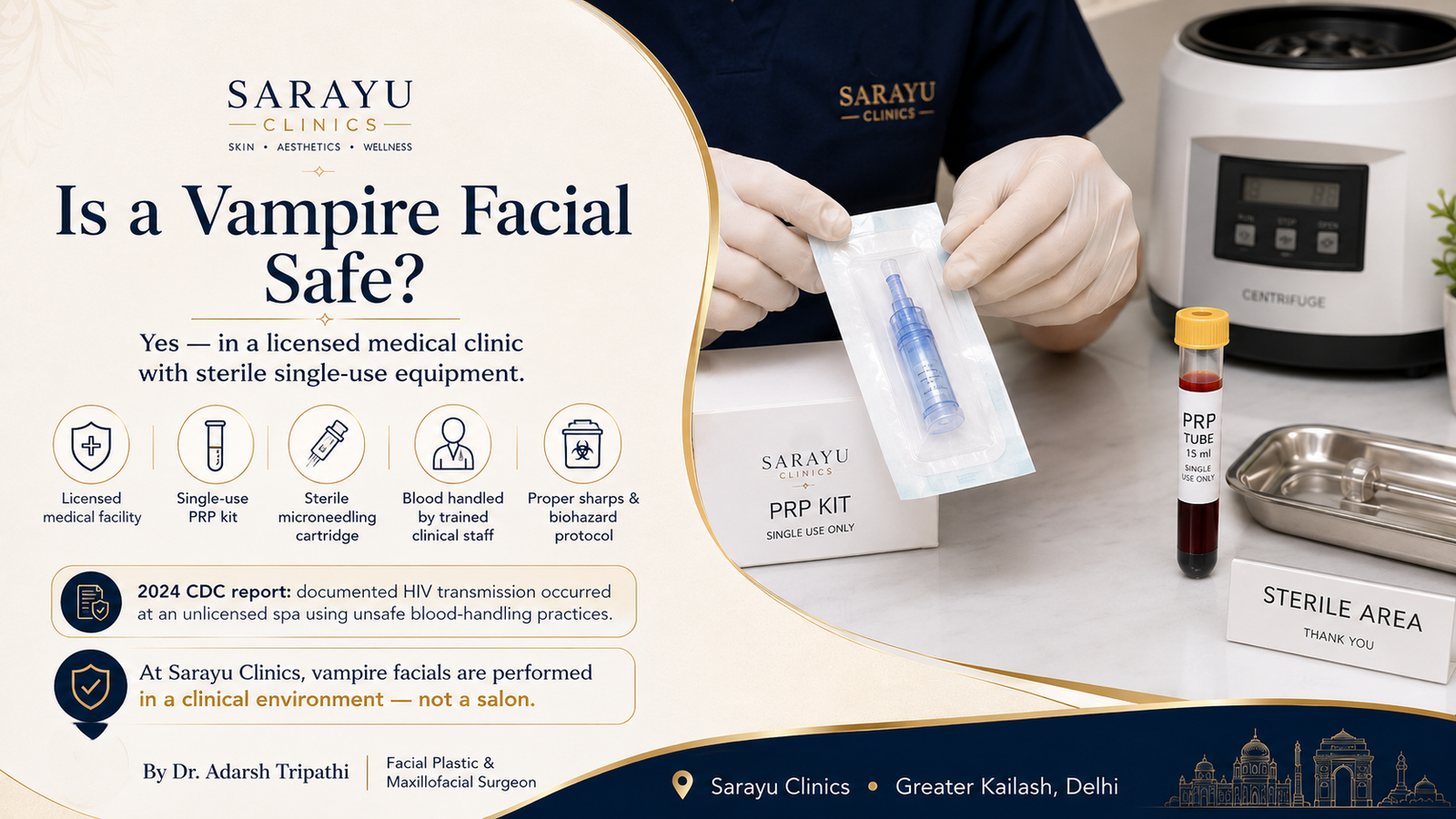
Is a Vampire Facial Safe? The Part Nobody Publishes
Yes — in the right hands, in the right place. Here is what happened when it was not.
In the summer of 2018, the New Mexico Department of Health was notified that a woman with no known risk factors had been diagnosed with HIV. She had received a vampire facial — PRP with microneedling — at a spa in Albuquerque. The investigation that followed ran for five years, involved the CDC, and tested nearly 200 former clients and their partners. Its findings were published in the CDC’s Morbidity and Mortality Weekly Report in April 2024.
Three women, with no social contact with one another and no shared risk factors, contracted closely related strains of HIV-1. The CDC concluded that contamination from an undetermined source at the spa had transmitted the virus. These are the first documented cases of HIV transmission through any cosmetic injection procedure anywhere in the world.
What the investigators found at the premises explains it. The spa was unlicensed. Disposable equipment intended for single use had been reused. Unlabelled tubes of blood sat on a kitchen counter beside a centrifuge. More blood, and injectable products, were stored in a kitchen refrigerator alongside food. The owner subsequently pleaded guilty to five felony counts of practising medicine without a licence.
Read this correctly, because it matters
The lesson of the New Mexico investigation is NOT that vampire facials are dangerous. Testing of 198 former clients found no hepatitis B or hepatitis C infections and no further HIV cases. The lesson is that a procedure involving human blood is exactly as safe as the infection control practised by the person performing it — and no safer. In a licensed medical facility, using single-use disposable equipment, with proper sterile technique and blood handled by qualified staff, transmission is prevented regardless of any patient’s status. Infectious disease specialists commenting on the report were explicit about this. There is no reason to avoid the treatment. There is every reason to ask where, and by whom, it is being done. // The questions worth asking, at any clinic in Delhi: Is this a licensed medical facility, or a spa? Who draws the blood, and what is their qualification? Is the microneedling cartridge single-use, opened in front of me? Is the centrifuge tube single-use? Are blood and injectables stored in a dedicated medical refrigerator? Are patient records maintained? // A clinic that answers these easily has nothing to hide. A clinic that bristles has answered you.
At Sarayu, blood is drawn by trained clinical staff, processed in a sealed single-use kit, and the microneedling cartridge is opened in front of you. The premises are a licensed medical clinic, not a salon. Read more about our clinic and team.
Vampire Facial vs Vampire Facelift
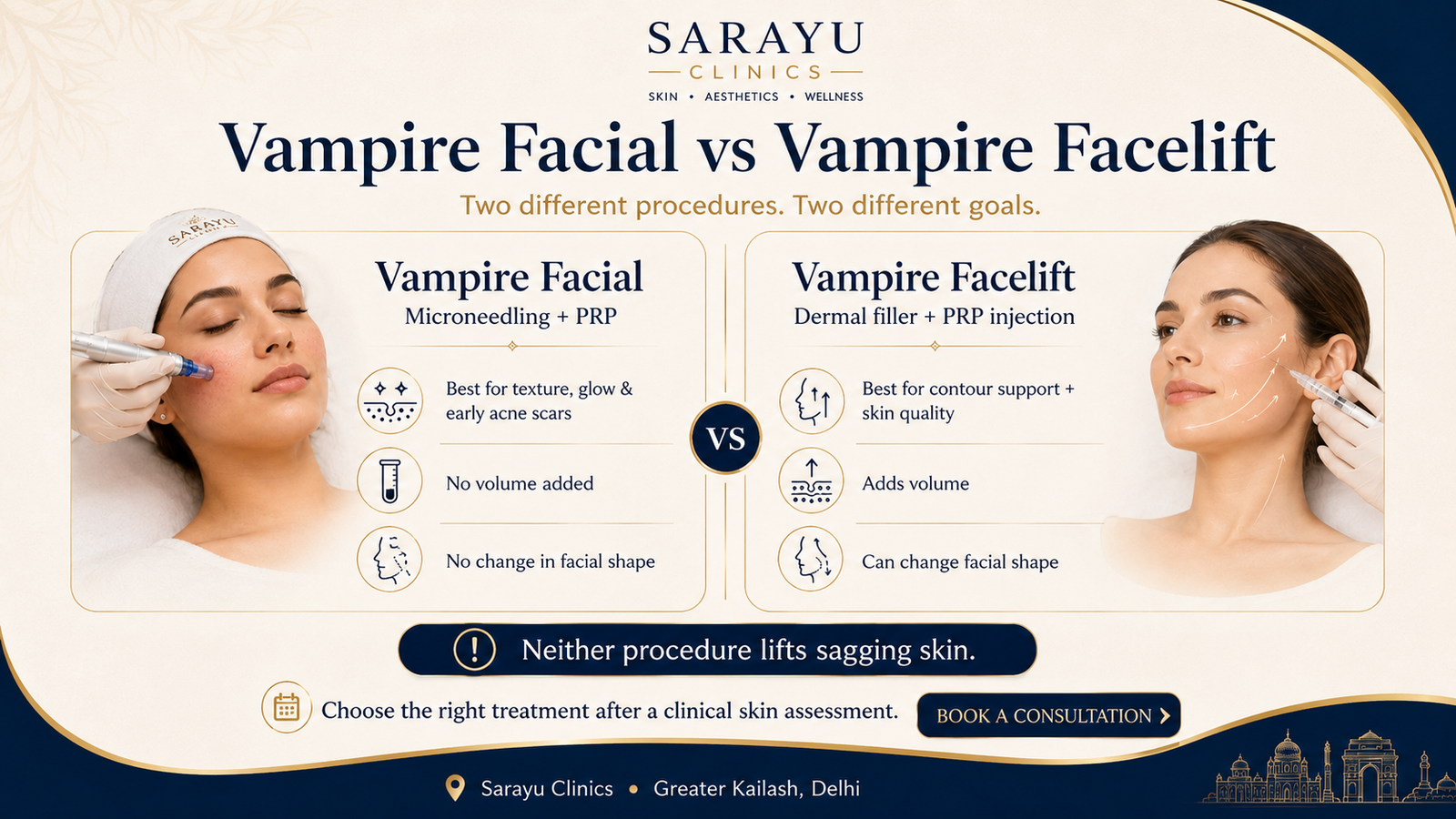
These are two different procedures, and the confusion between them is near-universal — including on the websites of several Delhi clinics that offer both. Both terms are registered trademarks of the American physician who devised the protocols.
| Vampire Facial | Vampire Facelift |
What it involves | Microneedling, with PRP applied topically and driven through the micro-channels | Dermal filler injected to restore structure, PLUS PRP injected into the skin |
Adds volume? | No | Yes — the filler does |
Changes facial shape? | No | Yes, subtly |
Primarily treats | Skin quality: texture, tone, fine lines, early scarring | Volume loss and contour, alongside skin quality |
Is it actually a facelift? | No | Also no — it is a filler treatment. No tissue is lifted |
Needles into the face? | Microneedles, superficially | Filler cannula/needle at depth, plus PRP |
Typical Delhi cost | Rs 6,000 – Rs 20,000 per session | Rs 30,000 – Rs 80,000+, depending on filler volume |
A word on the word ‘facelift’. Neither procedure lifts anything. A vampire facelift is a dermal filler treatment with PRP added. If you have genuine sagging — jowls, a loosening neck, true tissue descent — no injectable of any kind will fix it, and you need HIFU, a thread lift or a genuine facelift. This page is about the vampire facial: microneedling with PRP, for skin quality.
Prices shown are for guidance only. Your final treatment cost will be confirmed during the initial consultation, based on your individual needs, concerns, and personalised treatment plan.
How a Vampire Facial Actually Works ?
Two mechanisms, working together. Each does something the other cannot.
- Microneedling creates controlled micro-injury. Fine needles perforate the skin thousands of times, triggering the body’s wound-healing cascade: fibroblasts activate, collagen and elastin are laid down, and the dermis remodels. This is the engine of the result. It also, crucially, opens temporary micro-channels through the epidermis.
- PRP supplies the growth factors. Platelets are the cells your body deploys to a wound. Concentrated and applied through those micro-channels, they release growth factors — PDGF, TGF-beta, VEGF, EGF among them — that amplify the healing response, accelerate recovery and enhance collagen synthesis beyond what microneedling alone achieves.
The plasma is autologous: it comes from you. There is nothing foreign to react against, no allergy risk, no rejection. That is the treatment’s genuine and considerable virtue, and it is why PRP is used across orthopaedics, dentistry and hair restoration as well as aesthetics.
PRP Is Not a Standardised Product
Here is a fact that ought to change how you compare clinics, and that no Delhi page will tell you: two clinics both offering ‘PRP’ may be delivering products that differ by a factor of several in strength.
PRP quality is determined by how the blood is processed. The variables are real:
- Platelet concentration. Therapeutic PRP is generally accepted to require platelets concentrated to roughly three to five times their baseline level in whole blood. A poorly spun preparation may barely exceed baseline — and will do correspondingly little.
- Single spin versus double spin. A single centrifugation separates plasma from red cells. A second spin concentrates the platelets further. The protocol determines the product.
- Kit quality. A purpose-designed, sealed, single-use PRP kit with a separator gel yields a consistent, sterile preparation. A plain blood tube spun in a generic centrifuge does not, and introduces handling steps where contamination becomes possible.
- Leucocyte content. Whether white cells are included or excluded changes the inflammatory profile of the preparation. For facial skin, leucocyte-poor PRP is generally preferred.
You are entitled to ask which kit is used, whether it is single-use, whether it is opened in front of you, and what spin protocol is followed. A clinic that has thought carefully about its PRP will enjoy answering. A clinic offering a vampire facial at a price that seems remarkable has economised somewhere, and this is usually where.
PRP vs PRF
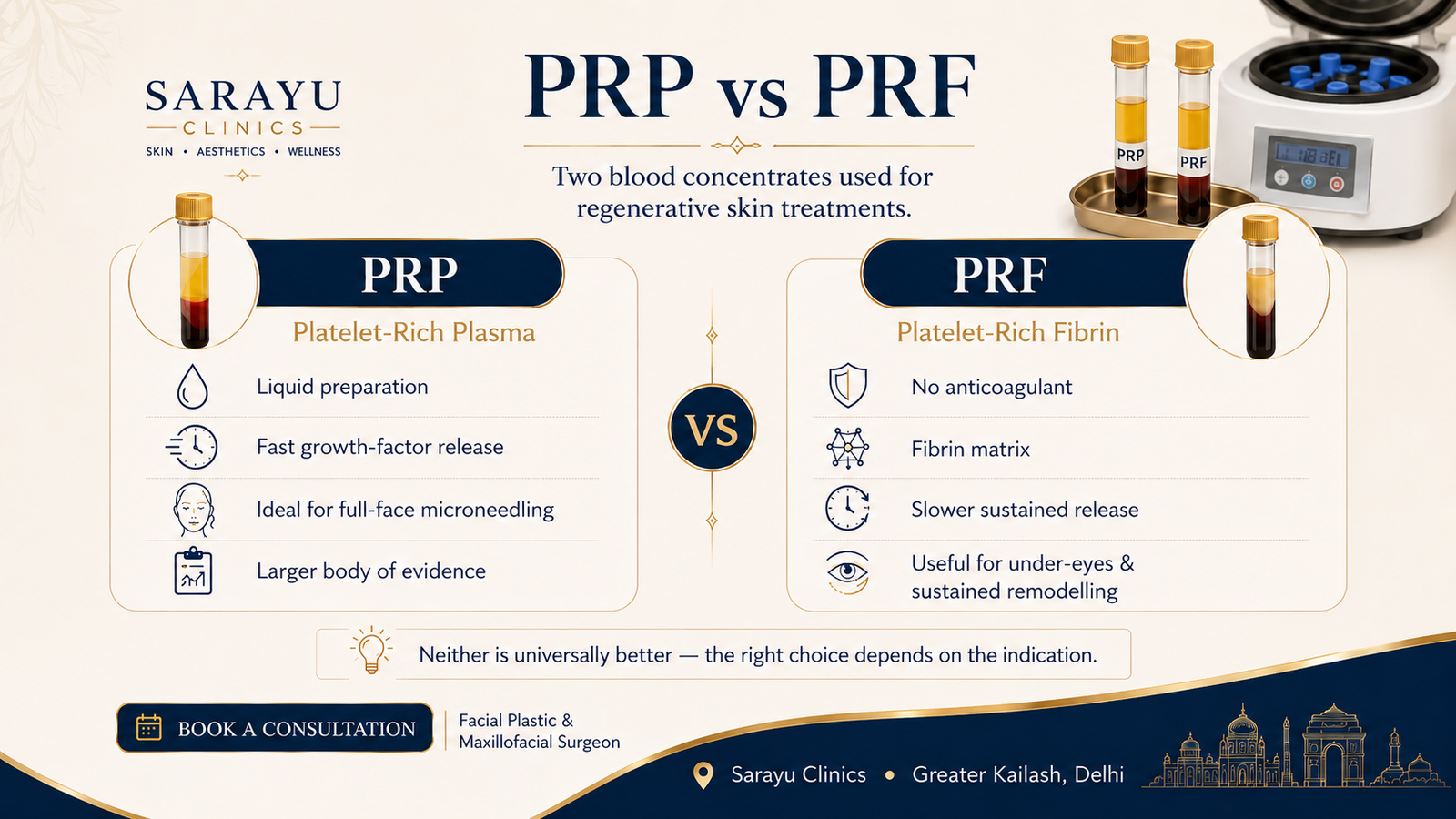
Platelet-rich fibrin is the second-generation preparation, and worth understanding because it is increasingly offered as an upgrade — sometimes justifiably.
| PRP (platelet-rich plasma) | PRF (platelet-rich fibrin) |
Anticoagulant used? | Yes | No — none at all |
Spin speed | Higher | Lower, shorter |
Physical form | Liquid plasma | Soft fibrin clot / gel |
Growth factor release | Rapid burst over hours | Slower, sustained over days |
Also contains | Platelets, plasma proteins | Platelets, fibrin scaffold, leucocytes, stem cells |
Best suited to | General skin quality, hair, broad application | Under-eyes, volumising, sustained release, scarring |
Handling | Straightforward, injectable/topical | Clots quickly; must be used within minutes |
Neither is universally better. PRF’s fibrin scaffold releases growth factors gradually rather than in a single burst, which suits sustained remodelling and the under-eye area particularly well. PRP is simpler to handle, easier to combine with microneedling across a full face, and has the larger body of evidence behind it. We use whichever the indication calls for, and will tell you which.
Benefits of a Vampire Facial
- It is made from you — autologous, so no allergy, no rejection, no foreign material. For patients wary of injectables and synthetic products, this is the entire appeal, and it is a legitimate one.
- Genuine collagen stimulation — microneedling drives the remodelling; PRP amplifies it. The improvement is structural, not cosmetic camouflage.
- Improved skin texture and tone — the most reliable and consistent result, and the reason most patients are satisfied.
- Meaningful improvement in early acne scarring — rolling and shallow boxcar scars respond, particularly across a course of three or four sessions.
- Refined pore appearance — as the dermis thickens and firms.
- Faster healing than microneedling alone — the growth factors shorten the inflammatory phase. Redness settles more quickly.
- Safe in Indian skin — nothing here targets melanin and no significant heat is generated, so the risk of post-inflammatory hyperpigmentation in Fitzpatrick IV–V skin is low. Careful needle depth still matters.
- Combines well with almost everything — PRP is routinely added to RF microneedling, laser sessions and hair restoration protocols to accelerate recovery and enhance the result.
- Modest cost — considerably less expensive per session than the imported injectable skin boosters, because the active ingredient is your own blood.
Areas We Treat
- Full face — cheeks, forehead, perioral area (the standard treatment)
- Under-eyes and periorbital skin (PRF often preferred here)
- Neck and décolletage
- Backs of the hands
- Individual acne scars, as part of a wider protocol
- Stretch marks (selected cases)
Scalp — for hair restoration. This is a distinct treatment with its own protocol and evidence base; see PRP hair treatment in Delhi.
Conditions & Concerns It Treats
- Rough or uneven skin texture — the core indication, and where results are most consistent.
- Dullness and loss of radiance — skin that has stopped catching light.
- Fine lines — textural ones. Expression lines are muscle-driven and need Botox.
- Early atrophic acne scarring — rolling and shallow boxcar. Full detail on our acne scar treatment
- Enlarged-looking pores — see also open pores treatment.
- Under-eye crepiness and dark circles of textural origin — not hollows, and not pigment. Our under-eye treatment page explains the difference, which decides the treatment.
- Skin dulled by pollution and urban exposure — a genuine factor in Delhi.
Before starting any scar protocol, be certain you are treating a scar and not a mark. Flat dark patches are post-inflammatory hyperpigmentation and need pigment treatment, not collagen stimulation. Our guide to acne marks versus acne scars gives the thirty-second test.
The Procedure: Step by Step
- Consultation and screening. Tripathi assesses your skin and reviews your medical history — bleeding disorders, anticoagulant medication, active infection, platelet disorders, recent isotretinoin. Some of these are contraindications.
- Blood draw. Roughly 10–20ml is drawn from a vein in your arm by trained clinical staff, into a sealed, single-use PRP tube. This step is the one that separates a medical clinic from a salon, and you should watch it being done.
- The tube is spun to separate the blood into layers and concentrate the platelets. Depending on the protocol, a second spin follows. The resulting plasma — straw-coloured, not red — is drawn off.
- Topical anaesthetic is applied to the face for 30 to 45 minutes while the blood is processed. The two happen in parallel.
- A sterile, single-use cartridge — opened in front of you — is passed systematically across the face at a depth chosen for the area and concern. The PRP is applied to the skin during the process, so it enters the micro-channels as they are created.
- PRP application and, where indicated, injection. Remaining plasma is applied as a mask, or injected superficially into specific areas such as the under-eye or individual scars.
- Immediate aftercare. Cool compress, a repair serum, sunscreen. You leave with written instructions. The whole appointment runs about 60 to 90 minutes.
- The course. Three to four sessions, four weeks apart. Results build cumulatively across the course and for months afterwards.
Downtime & Aftercare
- Immediately after: the face is red — like moderate sunburn — and feels warm and tight. This is normal and expected.
- Day 1–2: redness fades substantially. Mild swelling possible. Some patients notice a fine sandpapery texture as the skin sheds.
- Day 3: most people are comfortable in public, and makeup can usually be worn from around 24 to 48 hours.
- Do not: touch the face with unwashed hands, apply makeup for 24 hours, use active ingredients (retinoids, acids, vitamin C) for five to seven days, or go near a sauna, steam room or hot yoga for 48 hours.
- Do: use a gentle cleanser and a bland moisturiser, and wear SPF 50+ every single morning. This is not optional — freshly microneedled skin is more vulnerable to UV-induced pigmentation, and in Indian skin that matters more than most.
- Avoid before treatment: blood-thinning supplements — fish oil, high-dose vitamin E — for a week beforehand if medically appropriate for you, and alcohol for 24 hours. Both increase bruising and may affect platelet function.
- Bruising: uncommon on the face; more likely where PRP is injected, particularly under the eyes.
Vampire Facial Cost in Delhi
Cost varies more than it should, largely because PRP quality varies. Verified Delhi ranges:
Treatment | Typical cost per session (INR)* |
Consultation & skin assessment | Often nominal — confirmed when you book |
Vampire facial (PRP + microneedling), full face | Rs 6,000 – Rs 20,000 |
Course of 3 sessions | Rs 18,000 – Rs 50,000 |
PRP + RF microneedling (MNRF / Morpheus8) | Rs 15,000 – Rs 45,000 |
Under-eye PRP or PRF | Rs 8,000 – Rs 20,000 |
PRF upgrade (in place of PRP) | Rs 2,000 – Rs 6,000 additional |
Neck or décolletage (add-on) | Rs 5,000 – Rs 12,000 |
Vampire facelift (dermal filler + PRP) | Rs 30,000 – Rs 80,000+, by filler volume |
*Indicative ranges only. Because a course is three to four sessions, compare clinics on total course cost. And ask what the price includes: a sealed single-use PRP kit costs the clinic real money, and a clinic quoting well below these ranges has usually saved it by not using one.
Why the cheapest vampire facial in Delhi is the one to avoid ?
For most treatments, a low price signals an inexperienced injector or a grey-market product. For this one, it signals something worse. The genuine costs of a vampire facial are the sealed single-use PRP kit, the single-use microneedling cartridge, trained staff to draw blood, and a licensed clinical facility with proper sharps and biohazard handling. Every one of those can be economised away by someone willing to reuse what should be discarded. That is precisely what the CDC found in New Mexico. If a price looks remarkable, ask what has been removed to achieve it — and watch the cartridge and the tube being opened.
Results Timeline
Timeframe | What usually happens |
Day 0 | Redness, warmth, tightness. Not a result — an inflammatory response, which is the point. |
Day 1–3 | Redness settles. Skin may feel slightly rough as it sheds. A temporary ‘glow’ around day three is real but is largely hydration and inflammation. |
Week 1–2 | Skin looks brighter and feels smoother. This is the first honest change. |
Week 4 | Second session. Improvement is cumulative — each builds on the last. |
Week 6–8 | Collagen remodelling becomes visible. Texture refines; fine lines soften. |
Month 3 | Peak result of the course. This is the point to photograph and to judge. |
Month 3–6 | Collagen continues to mature. Acne scar improvement is slowest and most gradual. |
Month 9–12 | Gradual decline as collagen turns over. Two or three maintenance sessions a year sustain it. |
A single session is not a treatment; it is the first of a course. The photograph on day three that everyone posts is inflammation and hydration. The change worth having appears at week six and matters at month three.
Vampire Facial Compared to the Alternatives
Treatment | What drives the result | Strength for texture/scars | Downtime | Cost per session |
Vampire facial (PRP + microneedling) | Micro-injury + your own growth factors | Moderate | 1–3 days | Rs 6,000–20,000 |
Microneedling alone | Micro-injury | Mild–moderate | 1–2 days | Rs 5,000–10,000 |
MNRF / Morpheus8 (RF microneedling) | Micro-injury + radiofrequency heat | Strong | 2–5 days | Rs 10,000–45,000 |
Rejuran (PDRN) | Cellular signalling; salmon DNA | Strong | 24–48 hours | Rs 25,000–50,000 |
Profhilo | Hydration + bio-remodelling | Weak (not its purpose) | Hours | Rs 30,000–55,000 |
Fractional CO2 laser | Ablative resurfacing | Strongest | 5–10 days | Rs 8,000–20,000 |
The vampire facial sits in a sensible middle: more effective than microneedling alone, far cheaper than the imported injectable boosters, and gentler than ablative laser. It is frequently combined rather than chosen — PRP added to MNRF or Morpheus8 accelerates healing and enhances the result. For pure regenerative power on texture and scarring, Rejuran is stronger; for hydration and glow, Profhilo or the wider skin booster family is the better tool. None of these is a rival to the others. They answer different questions.
What a Vampire Facial Will Not Do ?
- It will not lift anything. Despite the name attached to its sibling procedure. Sagging needs HIFU, threads or surgery.
- It will not add volume. That is dermal filler.
- It will not treat pigmentation. Melasma and dark patches need a pigmentation treatment. Aggressive microneedling on melasma-prone skin can make it worse.
- It will not close deep ice-pick scars. Those need TCA CROSS or punch excision.
- It will not give you a result in one session, whatever the photograph on day three suggests.
- It will not out-perform RF microneedling or fractional laser for significant scarring. It is a gentler tool, and we will say so rather than sell you a course that under-delivers.
Are You a Good Candidate?
You are likely well-suited if you have:
- Rough, uneven or dull skin texture
- Early atrophic acne scarring — rolling or shallow boxcar
- Fine, textural lines and enlarged-looking pores
- A preference for autologous treatment over synthetic injectables
- Any Fitzpatrick skin type, including IV–V
- Realistic expectations, and the patience for a three-to-four-session course
This treatment is not for you, or needs careful discussion, if you:
- Have a bleeding or platelet disorder, or are taking anticoagulants
- Have an active blood-borne infection, or are on immunosuppressive therapy
- Have active acne, infection, cold sores or open lesions in the treatment area
- Have severe anaemia or a low platelet count
- Have a history of keloid scarring
- Are pregnant or breastfeeding
- Have taken isotretinoin within the last six months
- Have active melasma — microneedling can aggravate it; treat the pigment first
- Want volume, lift or significant scar correction — the wrong tool
- Are being offered this in an unlicensed facility, by anyone. Walk away.
Why Choose Sarayu Clinics for a Vampire Facial in Delhi
Of every treatment on this website, this is the one where the choice of clinic matters most — not because the procedure is complicated, but because it involves your blood. At Sarayu Clinics it is performed by facial plastic and maxillofacial surgeon Dr. Adarsh Tripathi, alongside co-founder and celebrity aesthetician Dr. Nidhi Bhatia.
- A licensed medical facility, not a salon. Proper sharps handling, biohazard protocol, dedicated medical refrigeration, maintained patient records. The CDC’s New Mexico report exists because a spa had none of these.
- Blood drawn by trained clinical staff. Into a sealed, single-use PRP kit, processed on site.
- Every disposable is disposable. The microneedling cartridge and the centrifuge tube are single-use and opened in front of you. Ask us to. We would rather you did.
- PRP protocol you can interrogate. Which kit, which spin, leucocyte-poor or leucocyte-rich, and why. These questions have answers here.
- PRP or PRF, chosen for the indication. Not whichever is on the price list.
- Surgeon-level periorbital technique. Under-eye PRP sits millimetres from structures that do not forgive error.
- An honest ‘no’. If your skin needs RF microneedling, laser or pigment treatment instead — or if you have active melasma, where microneedling could worsen things — you will hear that at the consultation rather than after the third session.
Medical Review & Sources
This page is for general information and is medically reviewed by the team at Sarayu Clinics under Dr. Adarsh Tripathi. It is not a substitute for an in-person consultation. Platelet-rich plasma procedures involve the handling of human blood and should only be performed in a licensed medical facility using sterile, single-use equipment. ‘Vampire Facial’ and ‘Vampire Facelift’ are registered trademarks of their respective owner and are used here as the terms by which patients search for these procedures. Sources:
- CDC Morbidity and Mortality Weekly Report — Investigation of Presumptive HIV Transmission Associated with Receipt of Platelet-Rich Plasma Microneedling Facials, New Mexico, 2018–2023
- American Academy of Dermatology — Microneedling
- American Academy of Dermatology — Acne scars: diagnosis and treatment
- Cleveland Clinic — Microneedling
How to Reach Us:
Phone: +91 9289111081 , +91 9289111082
Email: sarayuinquiries@gmail.com
Sarayu Clinics website: www.sarayuclinics.com
Facebook: https://www.facebook.com/sarayuclinic
Instagram: https://www.instagram.com/sarayuclinics/
Dr. Adarsh Tripathi’s profile: https://dradarshtripathi.com/
Online Booking: Visit our website https://sarayuclinics.com/contact-us/ to schedule appointments conveniently.
How much does a vampire facial cost in Delhi?
Roughly Rs 6,000–20,000 per session, with a course of three sessions running Rs 18,000–50,000. The wide range mostly reflects PRP quality — a sealed single-use PRP kit costs the clinic real money, and clinics quoting well below these ranges have usually saved it by not using one. Ask what the price includes, and watch the kit and microneedling cartridge being opened.
Is a vampire facial safe?
In a licensed medical facility with sterile single-use equipment, yes. The important context: in April 2024 the CDC published an investigation into three women who contracted HIV after receiving vampire facials at an unlicensed New Mexico spa that had reused single-use equipment and stored blood on a kitchen counter. These were the first documented HIV transmissions via any cosmetic injection procedure. Testing of nearly 200 clients found no hepatitis B or C. The lesson is not that the procedure is dangerous — it is that it is exactly as safe as the infection control of whoever performs it. Ask whether the facility is licensed, who draws the blood, and whether the cartridge and tube are single-use and opened in front of you.
What is the difference between a vampire facial and a vampire facelift?
They are different procedures, and both terms are registered trademarks. A vampire facial is microneedling with PRP applied through the micro-channels — it improves skin quality and adds no volume. A vampire facelift is dermal filler injected to restore contour, plus PRP injected into the skin — it does change facial shape. Neither lifts anything. If you have genuine sagging, no injectable will help; you need HIFU, threads or surgery.
Does a vampire facial hurt?
Modestly. Topical numbing cream is applied for 30 to 45 minutes while your blood is processed, so the microneedling itself is tolerable — most patients describe scratching and vibration rather than pain. The blood draw is an ordinary needle in the arm. Where PRP is injected rather than applied, particularly under the eyes, there is a little more discomfort.
How many sessions do I need?
Three to four sessions, spaced four weeks apart, for a full course. Results build cumulatively and continue improving for three to six months after the last session. Two or three maintenance sessions a year sustain the result. A single session is not a treatment; it is the first of a course, and any clinic selling it as a one-off is selling you the day-three glow rather than the outcome.
What is the difference between PRP and PRF?
PRP uses an anticoagulant and a faster spin, producing a liquid plasma that releases growth factors in a burst over hours. PRF uses no anticoagulant and a slower, shorter spin, producing a soft fibrin clot that releases growth factors gradually over days and also contains leucocytes and stem cells. PRF suits the under-eye area and sustained remodelling; PRP is easier to combine with microneedling across a full face and has more evidence behind it. Neither is universally better.
Will a vampire facial help my acne scars?
It improves early atrophic scarring — rolling and shallow boxcar scars — over a course of three or four sessions. It will not close deep ice-pick scars, which need TCA CROSS or punch excision. For significant scarring, RF microneedling (Morpheus8 or MNRF) or fractional laser is stronger, and PRP is often added to those treatments rather than used alone. First establish that you have scars rather than flat dark marks, which are pigmentation and need an entirely different treatment.

Is a vampire facial safe for Indian skin?
Yes, with proper technique. Nothing in the treatment targets melanin and no significant heat is generated, so the risk of post-inflammatory hyperpigmentation in Fitzpatrick IV–V skin is low — considerably lower than with ablative lasers. Needle depth still matters, and daily SPF 50+ afterwards is essential. One important exception: if you have active melasma, microneedling can aggravate it, and the pigment should be treated and stabilised first.
Are all PRP treatments the same?
No, and this is rarely explained. PRP quality depends on platelet concentration (therapeutic PRP is generally accepted to need platelets at three to five times their baseline level), whether a single or double spin is used, the quality of the kit, and whether white cells are included. Two clinics both offering ‘PRP’ may deliver preparations differing several-fold in strength. You are entitled to ask which kit is used and what protocol is followed.
What is the downtime after a vampire facial?
One to three days. Immediately afterwards the face is red, warm and tight, like moderate sunburn. Redness fades substantially by day two, and most people are comfortable in public by day three, with makeup usually possible after 24 to 48 hours. Avoid active skincare ingredients for five to seven days, skip saunas and hot yoga for 48 hours, and wear SPF 50+ every morning without exception.