
Smile Lines Removal in Delhi
The lines running from the sides of your nose to the corners of your mouth become a thing somewhere between your late twenties and your forties. You start noticing them in photos before you notice them in the mirror. The reflex is to ask for filler in the fold itself — and that’s exactly where so many treatments go wrong, leaving people with the heavy, “done” look they were hoping to avoid. The modern answer is more elegant.
At Sarayu Clinics in Greater Kailash, smile lines are treated by facial plastic and maxillofacial surgeon Dr. Adarsh Tripathi. The plan is built around your face as a whole — not just the line itself — with the full range of options on the table: from a single, well-placed syringe of filler all the way to surgical midface rejuvenation when that’s genuinely the right answer. Being surgeon-led means you don’t have to be referred elsewhere when injectables aren’t enough.
The short answer : Smile lines (nasolabial folds) are static lines caused mostly by midface volume loss — your cheek fat pads slide and shrink with age, and the skin folds where they used to support it. The best modern treatment isn’t filling the fold; it’s supporting the cheek above it with dermal filler, which lifts the fold naturally from the top. Skin boosters, thread lifts, lasers, RF microneedling and (in advanced cases) surgical lifts complete the toolkit. Botox plays only a small, supporting role here — these aren’t muscle lines. Filler results last 9–18 months.
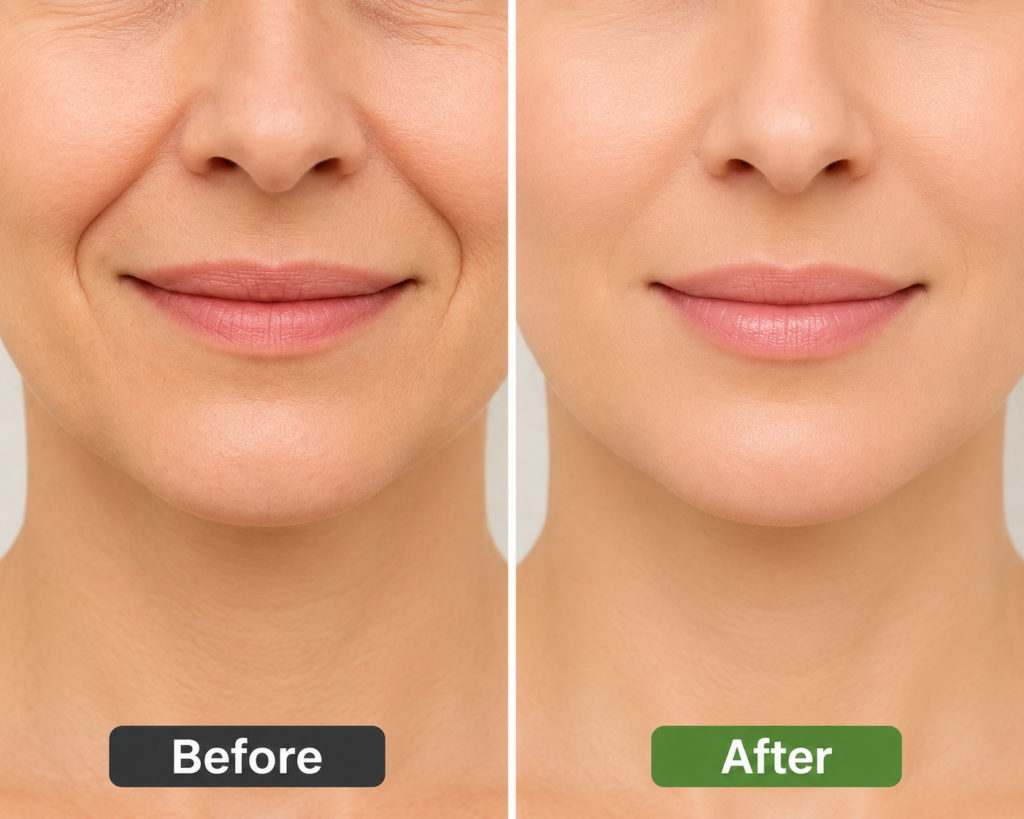
What Are Smile Lines, Really?
“Smile lines” is a loose, everyday term and people use it for three different things. Knowing which one you actually have is the first step to treating it well:
- Nasolabial folds — the main meaning. Lines that run from the sides of the nose down to the corners of the mouth. Caused mostly by cheek volume loss and skin laxity.
- Marionette lines — lines that drop from the corners of the mouth down toward the jaw. Caused by lower-face volume loss and the downward pull of small muscles.
- Perioral lines — fine vertical “barcode” lines above and below the lips, often grouped in with smile lines too.
Some people also call crow’s feet “smile lines” because they appear when you smile. Those are different and handled on our crow’s feet page. Most of this page focuses on the most common meaning — nasolabial folds.
Why Smile Lines Deepen With Age ?
Smile lines are largely a structural problem, not a muscle one. A few things layer up over the years:
- Cheek fat pads shrink and descend — the deep fat compartments in the midface lose volume and slide down with gravity. The skin above the fold ends up unsupported, and a crease forms where the cheek used to lift.
- Collagen and elastin loss — from your mid-twenties onwards, skin becomes thinner and less elastic, deepening the fold.
- Bone resorption — the facial skeleton itself remodels with age; the maxilla and orbital bone lose support, which worsens the fold above.
- Repeated expression — smiling, laughing and speaking pull on this area thousands of times a day.
- Sun, pollution and smoking — classic accelerators that thin the skin and break down its scaffolding.
- Weight loss — rapid loss of facial fat exposes the fold dramatically; this is why some people’s smile lines worsen suddenly after dieting.
- Genetics — if your parents had deep smile lines early, you’re more likely to as well.
Benefits of Professional Smile Line Treatment
- A softer, fresher lower face — less of the tired, drawn look that deep folds give.
- A subtle midface lift — done properly, the right treatment lifts your face from within rather than just filling a crease.
- A more youthful overall appearance — restoring midface support reshapes the way light falls on your face; people often look 5–10 years younger without being able to say why.
- Natural-looking results — when the technique addresses the cause (volume loss above) rather than just the line, there’s none of the puffy, heavy lower-face look.
- Quick and non-surgical — most treatments are 15–45 minutes with minimal downtime.
- Long-lasting — modern hyaluronic acid fillers last 9–18 months; biostimulating treatments build collagen for even longer effects.
Areas We Treat as Part of Smile Line Rejuvenation
Smile lines never sit in isolation — the surrounding architecture is usually doing some of the work of deepening them. We commonly treat:
- The cheeks and midface (the upstream cause for most smile lines)
- The nasolabial folds themselves (the fold from nose to mouth corner)
- The marionette lines (corners of mouth downward)
- The corners of the mouth (often turned down with age)
- The jawline and pre-jowl area (loss of definition that worsens the fold)
- Perioral barcode lines and the lip border
- The chin (subtle filler here lifts the lower face)
Types of Smile Lines & Related Concerns We Treat
Matching the technique to the type is what separates a good result from a heavy, overdone one:
- Early, mild folds — often respond beautifully to a single syringe placed deep at the cheek, plus skin boosters.
- Moderate folds with cheek hollowing — classic case for midface filler + a small, conservative touch of filler along the fold itself.
- Deep folds with skin laxity — need a layered approach — filler plus collagen-stimulating treatments and sometimes a thread lift.
- Marionette lines — a small amount of filler at the corners of the mouth and chin, sometimes with a tiny dose of Botox to relax the downward-pulling muscle.
- Crepey, sun-damaged skin around the fold — benefits from microneedling, RF or laser resurfacing.
- Heavy folds with significant facial sag — the territory where surgical midface lift or facelift quietly outperforms anything else — and where being surgeon-led actually matters.
Smile Lines Treatment Options at Sarayu Clinics
There’s no single “best” treatment — the right answer depends on what’s really causing the fold, your skin quality and how much improvement you want. The full ladder, in the order we usually consider it:
1. Dermal fillers (the gold standard — done right)
Modern hyaluronic-acid dermal fillers are the cornerstone of smile-line treatment — but the technique matters more than the product. The expert move is to support the midface first (the upstream cause) rather than filling directly into the fold. That’s what gives the natural “you look refreshed” result instead of the heavy lower-face look people fear.
2. Cheek filler / midface volumisation
Often the most important step. Cheek filler with a robust HA filler (e.g. Juvederm Voluma-class) restores the deep cheek volume that’s gone. The fold above is lifted from the top instead of filled from below — the same principle a good surgeon uses, just non-surgically.
3. Skin boosters and bio-remodellers
Injectable hyaluronic acid skin boosters and bio-remodellers (Profhilo-class products) improve skin quality — hydration, firmness, elasticity — around the fold itself. Excellent for crepey skin and as a long-term maintenance layer.
4. Thread lift
Dissolvable polydioxanone (PDO) or polylactic acid (PLLA) threads can be placed in the mid- and lower face to physically lift the soft tissue and reduce the fold from above. Results last 12–18 months. A useful option when there’s genuine laxity but you’re not yet ready for surgery.
5. HIFU (non-surgical lift)
High-intensity focused ultrasound tightens the deeper supportive layers of the face, including the SMAS layer surgeons work on in a facelift. It’s subtle and gradual but a strong addition to a long-term plan.
6. RF microneedling and Morpheus8
Adding radiofrequency through fine needles — MNRF or the deeper Morpheus8 — remodels collagen in the deeper layers and gives a real (if modest) tightening around the fold. A favourite combination with filler.
7. Microneedling with PRP, growth factors or exosomes
Classic microneedling — such as Dermapen 4 — paired with PRP (the vampire facial), growth factors or exosomes, supports the skin’s own collagen renewal. Good as a layered, low-downtime add-on.
8. Fractional laser resurfacing
Fractional CO2 or Erbium resurfacing is the strongest option for deep, etched static lines and crepey skin around the fold. More downtime than other options, reserved for the right cases.
9. Botox (limited but useful role)
Smile lines themselves aren’t muscle lines, so Botox isn’t the answer for the fold itself. But a small dose into the depressor anguli oris muscle can lift down-turned mouth corners; and a low dose into the lip area can soften perioral barcode lines. Used precisely, not as the main event.
10. Surgical midface lift / facelift (Sarayu’s edge)
When laxity is significant and non-surgical work no longer holds, surgical rejuvenation is what actually moves the needle. Because Dr. Tripathi is a facial plastic and maxillofacial surgeon, this option lives in-house — you don’t need to restart the conversation with someone new when injectables aren’t enough.
The single biggest mistake with smile-line treatments
Injecting too much filler directly into the fold. It looks better in the chair, then heavy and unnatural a week later. A good clinician treats the cause (midface volume loss) before treating the symptom (the line). If a clinic offers to “just fill the fold” without ever examining your cheeks, get a second opinion.
What Happens During a Session: Step by Step
- Consultation & facial analysis. We assess your face at rest and in expression, examine your cheek volume and skin quality, look at the fold from multiple angles, and identify the real upstream cause.
- Honest plan & expectations. We discuss what’s realistic, how much product or how many sessions you’ll need, and what “good” looks like — natural, not erased.
- Numbing cream is applied for 20–30 minutes; modern fillers also contain local anaesthetic.
- Cleansing & marking. The area is cleaned and key points are marked with you sitting upright.
- The treatment. Filler is placed precisely — cheek first, fold second — often using a blunt cannula to reduce bruising and improve safety. A session takes 20–45 minutes.
- Review & maintenance. We see you 2 weeks later to assess the result and add a small top-up if needed, and discuss a longer-term plan.
Downtime & Aftercare
Most smile-line treatments are walk-in, walk-out. What to expect:
- Fillers: mild swelling, occasional small bruise; you may feel small bumps that settle over 1–2 weeks. Pre-treatment with arnica or avoiding blood thinners (when medically safe) reduces bruising.
- Skin boosters: small injection bumps that flatten within 24 hours.
- Microneedling: redness for 24–48 hours, similar to mild sunburn.
- RF microneedling / Morpheus8: redness and grid marks for 24–48 hours.
- Threads: a few days of mild tenderness and possible pulling sensation; settles within a week.
- Laser resurfacing: 3–7 days of social downtime depending on intensity.
General aftercare: avoid heavy exercise, saunas and lying flat for 4–6 hours after injectables; no dental work for 2 weeks if you’ve had filler nearby; gentle skincare and SPF every morning.
Are You a Good Candidate?
You’re likely a good candidate if you have:
- Visible nasolabial folds or marionette lines that bother you in photos or the mirror
- Some cheek volume loss or midface flattening
- Realistic expectations — softer, lifted, refreshed; not erased or frozen
- Good general health and a healed, infection-free face
It may not be suitable, or needs extra caution, if you have:
- Pregnancy or breastfeeding
- Active skin infection, severe acne or cold sores at the planned site
- Allergy to filler ingredients or a history of severe reactions
- Certain autoimmune conditions — medical clearance needed
- Bleeding or clotting disorders, or strong blood thinners (relevant for injectables)
- Unrealistic expectations — expecting filler to substitute for a surgical lift in heavily lax skin
Smile Lines Treatment Cost in Delhi
Pricing is mainly driven by how much product or how many sessions you need. As a general guide for Delhi:
Treatment | Typical cost (INR)* |
Consultation & assessment | Often free or nominal — confirmed when you book |
Dermal filler (per syringe, premium HA) | ₹25,000 – ₹50,000 |
Cheek + nasolabial fold combination (2 syringes) | ₹50,000 – ₹1,00,000 |
Skin boosters / bio-remodellers | ₹15,000 – ₹35,000 per session |
Thread lift (mid- and lower face) | ₹40,000 – ₹1,20,000 |
HIFU (full face / focused areas) | ₹20,000 – ₹60,000 |
RF microneedling / Morpheus8 | ₹15,000 – ₹35,000 per session |
Microneedling (with PRP / growth factors) | ₹5,000 – ₹15,000 per session |
Fractional laser resurfacing | ₹12,000 – ₹25,000 per session |
Surgical midface lift / facelift | Quoted in person after assessment |
Results Timeline: What to Expect
One of the satisfying things about smile-line treatment is how quickly you see something — and how naturally it then settles in.
Treatment | Onset | Peak result | How long it lasts |
Dermal fillers | Immediate | 1–2 weeks (after swelling settles) | 9–18 months |
Skin boosters | 2–4 weeks | 2–3 months | 6–9 months |
Thread lift | Immediate (lift) + ongoing collagen | 1–3 months | 12–18 months |
HIFU | Some immediate lift; main result 2–3 months | 3–6 months | 12–18 months |
Microneedling / RF microneedling | 2–4 weeks | 3–6 months | 12–18 months with maintenance |
Fractional laser | After initial healing (≈1 month) | 3 months | 1–2 years |
Maintenance plan: most people top up their filler every 9–12 months. Skin boosters and collagen-based treatments are run as a short course up front and then maintained every 6–12 months. The goal isn’t to chase perfection — it’s to age more slowly.
Filler vs Botox vs Other Treatments — Which Is Right for You?
A simple decision tree most marketing pages won’t give you:
If your fold is… | Best first answer | Why |
Mild, with hollowed cheeks | Cheek filler | Lifts the fold from above; very natural result |
Moderate, with cheek volume loss | Cheek + small amount in fold | Combination addresses cause and line together |
Deep, with crepey skin | Filler + microneedling / laser | Restores volume AND improves skin quality |
Mostly skin laxity | Thread lift + HIFU / RF | Physical lift plus collagen stimulation |
Marionette-style (mouth corners down) | Small filler + a touch of Botox | Lifts corners and softens the muscle pulling them down |
Significant facial sag | Discuss surgical midface lift | Beyond a point, surgery quietly outperforms everything |
How to Slow Smile Lines from Deepening ?
Treatment is one half of the story; prevention is the other. The things that actually help:
- Broad-spectrum SPF 30+ every day, with reapplication — the single biggest lever
- A retinoid or peptide cream at night, started in your late twenties
- Stable weight — rapid weight loss dramatically worsens facial folds
- Adequate hydration, sleep and a sensible diet
- No smoking; minimise alcohol
- Start small and early — light, well-placed filler in your 30s gives a more natural long-term result than chasing deep folds in your 50s
- Combine with a collagen treatment (microneedling, RF, skin boosters) to maintain skin quality
Why Choose Sarayu Clinics for Smile Lines Treatment in Delhi
Smile lines look simple but they aren’t — the eye can spot an over-filled lower face from across a room. Treatment at Sarayu Clinics is led by facial plastic and maxillofacial surgeon Dr. Adarsh Tripathi, alongside co-founder and celebrity aesthetician Dr. Nidhi Bhatia. The plan is built around your full face, not just the line.
- The whole ladder under one roof — filler, cheek volumisation, skin boosters, threads, HIFU, RF, lasers and, when needed, surgery. Most competitors offer only a few rungs of this.
- Surgeon-led plans — if your folds need a midface lift or facelift, you’re already with the right specialist. No starting over.
- Midface-first technique — we treat the cause (cheek volume loss) before the symptom (the fold), which is what protects you from the heavy, overfilled look.
- Cannula and modern technique — blunt cannulae where appropriate to reduce bruising and improve safety, and premium HA fillers chosen for the specific layer and effect.
- Honest expectations — we’ll tell you when one syringe is enough, when two are better, and when nothing in a syringe will give you what you actually want.
More about our clinic and team.
Frequently Asked Questions
What is the best treatment for smile lines?
For most people, hyaluronic acid dermal filler is the gold-standard treatment — but the technique matters more than the product. The best modern approach supports the cheek and midface first to lift the fold from above, with a smaller amount placed in the fold itself only if needed. Adding skin boosters, microneedling or RF improves skin quality alongside it.
Will Botox get rid of smile lines?
Not really. Smile lines are static lines caused by volume loss and skin laxity — they’re not driven by a muscle the way crow’s feet are. Botox plays only a small, supporting role for related issues like down-turned mouth corners or fine perioral lines.
How many syringes of filler do I need?
Most people need 1–2 syringes for a natural correction — one in the cheek/midface area and, if needed, a smaller, conservative amount along the fold itself. Deeper folds with significant cheek hollowing may need more. We always start conservatively; you can add to a result but you can’t un-fill.
How long do smile-line fillers last?
Premium hyaluronic acid fillers in this area typically last 9–18 months, depending on the product, your metabolism, the depth of the fold and the layer of placement. A small maintenance top-up every 9–12 months keeps the result steady.
Will I look unnatural or “done” after treatment?
Not when done well. The heavy, overfilled look almost always comes from too much filler placed directly into the fold without addressing the cheek. The midface-first technique is what keeps it natural. We start conservatively and review at two weeks.
Is the treatment painful?
Most people find it very manageable. Numbing cream is applied for 20–30 minutes, and modern fillers also contain a local anaesthetic. Using a cannula instead of a needle, where appropriate, reduces discomfort and bruising.
Medical Review & Sources
This page is for general information and is medically reviewed by the team at Sarayu Clinics under Dr. Adarsh Tripathi. It is not a substitute for an in-person consultation. The clinical approach reflects current aesthetic and dermatological guidance, including:
How to Reach Us:
Phone: +91 9289111081 , +91 9289111082
Email: sarayuinquiries@gmail.com
Sarayu Clinics website: www.sarayuclinics.com
Facebook: https://www.facebook.com/sarayuclinic
Instagram: https://www.instagram.com/sarayuclinics/
Dr. Adarsh Tripathi’s profile: https://dradarshtripathi.com/
Online Booking: Visit our website https://sarayuclinics.com/contact-us/ to schedule appointments conveniently.
What if filler isn’t enough — do I need surgery?
If laxity is significant and non-surgical work no longer gives a real result, surgical midface lift or facelift is the honest answer. Because Sarayu is surgeon-led, that conversation happens in-house with the same specialist — you don’t have to start over elsewhere.
Are smile-line fillers safe?
Yes, when performed by an experienced clinician using premium HA fillers, sterile technique and appropriate anatomy knowledge. HA fillers are reversible with hyaluronidase if anything ever needs adjusting, which is part of why they’re the safest choice for this area.
What is the cost of smile-line treatment in Delhi?
A single syringe of premium HA filler typically costs ₹25,000–₹50,000. A cheek-plus-fold combination using 2 syringes usually runs ₹50,000–₹1,00,000. Skin boosters and microneedling add-ons start lower. Your exact cost is confirmed in an itemised plan after consultation.
How soon will I see results?
Filler results are visible immediately, with the final natural look settling in over 1–2 weeks as any swelling resolves. Skin boosters and collagen-based treatments build their effect over weeks to months.