Crow’s Feet Removal Treatment in Delhi
The lines that fan out from the outer corner of your eyes are usually the first place your face starts showing its age. They’re also one of the easiest things to soften — if you choose the right treatment for the right kind of line. Most people don’t. They head straight to Botox and are then surprised when the static, etched-in creases stay put even when their muscles relax. The trick is knowing what you’re actually dealing with.
At Sarayu Clinics in Greater Kailash, crow’s feet are treated by facial plastic and maxillofacial surgeon Dr. Adarsh Tripathi. Being a surgeon-led clinic matters here: the eye area is delicate, and you want one specialist who can move you up the treatment ladder from a quick anti-wrinkle injection right through to surgical eyelid rejuvenation if you ever need it — instead of being passed between providers.
The short answer
Crow’s feet have two flavours — dynamic lines that appear when you smile (caused by the orbicularis oculi muscle) and static lines that stay even at rest (caused by collagen loss, sun damage and thin skin). Botox handles dynamic lines beautifully. Static lines need something that rebuilds collagen or fills the crease: skin boosters, microneedling, fractional laser, fillers, or in advanced cases a surgical lift. A real plan usually combines two of these. Results from Botox last 3–4 months; collagen-based results build over months and last longer.
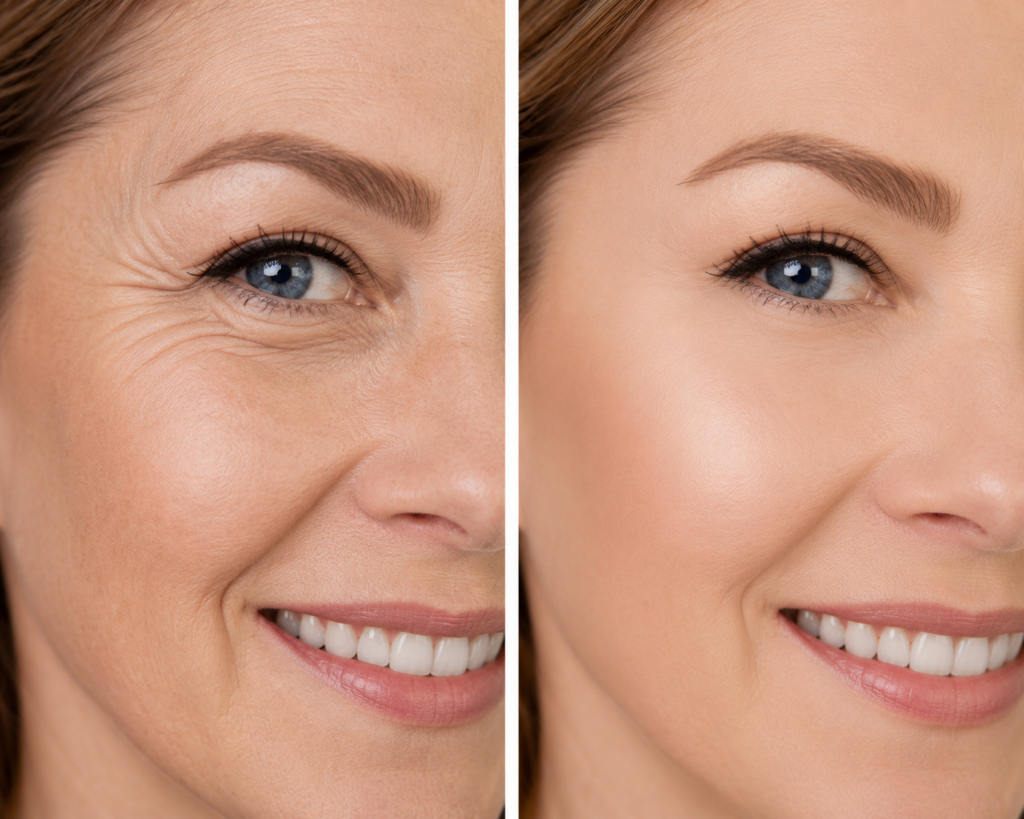
What Are Crow’s Feet, Really?
Crow’s feet — medically called lateral canthal lines — are the fine, fan-shaped wrinkles at the outer corners of your eyes. They appear because the skin around the eye is the thinnest on your face (less than half the thickness of cheek skin) and the muscle underneath it, the orbicularis oculi, contracts thousands of times a day every time you smile, squint or blink.
Two things matter for treatment, and almost no clinic explains them:
- Dynamic crow’s feet — only visible when you smile or squint. The muscle is doing it. Botox is the gold-standard answer.
- Static crow’s feet — visible even with a relaxed face. Years of muscle activity, sun and collagen loss have etched the line into the skin itself. Botox alone won’t fix these. You need a collagen-stimulating or filling treatment.
- Mixed pattern — the commonest situation by your mid-30s. You need a combination plan.
Getting this right is the difference between “you look refreshed” and “you paid for something that didn’t work.”
Why Crow’s Feet Form Earlier in Delhi ?
Crow’s feet are a normal part of ageing, but a few things speed them up — and several of them are background noise in Delhi life:
- Sun exposure — UV breaks down collagen and elastin around the eyes faster than anywhere else. The single biggest accelerator.
- Squinting — bright sun, dust, dry winters, long hours on screens; every squint deepens the crease.
- Pollution — particulate pollution generates oxidative stress that ages skin around the eyes faster.
- Collagen loss with age — we lose roughly 1% of skin collagen every year from our mid-twenties.
- Dehydration and poor sleep — thin under-eye skin loses elasticity quickly when chronically dry or under-rested.
- Smoking and alcohol — both speed up the breakdown of skin proteins.
- Genetics — if your parents got crow’s feet early, you might too.
Benefits of Professional Crow’s Feet Treatment
- A refreshed, not “done” look — softer lines around the eyes without losing your natural expression.
- A more rested appearance — less of the tired, drawn look that crow’s feet can give.
- Younger-looking eyes — the eye area is what people look at first; treating it pays back disproportionately.
- Prevention as well as correction — starting earlier with low-dose treatments slows the line from etching in permanently.
- Quick and non-surgical — most treatments are 15–45 minutes with little to no downtime.
- Stackable with other anti-ageing work — pairs naturally with forehead, frown and under-eye treatments.
Areas Around the Eyes We Treat
Crow’s feet rarely sit in isolation. The eye area is one connected canvas, and we usually plan it as a whole:
- Outer corners of the eyes — the classic crow’s feet fan
- Upper crow’s feet (extending up toward the temple)
- Lower lid lines that crinkle on smiling
- Bunny lines on the side of the nose
- Forehead and frown lines that pull on the eye area
- Tear troughs and hollowing under the eyes
- Excess upper-eyelid skin and lower-lid bags (where surgery may be discussed)
Types of Crow’s Feet & Related Concerns We Treat
Identifying the type properly is half the result:
- Dynamic crow’s feet — appear with expression; respond beautifully to Botox.
- Static crow’s feet — visible at rest; need collagen-rebuilding or surface treatments.
- Mixed crow’s feet — the most common pattern; needs a layered combination plan.
- Sun-damaged, crepey eye skin — thinning, lined skin that needs resurfacing or skin-quality treatments.
- Eye-area volume loss — hollowing at the outer cheek that makes crow’s feet look worse than they are.
- Eyelid laxity / hooded skin — when non-surgical options no longer hold, eyelid surgery (blepharoplasty) is the right answer — and Sarayu is one of the few clinics where that option lives in-house.
Crow’s Feet Treatment Options at Sarayu Clinics
Almost every clinic in Delhi offers Botox for crow’s feet. Few offer the full ladder of options below — and matching the option to your actual line type is what changes the result.
1. Anti-wrinkle injections (Botox / Dysport)
The gold-standard answer for dynamic crow’s feet. A few microdroplets of botulinum toxin into specific points along the orbicularis oculi muscle relax it just enough to soften the smile lines, while leaving the rest of your expression intact. A typical crow’s feet treatment uses about 6–12 units per side. See our Botox treatment in Delhi page for more.
2. Dermal fillers
Hyaluronic-acid dermal fillers are excellent for static crow’s feet and especially for crow’s feet that look worse because of volume loss in the outer cheek. We use very small amounts, very superficially, in the eye area — this is delicate, expert-only territory.
3. Skin boosters and bio-remodellers
Injectable hyaluronic acid skin boosters and bio-remodellers (similar to Profhilo-class products) are placed in tiny depots around the eye area to hydrate the skin from within, stimulate collagen and improve quality — not volume. Excellent for crepey, dehydrated eye skin and a good prevention choice in your 30s.
4. Microneedling with growth factors / PRP / exosomes
Carefully delivered Dermapen 4 microneedling around the eye area triggers natural collagen production. Layered with growth-factor serums, PRP (vampire facial) or exosomes, it strengthens the skin around the eye where most clinics never quite reach.
5. RF microneedling and Morpheus8
Adding radiofrequency heat through fine needles — MNRF or the deeper Morpheus8 — remodels deeper collagen and gives a subtle tightening of the skin around the eyes. A particularly good option for mid-30s and beyond.
6. Fractional and laser resurfacing
Fractional CO2 or Erbium laser resurfacing is the most powerful answer for deep, etched static crow’s feet and crepey eye skin — it strips and reseals the surface and rebuilds collagen. Has more downtime than the other options and is reserved for the right cases.
7. HIFU (non-surgical lift)
High-intensity focused ultrasound tightens the deeper supportive tissue layers, lifting the brow and outer eye area subtly. A useful piece of a long-term plan when mild laxity is part of the picture.
8. Chemical peels (eye-safe formulations)
Gentle, periorbital-safe peels exfoliate the surface and brighten fine lines and pigmentation around the eyes. A good “glow” add-on between deeper treatments.
9. Prescription topicals
Eye-area retinoids, peptides, growth factors and a high-SPF tinted sunscreen do quiet, daily work in the background. They’re what stops the lines you treat in clinic from coming back too fast.
10. Surgical eyelid rejuvenation (blepharoplasty)
When excess upper-eyelid skin or lower-eyelid bags are pulling the whole eye area down, no non-surgical treatment can match a precise eyelid lift. Because Sarayu is led by a facial plastic surgeon, this option is genuinely on the menu — you don’t have to go elsewhere when you outgrow the syringe.
How a real plan is built ?
If your crow’s feet are dynamic, we start with Botox. If they’re static, we lean on microneedling, skin boosters, fillers or laser. Most people have both — so a typical plan looks like Botox every 3–4 months, plus a course of microneedling or a skin booster every few months, plus daily sun protection and a retinoid. We add fillers or laser where needed, and we discuss surgery only if the structural problem is genuinely beyond the syringe.
What Happens During a Session: Step by Step ?
- Consultation & facial assessment. We watch your face at rest and in expression to identify dynamic vs static lines, check for asymmetry, eyebrow position and any history of dry eyes or lid surgery.
- Honest plan & expectations. We agree which treatments fit, how often you’ll need them, and what “good” will look like for you.
- Cleansing & marking. The area is cleaned; for injections, the muscle activity is marked while you smile.
- Numbing cream or a chilled-air device is used as needed. Botox is usually quick enough that numbing isn’t required.
- The treatment. Botox takes 5–10 minutes; fillers 15–30 minutes; microneedling around the eyes 30–45 minutes. You’ll be sitting upright with eyes protected.
- Aftercare guidance. Clear instructions for the next 24–48 hours and a date for your follow-up review.
Downtime & Aftercare
Most crow’s feet treatments are walk-in, walk-out. What to expect:
- Botox: tiny pinpoint marks, occasional small bruise; settles within a day. Avoid lying down, rubbing the area, heavy exercise or saunas for the first 4 hours.
- Fillers: mild swelling or bruising for a few days; you may feel a small bump that settles within a week or two.
- Microneedling around the eyes: redness for 24–48 hours, similar to mild sunburn.
- Skin boosters / Profhilo-class: small bumps at the injection points that flatten over 24 hours.
- Laser resurfacing: more downtime — redness, peeling and light social downtime for 3–7 days depending on intensity.
General aftercare: broad-spectrum SPF every morning, gentle cleanser, no aggressive eye creams or actives for 48 hours after a session, and no eye rubbing.
Are You a Good Candidate?
You’re likely a good candidate if you have:
- Visible crow’s feet at rest or with expression
- Crepey, fine-lined skin around the eyes
- Outer-eye hollowing or volume loss that makes the lines look deeper
- Realistic expectations — softer, fresher eyes, not Photoshopped skin
It may not be suitable, or needs extra caution, if you have:
- Pregnancy or breastfeeding
- A history of eyelid drooping (ptosis) or recent eyelid surgery
- Severe dry eye disease
- Active infection or eczema around the eyes
- Certain neuromuscular conditions (relevant for Botox)
- Bleeding/clotting disorders or strong blood thinners (relevant for injectables)
Crow’s Feet Treatment Cost in Delhi
Costs depend on which treatment you choose and how much product is needed. As a general guide for Delhi:
Treatment | Typical cost (INR)* |
Consultation & assessment | Often free or nominal — confirmed when you book |
Botox for crow’s feet (both sides) | ₹8,000 – ₹18,000 per session |
Dermal fillers (eye area) | ₹20,000 – ₹45,000 per syringe |
Skin boosters / bio-remodellers | ₹15,000 – ₹35,000 per session |
Microneedling around the eyes | ₹4,000 – ₹10,000 per session |
RF microneedling / Morpheus8 (eye area) | ₹12,000 – ₹30,000 per session |
Fractional laser resurfacing | ₹12,000 – ₹25,000 per session |
HIFU (eye area) | ₹15,000 – ₹50,000 depending on area |
Surgical blepharoplasty | Quoted in person after assessment |
What changes the price: brand of botulinum toxin or filler, number of units (deeper or stronger muscles need more), area covered, and whether you combine treatments in one visit.
Results Timeline: When Will You See a Difference?
Treatment | Onset | Peak result | How long it lasts |
Botox | 3–5 days | 2 weeks | 3–4 months |
Fillers (eye area) | Immediate | 1–2 weeks | 9–12 months |
Skin boosters | 2–4 weeks | 2–3 months | 6–9 months |
Microneedling | 1–2 weeks | 2–3 months | 6–12 months with maintenance |
RF microneedling / Morpheus8 | 2–3 weeks | 3–6 months | 12–18 months |
Fractional laser | 1 month (after healing) | 3 months | 1–2 years |
Maintenance matters. Botox every 3–4 months keeps lines from re-etching. Collagen-stimulating treatments (microneedling, RF, laser) usually run as a short course up front and then a top-up every 6–12 months.
Botox vs Fillers vs Skin Treatments — Which Is Right for You?
The honest comparison most marketing pages avoid:
If your line is… | Best first answer | Why |
Only there when you smile | Botox | Relaxes the muscle creating the line |
Visible at rest, fine | Skin booster + microneedling | Rebuilds collagen and hydration without filling |
Visible at rest, deeper | Filler (delicately) or fractional laser | Fills the etched crease or resurfaces it |
A mix of both | Botox + a collagen treatment | Stops new etching AND softens existing lines |
With outer-cheek hollowing | Cheek filler + Botox | Restoring the support fixes the line above it |
With heavy upper-lid skin | Discuss blepharoplasty | Surgery is the real answer beyond a point |
How to Stop Crow’s Feet From Coming Back ?
Treatment without prevention is a treadmill. The things that actually move the needle:
- Broad-spectrum SPF 30+ daily, with reapplication — the single biggest lever
- Sunglasses outdoors all year (stops the squint that deepens the line)
- An eye-area retinoid or peptide at night, started in your late twenties
- Adequate hydration and 7–8 hours of sleep — thin eye skin shows everything
- Take screen breaks; correct your prescription if you’re squinting to read
- No smoking; minimise alcohol
- Start preventive Botox earlier with lighter doses rather than chasing deep static lines later
Why Choose Sarayu Clinics for Crow’s Feet Treatment in Delhi ?
Around the eyes is the smallest, most expressive piece of real estate on your face — it punishes a heavy hand and rewards a careful one. Treatment at Sarayu Clinics is led by facial plastic and maxillofacial surgeon Dr. Adarsh Tripathi, supported by co-founder and celebrity aesthetician Dr. Nidhi Bhatia.
- The whole ladder under one roof — topicals, Botox, fillers, skin boosters, microneedling, RF, lasers, HIFU and, when needed, surgery. Most competitors offer only the first few rungs.
- Surgeon-led plans — if you ever need eyelid surgery, you’re already with the right specialist instead of being referred out.
- Eye-area expertise — conservative doses, careful placement, and full understanding of the orbital anatomy and the muscles around it.
- Indian-skin safety — we adjust settings and choices to protect against post-inflammatory pigmentation in the delicate periorbital area.
- Honest expectations — we’ll tell you when Botox is enough, when you also need a collagen treatment, and when surgery is the right answer.
Frequently Asked Questions :
What is the best treatment for crow’s feet?
It depends on the line type. Botox is the gold standard for dynamic crow’s feet (those visible when you smile). For static lines that stay at rest, you need collagen-stimulating treatments — microneedling, skin boosters, RF microneedling, fractional laser — or carefully placed fillers. Most people benefit from a combination.
Will Botox alone get rid of my crow’s feet?
If your lines are dynamic (only appear when you smile), yes — Botox softens them very well. If they’re already visible at rest, Botox stops them deepening but won’t erase the etched-in part. That’s why an honest plan often pairs Botox with a collagen treatment.
How many Botox units do I need for crow’s feet?
Typically 6–12 units per side, so around 12–24 units in total. The exact dose depends on muscle strength and how soft or strong an effect you want. We always start conservative and review.
How long do crow’s feet results last?
Botox lasts 3–4 months. Fillers in the eye area last 9–12 months. Skin boosters last 6–9 months. Collagen-based treatments (microneedling, RF, laser) build over months and last 12–18 months with maintenance.
Are these treatments safe around the eyes?
Yes, when done by an experienced clinician. The eye area is delicate — dose, depth, placement and product choice all matter. Working with a facial plastic surgeon gives you the deepest layer of safety because they understand the underlying anatomy.
Is the treatment painful?
Most people find it very manageable. Botox is quick pinpricks. For fillers and microneedling, numbing cream and chilled-air devices are used.
How to Reach Us :
Phone: +91 9289111081 , +91 9289111082
Email: sarayuinquiries@gmail.com
Sarayu Clinics website: www.sarayuclinics.com
Facebook: https://www.facebook.com/sarayuclinic
Instagram: https://www.instagram.com/sarayuclinics/
Dr. Adarsh Tripathi’s profile: https://dradarshtripathi.com/
Online Booking: Visit our website https://sarayuclinics.com/contact-us/ to schedule appointments conveniently.
What if non-surgical options aren’t enough?
If excess eyelid skin or significant laxity is part of the picture, eyelid surgery (blepharoplasty) is the real answer. Because Sarayu is surgeon-led, that option lives in-house — you don’t need to start over with a different specialist.
Can I have crow’s feet treatment before a wedding or event?
Yes — ideally 3–4 weeks before for Botox so it has time to settle, and at least 2 weeks before for any other injectable. Microneedling and laser need longer lead times. Plan ahead.
How much does crow’s feet treatment cost in Delhi?
Botox for crow’s feet usually costs ₹8,000–₹18,000 per session. Skin boosters and microneedling start from around ₹4,000–₹15,000 per session. Combination plans are quoted as a clear package after assessment.
When will I see results?
Botox kicks in over 3–5 days with peak effect at 2 weeks. Filler results are immediate. Collagen-based treatments build over 4–12 weeks as your skin remodels.