
Tired-looking eyes are one of the first things people notice about their own face — the heaviness on the upper lids, the puffiness or bags below, the sense of looking exhausted even after a full night’s sleep. In a city like Delhi, where long screen hours, sun, and dust all take a toll on the delicate skin around the eyes, it is one of the most common concerns people bring to a cosmetic consultation. And the first honest question is not ‘which surgery should I have’ — it is ‘do I need surgery at all?’
This guide answers exactly that. It explains what blepharoplasty is and the different types, who genuinely benefits from surgery versus a non-surgical lift, what recovery really looks like in Delhi’s particular climate, and what actually drives the cost. The aim is to help you walk into any consultation already knowing the right questions to ask.
What Is Blepharoplasty?
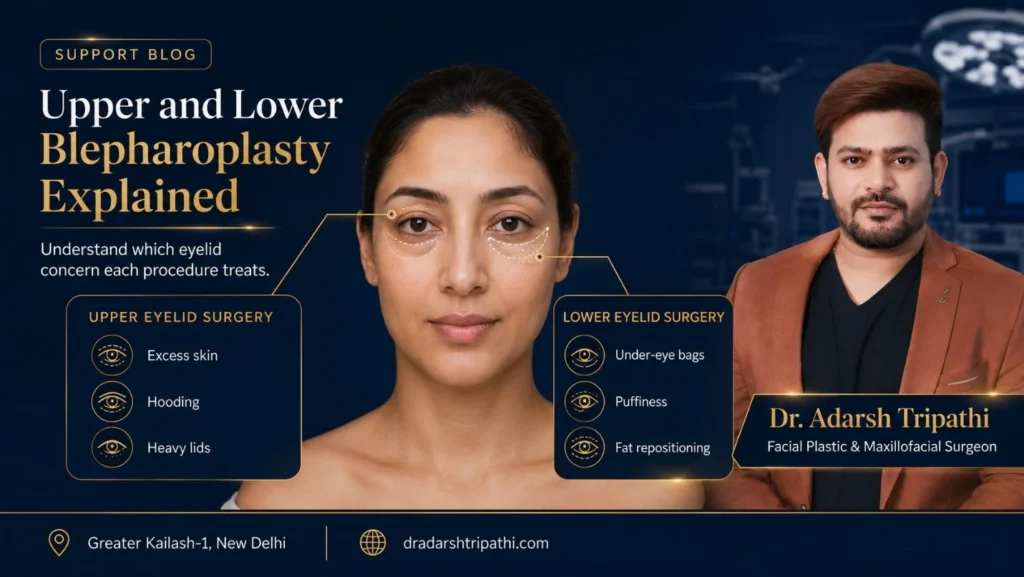
Blepharoplasty — eyelid surgery — removes or repositions excess skin, muscle and fat from the eyelids to refresh the eye area. It is one of the most popular facial procedures in India precisely because a small, well-judged change around the eyes makes the whole face look more rested. It comes in a few forms:
- Upper eyelid surgery — removes the excess skin and hooding that weighs down the upper lid, making the eyes look heavy or, in more advanced cases, actually blocking part of the vision.
- Lower eyelid surgery — addresses under-eye bags and puffiness caused by fat that has pushed forward, smoothing the transition between lid and cheek. Often done through a hidden incision inside the lid, leaving no visible scar.
- Double eyelid surgery — creates or defines an upper-lid crease, tailored to preserve each person’s natural character rather than impose a template.
The two also combine — treating all four lids together in a single recovery. Beyond appearance, upper-lid surgery can be genuinely functional: when sagging skin droops far enough to obstruct the visual field, removing it can improve peripheral vision.
The Real Question: Surgery or Non-Surgical?
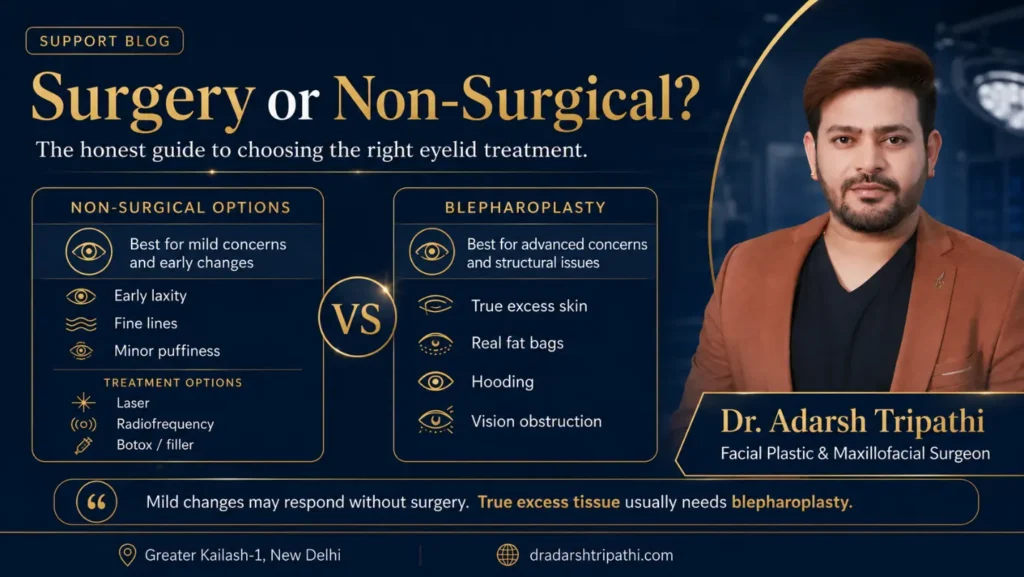
This is where most people actually need guidance, and the honest rule is simple — it depends on whether your problem is true excess tissue or just mild, early laxity.
| Non-surgical lift | Blepharoplasty (surgery) | |
| Best for | Mild laxity, early puffiness, fine lines | True excess skin, herniated fat bags, hooding, vision obstruction |
| How it works | Laser, radiofrequency, Botox, filler | Removes/repositions excess skin & fat |
| Result | Subtle; lasts ~12-18 months | Significant; lasts many years |
| Downtime | Minimal | 1-2 weeks |
| Scars | None | Hidden in the lid crease / inside the lid |
In short: if you have genuine excess skin, real fat bags, or hooding that ages you or blocks your sight, non-surgical treatments will underwhelm you — surgery is the honest answer. If your changes are mild and early, laser, radiofrequency or a little Botox and filler may be all you need, and are worth trying first. And if your main concern is actually dark circles rather than lids, that is a different problem with its own path — see our guide to dark circle treatment.
The Benefits That Matter
- A refreshed, less tired appearance — the eyes look open and rested rather than heavy.
- Improved vision — when heavy upper lids were obstructing the visual field.
- Long-lasting results — upper-lid results in particular last many years.
- A natural look — done well, people see a rested version of you, not a ‘done’ face.
- A confidence lift — looking as awake as you feel is a quietly powerful change.
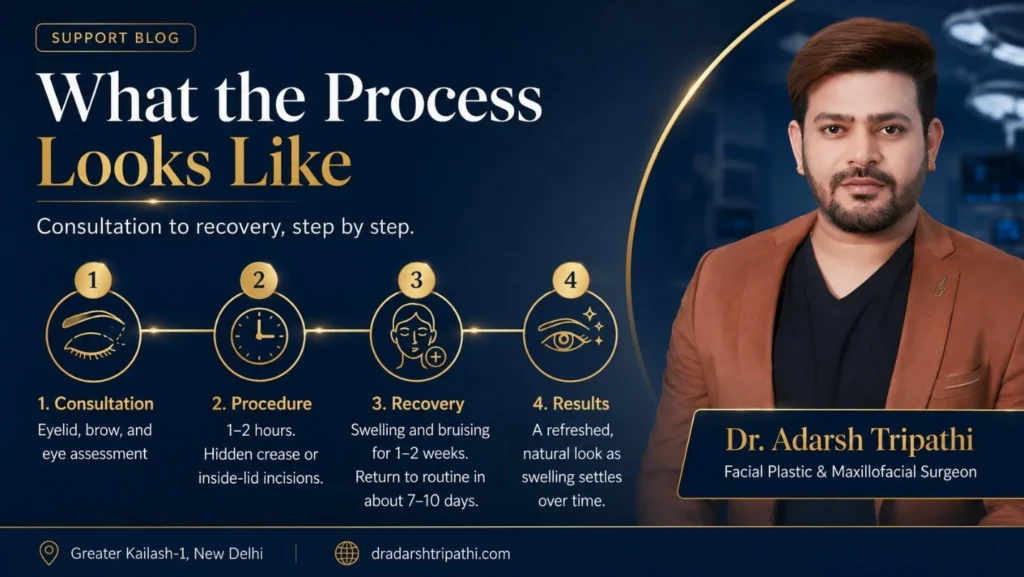
What the Process Looks Like
- An assessment of your eyelid skin, fat, muscle and brow position, your goals, your eye health and medical history — and an honest call on whether surgery or a non-surgical route suits you.
- The procedure. Usually 1-2 hours, often under local anaesthesia with sedation for upper lids. Incisions are hidden in the natural crease or inside the lower lid.
- Swelling and bruising for one to two weeks, cold compresses, and back to routine in about a week to ten days.
- The refreshed look emerges as swelling settles, with final refinement over a few months.

Recovering from Eyelid Surgery in Delhi
Delhi’s environment deserves its own note, because it genuinely affects eyelid healing in ways generic guides ignore.
- Dust and pollution. Delhi’s air quality can irritate healing incisions and aggravate the temporary dry-eye and grittiness that eyelid surgery often causes. During early recovery, minimise time outdoors on high-pollution days, keep indoor air clean, and use the lubricating drops your surgeon recommends.
- Sun and dryness. Strong sun and dry air are hard on fresh incisions. Wrap-around UV sunglasses do double duty — shielding from sun and from dust and wind — and become your best friend for a few weeks.
- Long screen hours worsen dryness while you heal; take frequent breaks and blink consciously.
- General care. Don’t rub the eyes, skip makeup and swimming for about two weeks, sleep with the head slightly elevated, and use cold compresses for swelling.

What Actually Influences the Cost
Rather than a single price, it helps to understand the factors that move it — so you can judge a quote sensibly:
- Upper, lower, or both — combined (quad) surgery costs more than a single area, though bundling all four lids is usually more economical than doing them separately.
- Complexity — fat repositioning, muscle tightening or a revision procedure require more skill and time.
- Anaesthesia — general anaesthesia costs more than local with sedation, which is often adequate for upper lids.
- Facility and accreditation — accredited, well-equipped centres in premium parts of Delhi carry higher overheads but better safety and aftercare.
- Surgeon expertise — experience around the delicate eye area is not the place to bargain-hunt.
As a broad guide, eyelid surgery in Delhi commonly falls in a wide range depending on all of the above, and combining upper and lower lids often attracts a package saving. One thing worth checking: if your upper-lid surgery is being done because sagging skin obstructs your vision (a functional rather than purely cosmetic reason), part of the cost may be covered by health insurance — ask your insurer.
Choosing Where to Have It Done
The eye area is unforgiving, so how you choose matters more than usual. Look for a surgeon with specific experience around the eyes and a conservative, natural aesthetic; an accredited, well-equipped facility; a consultation that assesses your whole eye and brow region rather than rushing to book; realistic expectations set honestly; and genuine patient reviews. A clinic that is willing to tell you that you do NOT need surgery — or that a non-surgical option would serve you better — is showing you exactly the judgement you want.
Book Your Blepharoplasty Consultation in Delhi
The honest first step is simply finding out which category you fall into — true excess tissue that surgery corrects beautifully, or mild changes better handled without a scalpel. If you would like a clear, no-pressure assessment of your eyes, learn more on our blepharoplasty in Delhi page and book a consultation. Your eyes are worth an expert, unhurried opinion — and an honest one.
📍 R-87, Greater Kailash-1, Block R, New Delhi 110048
📞 +91 9289111081, +91 9289111082
💻 Book your consultation for Blepharoplasty in Delhi today
Frequently Asked Questions
Do I really need eyelid surgery, or will a non-surgical lift work?
It depends on the severity. If you have genuine excess eyelid skin, herniated fat bags, real hooding, or sagging that obstructs your vision, surgery (blepharoplasty) is the reliable answer — non-surgical treatments will underwhelm. If your changes are mild and early — slight laxity, early puffiness, fine lines — non-surgical options like laser, radiofrequency, Botox or filler may be enough and are worth trying first. A proper assessment of your skin, fat and muscle is what settles it.
What’s the difference between upper and lower blepharoplasty?
Upper eyelid surgery removes excess skin and hooding from the upper lid, refreshing a heavy, tired look and, in some cases, improving vision. Lower eyelid surgery targets under-eye bags and puffiness by removing or repositioning fat, often through a hidden incision inside the lid with no visible scar. Some people need only one; others benefit from both (a combined or ‘quad’ procedure) for full rejuvenation of the eye area.
What are the factors that affect blepharoplasty cost in Delhi?
Several: whether you treat the upper lids, lower lids, or both; the complexity (fat repositioning, muscle tightening, or a revision are more involved); the type of anaesthesia (general costs more than local with sedation); the facility’s accreditation and location; and the surgeon’s experience. Combining upper and lower lids is often more economical than doing them separately. If upper-lid surgery is done for vision obstruction rather than cosmetics, part of the cost may be insurance-eligible.
How long is recovery, and does Delhi’s climate affect it?
Most swelling and bruising settle within one to two weeks, with a return to routine in about a week to ten days and final refinement over a few months. Delhi’s climate does matter: high dust and pollution can irritate healing incisions and worsen the temporary dry eye that surgery causes, and strong sun is hard on fresh scars. Wrap-around UV sunglasses, lubricating drops, clean indoor air, and limiting outdoor time on high-pollution days all help you heal comfortably.
Is blepharoplasty safe, and will it look natural?
Eyelid surgery has a strong safety record when performed by an experienced surgeon in an accredited facility; serious complications are uncommon, and temporary effects like dry eyes, swelling and bruising settle. A natural result comes from restraint and good judgement — removing what genuinely needs removing while preserving your individual character. The goal is to look like a rested version of yourself, not a changed person, which is why the choice of surgeon matters more than any single technique.