
Stretch Mark Removal Treatment in Delhi
Stretch marks aren’t a flaw and they aren’t a failure of self-care — they’re something most people get at some point, from pregnancy, puberty, weight changes or even a growth spurt of muscle. But if yours are bothering you in the mirror, in clothes, or in the way you avoid certain photos, modern treatment can soften them a long way. The trick is knowing what’s realistic, what works for your specific type of stretch mark, and what doesn’t.
At Sarayu Clinics in Greater Kailash, stretch marks are treated by facial plastic and maxillofacial surgeon Dr. Adarsh Tripathi. Being a surgeon-led clinic matters here for one specific reason: most non-surgical treatments significantly improve stretch marks, but if yours come with loose, hanging skin (as can happen after a big pregnancy or rapid weight loss), surgical removal of that skin is sometimes the only thing that actually erases the marks — because the affected skin is removed entirely. You get both routes assessed honestly in one place.
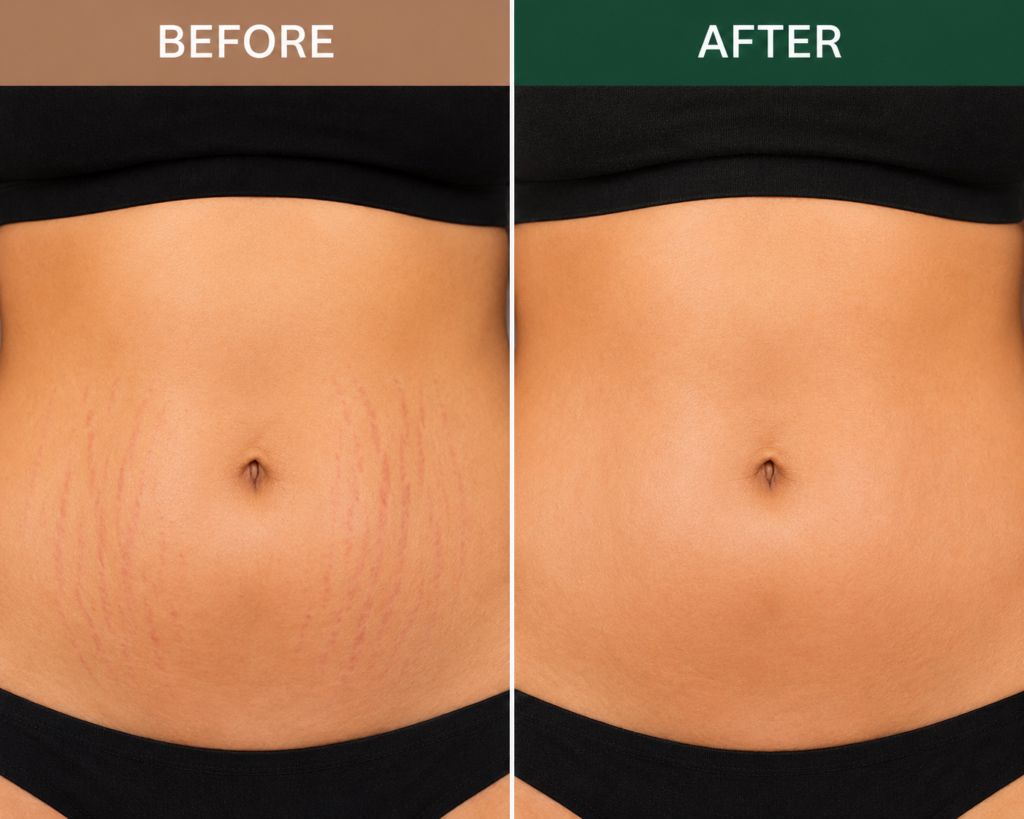
The honest short answer : Stretch marks are a form of dermal scar — not a pigmentation problem — so no treatment fully erases them. What modern treatment does, and does well, is dramatically improve their colour, depth, texture and visibility. Red/purple stretch marks (newer) respond better and faster than white ones (older). The best results come from a planned course of 4–8 sessions, usually combining MNRF or fractional laser with microneedling, PRP and the right topicals. For severe cases with hanging skin, surgical removal (abdominoplasty) is the only true ‘removal’ option.
What Are Stretch Marks, Really?
Stretch marks — medically called striae distensae — form when the skin is stretched faster than its collagen and elastin scaffolding can adapt. The middle layer of skin (the dermis) tears in fine, parallel lines; small blood vessels and inflammation show through, and over time the area heals as a thinned, scar-like band. Once you understand they’re scars, the treatment logic suddenly makes sense: you can’t un-scar skin, but you can remodel it.
Knowing which kind you have changes the treatment plan and the timeline:
- Striae rubrae — the early stage. Pink, red or purplish, sometimes slightly raised and itchy. Active inflammation is happening underneath, which is good news — they respond much better and faster to treatment.
- Striae albae — the mature stage. Silvery-white, slightly depressed, often shiny or scar-like. The blood supply has dropped and the skin is thinned. They’re harder to treat — not impossible, just slower, and the realistic goal is significant softening rather than disappearance.
- Striae gravidarum — the pregnancy variant; appears on the abdomen, breasts, hips and thighs.
- Striae nigrae — dark grey or brown stretch marks that can appear in darker skin tones.
- Striae atrophicans — thinner, more atrophic stretch marks often linked to corticosteroid use or conditions such as Cushing’s syndrome — worth a medical workup if these appear without an obvious cause.
In practical terms: catch them early and your results are dramatic. Treat them late and the results are still meaningful, just gradual.
Why Stretch Marks Form ?
They’re almost always about three things: how fast the skin stretches, how strong the underlying scaffolding is at the time, and hormonal/genetic susceptibility.
- Pregnancy — the abdomen and breasts grow rapidly while hormones soften the skin’s scaffolding; up to 90% of women develop some stretch marks during pregnancy.
- Adolescent growth spurts — teenage stretch marks across the thighs, lower back and hips are extremely common.
- Rapid weight gain or loss — particularly when it happens in months rather than years.
- Bodybuilding — aggressive muscle gain stretches skin across the shoulders, lats, biceps and inner knees — a very underdiscussed cause in men.
- Corticosteroid use — long-term oral or potent topical steroids thin the skin and predispose to stretch marks.
- Medical conditions — Cushing’s syndrome, Marfan syndrome, Ehlers–Danlos syndrome can all play a role.
- Genetics — if your mother or sisters had pregnancy stretch marks, you’re much more likely to.
Benefits of Professional Stretch Mark Treatment
- Visibly faded marks — red and purple stretch marks fade dramatically; white ones become significantly less noticeable.
- Smoother texture — the indented, crepey feel of older stretch marks improves as new collagen fills in.
- More even skin tone — better blend with the surrounding skin, especially with combination treatments.
- Real confidence return — more freedom in clothing, beachwear, intimate moments and how you feel in your own skin.
- Safe for Indian skin — when the right energy, depth and laser are chosen, results are reliable without rebound pigmentation.
- Walk-in, walk-out — most sessions take 30–60 minutes with minimal downtime.
- Combinable with body work — plans can be paced around weight goals, post-baby recovery and lifestyle.
Areas We Treat
Stretch marks can appear almost anywhere the skin has stretched fast. The areas we most commonly treat:
- Abdomen — the most common, especially after pregnancy
- Breasts and chest — after pregnancy, breastfeeding or rapid growth
- Thighs (inner and outer) and hips
- Buttocks
- Lower back — typical adolescent stretch marks
- Upper arms and shoulders — common in bodybuilders
- Inner knees — from rapid muscle gain
- Calves and the side of the trunk — less common but treatable
Types of Stretch Marks We Treat
Beyond the colour and age of the marks, we tailor the plan to what caused them and where you are in your life:
- Post-pregnancy stretch marks (striae gravidarum) — typically treated 3–6 months after delivery, after breastfeeding where relevant.
- Adolescent / growth-spurt stretch marks — often on the thighs, hips and lower back; respond well even when older.
- Weight-loss and weight-gain stretch marks — best treated after weight has stabilised.
- Bodybuilding stretch marks — on the shoulders, biceps, lats and inner knees — a common male concern that’s often overlooked.
- Steroid-induced stretch marks — from long-term oral or topical steroid use; we treat alongside addressing the underlying steroid plan.
- Old, white stretch marks — the harder type, but still meaningfully improvable with the right combination.
- Severe stretch marks with loose skin — for example after a major pregnancy or large weight loss; the territory where surgical removal becomes a real option.
Stretch Mark Treatment Options at Sarayu Clinics
There’s no single “magic” treatment for stretch marks. The best results almost always come from a planned combination, matched to your marks’ age, depth and your skin tone. The full ladder of what we offer:
1. Prescription topicals (early stretch marks only)
For early red/purple stretch marks, topical retinoids (tretinoin) and certain peptide-based creams can meaningfully reduce visibility — but only at the early stage. They’re prescribed and monitored, not picked off a shelf, and aren’t used during pregnancy or breastfeeding.
2. Microneedling / Dermapen
Classic collagen induction with Dermapen 4 or other skin microneedling devices. Triggers natural collagen formation in the thinned, scar-like skin of the stretch mark. A gentle, well-tolerated foundation step.
3. MNRF / RF microneedling (a workhorse for stretch marks)
Adding radiofrequency heat through insulated microneedles — our MNRF laser treatment — reaches deeper into the dermis where the actual scarring lives. Strong evidence for both striae rubrae and albae, and one of the safer choices for darker Indian skin because the surface stays intact.
4. Morpheus8 (the deeper RF microneedling option)
Morpheus8 goes deeper still and adds subdermal remodelling — useful when stretch marks come with mild skin laxity (post-pregnancy, post-weight-loss) and you want texture AND tightening from the same protocol.
5. Fractional CO2 / Erbium laser resurfacing
Fractional CO2 laser is among the most powerful resurfacing options for stubborn, white stretch marks — stripping micro-columns of damaged skin so the skin heals with new collagen. Erbium fibre laser is a gentler alternative. Both are used at carefully chosen settings in Indian skin to avoid pigment change.
6. Pulsed dye / vascular lasers (for red stretch marks)
Pulsed dye laser specifically targets the blood vessels feeding red/purple stretch marks. This calms the redness and is often combined with microneedling for the best early-stage results.
7. Microneedling with PRP, growth factors or exosomes
Combining microneedling with PRP (the vampire facial principle, applied to the body) or with growth-factor / exosome serums amplifies the healing response and speeds visible improvement.
8. Carboxytherapy
Tiny micro-injections of medical CO2 improve blood flow and stimulate collagen formation in the stretch mark area. A simple, low-downtime adjunct that pairs well with microneedling.
9. Chemical peels (TCA / glycolic)
Deeper TCA peels and glycolic acid peels can be used on the body to gradually resurface and improve texture, especially as an adjunct between deeper sessions.
10. Mesotherapy and skin nutrition
Mesotherapy — micro-injections of vitamins, peptides and hyaluronic acid — supports the surrounding skin between treatment sessions.
11. Surgical removal: abdominoplasty / tummy tuck
For severe post-pregnancy or post-weight-loss cases where the abdominal skin is loose, hanging or significantly damaged, surgical abdominoplasty (tummy tuck) is the only treatment that actually “removes” stretch marks — it removes the affected lower abdominal skin entirely, with stretch marks attached. Because Sarayu is led by a facial plastic and maxillofacial surgeon, this option is genuinely on the menu rather than a referral elsewhere.
Why combination almost always beats a single treatment ?
Stretch marks involve at least three problems at once — thinned skin, deep scar tissue and altered pigmentation. A single device can address one or two of those, but the best published results consistently come from layered protocols: for example, MNRF for deeper collagen, microneedling with PRP for the surface and growth-factor signalling, plus the right topicals as homework. We design plans around what your marks actually need, not what one machine can do.
What Happens During a Session: Step by Step ?
- Consultation & skin assessment. We examine your marks (often under good lighting and with dermoscopy), identify the type, age and skin tone considerations, and ask about pregnancy, breastfeeding, weight changes and medical history.
- Honest plan & expectations. We agree which treatments fit, how many sessions are realistic, and what your final result is likely to look like — significant fading and texture improvement, not erasure.
- Patch test, if needed. For ablative lasers in darker skin, a small test helps confirm safe settings.
- Cleansing & numbing. The area is cleaned; numbing cream is applied for 20–30 minutes before microneedling, MNRF or laser sessions.
- The treatment. Depending on the option chosen, the session takes 30–60 minutes. You’ll feel pricking, warmth or a snapping sensation, but most patients describe it as very manageable.
- Soothing & aftercare. Calming products are applied and clear home-care instructions given before you leave.
- Review & next session. Sessions are typically spaced 4–6 weeks apart, with a course of 4–8 for most plans, plus periodic maintenance.
Downtime & Aftercare
Most stretch mark treatments are walk-in, walk-out. What to expect:
- Microneedling: redness for 24–48 hours, like a mild sunburn.
- MNRF / RF microneedling: redness and a fine grid pattern for 24–72 hours; occasional pinpoint scabs over a few days.
- Fractional CO2 / Erbium laser: more downtime — 3–7 days of redness, mild swelling and light peeling, with sun-sensitivity for weeks.
- Pulsed dye / vascular laser: transient redness or purple bruise-like marks that fade within a few days.
- Carboxytherapy and chemical peels: very mild redness; back to normal quickly.
Aftercare is where the result is made or lost:
- Broad-spectrum SPF 30+ on any exposed treated area daily — essential for body skin too
- Gentle cleanser, light fragrance-free moisturiser; no scrubs or actives for 48–72 hours
- Avoid hot showers, saunas, swimming pools and heavy sweating for 48 hours
- Let any scabbing or peeling settle naturally — picking risks scarring
- Follow the prescribed home-care routine; it does more long-term work than the in-clinic session
Are You a Good Candidate?
You’re likely a good candidate if you have:
- Red, purple or white stretch marks anywhere on the body
- Realistic expectations — significant fading and texture improvement, not 100% erasure
- A stable weight (or are post-pregnancy and at least 3–6 months out, ideally past breastfeeding)
- Healthy skin around the marks, free of infection or active rashes
It may not be suitable, or needs extra caution, if you have:
- Pregnancy or current breastfeeding (active treatment is usually deferred)
- A history of keloid scarring
- Active skin infections, severe eczema or psoriasis at the site
- Bleeding/clotting disorders or strong blood thinners (relevant for needling and PRP)
- Recent unprotected sun exposure or a tan (for laser sessions, wait until skin returns to baseline)
- Steroid-induced marks with an ongoing high-dose steroid plan — we coordinate with your treating doctor first
Stretch Mark Treatment Cost in Delhi
Stretch mark treatment is priced per session, and the area size, the treatment chosen and the number of sessions all affect the total. As a general guide for Delhi:
Treatment | Typical cost per session (INR)* |
Consultation & assessment | Often free or nominal — confirmed when you book |
Microneedling (small area) | ₹3,000 – ₹8,000 |
Microneedling (large area, e.g. abdomen) | ₹5,000 – ₹12,000 |
MNRF / RF microneedling | ₹8,000 – ₹20,000 |
Morpheus8 (larger body areas) | ₹20,000 – ₹50,000 |
Fractional CO2 / Erbium laser | ₹10,000 – ₹25,000 |
Pulsed dye / vascular laser (for red stretch marks) | ₹6,000 – ₹15,000 |
Microneedling with PRP / growth factors | ₹8,000 – ₹18,000 |
Carboxytherapy | ₹3,000 – ₹6,000 |
Chemical peels (TCA / glycolic) | ₹3,000 – ₹8,000 |
Full course (4–8 sessions, combination) | ₹30,000 – ₹1,50,000 |
Surgical abdominoplasty | Quoted in person after assessment |
Results Timeline: When Will You See a Difference?
Stretch marks remodel slowly because they’re scars — your skin needs time to lay down new collagen and rebalance pigment. A realistic timeline:
Timeframe | What usually happens |
Weeks 1–2 | Mild redness and swelling settle. The marks may briefly look more visible (this is normal inflammation, not a worsening). |
Weeks 4–6 | First visible improvement in colour (especially for red stretch marks) and a softer feel to the texture. |
Months 2–3 | Clear improvement in texture and depth as new collagen forms. White stretch marks begin to blend better with surrounding skin. |
Months 4–6 | The most significant changes — final result of the initial course is visible. Maintenance sessions are then planned. |
6–12+ months | Ongoing remodelling continues quietly for up to a year after the final session. |
Most people need 4–8 sessions, spaced 4–6 weeks apart, with occasional maintenance afterwards. Red stretch marks tend to show improvement faster than white. Patience pays — chasing fast results with overly aggressive settings risks pigment changes that are harder to fix than the original marks.
Comparing Stretch Mark Treatments at a Glance
Where each option fits. Most plans combine two or three of these.
Treatment | Best for | Downtime | Notes |
Microneedling | Early marks, all skin tones | 1–2 days | Gentle, foundational; great safety in Indian skin |
MNRF / RF microneedling | Red and white marks | 1–3 days | A workhorse; safe in dark skin |
Morpheus8 | Marks with mild laxity | 1–3 days | Adds tightening; deeper RF |
Fractional CO2 / Erbium laser | Stubborn white marks | 3–7 days | Strongest resurfacing; cautious in dark skin |
Pulsed dye / vascular laser | Red / purple marks | Minimal | Targets the blood vessels in early marks |
Microneedling + PRP / exosomes | Boosting any of the above | 1–2 days | Adds growth-factor signalling |
Surgical abdominoplasty | Severe cases with loose skin | 2–4 weeks | The only true ‘removal’ — surgical only |
Can You Prevent Stretch Marks?
Not entirely — genetics, hormones and rate of stretching matter more than any cream — but you can stack the odds:
- Keep skin well moisturised; ingredients with hyaluronic acid, centella asiatica and shea butter help skin elasticity
- Stay hydrated and eat enough protein, vitamin C, vitamin E and zinc — the building blocks of collagen
- Manage weight changes gradually rather than rapidly
- If you’re pregnant, moisturise the abdomen, breasts and thighs daily from the second trimester; massage seems to help
- If you’re bodybuilding, build mass progressively; sudden bulking is harder on the skin than gradual gains
- Don’t use potent topical steroids without medical supervision, and discuss any long-term steroid plan with your doctor
- If you do notice new red/purple marks, treat them early — the best results in dermatology consistently come from early-stage striae rubrae
Why Choose Sarayu Clinics for Stretch Mark Treatment in Delhi ?
Stretch marks are unforgiving of shortcuts — wrong settings on Indian skin can leave pigment changes that are harder to live with than the original marks. Treatment at Sarayu Clinics is led by facial plastic and maxillofacial surgeon Dr. Adarsh Tripathi, alongside co-founder Dr. Nidhi Bhatia.
- Both non-surgical and surgical — a genuine advantage of a surgeon-led clinic. Most Delhi competitors can’t offer the abdominoplasty option for severe cases.
- The full non-surgical ladder — microneedling, MNRF, Morpheus8, fractional CO2/Erbium, vascular lasers, PRP, exosomes, peels, carboxytherapy and mesotherapy under one roof.
- Safe for Indian skin — MNRF, Nd:YAG and conservative settings to avoid post-inflammatory pigmentation in deeper skin tones.
- Combination protocols, not single-machine plans — we design layered courses based on what your marks actually need.
- Honest, evidence-led framing — we’ll tell you what’s realistic. Significant improvement is the promise; complete erasure isn’t.
Frequently Asked Questions
Can stretch marks be completely removed?
Honestly, no — stretch marks are a form of scar, and no treatment fully erases scars. What modern treatment does, and does well, is dramatically improve their colour, texture and visibility. For severe cases with loose skin (e.g. after a large pregnancy or major weight loss), surgical removal of the affected skin is the only treatment that truly removes the marks, because the skin itself is removed.
What is the best treatment for stretch marks?
There isn’t one universal best. For red/purple stretch marks, microneedling, MNRF and pulsed dye laser work especially well. For older, white ones, MNRF, fractional laser and combination protocols with PRP are typically used. We’ll recommend the right combination after seeing yours.
Are red or white stretch marks easier to treat?
Red. Active, early stretch marks have ongoing inflammation and a better blood supply, so they respond faster and to a wider range of treatments. White stretch marks are still improvable, just slower and usually with combination protocols.
How many sessions will I need?
Most plans involve 4–8 sessions spaced 4–6 weeks apart, often with maintenance afterwards. Older or extensive marks may need more. You’ll get a specific estimate after assessment.
Is treatment safe for Indian skin?
Yes, with the right choices. MNRF, Nd:YAG and conservative settings are well-suited to deeper Indian skin tones. Ablative lasers (fractional CO2) need careful settings and patch tests to avoid post-inflammatory pigmentation.
Can I treat stretch marks during pregnancy or while breastfeeding?
Active treatment is usually deferred. During pregnancy, the focus is on hydration, gentle topical care and moisturisation. Most laser and microneedling protocols are started 3–6 months after delivery and after breastfeeding finishes.
Medical Review & Sources
This page is for general information and is medically reviewed by the team at Sarayu Clinics under Dr. Adarsh Tripathi. It is not a substitute for an in-person consultation. The clinical approach reflects current dermatological and laser-surgery guidance, including:
How to Reach Us:
Phone: +91 9289111081 , +91 9289111082
Email: sarayuinquiries@gmail.com
Sarayu Clinics website: www.sarayuclinics.com
Facebook: https://www.facebook.com/sarayuclinic
Instagram: https://www.instagram.com/sarayuclinics/
Dr. Adarsh Tripathi’s profile: https://dradarshtripathi.com/
Online Booking: Visit our website https://sarayuclinics.com/contact-us/ to schedule appointments conveniently.
When is surgery the right answer for stretch marks?
When stretch marks come with significant loose, hanging skin — typically after a large pregnancy or major weight loss — abdominoplasty (tummy tuck) is the only treatment that physically removes the affected skin and its stretch marks. Because Sarayu is surgeon-led, you can discuss this honestly in the same consultation rather than being referred elsewhere.
Will stretch marks come back after treatment?
The treated marks themselves don’t ‘come back’, but you can develop new ones if the skin is stretched rapidly again — for example, in another pregnancy or rapid weight change. Maintaining a stable weight and a healthy skincare routine keeps results steady.
How much does stretch mark removal cost in Delhi?
Per session, treatments typically range from about ₹3,000 for microneedling to ₹25,000 for fractional CO2 laser, with most plans falling between ₹30,000 and ₹1,50,000 for a full course. Surgical abdominoplasty is a separate, larger investment and is quoted in person.
Is the treatment painful?
Most people find it very manageable. Numbing cream is applied for 20–30 minutes, and modern devices include cooling. You’ll feel pricking or warmth rather than pain.