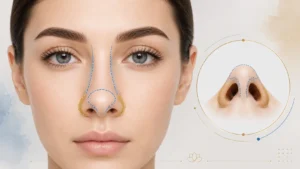

Fifteen minutes, no anaesthetic, no bandages, and you walk out with a straighter-looking nose. It is easy to see why non-surgical rhinoplasty has become one of the most requested treatments in Delhi’s aesthetic clinics.
What gets discussed far less is that the nose is the riskiest place on the face to inject filler. Not the most painful, not the most technically fiddly – the riskiest. And that single fact should shape how you choose who does it.
This is not a reason to avoid the treatment. Done properly, by the right person, it is genuinely excellent. It is a reason to be more careful about the “who” than about the price.
What non-surgical rhinoplasty actually is
Also called a liquid nose job, non-surgical rhinoplasty uses dermal fillers usually hyaluronic acid placed in precise spots along the nose to change how it looks.
Here is the part most people find counterintuitive: it works by adding, not removing. A filler cannot make a nose smaller. What it can do is even out a visible dorsal hump by filling the dip above and below it, so the profile reads as a straight line. It can lift a drooping tip. It can correct mild asymmetry or a deviation that only shows from certain angles. It can give definition to a flat or low bridge which is why it is so popular among Indian patients, where a lower dorsum is a common concern.
Results last roughly nine to eighteen months depending on the product used and how your body metabolises it. Then it gradually fades and you decide whether to repeat it.

Why the nose is different from every other filler area
Filler in a cheek or a lip sits in tissue with a generous, redundant blood supply. If a vessel is compromised, neighbouring vessels compensate.
The nose does not work like that. Its blood supply is dense but largely end-arterial, meaning many of its small vessels have no backup route. If filler is accidentally injected into or compresses one of them, the tissue it feeds can lose its supply. That can cause skin necrosis tissue death and in rare, well-documented cases, filler travelling backwards through connected vessels has caused permanent vision loss.
These events are uncommon. But they are not theoretical, and the nose accounts for a disproportionate share of them relative to how often it is treated. Which is precisely why this procedure belongs with a doctor who understands the vascular anatomy of the mid-face in three dimensions not just where to inject, but what runs underneath the point of the needle.
A clinic that has never mentioned any of this to you has told you something by omission.

What actually makes someone the right doctor for it
Set aside the marketing. Four things genuinely separate practitioners here.
They understand the anatomy surgically, not just cosmetically
A surgeon who performs rhinoplasty has seen the inside of the nose. They know where the vessels run because they have worked around them. That is a different order of familiarity from having learned injection points on a course.
They will tell you when filler is the wrong answer
This is the most useful thing a doctor can offer you, and the hardest to get from someone who only sells one treatment. Filler cannot reduce a large nose, cannot narrow a wide one, cannot fix a functional breathing problem, and cannot correct a significant structural deviation. Anyone who says otherwise is selling.
A doctor who also performs surgical rhinoplasty, alarplasty for nostril width, or nose augmentation has no reason to push you toward filler if surgery is what you actually need. That neutrality is worth more than any before-and-after gallery.
They inject conservatively
Good non-surgical rhinoplasty uses surprisingly little product often under a millilitre. Slow injection, low pressure, careful placement, and stopping before the temptation to “just add a bit more.” Over-filled noses look widened and heavy, which is the opposite of what almost everyone wants.
They are prepared for something going wrong
Hyaluronidase, the enzyme that dissolves hyaluronic acid filler, should be on the premises not orderable. Ask. It is a fair question and a good doctor will be pleased you asked rather than defensive about it.

What the appointment is actually like
The consultation should take longer than the injection. Expect a proper look at your nose from every angle, a conversation about what specifically bothers you, and an honest answer about whether filler will address it.
On the day: numbing cream for twenty minutes or so, then the injection itself usually ten to fifteen minutes, often with a blunt-tipped cannula rather than a needle in higher-risk zones. You will see the change immediately, though mild swelling means the first couple of days are not the final result.
Most people go back to work the same day. Bruising is possible but usually minor. Avoid glasses resting on the treated area, heavy exercise and sleeping face-down for a few days.

Non-surgical or surgical — the honest comparison
| Non-surgical | Surgical rhinoplasty | |
| Can it make the nose smaller? | No | Yes |
| Can it straighten a profile? | Yes, by adding | Yes, by reshaping |
| Downtime | A day or two | Two to three weeks |
| Lasts | 9-18 months | Permanent |
| Reversible | Yes, with hyaluronidase | No |
| Best for | Mild concerns, trial before surgery | Structural change, breathing issues |
A pattern worth knowing: plenty of patients use non-surgical rhinoplasty as a preview. If you like the change but want it permanently, surgical rhinoplasty is the next conversation. If you decide the nose you have suits you after all, the filler simply fades. That is a genuinely low-risk way to make a decision you have been circling for years.
Before you book
Ask four questions of whoever you are considering:
- Will a doctor perform this, and what is their training in facial anatomy?
- Is hyaluronidase available here today?
- Given my nose, would surgery actually give me a better result?
- How much product are you planning to use, and why that much?
A confident, specific answer to all four tells you most of what you need to know.
Considering it in Delhi?
Dr. Adarsh Tripathi is a maxillofacial and facial plastic surgeon practising at Sarayu Clinics in Greater Kailash-1. Because the practice performs both surgical and non-surgical nose procedures, the assessment you get is based on your anatomy rather than on what is available to sell you — including being told, where it applies, that filler is not the right answer for your nose.
Book a consultation at dradarshtripathi.com/contact-us or call +91 92891 11083.